 English
 中文简体
 русский
 Français
 Español
 عربى
 Indonesia

Landscape Linear Light GZD-XQD-2530: A Flexible Outdoor Solution for Continuous, Comfortable Illumination
Outdoor lighting is no longer limited to basic visibility after sunset. Modern landscape projects use light to define pathways, frame architectural features, guide visitors, improve public safety, and create attractive nighttime environments. The quality of the lighting system directly influences how a park, garden, resort, plaza, or recreational area is experienced. For these applications, the Landscape Linear Light GZD-XQD-2530 provides a practical combination of continuous illumination, flexible color options, low-voltage operation, outdoor durability, and programmable control.
Designed for landscape enhancement and garden illumination, the GZD-XQD-2530 is a 15 W LED linear fixture that operates on DC12-24V input voltage. It can be specified with red, green, blue, yellow, white, warm white, RGB, or RGBW light output. Available beam distributions include narrow and wide options, allowing lighting designers to adapt the fixture to pathways, planting beds, walls, handrails, garden structures, and other outdoor elements.
The fixture is particularly suitable for projects that require a softer and more integrated lighting effect than conventional architectural linear luminaires. Rather than creating an excessively strong visual presence, it can deliver a continuous line of light that complements natural surroundings. Its weather-resistant IP65 construction, energy-efficient LED sources, DMX512 or steady control modes, and low-voltage design support a wide range of commercial and public outdoor installations.
Manufactured by Cixi HuaSheng Lighting Co., Ltd., the product benefits from an integrated production system that includes die-casting, CNC machining, aging processes, optical testing, mold design, OEM/ODM support, and quality management. These capabilities allow the manufacturer to provide more than a standard fixture. Customers can obtain customized light colors, mounting configurations, control solutions, and low-voltage system arrangements for specific landscape projects.

Landscape Linear Light GZD-XQD-2530
Product Overview
The Landscape Linear Light GZD-XQD-2530 is developed for outdoor environmental enhancement rather than general-purpose indoor illumination. Its primary role is to produce a visually continuous lighting line across landscape features. It can be installed along pathways, around garden borders, beside water features, beneath architectural edges, or on outdoor structures where a clean and coordinated lighting effect is desired.
Linear lighting is valuable because it distributes illumination along a defined length instead of concentrating light at isolated points. This can reduce the fragmented appearance sometimes associated with individual spotlights or small decorative lamps. When correctly positioned, the GZD-XQD-2530 can help create visual rhythm, emphasize the form of a landscape element, and support safe movement through an outdoor environment.
The fixture has a nominal power rating of 15 W and uses DC12-24V input voltage. Low-voltage operation is especially useful for landscape projects because outdoor lighting systems often include multiple fixtures distributed across gardens, pathways, terraces, or public spaces. A low-voltage design can simplify system planning and support safer integration when the installation is designed and protected correctly.
The product can be equipped with LED sources from recognized options including Epileds, Bridgelux, Epistar, Osram, and Cree, depending on the customer’s project requirements and production configuration. The available source options give project planners flexibility when balancing efficiency, color quality, procurement requirements, and budget considerations.
With a stated IP65 protection rating, the fixture is designed for outdoor environments where dust and water exposure are expected. IP65 construction helps protect the luminaire against dust ingress and water jets from different directions. However, the complete installation must still include appropriate cable glands, connectors, power supplies, drainage provisions, and mounting details to preserve system reliability.
Technical Specification
The following table summarizes the principal product information supplied for the Landscape Linear Light GZD-XQD-2530. The manufacturing record also identifies the item number as GZD-XTD-2530. Buyers should confirm the exact ordering code, product length, connection configuration, and final technical drawing with the manufacturer before placing a production order.
| Specification | Available Configuration or Value |
|---|---|
| Product name | Landscape Linear Light GZD-XQD-2530 |
| Product category | LED Linear Light |
| Item number shown in technical information | GZD-XTD-2530 |
| Light source options | Epileds, Bridgelux, Epistar, Osram, or Cree |
| Input voltage | DC12-24V |
| Rated power | 15 W |
| LED color options | Red, green, blue, yellow, white, warm white, RGB, or RGBW |
| Beam angle options | 10° × 45°, 10° × 65°, 60°, 90°, or 110° |
| Light output ratio | Approximately 70 lm/W as provided |
| Color temperature range | 1800-6500K |
| Control modes | DMX512 or steady operation |
| Operating environment temperature | -20°C to 45°C |
| Ingress protection | IP65 |
The specification range makes the product adaptable to both understated and dynamic landscape concepts. Warm white settings can create a relaxed and welcoming atmosphere in gardens, hospitality areas, and residential environments. Neutral or cool white settings may be selected where stronger visual clarity is needed. RGB and RGBW configurations can support decorative color scenes, event programming, seasonal themes, and branded public spaces.
Continuous Illumination for Landscape Design
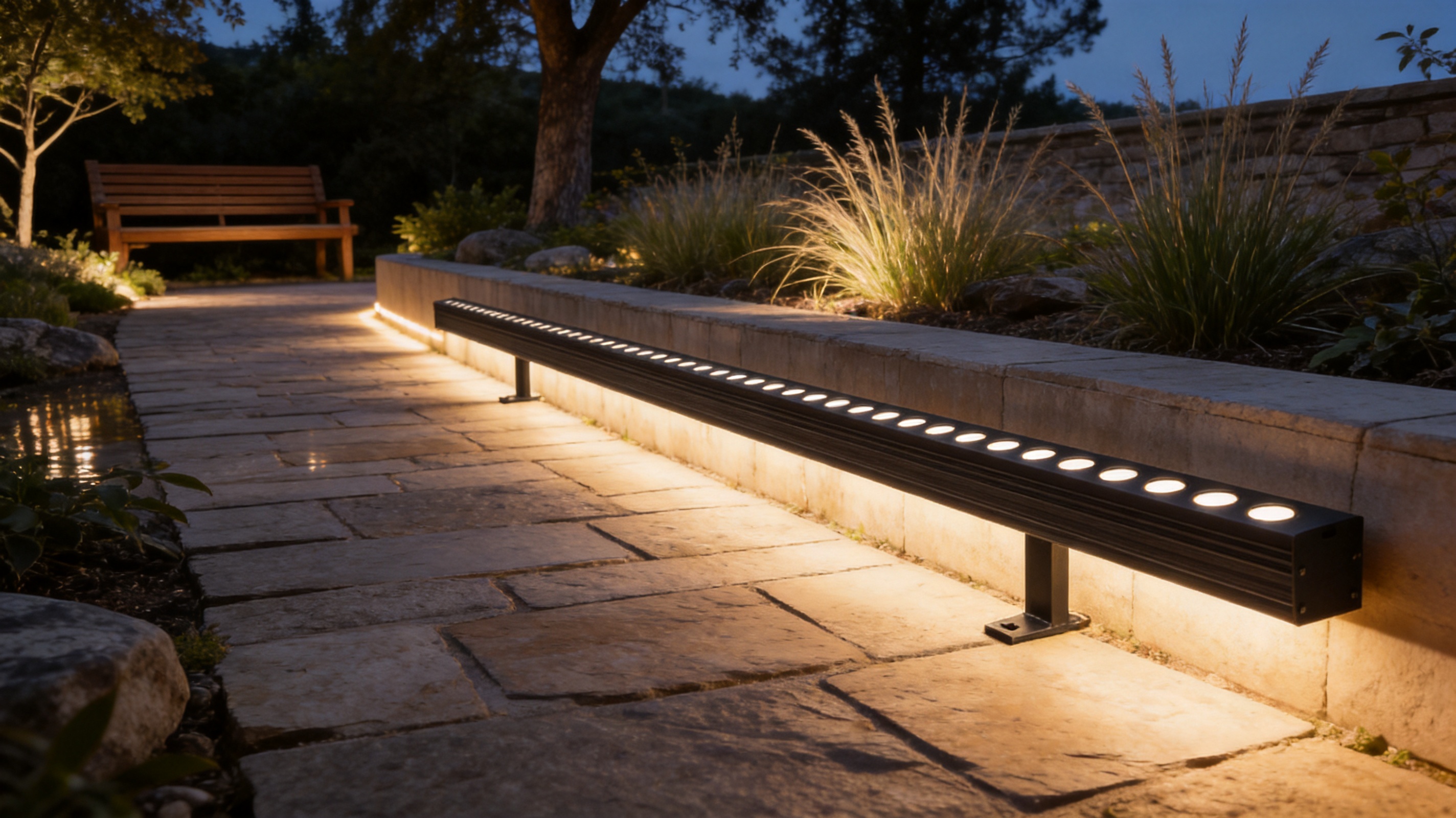
One of the main advantages of a linear fixture is its ability to produce a continuous visual effect. Landscape designers often work with long edges, curves, steps, planter walls, architectural lines, and circulation routes. A point-source fixture may illuminate only selected portions of these features, while a linear light can visually connect them.
The GZD-XQD-2530 is intended to provide soft, continuous illumination that integrates with natural surroundings. This makes it different from many high-intensity architectural luminaires designed primarily to emphasize building façades or produce strong graphic effects. In a landscape environment, excessive brightness can cause glare, disturb the visual balance of planting and hardscape, or make a space feel less comfortable. A softer linear approach can preserve the character of the setting while still improving nighttime visibility.
When installed along a pathway, the fixture can help define the route and make changes in direction easier to recognize. When installed beneath a bench, planter, railing, or low wall, it can provide visual separation between surfaces. When installed near trees or planting beds, it can emphasize the boundary between vegetation and circulation areas without requiring numerous separate fixtures.
The fixture can also be used to create layered lighting. For example, a landscape project may combine low-level linear illumination with taller decorative poles, accent spotlights, and building façade lighting. The GZD-XQD-2530 can serve as the connecting layer that gives the entire lighting scheme a consistent base.
Because the unit supports several beam angles, designers can choose a distribution suitable for the intended mounting position. A narrow 10° × 45° distribution may be useful for elongated wall or edge effects. A wider 60°, 90°, or 110° beam may be appropriate where broader surface coverage is required. Beam selection should be based on mounting height, surface texture, fixture spacing, viewing direction, and desired illuminance.
Color and Control Flexibility
Outdoor spaces are used in different ways throughout the year. A hotel garden may need warm white light for ordinary evenings and colorful scenes for celebrations. A public plaza may use white light for regular operation and RGBW effects during festivals or community events. A resort pathway may require low-intensity warm white light to maintain a calm atmosphere while still supporting orientation.
The GZD-XQD-2530 supports a broad range of LED color choices. Red, green, blue, and yellow can be used for decorative features or thematic applications. White and warm white are suitable for more natural and comfortable environments. RGB configurations provide multiple color combinations, while RGBW systems add a dedicated white channel for more precise white-light performance alongside color effects.
The stated color temperature range of 1800-6500K allows the product to cover very warm to cool white appearances. Lower color temperatures generally create a more intimate and relaxed feeling, which may suit hospitality gardens, residential landscapes, pathways, and historical environments. Higher color temperatures can offer a cleaner and more energetic appearance, although the final selection should be coordinated with surrounding materials and the project’s visual objectives.
DMX512 control provides a foundation for synchronized color changes, programmed scenes, dimming sequences, and coordinated operation with other compatible lighting equipment. In a larger landscape project, multiple linear fixtures can be grouped into zones or scenes. Designers may create gradual transitions, static color displays, event modes, or low-output night settings.
Steady operation is available for projects that do not require dynamic control. This mode is useful for simple pathway lighting, garden edging, decorative wall illumination, or installations where the priority is reliable continuous output. Choosing steady operation can also reduce system complexity and simplify commissioning.
Control planning should be completed before installation. The project team should determine the number of lighting zones, controller capacity, cable routing, power supply positions, address allocation, scene requirements, and emergency or maintenance procedures. Proper planning helps ensure that the advantages of DMX512 are realized without unnecessary wiring or programming complications.
Low-Voltage Outdoor System Benefits
The DC12-24V input range is a practical feature for landscape lighting systems. Low-voltage equipment is commonly used in gardens, parks, walkways, hospitality properties, and decorative outdoor installations because it can support safer and more flexible system layouts when paired with suitable power supplies and protective equipment.
Using a low-voltage system allows the main conversion equipment to be positioned in a protected service area while fixtures are distributed throughout the landscape. This can make it easier to separate high-voltage infrastructure from public areas. It also gives designers more freedom when routing cables around planting beds, paved surfaces, water features, and outdoor structures.
However, low-voltage does not mean that installation design can be overlooked. Voltage drop should be considered, especially on long cable runs or systems with many fixtures. Cable size, maximum circuit length, load distribution, power supply efficiency, connector quality, and access for maintenance all affect performance. Outdoor junction boxes and connectors should be appropriately protected, and all wiring should comply with applicable local electrical requirements.
For OEM and project-specific applications, the manufacturer can support low-voltage system options. This may include customized cable arrangements, connection methods, mounting details, and fixture grouping requirements. Customers should provide the planned circuit layout and operating conditions early in the design process so that the fixture and supporting components can be coordinated correctly.
Weather Resistance and Outdoor Reliability
Outdoor lighting fixtures face conditions that indoor products do not encounter. Rain, dust, humidity, temperature variation, ultraviolet exposure, wind, accidental impact, and repeated thermal cycling can influence long-term performance. A suitable landscape luminaire therefore needs more than an attractive appearance. Its housing, seals, optical components, cable entries, and mounting hardware must work together as an outdoor system.
The GZD-XQD-2530 is specified with an IP65 protection rating. This level of protection is intended to provide resistance to dust ingress and water jets. It is appropriate for many exposed outdoor applications, including garden edges, pathways, façades, resorts, and public recreational areas. The rating is valuable because it supports more consistent operation in environments where airborne dust and rain are expected.
IP protection is not a substitute for correct installation. Fixtures should be mounted in accordance with the manufacturer’s instructions and should not be placed where water can remain trapped around cable entries or connection points. Drainage, cable routing, connector orientation, and mechanical support are especially important in areas exposed to heavy rain or irrigation systems.
The stated operating temperature range is -20°C to 45°C. This range supports use in many moderate outdoor climates. Project planners should still review local conditions, including direct solar exposure, enclosure temperatures, snow or ice accumulation, coastal salt air, and seasonal extremes. Where the actual environment exceeds the stated range, additional engineering review may be required.
Stable performance also depends on the power supply and control system. A high-quality fixture connected to an unsuitable driver, overloaded circuit, or poorly protected cable network may not deliver expected service life. For this reason, the lighting supplier’s role in system coordination is important. A complete solution should consider the luminaire, power conversion, control, mechanical installation, and maintenance access together.
Energy Efficiency and Operating Value
LED technology offers advantages over traditional light sources in applications that require long operating hours, frequent switching, compact form factors, and flexible color control. The GZD-XQD-2530 uses a 15 W LED configuration, helping project owners manage energy consumption while maintaining a continuous decorative lighting effect.
The supplied information lists a light output ratio of approximately 70 lm/W. Actual delivered performance can vary according to LED color, optical distribution, operating current, ambient temperature, diffuser or lens configuration, and production specification. Buyers should request the relevant photometric files and test data for the exact configuration being ordered.
Energy efficiency is especially meaningful in large landscape projects. A resort, public park, or commercial development may contain hundreds of luminaires operating for many hours each evening. A moderate reduction in power consumption per fixture can produce meaningful savings over the operating life of the installation. Lower energy demand can also reduce the required capacity of power supplies and supporting electrical infrastructure.
LED fixtures can offer long service intervals compared with many conventional lamps, reducing the need for frequent lamp replacement. In landscape applications, maintenance can be expensive because fixtures may be installed beside planted areas, over water features, along paved routes, or in locations that require temporary access control. A reliable LED system can therefore reduce disruption as well as direct maintenance cost.
Energy performance should be evaluated as part of a complete design. The most efficient fixture is not necessarily the best choice if it produces glare, requires excessive over-lighting, or is poorly aimed. Correct beam selection, dimming schedules, zoning, and nighttime output reduction can often produce greater practical savings than selecting a fixture based only on nominal wattage.
Applications in Parks and Gardens
Parks and gardens require lighting that supports safety without overpowering the natural setting. The GZD-XQD-2530 can be used along pedestrian routes, garden borders, seating areas, planting walls, bridges, steps, and small outdoor structures. Its linear form can help maintain a consistent design language across different parts of the site.
Along a pathway, the fixture may be placed at low level to define the edge of the route. Designers should avoid positioning the light directly toward pedestrians, as this can create glare. Concealed or shielded installation can help direct light toward the ground or adjacent landscape feature while preserving visual comfort.
In a garden, warm white or low color-temperature light may be selected to complement foliage, stone, timber, and water. Linear illumination beneath a raised planter can create a floating effect, while illumination along a retaining wall can emphasize material texture. RGB or RGBW versions may be appropriate for special events, but everyday operation can remain within a restrained white-light scene.
Public parks may benefit from steady operation combined with scheduled dimming. Early evening periods can use normal output when visitor activity is high. Later hours may use lower output to reduce energy use and limit unnecessary light exposure. Control systems should be programmed with consideration for local regulations, neighboring properties, wildlife, and community expectations.
Resorts, Hospitality Areas, and Recreational Spaces
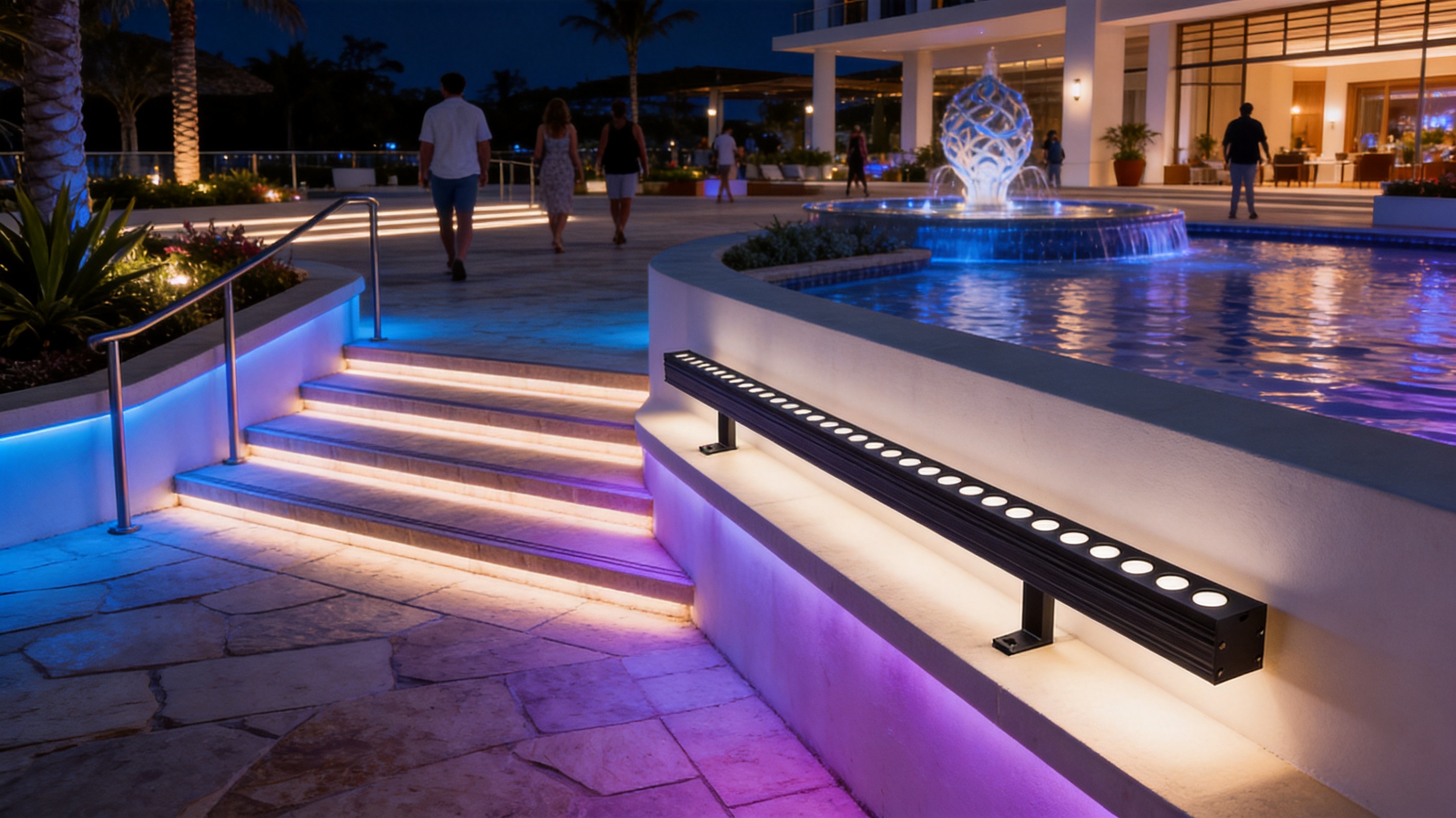
Hotels, resorts, restaurants, and recreational properties use outdoor lighting to influence guest experience. Lighting can guide guests from entrances to gardens, swimming pools, dining terraces, event spaces, and accommodation areas. The fixture’s soft continuous appearance can contribute to an atmosphere that feels organized and welcoming without appearing excessively commercial.
Warm white light is often suitable for hospitality areas because it creates a comfortable visual environment. Linear fixtures may be mounted beneath handrails, along deck edges, around planter walls, or beside steps. When installed with careful shielding, they can provide orientation while minimizing direct glare into guest rooms or seating areas.
Color-changing operation can support events, seasonal decorations, and themed experiences. A resort may use a single color palette for a wedding, dynamic scenes for a festival, or a calm white setting for ordinary evenings. DMX512 control allows the lighting system to be integrated into a wider event or building-management strategy when required.
In hospitality projects, maintainability is particularly important. Lighting failures in a public-facing area can affect the visual quality of the property and may require rapid correction. Clear circuit labeling, accessible power supplies, spare fixture planning, and documented control programming can improve maintenance response.
Façade Edges and Architectural-Landscape Integration
Although the GZD-XQD-2530 is designed primarily for landscape lighting, it can also support the transition between buildings and outdoor environments. It may be used beneath façade projections, along entrance platforms, around courtyards, or on low architectural walls where a softer effect is preferred over a high-output façade wash.
This distinction is important. Architectural façade lighting often seeks to reveal building mass, structural geometry, or material texture from a distance. Landscape linear lighting generally works closer to the user and is intended to support atmosphere, orientation, and integration with planting and hardscape. The GZD-XQD-2530 can be selected when the design goal is a gentle connection between these two layers.
Beam angle selection should reflect the mounting surface. A narrow distribution may highlight a precise edge or create a controlled band of light. A wider distribution may be used on lower walls or broader surfaces. Photometric simulation through appropriate lighting software can help designers review uniformity, glare, overlap, and light spill before installation.
Advantages Compared with Conventional Landscape Fixtures
The GZD-XQD-2530 offers several practical advantages over conventional point-source landscape lights. First, its linear format can provide a more continuous visual line. This may reduce the need to install many separate small fixtures when the design objective is to emphasize a long edge or boundary.
Second, the product offers more color and control flexibility than a simple fixed-color garden lamp. Customers can specify white, warm white, RGB, or RGBW configurations, while DMX512 operation supports programmed scenes. This allows one product family to serve ordinary illumination, decorative effects, and event-based requirements.
Third, DC12-24V operation supports flexible low-voltage system planning. Compared with fixtures designed only for direct mains input, low-voltage products can be easier to incorporate into distributed landscape systems when appropriate power supplies and protection are provided.
Fourth, the product combines several beam options with a compact linear design. This gives designers greater control over how light interacts with pathways, walls, planting, and structures. A single fixed beam would limit the number of suitable installation positions, while multiple distributions support more project-specific use.
Fifth, the IP65 rating and stated operating temperature range make the fixture suitable for many exposed outdoor environments. The product is intended for real landscape conditions rather than occasional indoor decorative use.
Finally, OEM/ODM support can provide an advantage over catalog-only products. Customers may discuss mounting flexibility, light color customization, low-voltage arrangements, and other project details with the manufacturer. This is particularly valuable for contractors, distributors, lighting designers, and developers working on repeated projects or customized site requirements.
Advanced Manufacturing Capabilities
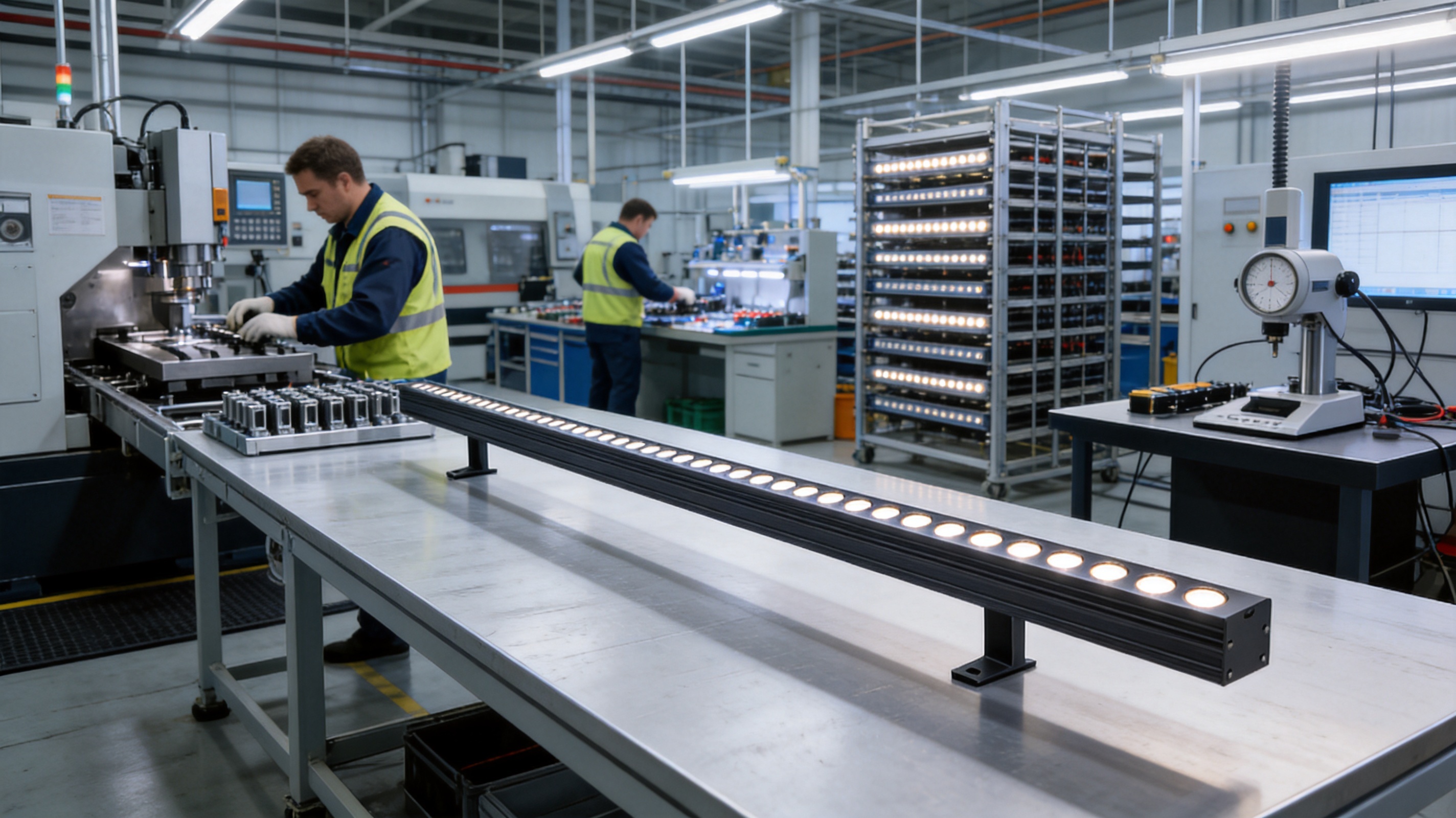
Product performance is influenced by manufacturing consistency as much as by the published specification. Cixi HuaSheng Lighting Co., Ltd. operates as a professional lighting manufacturer in Ningbo, China, serving international customers with outdoor and industrial lighting products.
The company’s production capabilities include die-casting and CNC machining. These processes are relevant to outdoor luminaires because accurate housing dimensions, stable mechanical interfaces, and consistent mounting surfaces help support sealing, assembly, heat management, and installation reliability. Die-casting can produce repeatable metal housings with integrated structural features, while CNC machining can refine critical surfaces, holes, threads, and connection points.
Mold design is another important capability. Customized landscape lighting projects may require specific housing shapes, brackets, end caps, cable exits, or mounting components. In-house or closely coordinated mold development can help reduce communication delays between design and production. It can also support repeatability when a customer needs a dedicated product configuration for multiple projects.
The manufacturer also uses aging lines and goniophotometers. Aging processes can help identify early failures or unstable components before shipment. Goniophotometric testing is useful for evaluating light distribution, beam angle, luminous intensity, and photometric behavior. These capabilities support more reliable lighting design documentation and can help customers obtain data for project calculations.
Quality and environmental management are represented by ISO 9001, ISO 14001, and ISO 45001 certifications according to the supplied company information. ISO 9001 relates to quality management, ISO 14001 to environmental management, and ISO 45001 to occupational health and safety management. Together, these systems indicate a structured approach to process control, environmental responsibility, and workplace safety.
The company also reports products certified by CB and CE. Certification requirements may differ by product, market, and final configuration, so buyers should confirm which certificates apply to the exact GZD-XQD-2530 version, control system, power supply, and destination market.
OEM and ODM Project Support
Lighting projects often involve requirements that cannot be met by an unchanged standard product. The fixture may need a different mounting bracket, cable length, color temperature, control address arrangement, housing finish, or installation method. OEM and ODM services can help adapt the product to these needs.
For the GZD-XQD-2530, possible customization discussions may include light color, RGB or RGBW selection, beam distribution, mounting flexibility, and low-voltage system configuration. Customers should provide drawings, installation photographs, target quantities, project location, environmental conditions, expected operating hours, and desired control method.
A professional customization process normally begins with requirement clarification. The manufacturer and customer define the mechanical dimensions, optical target, electrical input, control protocol, connection method, material, finish, packaging, and inspection requirements. A sample or prototype may then be produced for evaluation before mass production.
For larger projects, photometric verification is important. The customer may request test data for the selected LED source and optical configuration. This information can be used in lighting calculations and helps reduce the risk of changing performance between sample approval and production delivery.
OEM/ODM support is also valuable for distributors and system integrators. A customized product can help create a consistent product range or meet a tender specification without requiring the customer to manage every production process independently. The supplier’s experience in die-casting, CNC machining, assembly, aging, testing, and export delivery can simplify project coordination.
Installation Planning
Before installing the GZD-XQD-2530, the project team should review the intended mounting location, viewing direction, cable route, power supply position, control architecture, drainage conditions, and maintenance access. Linear fixtures often produce their best effect when installed with precise alignment. Uneven mounting or inconsistent spacing can interrupt the visual continuity of the lighting line.
Beam angle should be selected according to the target surface. A narrow distribution may require accurate aiming, while a wider distribution can tolerate more variation but may create additional spill light. The designer should review the relationship between fixture distance and illuminated width before finalizing brackets or recesses.
Power supply selection must match the DC12-24V input requirement and the total connected load. The power supply should include sufficient capacity for continuous operation and should be located in a protected, serviceable position. Cable voltage drop should be calculated for longer runs, particularly where many 15 W fixtures are connected to a common circuit.
For DMX512 systems, the control topology, addressing, termination, cable type, and maximum run length should follow appropriate control-system practice. Fixtures should be labeled by zone and address during installation. Clear documentation will simplify commissioning and future maintenance.
Where the fixture is installed near irrigation, fountains, pools, or water features, additional attention should be given to connectors and junction boxes. The IP65 rating of the luminaire does not automatically protect every external connection. The complete system must be designed for the actual water exposure and local electrical code.
Maintenance and Service Considerations
Regular inspection helps preserve the appearance and performance of outdoor linear lighting. Maintenance personnel should check the fixture housing, lens or diffuser, mounting hardware, cable entries, connectors, power supplies, and control behavior. Dirt, leaves, moss, irrigation residue, or construction dust can reduce light output and alter the intended appearance.
Cleaning should be performed with methods compatible with the fixture materials and finish. Abrasive tools and aggressive chemicals may damage optical surfaces or protective coatings. Any cleaning procedure should be tested and should follow the manufacturer’s recommendations.
During inspection, signs of water ingress, corrosion, loose mounting, damaged cables, flickering, color inconsistency, or unexpected control behavior should be recorded and corrected. In systems with RGB or RGBW fixtures, a color imbalance may result from a control issue, wiring problem, LED channel fault, or configuration error. Systematic troubleshooting is more effective than replacing components without checking the entire circuit.
Landscape projects should retain installation drawings, circuit schedules, DMX addresses, power supply locations, product specifications, and spare-part information. These records are especially important when a site contains multiple fixture types or customized versions.
Design and Sustainability Considerations
Responsible landscape lighting should achieve the intended visual and safety objectives while minimizing unnecessary energy use and light spill. The GZD-XQD-2530 can support this approach through low power consumption, dimming or scene control, selectable beam angles, and the ability to use lower color temperatures where appropriate.
Designers should avoid directing light into neighboring properties, residences, roadways, or the sky. Shielding, careful aiming, reduced late-night output, and appropriate fixture placement can help limit unwanted illumination. In environmentally sensitive locations, the project team should consider the potential effect of light on insects, birds, nocturnal wildlife, and nearby water habitats.
Warm white settings may be preferred in areas where a softer visual environment is desired. RGB effects should be used thoughtfully, with attention to duration, intensity, and local context. The ability to produce colorful light is valuable, but dynamic lighting should support the character of the site rather than overwhelm it.
Environmental responsibility also extends to manufacturing and product life. The manufacturer’s reported ISO 14001 environmental management certification indicates that environmental processes are part of its management framework. Customers may request further information about materials, packaging, energy performance, repairability, and end-of-life handling when these factors are important to a project or procurement policy.
Why Choose This Product for a Landscape Project?
The Landscape Linear Light GZD-XQD-2530 is a strong option for buyers seeking more than a basic outdoor lamp. It combines a continuous linear form with a broad choice of colors, beam angles, color temperatures, and control modes. Its 15 W rating and DC12-24V input support efficient and flexible system planning, while IP65 protection helps it serve many exposed outdoor applications.
Its main design strength is adaptability. A single product platform can be used for pathways, gardens, resorts, public spaces, low walls, decorative edges, and landscape-architecture transitions. The same basic fixture can deliver a calm steady white effect or participate in a coordinated DMX512 color scene.
Its manufacturing strength is equally important. Die-casting, CNC machining, mold development, aging lines, and goniophotometric testing provide a foundation for repeatable product quality and project-specific development. ISO management systems, CB and CE-related product certification, international export experience, and OEM/ODM support further strengthen the supplier’s ability to serve commercial and municipal projects.
For customers comparing suppliers, the most important evaluation should include not only the fixture’s appearance and price, but also technical documentation, sample consistency, optical data, control compatibility, power supply coordination, production capacity, inspection procedures, packaging, warranty conditions, and after-sales support. A supplier that can support these areas can reduce risk across the entire project lifecycle.
Questions and Answers
What is the main purpose of the GZD-XQD-2530?
The main purpose is to provide soft, continuous outdoor illumination for landscape enhancement and garden lighting. It is suitable for parks, gardens, pathways, resorts, public recreational areas, low walls, planting beds, and other outdoor features.
What input voltage does the product use?
The supplied specification lists DC12-24V input voltage. The final system should use a compatible power supply and should be checked for voltage drop, total load, protection, and local electrical requirements.
How much power does the fixture consume?
The listed power rating is 15 W. Actual system consumption may also include the power supply, controller, and other electrical components.
Which LED colors are available?
The stated options include red, green, blue, yellow, white, warm white, RGB, and RGBW. Availability may depend on the production configuration and project quantity.
Can the product operate with DMX512?
Yes. The listed control modes are DMX512 and steady operation. DMX512 can support programmed scenes, synchronized color changes, dimming, and zone control when the complete control system is correctly designed.
What color temperature range is available?
The supplied range is 1800-6500K. This allows selection from very warm white through cool white, subject to the final LED and production configuration.
Which beam angles can be selected?
The listed beam options are 10° × 45°, 10° × 65°, 60°, 90°, and 110°. The correct choice depends on mounting height, target surface, desired coverage, and light-spill requirements.
Is the fixture suitable for outdoor use?
Yes. It is described as an outdoor landscape lighting fixture and has an IP65 protection rating. Proper installation, protected connections, suitable power supplies, and appropriate maintenance remain necessary for reliable outdoor performance.
What operating temperature range is specified?
The stated environmental temperature range is -20°C to 45°C. Projects with more extreme temperatures, severe solar exposure, coastal conditions, or unusual environmental hazards should be reviewed with the manufacturer.
Can the product be customized?
OEM/ODM support includes mounting flexibility, light color customization, and low-voltage system options. Customers should submit project requirements and request confirmation of the available customization scope before ordering.
What should buyers confirm before placing an order?
Buyers should confirm the final item number, product dimensions, LED source, color configuration, beam angle, color temperature, control mode, cable arrangement, mounting method, IP requirements, power supply, photometric data, certification documents, packaging, warranty, and delivery schedule. The supplied information shows both GZD-XQD-2530 in the product title and GZD-XTD-2530 in the item-number field, so the exact ordering code should be verified.
Where is the product manufactured?
The product is manufactured by Cixi HuaSheng Lighting Co., Ltd., a professional lighting manufacturer located in Ningbo, Zhejiang, China, with production and export capabilities for outdoor and industrial lighting applications.
Conclusion
The Landscape Linear Light GZD-XQD-2530 is designed for projects that need comfortable, continuous, and adaptable outdoor illumination. Its 15 W LED platform, DC12-24V operation, multiple beam angles, broad color selection, 1800-6500K range, DMX512 compatibility, steady control option, and IP65 protection make it suitable for a wide variety of landscape environments.
Compared with simple fixed-color or point-source fixtures, it offers greater freedom in visual design and system control. It can define pathways, reinforce landscape boundaries, integrate with architecture, support event lighting, and create coordinated nighttime environments. Its soft output is intended to complement natural surroundings rather than dominate them.
The product is also supported by a manufacturer with die-casting, CNC machining, mold development, aging, photometric testing, quality management, environmental management, and OEM/ODM capabilities. This combination of product flexibility and manufacturing depth makes the fixture suitable for distributors, contractors, lighting designers, developers, resorts, municipal projects, and customized landscape installations.
When correctly specified, installed, controlled, and maintained, the GZD-XQD-2530 can help transform outdoor spaces into safer, more comfortable, and more visually coherent environments. For the best project outcome, customers should work with the manufacturer to confirm the final technical configuration, photometric performance, certification, system accessories, and installation requirements before production.
References
1. Product technical information for the Landscape Linear Light GZD-XQD-2530, including LED source, input voltage, power, color, beam angle, control, temperature, and ingress protection data.
2. International Electrotechnical Commission, standards and guidance relating to degrees of protection provided by enclosures.
3. International Electrotechnical Commission, standards and guidance relating to LED modules, LED luminaires, and lighting equipment safety.
4. ISO 9001, Quality Management Systems: Requirements.
5. ISO 14001, Environmental Management Systems: Requirements with Guidance for Use.
6. ISO 45001, Occupational Health and Safety Management Systems: Requirements with Guidance for Use.
7. Professional practice guidance for outdoor lighting design, low-voltage electrical planning, glare control, light-spill reduction, and landscape illumination.
8. Manufacturer information concerning die-casting, CNC machining, aging lines, goniophotometric testing, OEM/ODM services, and international lighting production.
Product: Landscape Linear Light GZD-XQD-2530

YQF Group - World Leading One-Stop Lighting & Solar For the Global Partners
Custom & OEM Solutions for Global Lighting Brands
Copyright © Cixi HuaSheng Lighting Co., Ltd. All Rights Reserved.
Die-Casting Mould Supplier
