 English
 中文
中文 Pусский
 French
 Español
 عربى
عربى
High Power Street Light for Wide-Area Roads and Industrial Applications
Modern roads, industrial parks, expressways, logistics centers, and large intersections require lighting systems that deliver more than basic illumination. These environments need strong and consistent brightness, reliable operation in changing weather, efficient thermal control, durable mechanical construction, and flexible installation options. The High Power Street Light HS-LD23TP is designed to address these requirements with a broad power range, high luminous efficacy, robust protection, and a structure suitable for demanding outdoor applications.
The HS-LD23TP is a high-power LED street light developed for wide-area illumination and long-distance visibility. Its input wattage range extends from 30W to 240W, allowing project planners to select an appropriate configuration for different road widths, mounting heights, traffic conditions, and lighting layouts. With a lighting performance of 100–160 lm/W ±5%, the product is designed to provide a strong balance between brightness and electrical efficiency.
Unlike conventional street lights that may produce uneven illumination, experience rapid heat accumulation, or require frequent maintenance, this high-power LED fixture combines premium LED chips with a reinforced heat sink structure. Its IP66 and IK08 protection ratings support outdoor operation in dusty, wet, and mechanically demanding environments. The AC100–305V input range also makes it suitable for electrical systems with voltage fluctuation and for projects serving different regional markets.
For municipal contractors, infrastructure developers, industrial facility owners, and lighting distributors, the product offers a practical combination of performance, durability, customization, and manufacturing support. OEM and ODM services are available for power ranges and beam angles, making the HS-LD23TP adaptable to application-specific requirements rather than limited to a single standard configuration.
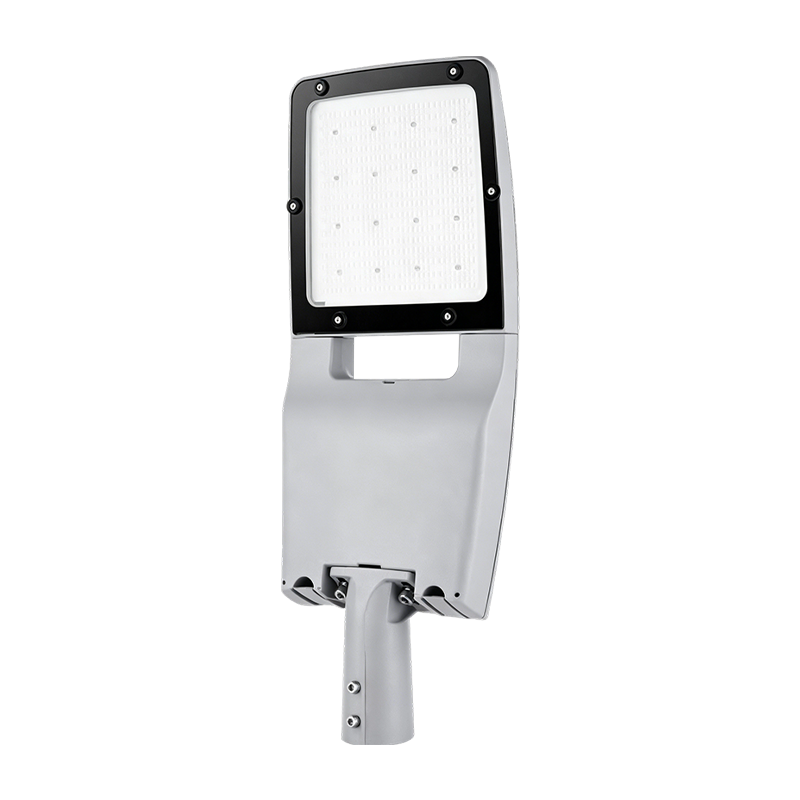
High Power Street Light HS-LD23TP
1. Product Overview
The High Power Street Light HS-LD23TP is engineered as a professional outdoor roadway luminaire. Its primary function is to provide high-intensity illumination over broad areas where visibility, traffic safety, and reliable operation are essential. Typical application environments include expressways, industrial zones, large intersections, municipal roads, ports, parking areas, logistics yards, and other locations where standard low-power fixtures may not provide sufficient coverage.
The design focuses on high luminous output and effective light distribution. When installed at an appropriate height and combined with the correct beam angle, the fixture can support long-distance light projection and broad road coverage. This is especially useful on roads with multiple lanes, open industrial yards, and junctions where drivers and pedestrians need to identify obstacles, markings, vehicles, and changes in traffic direction quickly.
The HS-LD23TP is available in a wide input wattage range of 30W to 240W. This range gives lighting designers the flexibility to specify one product family across different project zones. Lower-power configurations may be suitable for smaller roads, access lanes, or lower mounting heights, while higher-power versions can be considered for expressways, wide intersections, and large industrial areas.
The product information identifies three representative model configurations: HS-LD23TP-100W, HS-LD23TP-150W, and HS-LD23TP-240W. Their listed dimensions are 644 × 250 × 122 mm, 710 × 270 × 130 mm, and 810 × 270 × 130 mm respectively. The graduated housing sizes correspond to the increasing output requirements and provide a clear basis for planning storage, transportation, mounting, and replacement operations.
Key Technical Specifications
| Specification | HS-LD23TP Range or Value |
|---|---|
| Product category | LED Street Light |
| Input wattage | 30W–240W |
| Lighting effect | 100–160 lm/W ±5% |
| Protection grade | IP66 / IK08 |
| Input voltage | AC100–305V |
| Representative models | 100W, 150W, and 240W configurations |
| 100W product size | 644 × 250 × 122 mm |
| 150W product size | 710 × 270 × 130 mm |
| 240W product size | 810 × 270 × 130 mm |
These specifications position the HS-LD23TP as a high-output roadway fixture rather than a decorative or low-intensity outdoor lamp. The product is intended for applications where the lighting system must contribute directly to safe movement, operational productivity, and visual security.
2. Strong Illumination for High-Traffic Areas
High-traffic areas require lighting that remains visible across long distances and maintains sufficient brightness across the required road surface. Poorly selected fixtures can create dark zones, excessive glare, inconsistent illumination, or insufficient visibility at intersections. A high-power street light must therefore be evaluated not only by its nominal wattage but also by its luminous efficacy, optical distribution, thermal design, and installation compatibility.
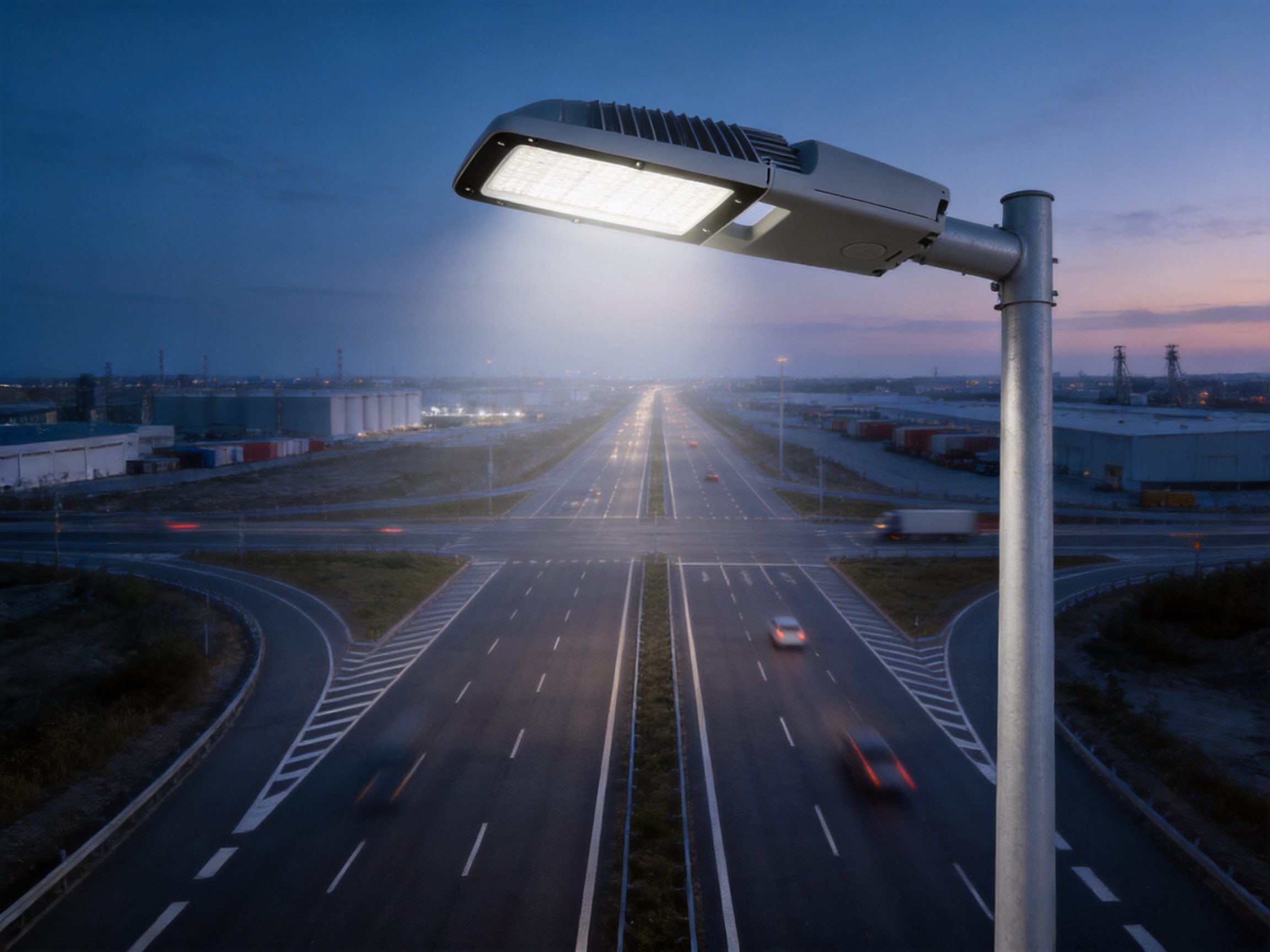
The HS-LD23TP is designed to deliver extremely strong brightness with long-distance light penetration. Its high-power configurations are suitable for locations where broad illumination and enhanced visibility are critical. On expressways, strong roadway lighting can help drivers recognize lane changes, roadside objects, merging traffic, and unexpected obstructions. At industrial entrances and logistics yards, it can improve the visibility of trucks, loading equipment, personnel, and access routes.
At large intersections, a high-output luminaire can support a more consistent lighting plan across turning lanes, pedestrian crossings, traffic islands, and waiting areas. The ability to customize beam angles provides additional flexibility. A narrow or focused beam may help direct light toward long road sections, while a wider distribution may be more suitable for open intersections, yards, or broad pavement areas.
The stated lighting effect of 100–160 lm/W ±5% indicates that the product can provide a high level of light output relative to its electrical consumption. Actual project performance will depend on LED configuration, optical distribution, mounting height, spacing, surface reflectance, environmental conditions, and control settings. For this reason, the fixture should be evaluated as part of a complete lighting design rather than as an isolated component.
Compared with older conventional lighting technologies, high-efficiency LED street lights can help reduce energy use while producing more controllable light. LEDs also support rapid startup, directional light distribution, and compatibility with modern lighting controls. These characteristics make them suitable for roadway projects seeking better illumination performance and improved operating efficiency.
Visibility and Safety Benefits
Visibility is an important factor in roadway safety. Drivers need enough light to distinguish road markings, vehicles, signs, pedestrians, barriers, and surface changes. In industrial environments, workers and vehicle operators must be able to identify equipment, storage areas, loading zones, and potential hazards. Strong, well-distributed illumination can support these requirements when the fixture layout and optical design are correctly selected.
The HS-LD23TP is particularly appropriate for customers who prioritize maximum visibility in high-traffic or wide-area environments. Its high-power range allows project engineers to respond to demanding site conditions without combining multiple unrelated fixture models. Using one product family across a project may simplify procurement, maintenance training, spare-parts planning, and replacement procedures.
3. Efficient Thermal Management and Long-Term Reliability
Thermal management is one of the most important factors in high-power LED lighting. LEDs, drivers, and related electronic components generate heat during operation. If this heat is not transferred away efficiently, the fixture may experience performance reduction, shortened component life, color or output instability, and increased maintenance requirements.
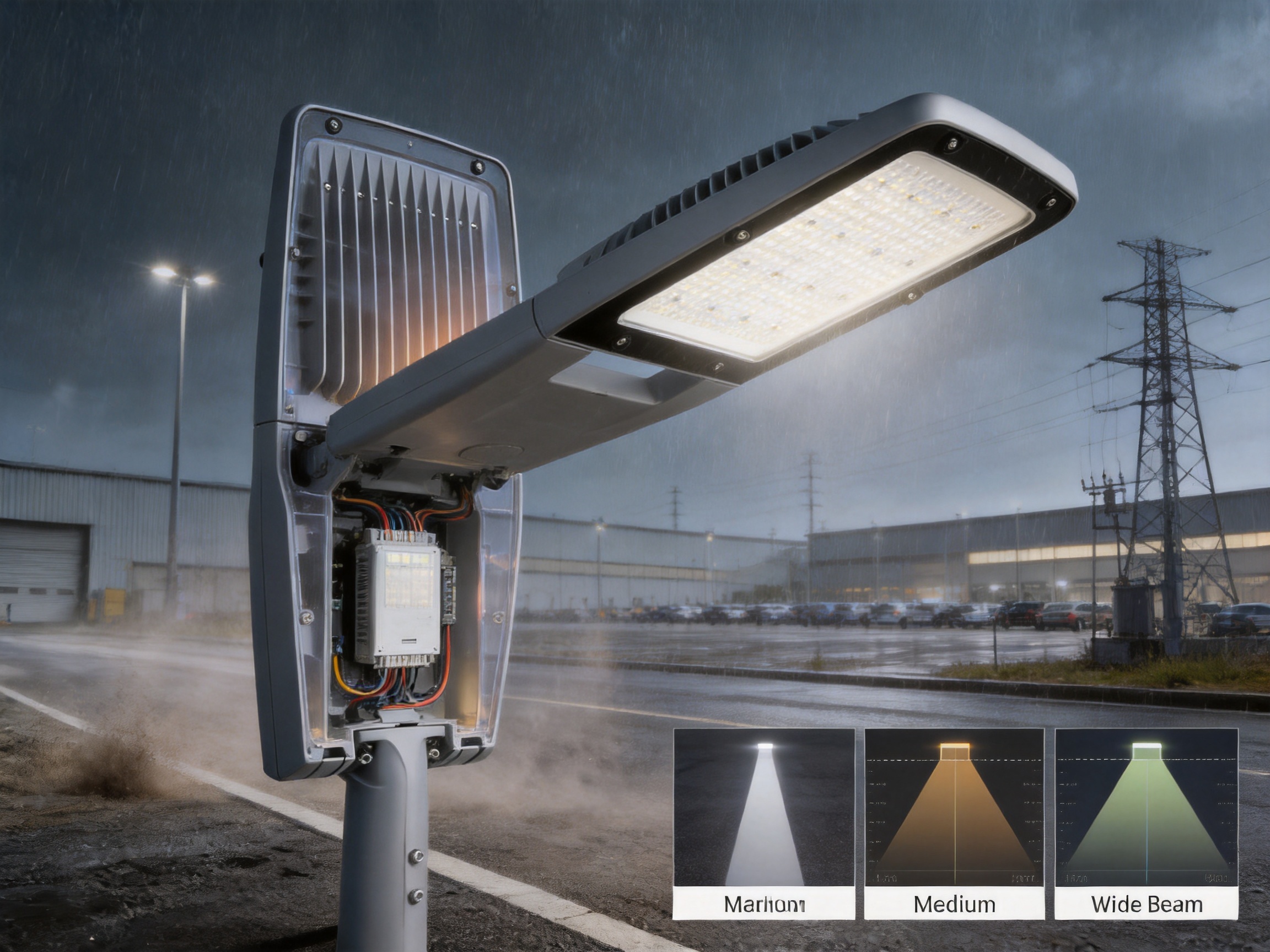
The HS-LD23TP uses a reinforced heat sink structure to support heat dissipation. The heat sink is an essential part of the fixture body because it transfers heat from the LED assembly to the surrounding air. A robust heat-dissipation structure helps the luminaire operate more reliably under continuous outdoor use, especially when installed in warm climates or locations with long operating hours.
Heat management is particularly significant for the 150W and 240W configurations because higher-power fixtures naturally require greater thermal control. The larger listed housing dimensions of these models provide a substantial platform for the high-output configurations. While final thermal performance depends on installation conditions and operating environment, the reinforced heat sink design demonstrates that thermal reliability is a central part of the product development approach.
Compared with basic street lights that may use a small or insufficient heat sink, a carefully designed high-power housing can offer better support for stable operation. It can also help protect the LED chips and driver from excessive thermal stress. For customers planning long service periods, reduced thermal stress may contribute to lower replacement frequency and more predictable maintenance planning.
Outdoor Environmental Protection
The HS-LD23TP is rated IP66 for protection against dust and powerful water jets. This rating is relevant to outdoor applications where the fixture may be exposed to rain, wind-driven dust, road debris, and periodic cleaning. A sealed outdoor structure helps prevent contaminants from entering critical internal areas and supports dependable operation in changing weather conditions.
The IK08 rating indicates resistance to a defined level of mechanical impact. This is valuable in public infrastructure, industrial zones, parking facilities, and other locations where equipment may be exposed to accidental contact, vibration, maintenance activity, or minor impact. IK08 does not mean that the fixture is indestructible, but it provides a stronger mechanical protection level than fragile indoor lighting products.
The combination of IP66 and IK08 makes the HS-LD23TP suitable for demanding outdoor installations. It also allows the product to be considered for projects where dust ingress, rain exposure, and mechanical durability are important selection criteria. Proper installation remains essential, including correct mounting, cable protection, grounding, and adherence to local electrical requirements.
4. Wide Input Voltage for International Projects
The HS-LD23TP accepts an input voltage range of AC100–305V. This wide range is useful for projects in regions where power systems differ or where supply voltage may fluctuate. It can simplify product selection for international distributors and engineering contractors who serve multiple markets.
A wide input range does not eliminate the need for correct electrical design. The installation must still comply with local regulations, wiring standards, circuit protection requirements, and grounding practices. However, the broad voltage compatibility gives the product greater adaptability than a fixture designed for only one narrow voltage range.
For industrial areas and large outdoor sites, voltage conditions may vary because of long cable runs, heavy machinery, or changing electrical loads. A fixture designed to support AC100–305V can provide a practical level of flexibility for these environments. It can also reduce the need to maintain separate product versions for different regional supply conditions.
For exporters and project suppliers, the wide input range can simplify inventory management. A single product family may be specified for multiple customer markets, subject to applicable certification and project requirements. This can support more efficient procurement and reduce the risk of selecting a fixture that is incompatible with the target site voltage.
5. Flexible Power and Beam-Angle Customization
Road lighting projects rarely have identical requirements. Road width, pole spacing, mounting height, traffic density, pavement reflectance, climate, and local lighting standards all influence the appropriate fixture specification. A product that offers only one fixed wattage and one beam pattern may require compromises during design.
The HS-LD23TP supports OEM and ODM customization for the power range and beam angle. This gives customers an opportunity to adapt the product to project-specific conditions. Power customization can help align the fixture with required illuminance levels and energy targets. Beam-angle customization can help distribute light more effectively across the road or site.
Customization is particularly useful for infrastructure contractors and lighting distributors who need differentiated products for different tenders. A distributor may require a particular wattage step for a regional market, while a municipal project may require a customized optical pattern to meet a road classification or lighting calculation. Industrial users may also need a beam distribution that favors work zones, access roads, or loading areas.
Any customization should be confirmed through technical documentation and, where necessary, photometric simulation. Factors such as LED selection, driver compatibility, housing configuration, optical lens design, surge protection, and certification requirements should be reviewed before mass production. A controlled customization process allows the product to remain reliable while responding to individual project needs.
Application-Specific Lighting Design
A high-power street light should not be selected based solely on the highest available wattage. Over-lighting can increase energy consumption and glare, while under-lighting can create safety problems. The best approach is to match the product configuration to the site through a complete lighting assessment.
The manufacturer provides efficient lighting solutions and DIALux design support as part of its service capabilities. A DIALux-based study can help evaluate illuminance, uniformity, spacing, mounting height, beam distribution, and energy consumption before installation. This can be valuable for project owners who need documentation for tender submissions, approval procedures, or quality assurance.
With the HS-LD23TP, customers can discuss the application conditions and select a suitable configuration within the available power range. The resulting lighting plan should consider both horizontal illumination on the road surface and vertical visibility for vehicles, pedestrians, signs, and structures. The purpose is to create a balanced system that delivers useful light rather than simply maximum brightness.
6. Product Advantages Compared with Standard Street Lights
The HS-LD23TP offers several advantages over standard low-output or less specialized street lights. The first is its high-power capability. With configurations reaching 240W, it can address wide roads and open areas that may exceed the coverage capacity of compact fixtures.
The second advantage is the combination of high luminous efficacy and reinforced thermal management. High output is more valuable when the fixture can maintain stable operation and manage heat effectively. The stated 100–160 lm/W ±5% lighting effect provides a basis for comparing performance with lower-efficiency alternatives, while the heat sink structure supports the mechanical and thermal requirements of a high-power design.
The third advantage is environmental protection. IP66 and IK08 provide a stronger outdoor protection profile than many indoor-oriented or lightly protected lighting products. This makes the HS-LD23TP better suited to locations exposed to rain, dust, road conditions, and physical contact.
The fourth advantage is voltage flexibility. The AC100–305V input range supports a broad range of electrical systems and can be beneficial for export projects. Contractors and distributors may be able to use the same product family in multiple locations, subject to local certification and installation requirements.
The fifth advantage is customization. OEM and ODM support for power range and beam angle allows the product to be adapted to the needs of specific customers. Competitors that offer only fixed configurations may not provide the same degree of project flexibility.
The sixth advantage is manufacturing support. The product is supplied by a manufacturer with die-casting and CNC equipment, aging lines, goniophotometers, and experience in OEM, ODM, SKD, and CKD services. This combination allows customers to receive not only a lighting fixture but also technical assistance, product adaptation, photometric evaluation, and supply-chain support.
Comparison of Selection Factors
| Selection Factor | HS-LD23TP Benefit | Project Value |
|---|---|---|
| Power range | 30W–240W configurations | Supports small access roads through high-demand wide-area applications |
| Lighting effect | 100–160 lm/W ±5% | Helps balance high brightness and energy efficiency |
| Thermal structure | Reinforced heat sink design | Supports stable operation in high-power applications |
| Outdoor protection | IP66 and IK08 | Improves suitability for dusty, wet, and exposed locations |
| Voltage compatibility | AC100–305V | Supports varied electrical networks and export markets |
| Customization | Power range and beam-angle OEM/ODM options | Enables application-specific product development |
| Technical services | DIALux design and lighting solution support | Helps optimize layouts and document project performance |
This comparison does not suggest that one fixture is appropriate for every road or site. Instead, it shows why the HS-LD23TP is a strong candidate for projects where high output, environmental protection, flexibility, and technical support are important.
7. Advanced Manufacturing Capabilities
The performance of a high-power street light depends on more than its published specifications. Manufacturing accuracy, material consistency, process control, testing, and final inspection all influence the product’s reliability in the field. Cixi HuaSheng Lighting Co., Ltd. operates as an outdoor lighting manufacturer in Ningbo, China, with capabilities covering product development, production, testing, and international supply.
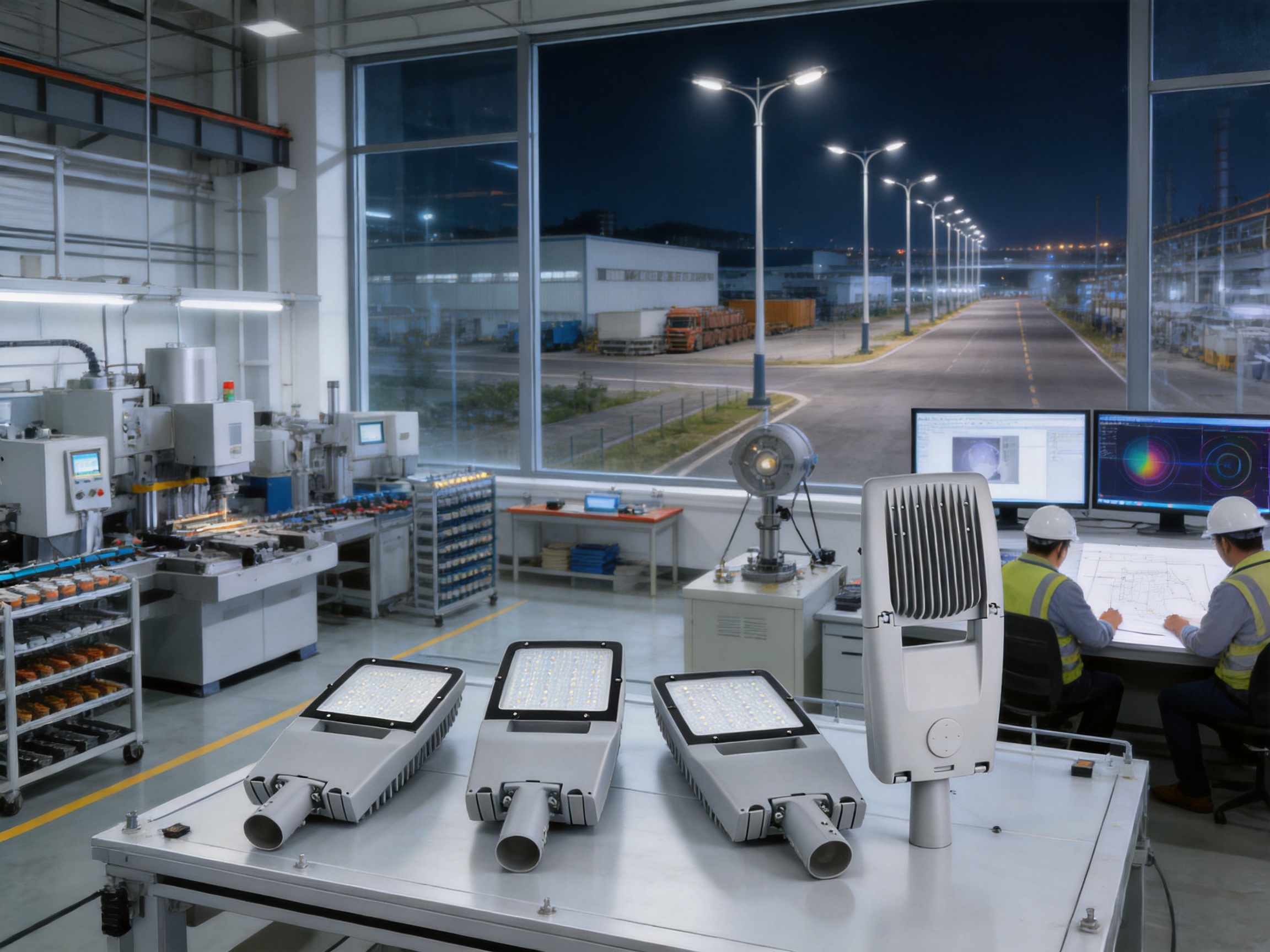
The company’s manufacturing resources include die-casting machines, CNC machines, aging lines, and goniophotometers. Each of these resources contributes to a different stage of product quality and performance.
Die-Casting Production
Die-casting is widely used for aluminum lighting housings because it can produce complex shapes with repeatable dimensions and strong structural integrity. For a high-power street light, the housing must support the LED board, driver, optical components, mounting structure, sealing features, and heat-dissipation requirements.
In-house or closely controlled die-casting capability can improve control over housing development. It allows the manufacturer to refine heat sink geometry, mounting interfaces, wall thickness, reinforcing ribs, and cable-entry details according to the needs of the product. Consistent die-cast parts also support smoother assembly and more reliable sealing.
For the HS-LD23TP, a reinforced housing is especially important because the product is designed for high-power operation. The body must be sufficiently robust for outdoor mounting while also supporting the thermal path from the LED assembly to the surrounding environment. Die-casting provides a suitable manufacturing foundation for this type of structure.
CNC Machining
CNC machining supports precision processing after casting or during the production of specific components. It can be used to improve the accuracy of mounting surfaces, threaded areas, connection interfaces, and other parts that require controlled dimensions. Precision machining is valuable when a fixture must align correctly with a pole arm, mounting bracket, cover, or internal component.
Accurate machining can also support better assembly consistency. When parts fit correctly, the production line can reduce unnecessary adjustment, improve sealing alignment, and maintain more stable quality between batches. This is particularly important for products intended for international distribution, where replacement parts and fixtures may be installed by different teams in different countries.
The combination of die-casting and CNC processing provides a stronger manufacturing base than simple outsourced assembly. It gives the manufacturer greater influence over the form, function, and repeatability of the luminaire housing.
Aging and Reliability Testing
Aging lines are used to operate products for a controlled period before shipment. This process can help identify early-stage defects in LED drivers, electronic connections, solder joints, and other components. Although aging cannot predict every field condition, it is an important quality-control step for reducing the risk of premature failure after installation.
For a street light intended to operate during long nighttime periods, early fault screening is important. Customers generally expect outdoor fixtures to function reliably after installation because access to poles and road corridors can be difficult, expensive, and disruptive. A controlled aging process supports a more dependable product release procedure.
Testing may be combined with visual inspection, electrical measurement, mechanical checks, and production records. The precise test program depends on the product model and customer requirements, but the presence of aging-line capability reflects a manufacturing approach focused on operational reliability rather than assembly alone.
Photometric Measurement
Goniophotometers are used to measure the distribution of light from a luminaire. They can provide photometric data such as luminous intensity at different angles, beam distribution, total luminous flux, and related performance information. This data is useful for lighting design, product verification, and project documentation.
For the HS-LD23TP, photometric measurement is especially relevant because beam angle and distribution are central to roadway performance. A fixture may have high lumen output but still perform poorly if the light is distributed inefficiently. Goniophotometer testing helps evaluate how the light leaves the fixture and whether the optical design supports the intended application.
Photometric files and DIALux simulations can help engineers compare different layouts before construction. They can also assist customers in selecting between 100W, 150W, and 240W configurations or in discussing a customized beam angle for a specific road geometry.
8. Quality Systems, Certification, and International Supply
The manufacturer reports ISO 9001, ISO 14001, and ISO 45001 certifications. These standards address quality management, environmental management, and occupational health and safety respectively. Together, they indicate a structured approach to manufacturing operations, process control, environmental responsibilities, and workplace practices.
ISO 9001 is relevant to customers seeking consistent production and documented quality procedures. A controlled quality management system can support traceability, corrective actions, supplier evaluation, inspection procedures, and continuous improvement. For large lighting projects, these processes can help reduce variation between production batches.
ISO 14001 reflects attention to environmental management. Lighting manufacturers may address energy use, material handling, waste management, emissions, and regulatory compliance through an environmental management system. This is increasingly important for infrastructure projects that include sustainability requirements or environmental procurement criteria.
ISO 45001 focuses on occupational health and safety. Manufacturing facilities involve machinery, electrical systems, metal processing, assembly lines, and testing equipment. A structured safety management system helps establish procedures for reducing workplace risks and improving operational discipline.
The company also identifies relevant products as certified by CB and CE, subject to the specific model and market requirements. Customers should confirm the exact certification scope, test reports, and applicable standards for the selected configuration before placing an order. Certification review is an important part of international procurement, especially for municipal, industrial, and infrastructure projects.
The manufacturer exports products worldwide and has established strategic partnerships with international companies. Its product portfolio includes LED street lights, tunnel lights, high-bay lights, linear lights, garden lights, solar lights, grow lights, explosion-proof lights, and other lighting products. This broad experience can be valuable for customers managing several types of lighting within one project or procurement program.
9. One-Stop Lighting Solutions
Many commercial and infrastructure customers need more than a standard catalog product. They may require optical calculations, sample development, private labeling, packaging customization, mold design, component adaptation, or support with logistics and documentation. A manufacturer capable of providing these services can reduce coordination between multiple suppliers.
Cixi HuaSheng Lighting Co., Ltd. provides one-stop lighting solutions that include efficient lighting design, DIALux support, mold design, OEM/ODM development, SKD/CKD customization, and delivery services. These capabilities support the HS-LD23TP from early project planning through production and shipment.
OEM services can be useful for distributors and lighting brands that need products under their own names or packaging systems. ODM services can support customers who need changes to the product design, power level, beam angle, mounting arrangement, or other performance characteristics. The extent of customization should be discussed during the technical review stage.
Mold design capability is an important advantage for customers seeking a distinctive housing or a revised mechanical structure. Because high-power street lights rely heavily on the housing for thermal performance and protection, mold development should be handled with attention to heat dissipation, sealing, mechanical strength, assembly, and manufacturability.
SKD and CKD services may help customers with regional assembly strategies, local content programs, or different supply-chain requirements. These models require careful coordination of components, packaging, quality standards, assembly instructions, and inspection procedures. A manufacturer with experience in these services can help establish a more organized implementation process.
Delivery support is also important for large lighting projects. Street lights are relatively large products, especially in 150W and 240W configurations. Efficient packing, labeling, documentation, and shipment planning can reduce the risk of transit damage and simplify receiving operations at the project site or distribution warehouse.
10. Applications for the HS-LD23TP
Expressways and Main Roads
Expressways and main roads typically involve high vehicle speeds, long sight distances, and strict requirements for roadway visibility. High-power fixtures can be considered for interchanges, toll areas, merging zones, service sections, and other locations where broad and consistent illumination is required.
The HS-LD23TP’s high-output range and beam-angle customization support different roadway layouts. A lighting designer can evaluate mounting height, pole spacing, road width, median arrangement, and required uniformity to determine the appropriate configuration.
Industrial Parks
Industrial parks often operate throughout the night and contain a mixture of roads, loading areas, warehouses, production buildings, parking zones, and security checkpoints. Lighting must support both vehicle movement and workplace visibility.
The HS-LD23TP is suitable for industrial zones because it combines strong brightness with IP66 and IK08 protection. Its wide voltage input range may also be useful in facilities with variable electrical loads. For industrial operators, reliable lighting can support safer logistics, better perimeter visibility, and more efficient nighttime operations.
Large Intersections
Large intersections may include multiple turning lanes, pedestrian crossings, traffic islands, bus stops, and complex road markings. In these locations, the lighting plan must minimize dark areas and provide useful visibility from several directions.
Beam-angle selection is important for intersections. A customized distribution may help place light where it is needed while reducing unnecessary spill into neighboring properties or into drivers’ eyes. The HS-LD23TP can be evaluated as part of an intersection lighting simulation to determine whether a 100W, 150W, 240W, or customized configuration is appropriate.
Logistics and Distribution Centers
Logistics centers require lighting for truck circulation, loading docks, container movement, pedestrian paths, and gate operations. These sites may have wide paved areas and extended operating hours, making both brightness and energy efficiency important.
A high-power LED street light can help illuminate open yards and vehicle routes. The product’s robust protection rating is relevant to outdoor loading areas where dust, moisture, and mechanical activity are common.
Parking Areas and Public Facilities
Large parking areas, transportation facilities, campuses, and public service zones often need broad illumination with reliable nighttime operation. The HS-LD23TP can be considered where pole-mounted lighting is preferred and where a single fixture family can simplify maintenance across multiple areas.
11. Installation and Project Planning Considerations
Correct installation is essential to achieving the intended performance of any high-power street light. Before installation, the project team should verify pole strength, mounting compatibility, cable size, circuit protection, grounding, access for maintenance, and the environmental conditions at the site.
Mounting height and pole spacing should be determined through a lighting calculation. The selected beam angle must correspond to the road width and fixture position. A high-output fixture installed with an unsuitable angle may produce excessive brightness in one area while leaving insufficient light in another.
Designers should also consider glare control. Strong brightness is beneficial only when it contributes to useful visibility. Optical aiming, fixture tilt, mounting orientation, and beam distribution should be reviewed to reduce discomfort glare and unwanted light trespass.
Thermal performance depends partly on installation conditions. The heat sink should not be obstructed by nearby structures, excessive dirt accumulation, or incorrect mounting accessories. The fixture should be installed according to the manufacturer’s instructions so that ventilation and mechanical support are maintained.
Electrical protection should be selected according to local regulations and site conditions. Outdoor roadway systems may be exposed to switching events, voltage surges, lightning-related disturbances, and other transient conditions. Project engineers should evaluate appropriate surge protection and grounding arrangements as part of the complete system design.
Maintenance planning should be completed before commissioning. Even a durable IP66 and IK08-rated product benefits from periodic inspection. Maintenance teams may check housing condition, cable connections, mounting bolts, optical cleanliness, pole stability, and light output. A clear inspection schedule can help preserve performance throughout the operating period.
12. Energy Efficiency and Operating Value
Energy consumption is a major consideration in roadway lighting because fixtures may operate from dusk until dawn. The HS-LD23TP’s stated lighting effect of 100–160 lm/W ±5% supports a high-efficiency approach to outdoor illumination. The actual energy savings will depend on the existing lighting system, operating schedule, control strategy, required illuminance, and project layout.
Replacing older fixtures with efficient LEDs can provide several potential benefits. These may include lower electricity consumption, reduced lamp replacement requirements, faster startup, improved controllability, and more consistent light quality. High-output LEDs can also allow a project to achieve required illumination with fewer fixtures in some layouts, although this must be verified through photometric design.
Energy efficiency should be evaluated together with total cost of ownership. Purchase price is only one part of the financial calculation. Other factors include installation labor, pole and cable requirements, electricity use, maintenance access, replacement parts, downtime, and disposal. A well-designed LED street lighting system can provide value over the full operating period when these factors are considered.
The HS-LD23TP may also be integrated into broader energy-management strategies, depending on the selected driver and project control requirements. Dimming schedules, photocell operation, motion-based controls, and centralized management may be evaluated where they are compatible with the final product configuration and local standards.
13. Procurement Guidance for Distributors and Contractors
Distributors and contractors should begin by identifying the application, road classification, mounting height, spacing, environmental exposure, input voltage, and required lighting level. This information will help determine whether the HS-LD23TP is suitable and which configuration should be considered.
For an initial quotation, customers should provide the expected quantity, target market, required certifications, packaging needs, delivery destination, preferred power levels, beam-angle requirements, and branding instructions. If OEM or ODM customization is requested, technical drawings, sample approvals, photometric data, and production lead times should be discussed in advance.
Customers should request confirmation of the exact product configuration. The general product range is 30W–240W, while the listed representative models are 100W, 150W, and 240W. The final quotation should identify wattage, LED configuration, driver details, optical distribution, housing finish, mounting interface, cable arrangement, certification scope, and warranty terms where applicable.
For public and industrial projects, sample testing may be appropriate before mass production. A sample can be used to verify dimensions, installation compatibility, light distribution, finish quality, electrical performance, and documentation. Photometric files should be reviewed in the intended design software when project approval depends on calculated results.
Packaging and logistics should also be considered. The 240W housing is listed at 810 × 270 × 130 mm, so warehouse racking, pallet arrangement, container loading, and final-mile delivery should be planned accordingly. Proper packaging can help protect the fixture during transportation and reduce handling damage.
14. Why Manufacturing Depth Matters
Lighting performance and manufacturing capability are closely connected. A street light may have an attractive specification sheet, but the long-term result depends on whether the manufacturer can consistently produce the housing, electronics, optics, seals, and assemblies to the required standard.
Die-casting capability supports housing consistency and thermal design. CNC machining supports dimensional accuracy. Aging lines support early fault screening. Goniophotometers support optical verification. ISO management systems support documented processes. Together, these capabilities create a stronger foundation for reliable production than a purely trading-based supply model.
Manufacturing depth also supports faster engineering communication. When a customer requests a beam-angle change, a revised mounting interface, a modified housing, or a new power configuration, a manufacturer with internal engineering and production resources can evaluate the request more effectively. This can reduce communication gaps between design, tooling, production, and quality teams.
For international customers, manufacturing depth can contribute to supply continuity. A supplier with broader production resources may be better positioned to manage product updates, replacement parts, quality investigations, and future orders. This is especially valuable for infrastructure projects that require consistent products over several phases.
15. Environmental and Social Responsibility
Outdoor lighting projects increasingly consider environmental impact, energy performance, material use, and workplace responsibility. The manufacturer’s ISO 14001 and ISO 45001 certifications indicate that environmental management and occupational safety are included within its formal management framework.
LED technology itself can support energy-conscious project planning by producing high light output with comparatively efficient electrical consumption. Long operating life and lower maintenance demand may also reduce the need for frequent replacement and service trips. These benefits depend on proper design, installation, electrical protection, and ongoing maintenance.
Responsible manufacturing also includes efficient material use, controlled production processes, waste management, and safe working conditions. Customers with sustainability policies may wish to review the manufacturer’s environmental documents, product declarations, packaging practices, and compliance records during procurement.
16. Frequently Asked Questions
Q1: What type of product is the HS-LD23TP?
The HS-LD23TP is a high-power LED street light designed for wide-area outdoor illumination. It is suitable for expressways, industrial zones, large intersections, logistics areas, municipal roads, and other locations that require strong brightness and reliable outdoor performance.
Q2: What wattage range is available?
The stated input wattage range is 30W–240W. Representative listed models include 100W, 150W, and 240W versions. The correct wattage should be selected according to the road width, pole height, spacing, lighting standard, and photometric calculation.
Q3: What is the lighting efficiency of the product?
The stated lighting effect is 100–160 lm/W ±5%. Actual project output may vary according to the selected LED chips, optical system, driver, operating temperature, and customized configuration.
Q4: Is the product suitable for rainy and dusty environments?
Yes. The HS-LD23TP is rated IP66, which supports protection against dust and powerful water jets. It is designed for outdoor use, although correct installation, sealing, cable protection, and maintenance remain necessary.
Q5: What does the IK08 rating mean?
IK08 indicates a defined level of resistance to mechanical impact. It helps the product withstand ordinary outdoor handling and minor impact risks better than fragile indoor fixtures. It does not mean the fixture is immune to severe impact or intentional damage.
Q6: What input voltage does the street light support?
The product supports AC100–305V. Customers should still verify local electrical requirements, circuit protection, grounding, and the exact driver configuration before installation.
Q7: Can the beam angle be customized?
Yes. OEM and ODM customization is available for the power range and beam angle. Custom requirements should be reviewed through technical drawings, photometric data, sample approval, and confirmation of certification requirements.
Q8: How does the product manage heat?
The HS-LD23TP uses a reinforced heat sink structure designed to support heat dissipation from the high-power LED assembly. Thermal performance also depends on ambient temperature, fixture orientation, installation clearance, and maintenance conditions.
Q9: Does the manufacturer provide lighting design support?
Yes. The company provides efficient lighting solutions and DIALux design support. This can help customers evaluate mounting height, fixture spacing, beam distribution, uniformity, and energy performance before installation.
Q10: What manufacturing equipment does the company have?
The company operates or uses die-casting machines, CNC machines, aging lines, and goniophotometers. These resources support housing production, precision processing, reliability screening, and photometric evaluation.
Q11: Are OEM and ODM services available?
Yes. OEM and ODM services are available, including customization of power range and beam angle. The company also provides mold design and SKD/CKD customization services for suitable projects.
Q12: What should customers confirm before ordering?
Customers should confirm the required wattage, input voltage, beam angle, mounting arrangement, product dimensions, certifications, packaging, quantity, delivery schedule, branding requirements, and any special environmental or project standards.
17. Conclusion
The High Power Street Light HS-LD23TP is designed for outdoor applications that demand strong illumination, long-distance visibility, dependable protection, and flexible project configuration. Its 30W–240W power range, 100–160 lm/W ±5% lighting effect, AC100–305V input, IP66 protection, and IK08 impact resistance make it a practical candidate for expressways, industrial zones, large intersections, logistics centers, and other wide-area environments.
Its reinforced heat sink structure supports the thermal demands of high-power LED operation, while OEM and ODM options allow customers to adapt power levels and beam angles to project requirements. The availability of representative 100W, 150W, and 240W models gives buyers a clear starting point for product selection.
The product is supported by a manufacturer with die-casting, CNC machining, aging, and photometric testing capabilities, along with ISO 9001, ISO 14001, and ISO 45001 management certifications. Additional services include DIALux lighting design, mold development, OEM/ODM production, SKD/CKD customization, and international delivery support.
For customers comparing high-power outdoor lighting products, the HS-LD23TP stands out through its combination of illumination performance, outdoor durability, thermal design, voltage flexibility, customization potential, and manufacturing support. Final product selection should always be confirmed through a complete site assessment and technical review, but the fixture provides a strong foundation for demanding roadway and industrial lighting projects.
References
1. Cixi HuaSheng Lighting Co., Ltd., HS-LD23TP product specifications and technical information.
2. International Electrotechnical Commission, Degrees of Protection Provided by Enclosures, IP Code guidance.
3. International Electrotechnical Commission, Degrees of Protection Provided by Enclosures Against External Mechanical Impacts, IK Code guidance.
4. International Organization for Standardization, ISO 9001 Quality Management Systems principles.
5. International Organization for Standardization, ISO 14001 Environmental Management Systems principles.
6. International Organization for Standardization, ISO 45001 Occupational Health and Safety Management Systems principles.
7. DIALux lighting design and photometric simulation methodology.
8. General roadway lighting design practices for expressways, intersections, industrial roads, and outdoor public infrastructure.
Product: High Power Street Light HS-LD23TP
Custom & OEM Solutions for Global Lighting Brands
Copyright © Cixi HuaSheng Lighting Co., Ltd. All Rights Reserved.
Die-Casting Mould Supplier
