 English
 中文简体
 русский
 Français
 Español
 عربى
 Indonesia

Adjustable LED Road Light JD-1052: Efficient, Adaptable Roadway Illumination for Modern Infrastructure
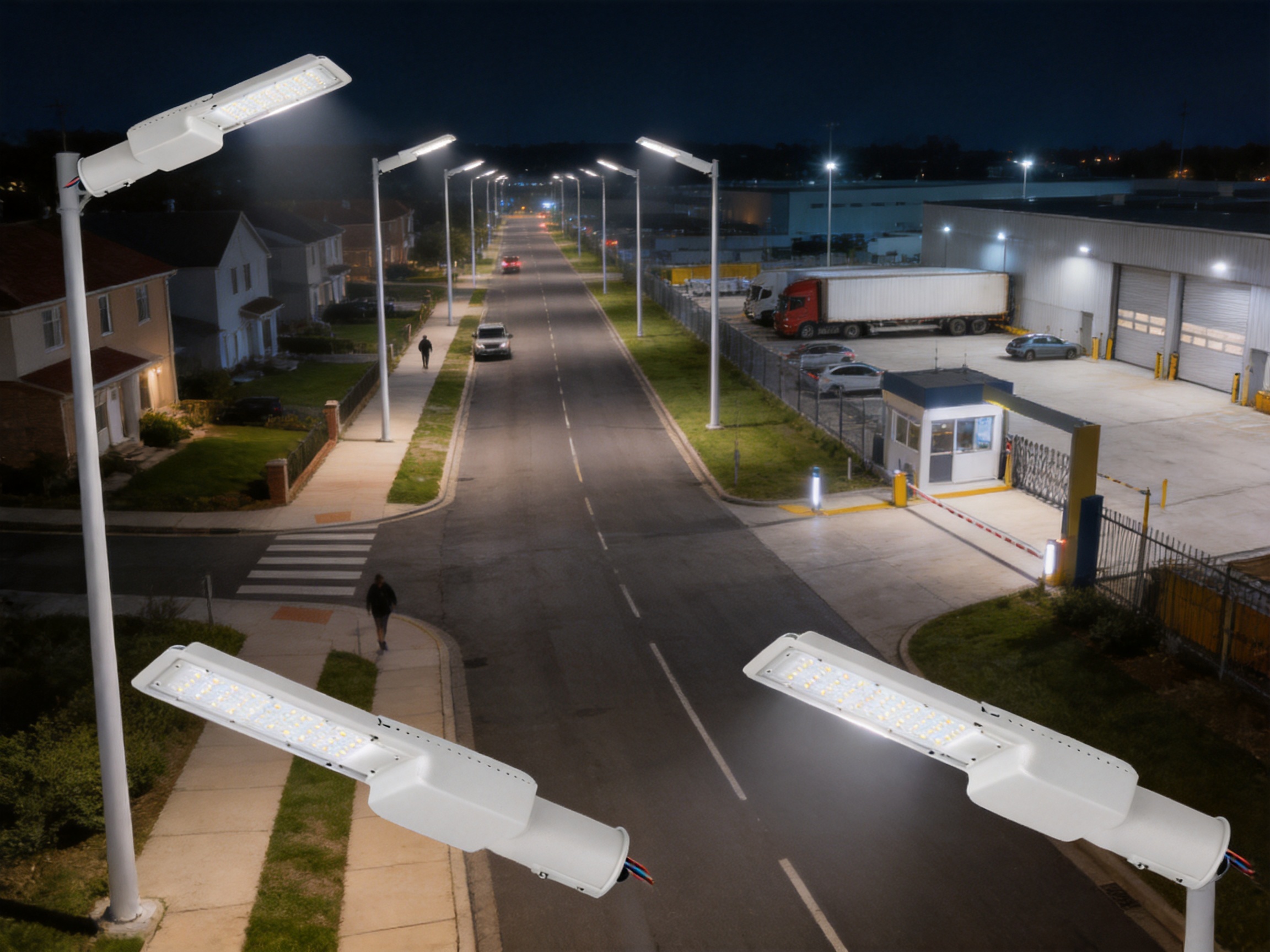
Modern road infrastructure requires lighting systems that deliver dependable illumination, controlled energy consumption, long service life, and straightforward maintenance. Municipal roads, industrial parks, residential developments, commercial access routes, and outdoor infrastructure projects all depend on lighting that can perform consistently in changing weather and operating conditions. The Adjustable LED Road Light JD-1052 is designed to meet these practical requirements through a compact, efficient, and adaptable roadway lighting platform.
With a power range of 30-60W, support for 3030 or 5050 LED configurations, and an efficacy of 130-160 lm/W, the JD-1052 provides a useful balance between brightness and energy efficiency. Its adjustable design enables lighting planners and installers to optimize the fixture for different mounting arrangements, road widths, pole heights, and optical requirements. The product is particularly suitable for projects that need dependable roadway visibility without adopting an unnecessarily large or overpowered luminaire.
The JD-1052 is manufactured by Cixi HuaSheng Lighting Co., Ltd., an outdoor lighting manufacturer based in Ningbo, China. The company combines product development, die-casting, CNC machining, aging, optical testing, and customized manufacturing services within its production capabilities. This integrated approach supports consistent quality control and enables customers to request adaptations for power configuration, housing finish, optical distribution, and project-specific requirements.
Rather than treating a road light as a simple LED assembly, the JD-1052 is developed as a complete outdoor lighting system. Its value comes from the interaction between its LED source, thermal structure, housing, adjustability, manufacturing precision, and application flexibility. These features help the product compete effectively with conventional fixed-position street lights and with less adaptable entry-level LED road fixtures.
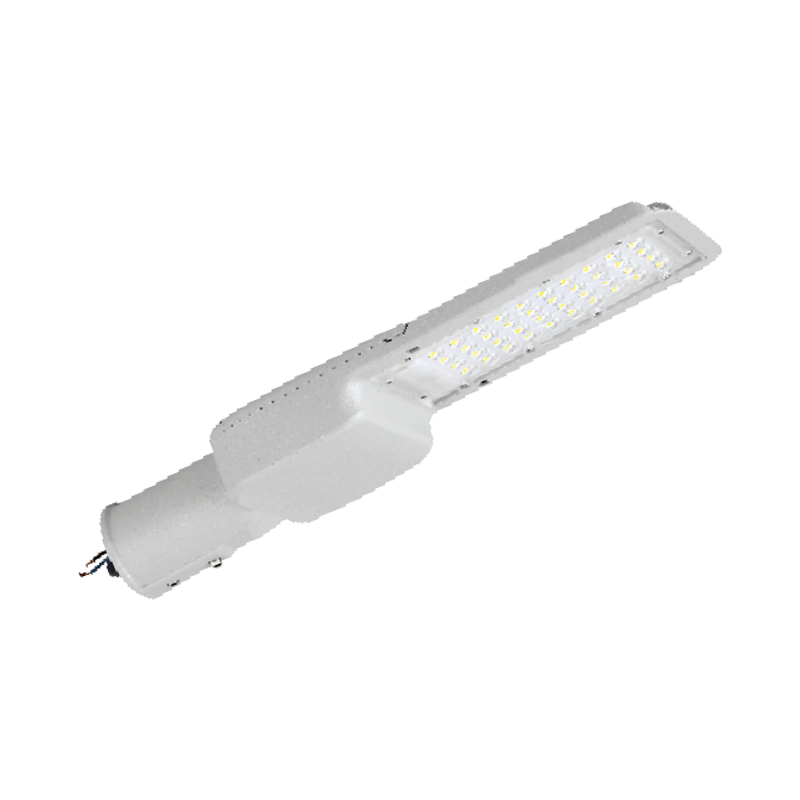
Adjustable LED Road Light JD-1052
1. The Role of Efficient Road Lighting in Outdoor Infrastructure
Road lighting has a direct effect on visibility, traffic comfort, pedestrian confidence, and the perceived safety of public and private outdoor spaces. A roadway fixture must provide sufficient illumination across the intended area while avoiding excessive glare, uneven brightness, dark spots, and unnecessary energy use. These requirements become more important as cities expand, industrial areas grow, and existing lighting networks are upgraded from older technologies.
Traditional high-pressure sodium, metal halide, and other discharge-based lamps often require more energy to provide comparable usable illumination. They may also have longer startup times, less convenient dimming behavior, and higher maintenance demands. LED technology offers a more flexible alternative because it converts electrical power into useful light more efficiently and can be designed around specific optical and mechanical requirements.
However, not every LED road light provides the same project value. An efficient LED chip alone does not guarantee effective roadway performance. The housing must protect internal components from outdoor exposure, the heat dissipation structure must control operating temperature, and the optical arrangement must direct light where it is needed. Mechanical adjustment is also important because a fixture that cannot be aligned correctly may produce poor coverage even when its nominal lumen output is high.
The JD-1052 addresses these practical factors through a combination of adjustable positioning, efficient LED options, durable construction, and a compact form factor. This makes it suitable for applications where project managers need a reliable fixture that can be adapted during installation rather than permanently limited by a fixed angle.
2. Product Overview
The Adjustable LED Road Light JD-1052 is a roadway luminaire designed for urban roads and outdoor infrastructure projects. Its rated power range is 30-60W, allowing one product family to cover multiple lighting requirements. Lower-power configurations can be selected for smaller roads, access lanes, pedestrian-oriented routes, residential streets, and low-speed areas. Higher-power configurations can be considered for broader roadway coverage, industrial access roads, and locations requiring stronger illumination.
The product supports 3030 and 5050 LED packages. These LED formats are widely used in professional lighting applications and provide flexibility when configuring the light source, output level, thermal layout, and optical performance. Depending on project specifications, customers can work with the manufacturer to determine the most appropriate LED arrangement and power setting.
With an efficacy range of 130-160 lm/W, the JD-1052 is designed to produce substantial light output from a moderate electrical input. Efficacy is an important project metric because it influences operating cost, energy consumption, electrical infrastructure requirements, and long-term sustainability. Actual system performance depends on the selected LED configuration, driver, operating conditions, optics, and installation environment, but the stated range demonstrates the product’s focus on efficient illumination.
The compact size of the standard S-size version is 397 x 110 x 61 mm. This relatively streamlined structure helps the fixture integrate with poles and brackets without creating an unnecessarily bulky appearance. A compact housing can also simplify handling during installation and reduce visual impact in urban, residential, and commercial areas.
| Specification | JD-1052 Information |
|---|---|
| Product type | Adjustable LED road light |
| Application category | LED street lighting |
| Power range | 30-60W |
| LED options | 3030 or 5050 |
| Rated efficacy | 130-160 lm/W |
| Standard size | 397 x 110 x 61 mm |
| Primary applications | Urban roads, outdoor infrastructure, industrial access routes, residential roads, and project roadway lighting |
| Customization | Power configuration, housing finish, optical distribution, OEM, and ODM services |
These specifications make the JD-1052 a practical option for buyers who want a road lighting fixture that can be selected and adjusted according to the application instead of relying on one fixed output and one fixed installation position.
3. Adjustable Design for More Flexible Installation
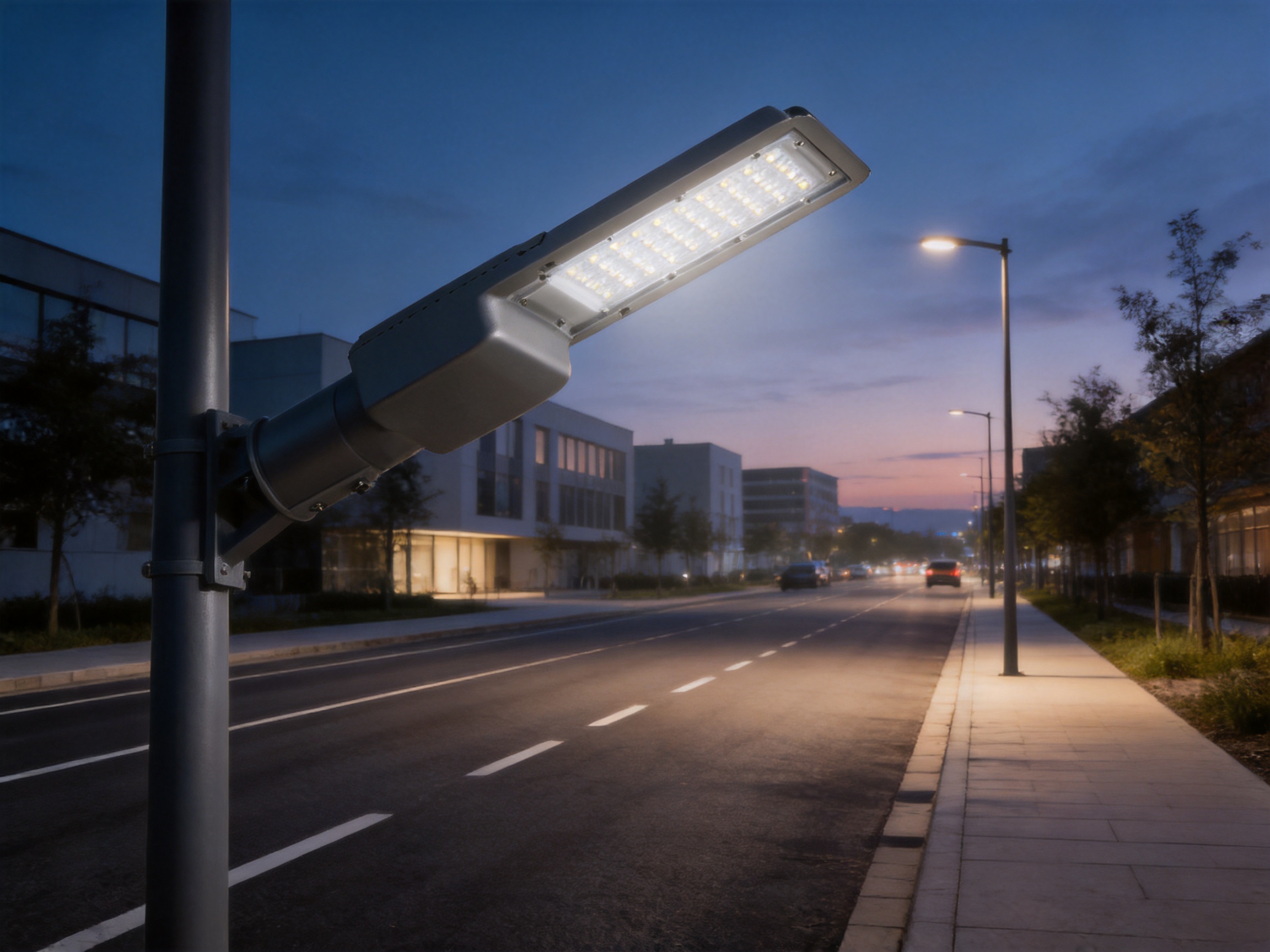
One of the clearest advantages of the JD-1052 is its adjustable structure. Roadway lighting conditions vary considerably from one project to another. Pole height, road direction, mounting arm design, lane width, sidewalk placement, building locations, and nearby trees can all affect the required light distribution. A fixed-angle fixture may be acceptable in a standardized installation, but it can be less effective when site conditions vary.
An adjustable road light gives installers greater control over the direction in which the luminaire is aimed. This can help align the light with the centerline of a road, distribute light toward a wider area, or compensate for a pole position that is not perfectly perpendicular to the roadway. The ability to make this adjustment during installation can reduce the need for custom brackets or repeated mechanical modifications.
Adjustability also supports project adaptation. A lighting contractor may use the same basic product family in several areas with different pole arrangements. Instead of maintaining many separate fixture models, the contractor can specify the appropriate power and make the final directional adjustment on site. This can simplify procurement, inventory planning, installation training, and replacement management.
Compared with inexpensive fixed-position road lights, the JD-1052 can offer a more forgiving installation process. If the original mounting position produces a slightly different angle than anticipated, the fixture may be repositioned to improve roadway coverage. This does not replace professional photometric design, but it provides a useful mechanical advantage when converting a lighting plan into a real installation.
Adjustability is also valuable during refurbishment projects. Existing poles are not always installed according to current design assumptions, and old infrastructure may have variations in arm length or orientation. A fixture with directional flexibility can help installers achieve more appropriate illumination without replacing every pole or support structure.
3.1 Supporting Better Light Placement
Effective roadway lighting is not simply a matter of producing a large lumen number. The light must be placed on the road surface, pedestrian areas, intersections, or access zones where it contributes to visibility. Poorly aimed light can create bright areas near the pole while leaving distant portions of the road inadequately illuminated. It may also direct unnecessary light toward building facades, private property, or the night sky.
The JD-1052’s adjustable format gives lighting designers and installers a practical tool for improving placement. When combined with suitable optical distribution, the fixture can be oriented to support a more balanced lighting layout. The final result should always be verified through appropriate photometric calculations and, where necessary, on-site testing.
4. Energy Efficiency and Operating Value
Energy consumption is one of the largest ongoing costs associated with roadway lighting. A road light may operate every night for many hours, often throughout the year. Even a modest improvement in efficacy can produce meaningful savings when multiplied across hundreds or thousands of fixtures.
The JD-1052 offers an efficacy of 130-160 lm/W. This range allows project customers to evaluate the product according to the desired balance between output, power, and budget. A 30W configuration may be appropriate for a smaller route, while a 60W configuration may provide additional output for a broader or more demanding roadway. The ability to select within a power range helps avoid the common problem of installing oversized fixtures where a lower-power option would meet the actual requirement.
Compared with many older roadway lighting systems, an efficient LED fixture can reduce electrical demand while maintaining useful visibility. Lower power consumption may reduce the load on distribution equipment and support projects seeking lower operational emissions. The economic benefit becomes more apparent over the total service period, especially where lighting operates from dusk until dawn.
Energy performance also depends on correct design. A high-efficacy luminaire should be matched with the correct mounting height, spacing, road classification, dimming strategy, and optical distribution. The JD-1052 can be incorporated into a broader energy-saving plan that may include scheduled dimming, smart control compatibility, occupancy-based operation in selected areas, and lighting-level adjustment during low-traffic periods.
For infrastructure owners, the product’s energy value is therefore not limited to its LED specification. It also comes from the opportunity to select an appropriate power level, aim the light more accurately, and reduce over-lighting through better application planning.
5. Thermal Management and Long-Term Reliability
Heat is one of the most important factors affecting LED lighting reliability. When LED junction temperatures remain unnecessarily high, light output, color stability, driver life, and overall component durability may be affected. A professional outdoor fixture must therefore provide a path for heat to move away from the LED board and driver area into the surrounding environment.
The JD-1052 is designed with optimized heat dissipation as one of its core performance considerations. Its housing structure supports the removal of heat generated during operation, helping the fixture maintain stable performance under normal outdoor conditions. The compact housing must balance size, strength, airflow, and thermal transfer, which makes manufacturing precision and material selection important parts of the product development process.
Good thermal management can provide several practical benefits. It may help maintain more consistent lumen output, reduce stress on electronic components, and support longer maintenance intervals. It also contributes to predictable operation in locations where the light operates for extended periods, including industrial estates, highways, factory entrances, logistics parks, and municipal roads.
Thermal performance should always be considered together with installation conditions. Ambient temperature, direct sunlight, mounting orientation, dust accumulation, and surrounding obstructions can affect heat dissipation. The JD-1052’s durable housing and heat-management design provide a solid foundation, while proper installation and routine inspection help preserve the intended performance over time.
6. Durable Housing for Outdoor Environments
Outdoor luminaires must withstand more than darkness and rain. Road lights may be exposed to temperature variation, wind, airborne dust, humidity, vehicle vibration, insects, cleaning activities, and accidental impact during installation or maintenance. The housing therefore has to protect the LED assembly, driver, and internal connections while maintaining structural stability.
The JD-1052 uses a durable housing structure intended for long-term outdoor operation. The design supports the product’s use in municipal, commercial, industrial, and residential settings where the fixture must remain functional through changing environmental conditions. A robust enclosure also helps reduce the likelihood that minor mechanical stress will affect the alignment of the optical system.
Housing durability contributes directly to maintenance efficiency. If the body, mounting interface, and thermal structure remain stable, maintenance teams can focus on planned inspection and cleaning rather than frequent mechanical repairs. This is particularly valuable when luminaires are installed at significant heights or along roads where traffic control is required for access.
For large projects, the maintenance implications can be substantial. A fixture that is easier to service and less likely to require early replacement can reduce labor, equipment rental, traffic management, and spare-part costs. The JD-1052 is designed with this long-term project perspective in mind.
7. LED Options and Project Configuration
The availability of 3030 and 5050 LED options gives the JD-1052 a degree of configuration flexibility. Different projects may have different priorities regarding luminous output, package arrangement, thermal behavior, optical layout, and cost. A lighting manufacturer with experience in customized production can help determine which LED configuration is more appropriate for the requested application.
The selected LED package should not be viewed in isolation. It works together with the LED board, lens or reflector system, driver, housing, thermal interface, and installation angle. A well-designed combination can provide uniform output and useful roadway coverage, while an unsuitable combination may produce excessive glare or inefficient light distribution.
For customers ordering large quantities, configuration flexibility can be particularly useful. A project may require one output level for local roads and another for main access routes, while maintaining a similar visual appearance across the development. The JD-1052 platform can be discussed in relation to these requirements, including power configuration and optical distribution.
OEM and ODM services also allow buyers to consider project-specific branding, housing finishes, mechanical details, packaging, and technical configurations. Customization should be evaluated early because it may affect tooling, sample approval, testing, production scheduling, and minimum order quantities. The manufacturer’s experience in die-casting and CNC processing supports a more structured approach to such adaptations.
8. Comparing the JD-1052 with Conventional Road Lighting
Compared with older non-LED roadway fixtures, the JD-1052 offers the fundamental advantages of LED technology: efficient operation, instant illumination, compact construction, directional control, and the ability to select different power levels. These characteristics can simplify the transition from legacy lighting systems to modern infrastructure.
Traditional discharge lamps often distribute light through larger reflectors and may lose a considerable amount of useful light outside the target area. An LED road light can use a more controlled optical system, placing light more deliberately on the roadway. The JD-1052’s adjustable format further supports this directional approach by allowing the installer to optimize the fixture’s orientation.
LED products also provide more convenient control possibilities. Although the exact control configuration depends on the project specification and driver selection, LED luminaires are generally compatible with modern strategies such as timed dimming, photocell operation, centralized monitoring, and smart city control systems. These strategies can extend energy savings beyond the basic efficiency of the light source.
Maintenance is another area of comparison. Conventional lamps may require periodic lamp replacement and can experience output degradation as they age. A properly designed LED luminaire can reduce the frequency of routine light-source replacement. The JD-1052’s durable construction and thermal design support a lower-maintenance approach, although all outdoor fixtures still require inspection, cleaning, and electrical checks according to the installation environment.
9. Comparing the JD-1052 with Fixed-Position LED Road Lights
Many entry-level LED road lights are built around a fixed mounting angle. These products may perform adequately where pole geometry and road layout are highly standardized, but they can be less flexible when applied across different sites. A fixed fixture may require additional brackets, modified arms, or compromises in light direction if the installation conditions do not match the original design.
The JD-1052 differentiates itself through adjustability. This feature can reduce installation constraints and support a wider range of pole and roadway conditions. It can also be useful when replacing older luminaires whose mounting geometry differs from that of newer products.
The product’s 30-60W range is another competitive advantage for projects seeking a scalable specification. Rather than selecting a completely different luminaire for every small change in output, customers can work within a consistent model family. This can streamline visual coordination across a development and simplify spare inventory.
Its compact 397 x 110 x 61 mm S-size format may also be advantageous where appearance and wind profile are important. A smaller housing can create a cleaner installation on narrow poles or short outreach arms. The final suitability still depends on the application, but the product’s dimensions provide flexibility for projects that do not require a large high-output luminaire.
10. Manufacturing Strengths Behind the Product
The performance of a professional outdoor light depends heavily on how it is manufactured. Even a well-designed concept can lose value if the housing dimensions vary excessively, the thermal interface is inconsistent, or assembly controls are weak. Cixi HuaSheng Lighting Co., Ltd. supports the JD-1052 with manufacturing capabilities that cover multiple stages of the product lifecycle.
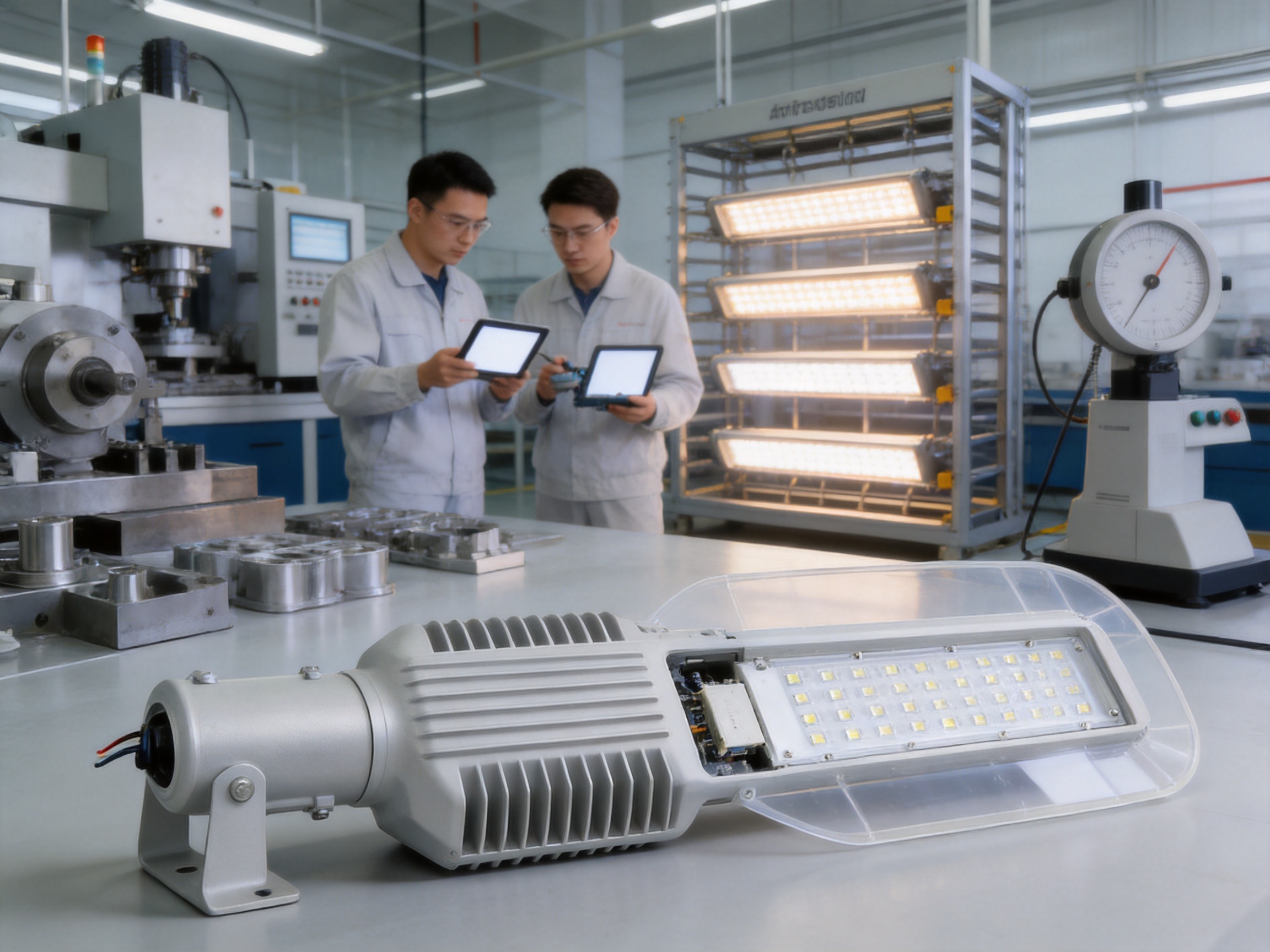
The company operates die-casting and CNC machining equipment. Die-casting enables the production of metal housings with repeatable shapes, integrated structural features, and efficient material use. For outdoor lighting, a well-formed die-cast body can support heat dissipation, mechanical strength, and a consistent appearance. It can also provide a stable platform for mounting the LED board, driver, cover, and adjustment components.
CNC machining provides a further level of precision for selected parts and interfaces. Machining can be used to refine mounting surfaces, connection points, threaded sections, and other areas where dimensional accuracy is important. Consistent mechanical interfaces support smoother assembly and more reliable installation.
The company also maintains aging lines. Aging is an important manufacturing step for identifying potential early failures in electronic and lighting assemblies. Products can be operated under controlled conditions before shipment so that unstable components or assembly issues have a better chance of being detected during production rather than after installation.
Goniophotometers are available for optical testing. This equipment allows manufacturers to measure the distribution of light across different angles and create data that can support professional lighting design. For roadway projects, photometric information helps designers evaluate illuminance, uniformity, glare considerations, and spacing. Access to optical measurement equipment strengthens the connection between product manufacturing and real-world application planning.
These capabilities create an integrated manufacturing structure. Instead of relying entirely on external suppliers for housing, machining, testing, and production verification, the company can coordinate more of the process internally. This may improve communication, shorten feedback cycles, and provide customers with a clearer path from concept development to finished product.
10.1 Quality Management and Certification Support
Cixi HuaSheng Lighting Co., Ltd. is identified as holding ISO 9001, ISO 14001, and ISO 45001 certifications. These management systems correspond respectively to quality management, environmental management, and occupational health and safety. Certification does not eliminate the need for product-specific testing or project evaluation, but it indicates that the company operates within structured management frameworks.
The company also states that relevant products have CB and CE certifications. Customers should confirm the exact certification scope, product model, market requirements, and test documentation for each order. Nevertheless, the availability of internationally recognized compliance support can help simplify procurement and technical review for overseas projects.
A structured quality system is especially valuable for customized products. When a customer requests a different power level, housing finish, optical distribution, or mechanical detail, the manufacturer must control drawings, samples, materials, production changes, inspection records, and final approval. Quality management processes help reduce the risk that a customization will be implemented inconsistently across production batches.
11. Application Areas
11.1 Urban and Residential Roads
The JD-1052 can be used on urban streets, residential roads, internal community routes, and local access lanes where a compact and efficient luminaire is required. Its adjustable design helps installers align the light with road direction and sidewalk placement. The 30-60W range provides options for areas with different widths and mounting conditions.
In residential environments, appearance, glare control, and maintenance are important. The compact housing can create a less visually intrusive installation, while appropriate optical planning can help limit light trespass toward homes. The fixture should be specified with the correct distribution and mounting angle for the particular street layout.
11.2 Industrial Parks and Factory Entrances
Industrial sites often include internal roads, loading approaches, parking areas, security gates, and service routes. These areas may operate throughout the night and can require reliable lighting for vehicles, workers, and site security. The JD-1052’s durable housing, efficient LED source, and adjustable mounting format make it suitable for many of these applications.
Industrial environments may also present additional dust, vibration, and maintenance challenges. Project engineers should verify environmental conditions and select the appropriate installation and protection requirements. Regular inspections remain important, particularly near manufacturing processes that generate airborne particles.
11.3 Commercial and Logistics Areas
Shopping centers, office parks, logistics facilities, and warehouse developments need roadway lighting that combines safety, appearance, and energy control. The JD-1052 can support internal circulation roads and entrance routes where a medium-power, compact fixture is appropriate.
For logistics sites, lighting designers may need to consider truck turning areas, loading dock approaches, pedestrian crossings, and long operating hours. Adjustable aiming allows the luminaire to be coordinated with these different zones, while the selected power level can be matched to the required illumination category.
11.4 Municipal Infrastructure Upgrades
Municipal customers frequently need to modernize existing lighting while preserving current poles and electrical routes. The JD-1052 can be considered for replacement programs where an adjustable and efficient LED fixture is preferred. Its configuration flexibility may assist projects that include several road types within one administrative area.
Before replacement, municipalities should complete a site survey covering pole condition, mounting dimensions, cable capacity, spacing, road classification, and existing illumination. Photometric modeling can then determine whether the 30W, 40W, 50W, or 60W configuration is most suitable.
12. Customization and OEM/ODM Services
Infrastructure projects are often designed around specific technical, visual, and procurement requirements. Standard products may meet many needs, but customization can be valuable when a project has unusual mounting conditions, a coordinated architectural appearance, or a required optical distribution.
The JD-1052 is available with OEM and ODM support. Customers may discuss power configuration, housing finish, and optical distribution with the manufacturer. These options allow the product to be adapted for different roadway categories and project identities while retaining the core platform.
Housing finish can influence corrosion resistance, appearance, and coordination with existing infrastructure. A selected finish should be evaluated according to the local climate, exposure level, maintenance plan, and project color requirements. In coastal or highly humid environments, the finish and material specification deserve particular attention.
Optical distribution is equally important. A narrow distribution may be useful for certain road geometries, while a wider distribution may be better for open areas or shorter mounting arrangements. The correct choice depends on pole spacing, mounting height, road width, sidewalk position, and required uniformity. Goniophotometric testing can support the development and verification of customized optical solutions.
OEM and ODM cooperation should follow a documented process. The customer and manufacturer should agree on drawings, target output, LED selection, driver details, thermal requirements, sample evaluation, testing standards, packaging, and production tolerances. This reduces ambiguity and helps ensure that the final product matches the project’s expectations.
13. Installation and Project Planning Considerations
Although the JD-1052 is designed for convenient outdoor installation, successful performance depends on appropriate planning. The first step is to identify the road classification and the target illumination level. Local roads, industrial roads, pedestrian-oriented routes, and major urban streets can have different requirements.
Designers should then review pole height, spacing, outreach length, arm orientation, road width, lane arrangement, sidewalk position, nearby buildings, trees, signs, and intersections. These details influence the correct power level and optical distribution. The adjustable feature provides additional flexibility, but it should be used as part of a complete design rather than as a substitute for planning.
Electrical compatibility must also be confirmed. The driver, input voltage, control method, surge protection, wiring, and grounding requirements should match the project infrastructure and applicable regulations. Customers should request the relevant technical documentation before placing a large order.
During installation, the fixture should be aligned securely and checked for mechanical stability. The adjustment mechanism must be locked according to the manufacturer’s instructions so that vibration and wind do not change the intended aiming position. Cable entries and covers should be checked carefully to preserve the housing’s protective function.
After installation, the project team should verify illumination on the road surface, confirm that the light is aimed correctly, and inspect potential glare or light trespass. For major projects, a commissioning record can document the installed power, angle, location, and test results of each luminaire.
14. Maintenance Efficiency and Lifecycle Benefits
Road lighting maintenance can be expensive because fixtures are often mounted on tall poles beside active traffic lanes. Every service visit may require a lift vehicle, traffic control, trained personnel, and replacement parts. A reliable LED fixture can help reduce the number of unplanned interventions.
The JD-1052 supports a maintenance-oriented approach through its durable housing, stable LED technology, and efficient thermal design. Lower energy consumption reduces operating costs, while a compact and standardized product family can simplify spare inventory. If several areas use the same model, maintenance teams may need to manage fewer types of replacement components.
Preventive maintenance should include visual inspection, cleaning when necessary, checking the mounting connection, reviewing cable entries, and confirming that the fixture remains correctly aimed. Industrial and coastal sites may require more frequent inspection because dust, salt, or airborne contaminants can accumulate on external surfaces.
Lifecycle value should be evaluated across the full period of ownership. Initial purchase price is only one factor. Energy consumption, installation time, maintenance access, replacement frequency, spare-parts requirements, and disposal considerations all influence the total cost of ownership. The JD-1052 is designed to provide value through the combined effect of efficient operation, adaptable installation, durable construction, and manufacturing support.
15. Environmental and Sustainability Considerations
Energy-efficient lighting contributes to sustainability by reducing electricity demand during the operating life of the fixture. When multiplied across a roadway network, the reduction can support broader municipal or corporate energy targets. LED technology also allows lighting levels to be managed more precisely than many older systems.
The company’s ISO 14001 environmental management certification indicates that environmental management is included within its organizational systems. Customers may still need to review material declarations, packaging policies, recycling procedures, and market-specific environmental requirements for their projects.
Longer service intervals can also reduce the environmental impact associated with replacement products, transport, access equipment, and discarded lamps. Durable manufacturing, controlled production, and appropriate end-of-life handling all contribute to a more responsible lighting lifecycle.
Sustainability should not be separated from lighting quality. Over-lighting wastes energy, while under-lighting may create safety and operational problems. The most sustainable design is generally one that provides the required visibility with the correct output, distribution, spacing, and control strategy. The JD-1052 can support this approach when it is specified through professional photometric planning.
16. Why Choose This Product for Competitive Projects?
Customers comparing roadway lighting products often evaluate several factors simultaneously: price, output, efficacy, adjustment, appearance, manufacturing capacity, certifications, delivery capability, and customization. The JD-1052 presents a balanced offer across these categories.
Its 30-60W power range provides practical flexibility without moving into the size and complexity of very high-output roadway luminaires. The 130-160 lm/W efficacy supports energy-conscious projects. The 3030 and 5050 LED options allow configuration according to output and design requirements. The adjustable structure helps address varied pole and road conditions.
The product is also supported by a manufacturer with die-casting, CNC machining, aging lines, and goniophotometric testing. These capabilities are important because they connect the product’s advertised specifications with controlled manufacturing and testing processes. Customers seeking OEM or ODM cooperation can benefit from a supplier capable of discussing both the mechanical and optical aspects of a customized road light.
Compared with low-cost products that focus primarily on purchase price, the JD-1052 offers a broader project proposition. Its advantages are related not only to the luminaire itself but also to configuration support, production capability, technical coordination, and long-term application value.
17. Recommended Evaluation Process for Buyers
Before selecting the JD-1052 for a project, buyers should prepare a clear technical brief. The brief should include the road type, pole height, pole spacing, roadway width, mounting arrangement, desired illumination level, operating schedule, local environmental conditions, input voltage, control requirements, and applicable certification standards.
The manufacturer can then recommend a power configuration, LED option, optical distribution, housing finish, and adjustment range. For larger projects, buyers should request photometric files, sample products, test documentation, drawings, and quality-control information for review.
A sample installation can provide useful information before full deployment. The project team can examine illumination uniformity, visual appearance, glare, mounting convenience, and compatibility with existing poles. Any adjustment to the optical or mechanical configuration should be agreed upon before mass production.
Procurement teams should also clarify production lead time, packaging, warranty terms, spare-parts support, inspection procedures, and delivery responsibilities. Clear documentation protects both the buyer and manufacturer and helps ensure that the final product is evaluated against the same requirements used during design.
18. Frequently Asked Questions
Q1. What type of product is the JD-1052?
The JD-1052 is an adjustable LED road light designed for urban roads, outdoor infrastructure, industrial access routes, residential streets, commercial developments, and other roadway applications.
Q2. What power range is available?
The standard power range is 30-60W. The appropriate setting depends on road width, pole height, spacing, required illumination, and optical distribution.
Q3. What LED packages does the product support?
The product supports 3030 and 5050 LED configurations. The preferred option should be selected according to the required output, thermal design, optical arrangement, and project budget.
Q4. What is the stated efficacy?
The stated efficacy is 130-160 lm/W. Actual system performance can vary according to the selected LED configuration, driver, optical system, operating temperature, and installation conditions.
Q5. Why is the adjustable structure important?
The adjustable structure allows installers to direct the fixture more accurately toward the roadway or target area. It can also help accommodate variations in pole orientation, arm length, road width, and replacement conditions.
Q6. What is the standard size?
The listed S-size is 397 x 110 x 61 mm. Buyers should confirm final dimensions for any customized version before installation or packaging design.
Q7. Can the housing finish be customized?
Yes. Housing finish customization is available for suitable OEM and ODM projects. The finish should be selected according to appearance, climate, corrosion exposure, and project requirements.
Q8. Can the optical distribution be customized?
Yes. Optical distribution can be discussed according to the road layout, pole spacing, mounting height, and desired lighting pattern. Photometric testing and project-specific approval are recommended.
Q9. What manufacturing capabilities support the product?
The manufacturer has die-casting and CNC machining equipment, aging lines, and goniophotometers for optical testing. These capabilities support housing production, precision machining, reliability screening, and photometric evaluation.
Q10. Is OEM or ODM cooperation available?
Yes. OEM and ODM services are available, including discussions related to power configuration, housing finish, optical distribution, and other suitable project adaptations.
Q11. Is the product suitable for municipal road upgrades?
The JD-1052 can be considered for municipal upgrades, especially where an efficient and adjustable fixture is required. A site survey and photometric design should be completed to confirm the correct configuration.
Q12. How should buyers verify suitability before mass ordering?
Buyers should provide project details, review technical documents, request samples where appropriate, complete photometric calculations, confirm electrical and certification requirements, and approve the final configuration before production.
19. Conclusion
The Adjustable LED Road Light JD-1052 is a practical solution for roadway and outdoor infrastructure projects that require efficient, compact, and adaptable illumination. Its 30-60W power range, 3030 and 5050 LED options, 130-160 lm/W efficacy, and adjustable structure allow it to serve a variety of road and installation conditions.
The product’s advantages over conventional and fixed-position alternatives are found in its combination of energy performance, aiming flexibility, durable construction, and project configurability. These features can help reduce operating costs, simplify installation, support more accurate light placement, and improve long-term maintenance planning.
Its manufacturing foundation further strengthens the product proposition. Die-casting, CNC machining, aging lines, and goniophotometric testing provide capabilities across housing production, precision processing, reliability control, and optical verification. Supported by ISO 9001, ISO 14001, and ISO 45001 management certifications and relevant CB and CE certification support, Cixi HuaSheng Lighting Co., Ltd. is positioned to serve customers seeking both standard products and customized lighting solutions.
For buyers, the best results will come from treating the JD-1052 as part of a complete lighting project rather than as an isolated fixture. When the correct power, optics, mounting angle, spacing, control system, and maintenance plan are selected together, the product can provide dependable roadway illumination and strong lifecycle value for municipal, industrial, commercial, and residential infrastructure.
References
1. Cixi HuaSheng Lighting Co., Ltd. Product specification information for Adjustable LED Road Light JD-1052.
2. Cixi HuaSheng Lighting Co., Ltd. Company information and manufacturing capability overview.
3. General principles of LED luminaire efficacy, thermal management, and outdoor lighting design.
4. Roadway lighting planning practices for illuminance, uniformity, glare control, and optical distribution.
5. ISO 9001 quality management system principles.
6. ISO 14001 environmental management system principles.
7. ISO 45001 occupational health and safety management system principles.
8. Professional guidance on photometric testing and goniophotometric evaluation of LED luminaires.
Product: Adjustable LED Road Light JD-1052

YQF Group - World Leading One-Stop Lighting & Solar For the Global Partners
Custom & OEM Solutions for Global Lighting Brands
Copyright © Cixi HuaSheng Lighting Co., Ltd. All Rights Reserved.
Die-Casting Mould Supplier
