 English
 中文简体
 русский
 Français
 Español
 عربى
 Indonesia

Landscape Linear Light GZD-XQD-2530: A Flexible Outdoor Solution for Gardens, Parks, and Architectural Environments
Outdoor lighting is no longer limited to basic floodlights or conventional decorative fixtures. Modern landscape projects require lighting systems that improve visibility, support architectural design, create a welcoming atmosphere, and remain reliable under changing outdoor conditions. The Landscape Linear Light GZD-XQD-2530 is designed to meet these requirements with a continuous, low-voltage lighting format suitable for gardens, pathways, parks, resorts, public recreational spaces, and other landscape environments.
Unlike many rigid architectural linear lights that emphasize sharp outlines and high-intensity illumination, this landscape linear light is intended to blend naturally with its surroundings. Its soft and continuous output can highlight planting areas, pedestrian routes, retaining walls, garden structures, bridges, terraces, and other outdoor features without overwhelming the visual character of the space.
The fixture combines energy-efficient LED technology, multiple color options, adjustable beam distributions, DMX512 control compatibility, and an IP65-rated outdoor construction. These characteristics make it suitable for projects that require both functional illumination and creative visual effects. With a DC12–24V input range and a rated power of 15W, it can also be integrated into low-voltage outdoor lighting systems where safety, installation flexibility, and energy management are important considerations.

Landscape Linear Light GZD-XQD-2530
Product Overview
The Landscape Linear Light GZD-XQD-2530 is an outdoor linear lighting fixture developed for environmental enhancement and garden illumination. Its primary role is to provide a consistent line of light across landscape elements while helping designers create a comfortable and visually coordinated nighttime environment.
The product is suitable for projects where lighting must support the surrounding environment rather than dominate it. In a garden, for example, the light can be positioned along a pathway, beneath a handrail, beside a planting bed, or near a low wall. In a resort or public recreational area, it can be used to define circulation routes, emphasize landscape levels, and provide decorative color effects. In a park, it can contribute to safety and wayfinding while preserving a calm and natural atmosphere.
The fixture supports several light colors, including red, green, blue, yellow, white, warm white, RGB, and RGBW. This range allows the same product platform to be specified for different project objectives. White or warm white light can be selected for general landscape illumination, while RGB and RGBW versions can support dynamic scenes, seasonal displays, public events, and themed environments.
The lighting system can operate in DMX512 mode or steady mode. Steady operation is suitable for installations that require a fixed output and simple control. DMX512 operation enables coordinated control of color, brightness, and lighting scenes when the product is used as part of a larger entertainment, architectural, or landscape lighting system.
Key Technical Specifications
| Specification | Details |
|---|---|
| Product | Landscape Linear Light GZD-XQD-2530 |
| Product Category | LED Linear Light |
| Item Number Listed in Technical Information | GZD-XTD-2530 |
| Light Source Options | Epileds, Bridgelux, Epistar, Osram, or Cree |
| Input Voltage | DC12–24V |
| Rated Power | 15W |
| LED Color Options | Red, green, blue, yellow, white, warm white, RGB, or RGBW |
| Beam Angle Options | 10° × 45°, 10° × 65°, 60°, 90°, or 110° |
| Light Output Ratio | Listed as 70 lm/W in the supplied specification |
| Color Temperature | 1800–6500K |
| Control Modes | DMX512 or steady operation |
| Operating Temperature | −20°C to 45°C |
| Ingress Protection | IP65 |
The item number in the supplied technical information is shown as GZD-XTD-2530, while the product title identifies the fixture as GZD-XQD-2530. Buyers and project managers should confirm the exact model code, dimensions, mounting method, cable configuration, and final optical specification before issuing a purchase order. This type of confirmation is especially important when a project includes multiple linear light models or when replacement units must match an existing installation.
Soft Continuous Illumination for Landscape Design
One of the principal advantages of a landscape linear fixture is the ability to create a continuous visual line. Point light sources can produce repeated bright spots and dark gaps, while a properly configured linear fixture can deliver a more unified appearance. This quality is useful in pathways, garden borders, architectural edges, planter walls, steps, bridges, and low-level landscape structures.
The GZD-XQD-2530 is designed for a softer lighting effect than many high-output architectural linear products. This makes it appropriate for locations where glare control and visual comfort are important. A garden or resort landscape often benefits from gentle illumination that reveals form and texture without making the area feel overly commercial or industrial.
Soft lighting can also support a stronger relationship between the built environment and natural surroundings. Rather than turning every surface into a high-brightness feature, designers can use the fixture selectively to guide attention toward trees, water features, planting groups, paths, and structural details. This approach can produce a more balanced nighttime environment and reduce unnecessary visual competition between different parts of a project.
The available beam angles provide additional flexibility. Narrower distributions such as 10° × 45° or 10° × 65° can be considered for directional highlighting, edge illumination, or applications where the light needs to be projected toward a particular surface. Wider options such as 60°, 90°, or 110° may be more suitable for broader pathway coverage, wall washing, or general landscape illumination. The appropriate beam angle depends on mounting height, fixture spacing, target surface, desired uniformity, and local glare requirements.
Applications in Gardens and Parks
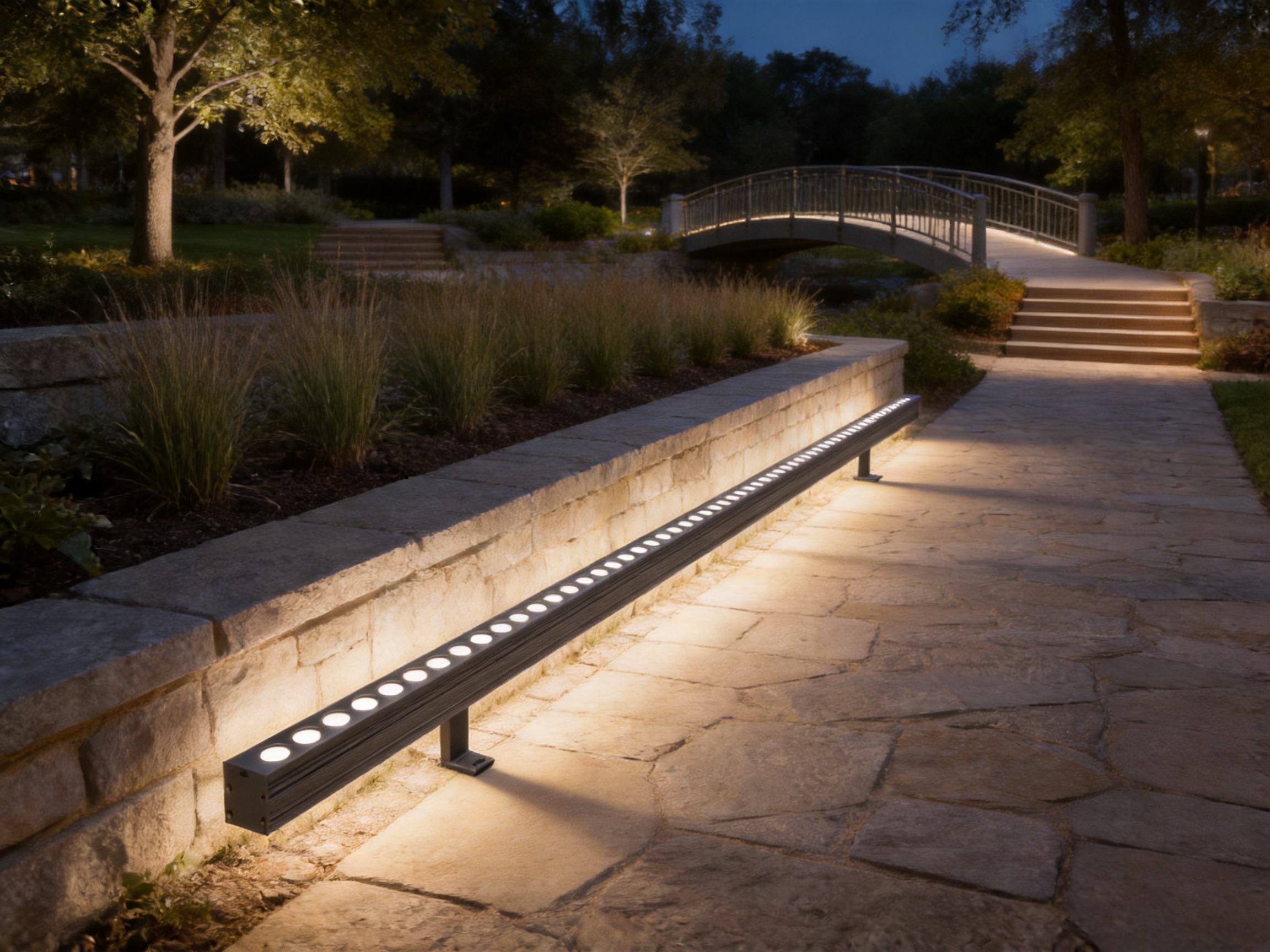
Gardens frequently contain a mixture of plants, stonework, water elements, paths, seating areas, and decorative structures. Linear light can be used to connect these elements visually. Installed near the base of a low wall, it can define an edge. Mounted beneath a bench or railing, it can provide discreet guidance lighting. Placed along a pathway, it can improve visual orientation without relying on tall poles.
In parks, the fixture can contribute to safe movement after dark. It may be used along pedestrian routes, near bridges, around public seating, or beside changes in level. Because the product operates on DC12–24V, it can be considered for low-voltage landscape systems where the design calls for distributed fixtures and appropriate power supplies.
Landscape lighting should always be designed with consideration for pedestrians, nearby residences, traffic, wildlife, and the intended nighttime character of the site. The fixture’s capabilities support many design directions, but the final installation should be based on a professional lighting layout and suitable electrical protection.
Applications in Resorts and Hospitality Areas
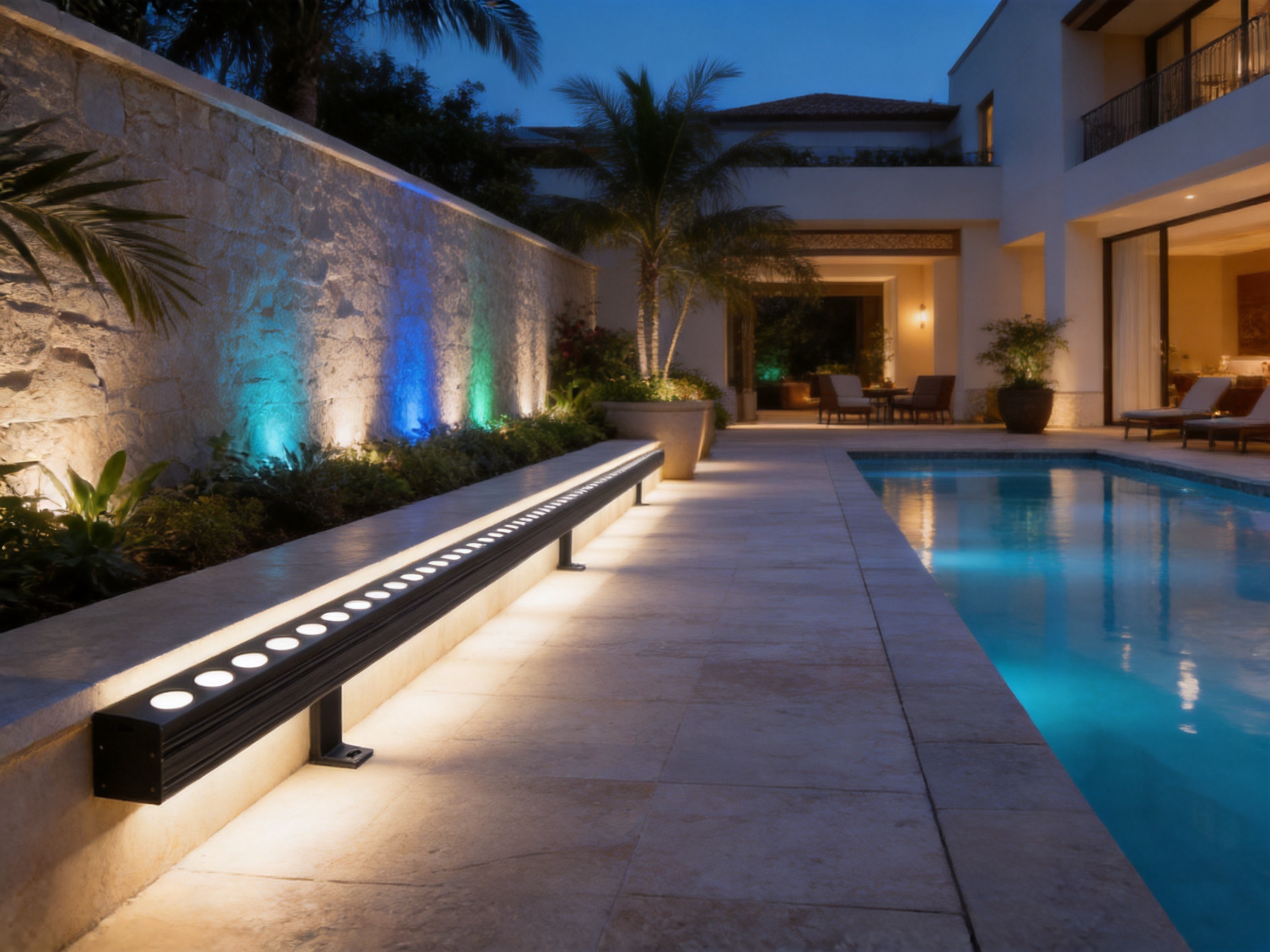
Resorts, hotels, restaurants, and recreational facilities often use outdoor lighting to extend the usability of public areas and create a recognizable atmosphere. The GZD-XQD-2530 can be integrated into courtyards, poolside areas, garden paths, entrance approaches, outdoor dining spaces, and decorative structures.
Warm white light within the stated 1800–6500K range can help create a comfortable and intimate environment. Neutral or cool white settings may be selected where clearer visibility is preferred. RGB or RGBW versions can support special events, holiday displays, brand-neutral themed environments, or coordinated color scenes across a property.
DMX512 compatibility is valuable in hospitality projects that already use centralized lighting control. It can allow linear fixtures to operate in scenes alongside other compatible luminaires. A static evening setting, a brighter event setting, and a color-changing celebration scene can be created from the same installed lighting infrastructure, subject to the selected control equipment and system design.
Advantages Compared with Conventional Outdoor Lighting
The GZD-XQD-2530 offers several advantages over conventional outdoor lighting approaches. These advantages relate not only to appearance, but also to system flexibility, energy use, installation planning, and long-term project adaptability.
1. More Continuous Visual Coverage
Traditional spotlights often illuminate separate points. This can be effective for trees or individual objects, but it may create an interrupted appearance when used along paths, walls, or linear landscape features. A linear fixture is better suited to applications that require an uninterrupted or visually connected lighting effect.
Continuous lighting can help define boundaries and movement routes. It can make a long edge easier to read at night and provide a more coordinated appearance when several landscape elements share a common line or direction.
2. Softer Integration with Natural Surroundings
The fixture is designed for landscape use, where excessive brightness may reduce comfort or distract from the surrounding environment. Its softer output can support a more natural transition between illuminated and non-illuminated areas.
This is an important distinction from some architectural products that are optimized for strong façade definition or high-intensity surface illumination. Landscape lighting generally benefits from restraint. The objective is often to reveal the environment rather than overpower it.
3. Flexible Color Selection
Many conventional outdoor fixtures are limited to one fixed color temperature. The available options for this product include single-color outputs, white and warm white, RGB, and RGBW. This gives project designers a broader set of visual tools.
Single-color versions can simplify a project that requires consistent illumination. RGB versions can provide colored scenes, while RGBW versions may offer greater control over both saturated colors and white light, depending on the selected LED configuration and control system.
4. Adjustable Beam Distribution
A range of beam angles allows the product to be adapted to different installation conditions. A narrow beam can emphasize a specific architectural edge or landscape object. A wide beam can help spread light across a pathway, planter, wall, or open area.
Beam selection should be made before installation rather than treated as an afterthought. It affects fixture spacing, illumination uniformity, glare, power planning, and the final appearance of the project.
5. Low-Voltage System Compatibility
The DC12–24V input range supports integration into low-voltage outdoor lighting systems. Low-voltage design can be useful in gardens, resorts, residential landscapes, and public areas where distributed fixtures must be installed around pedestrian zones and landscape structures.
Low-voltage systems still require appropriate engineering. Power supplies, cable lengths, voltage drop, connectors, circuit protection, waterproof junctions, and maintenance access must be considered. The product’s low-voltage input is an advantage when matched with a properly designed electrical system.
6. Scene Control Potential
DMX512 compatibility allows the product to participate in programmable lighting scenes. Compared with a simple on-and-off fixture, a DMX-controlled linear light can offer greater control over brightness, color, timing, and coordination with other compatible devices.
This function is particularly useful for public spaces, entertainment venues, hotels, commercial landscapes, and projects where lighting scenes change throughout the evening. Steady mode remains available for applications that do not need dynamic control.
7. Outdoor Protection
The stated IP65 rating indicates protection against dust ingress and water jets from multiple directions. This makes the fixture appropriate for many outdoor environments when it is installed according to the manufacturer’s instructions and used within its specified operating conditions.
IP65 does not mean that a fixture may be submerged or installed without attention to drainage, cable entry, connectors, or power supply protection. Proper installation remains essential, especially in areas exposed to heavy rain, irrigation spray, condensation, coastal air, or standing water.
LED Performance and Energy Considerations
LED technology provides several benefits for outdoor landscape projects. LEDs are compact, controllable, and available in a wide range of colors and color temperatures. They can deliver directional light more efficiently than many traditional sources, which is useful when the design requires controlled illumination along a surface or route.
The product is specified at 15W, allowing designers to create linear effects without automatically selecting a high-power floodlight. A lower fixture wattage can simplify circuit planning and may help reduce operating energy, although the total energy performance of a project depends on fixture quantity, operating hours, control settings, power supply efficiency, and maintenance conditions.
The supplied specification lists a light output ratio of 70 lm/W. In professional project documentation, buyers should confirm whether this figure refers to LED efficacy, fixture efficacy, or a particular test configuration. Photometric files, test reports, and final product samples can help designers evaluate actual performance for a specific beam angle and color option.
Energy efficiency should be evaluated together with lighting quality. A fixture with a high numerical efficacy is not automatically the best choice if it produces glare, poor uniformity, excessive spill light, or an unsuitable color appearance. The GZD-XQD-2530 is valuable because it combines moderate power, linear distribution, color flexibility, and controllability in one platform.
Color Temperature Range
The stated color temperature range is 1800–6500K. This is broad enough to support very warm decorative light, traditional warm white landscape schemes, neutral white illumination, and cooler white applications where greater visual clarity is required.
Very warm light can be used to create a relaxed and welcoming environment around gardens, restaurants, outdoor seating, and hospitality spaces. Warm white is often selected for pathways, planting areas, and architectural details. Neutral or cooler white may be considered for functional zones, contemporary designs, or locations where surface details must be more clearly visible.
Color temperature should be selected consistently across a project unless contrast is an intentional part of the design. Mixing different white temperatures without a clear plan can make a landscape appear visually disorganized. The use of RGB or RGBW should also be coordinated with the overall design concept and neighboring lighting equipment.
Manufacturing Strengths and Quality-Oriented Production
The product is manufactured by Cixi HuaSheng Lighting Co., Ltd., an outdoor lighting manufacturer located in Ningbo, China. The company serves international customers and provides lighting products for industrial, residential, commercial, and municipal applications.
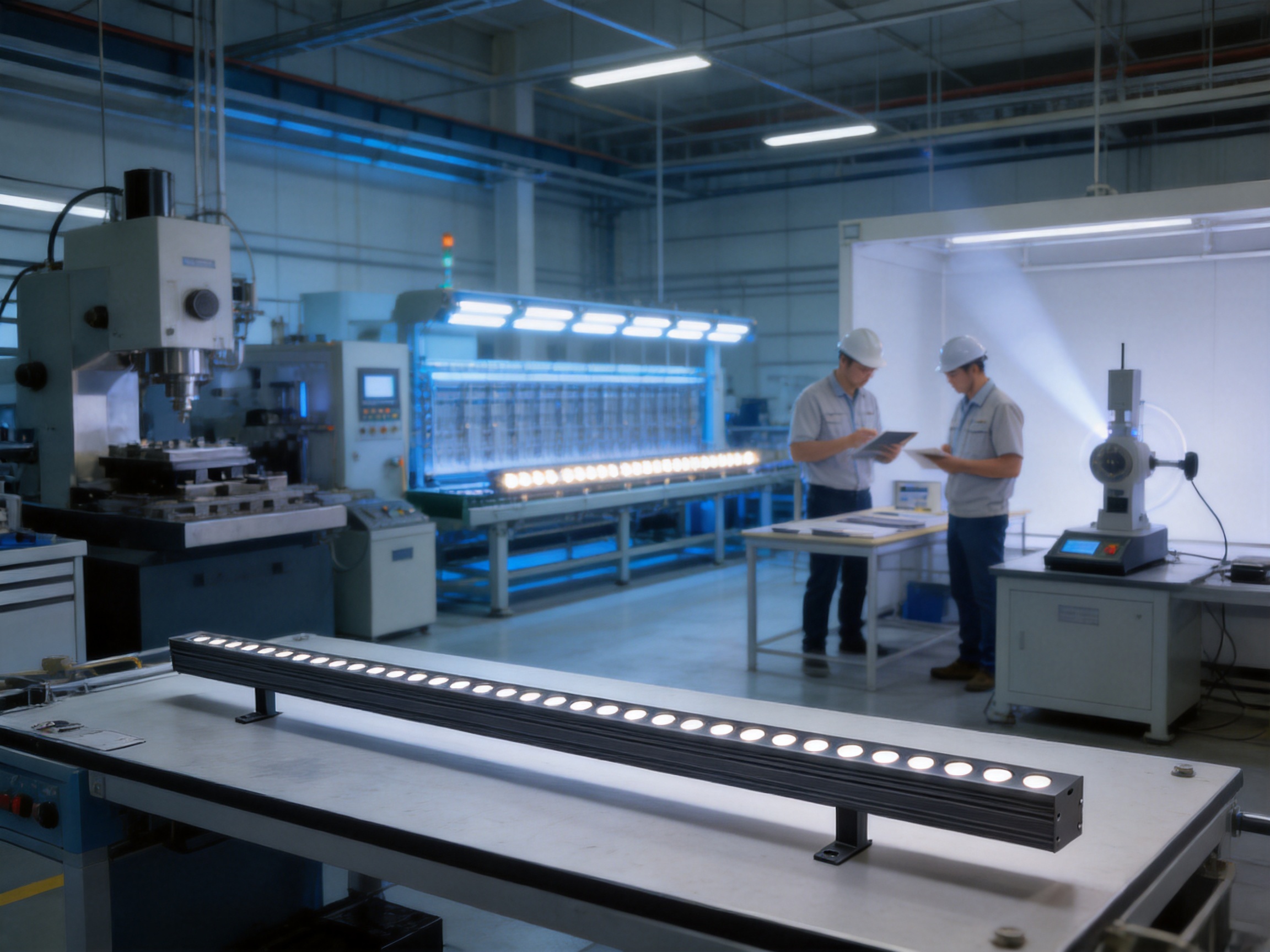
Its manufacturing capabilities include die-casting and CNC machining equipment, aging lines, and goniophotometers. These resources are important because outdoor lighting quality depends on more than the LED component alone. Mechanical accuracy, heat management, optical performance, electrical stability, surface treatment, and final inspection all influence product reliability.
Die-Casting Capability
Die-casting is widely used in lighting manufacturing for producing metal housings with repeatable shapes and integrated structural features. A well-designed die-cast housing can support mechanical strength, dimensional consistency, and heat dissipation.
For outdoor fixtures, the housing must help protect internal components and maintain its shape through temperature changes and long-term environmental exposure. Die-casting also allows manufacturers to develop customized forms that fit specific mounting requirements or visual design goals.
The company’s die-casting capability supports its role as both a lighting manufacturer and a die-casting mould supplier. This can be advantageous for OEM and ODM customers that require a customized housing, special mounting profile, modified cable arrangement, or project-specific external appearance.
CNC Machining and Dimensional Control
CNC machining can be used to refine cast components, produce accurate mounting features, prepare connection points, and achieve the tolerances required for assembly. Consistent machining is particularly important when fixtures must be installed in a straight line or connected to project-specific brackets.
Accurate mechanical interfaces can reduce installation difficulty and help maintain a uniform appearance across a large site. They also support repeatable production when the same product is ordered for multiple phases of a project.
Aging Lines and Product Stability
LED lighting products benefit from controlled aging and testing procedures. Aging lines can be used to operate fixtures for a defined period before shipment, helping manufacturers identify certain early-stage electrical or assembly problems.
Although aging cannot eliminate every possible field issue, it is an important part of quality-oriented production. It can provide greater confidence that the fixture has passed a controlled operating process before it reaches the customer.
Photometric Testing with Goniophotometers
A goniophotometer measures the distribution of light from a fixture at different angles. This equipment supports the development and verification of beam angles, luminous intensity distribution, and photometric data.
For a linear landscape light, photometric testing is especially useful because the final visual effect depends on how light is distributed across horizontal and vertical directions. Beam options such as 10° × 45°, 10° × 65°, 60°, 90°, and 110° should be evaluated through reliable photometric data when a project requires accurate simulation or compliance documentation.
Photometric files can also support DIALux or other lighting design workflows. The company provides one-stop services that include efficient lighting solutions and DIALux designs, helping customers evaluate fixture placement, illumination levels, spacing, and overall project performance before installation.
OEM and ODM Customization Options
Outdoor lighting projects often have requirements that cannot be met by a standard catalog fixture. Mounting conditions may differ from one site to another, color requirements may be linked to a landscape concept, and electrical systems may use different low-voltage architectures. The manufacturer offers OEM and ODM support to address these project-specific needs.
Mounting Flexibility
Mounting flexibility can include bracket selection, fixing positions, installation orientation, connection arrangements, and other mechanical adaptations. These details are important when the fixture must be integrated into a narrow architectural edge, a curved landscape structure, a handrail, or a concealed recess.
Customers should provide drawings, installation photographs, dimensions, target surfaces, and site conditions when requesting customization. Clear technical information helps the manufacturer evaluate tooling, sample development, structural strength, cable routing, and installation practicality.
Light Color Customization
Color customization may involve selecting a particular white color temperature, defining a single-color LED configuration, or specifying RGB and RGBW functionality. The stated color temperature range of 1800–6500K provides a broad starting point for project development.
For large projects, sample approval is recommended. A physical sample can help the customer evaluate perceived brightness, color consistency, diffusion, surface appearance, and coordination with other fixtures before mass production begins.
Low-Voltage Integration
The DC12–24V operating range gives system designers options when integrating the fixture into low-voltage power networks. OEM or ODM discussions may also address cable lengths, connectors, control interfaces, power injection arrangements, and packaging for project deployment.
Any modified electrical configuration should be verified through testing. The final design should specify maximum cable runs, power supply capacity, waterproofing requirements, and installation procedures so that the system performs consistently across the entire site.
SKD and CKD Support
The company also provides SKD and CKD customization services. These options may be useful for customers with local assembly capabilities, regional manufacturing arrangements, or specific import and logistics requirements.
Such cooperation requires clear agreements regarding component specifications, assembly instructions, testing procedures, quality acceptance, packaging, and technical responsibility. When properly managed, SKD and CKD programs can support localized production while maintaining a consistent product platform.
Installation Planning and System Design
A successful landscape linear lighting installation begins with a clear lighting objective. The project team should determine whether the fixture is intended for pathway guidance, wall washing, decorative edge lighting, object highlighting, architectural integration, or color-changing effects.
The installation position should be reviewed in relation to pedestrian sight lines. Fixtures placed too close to eye level or directed toward approaching pedestrians may create discomfort. Where possible, the light source should be shielded, recessed, angled, or positioned so that the desired surface receives the light without exposing viewers to unnecessary glare.
Spacing depends on beam angle, mounting height, target surface, desired uniformity, and the visual effect requested by the designer. Narrow beams may require different spacing from wider beams. A mock-up installation is often useful for determining the actual appearance before the complete project is installed.
Low-voltage systems require careful power planning. The designer should calculate the total connected load, select a suitable power supply, account for voltage drop, and plan circuit distribution. Long cable runs may require additional power injection or separate circuits, depending on the installation design.
All outdoor cable connections should be protected using appropriate waterproof methods. Junction boxes, connectors, cable glands, conduits, and drainage paths should be selected for the actual environment. In areas exposed to irrigation, snow, salt spray, or frequent rainfall, additional protective measures may be necessary.
Control System Considerations
When DMX512 is selected, the project should include a compatible controller, addressing plan, signal distribution method, and appropriate termination practices. The lighting designer should determine how many fixtures will be placed on each control line and how the system will be divided into scenes or zones.
Steady mode may be preferred for simple installations where a fixed output is sufficient. It can reduce system complexity and make operation easier for small gardens, pathways, or residential landscape projects.
RGB and RGBW fixtures may require a greater level of control planning than single-color fixtures. The project documentation should identify the selected control mode, channel arrangement, color sequence, brightness behavior, and default condition after power restoration.
Environmental Performance and Maintenance
The fixture is specified for an operating temperature range of −20°C to 45°C. This range covers many ordinary outdoor landscape conditions, but the final application should be reviewed against the local climate. Projects in regions with extreme heat, severe winter conditions, coastal exposure, or unusual humidity may require additional evaluation.
The IP65 rating provides protection against dust and water jets, but maintenance teams should still inspect the installation periodically. Dirt, leaves, mud, mineral deposits, and biological growth can reduce light output or change the visual appearance of the fixture. Cleaning methods should follow the manufacturer’s recommendations and avoid damaging lenses, seals, coatings, or cables.
Drainage is also important. A fixture may have adequate ingress protection while the surrounding installation allows water to accumulate around cable entries or mounting points. Proper site grading and cable routing can reduce long-term moisture risks.
Landscape maintenance activities should be coordinated with the lighting system. Grass cutting, tree pruning, irrigation, fertilization, and construction work can damage cables or shift fixtures. Accessible mounting and clearly documented cable routes can help reduce accidental damage and simplify future service.
Why the Manufacturer Is Suitable for International Projects
Cixi HuaSheng Lighting Co., Ltd. provides a broad product range that includes LED street lights, tunnel lights, high-bay lights, linear lights, garden lights, solar lights, grow lights, explosion-proof lights, and other lighting products. This breadth allows customers to source multiple lighting categories from one manufacturing partner.
The company is described as holding ISO 9001, ISO 14001, and ISO 45001 certifications. These management systems relate respectively to quality management, environmental management, and occupational health and safety. Customers should request current certificates and confirm their scope when certification documentation is required for a specific tender or project.
Relevant products are also described as having CB and CE certifications. Certification requirements vary according to product type, destination market, electrical configuration, and applicable standards. Buyers should verify the exact certification documents for the selected model rather than assuming that certification for one product automatically applies to every product in the range.
The company’s strategic partnerships with international companies and its experience exporting worldwide support its ability to work with overseas customers. International project cooperation typically requires clear communication about specifications, samples, packaging, delivery schedules, documentation, after-sales support, and compliance requirements.
Its one-stop service model includes lighting solutions, DIALux design, mold design, OEM/ODM development, SKD/CKD customization, and delivery. This integrated approach can reduce coordination between separate suppliers and help maintain consistency from initial concept through production.
Recommended Project Workflow
A structured workflow can help customers obtain the best result from the Landscape Linear Light GZD-XQD-2530.
Step One: Define the Lighting Objective
Identify whether the fixture will provide pathway guidance, decorative outlining, wall washing, garden enhancement, architectural integration, or programmable color effects. The objective determines the appropriate color, beam angle, control system, and mounting position.
Step Two: Confirm the Product Configuration
Confirm the model code, LED brand, power rating, voltage, color option, color temperature, beam angle, control mode, cable arrangement, and ingress protection. The product information supplied for this model lists both GZD-XQD-2530 in the title and GZD-XTD-2530 in the item number field, so this detail should be clarified before ordering.
Step Three: Review Drawings and Photometric Data
Request product drawings, installation details, and photometric data where required. Use the information to prepare a lighting layout, determine spacing, evaluate glare, and calculate the power supply requirements.
Step Four: Approve a Sample
For projects with strict appearance requirements, review a sample under representative conditions. Check the light color, surface finish, diffusion, beam distribution, cable length, mounting details, and compatibility with the planned control system.
Step Five: Confirm Production and Quality Requirements
Discuss inspection procedures, packaging, labeling, test reports, certifications, mold requirements, and acceptance standards. OEM and ODM projects should include written approval procedures for drawings and samples.
Step Six: Plan Installation and Commissioning
Prepare a detailed installation plan covering cable routing, power supply locations, control addresses, waterproof connections, fixture alignment, and testing. Commission the system during both daytime and nighttime conditions to verify appearance, safety, and operational performance.
Applications by Project Type
| Project Type | Recommended Lighting Role | Potential Configuration |
|---|---|---|
| Private gardens | Pathway guidance, planting-bed definition, and decorative edge lighting | Warm white or steady single-color operation |
| Public parks | Pedestrian route lighting and landscape feature enhancement | White or warm white with suitable beam distribution |
| Resorts and hotels | Courtyard, garden, poolside, and entrance atmosphere | Warm white, RGB, or RGBW with optional DMX512 |
| Restaurants and outdoor dining | Low-glare decorative illumination and boundary definition | Very warm white or warm white |
| Commercial landscapes | Architectural edge lighting and programmed visual effects | RGB or RGBW with DMX512 control |
| Residential developments | Pathway, wall, and communal landscape lighting | DC12–24V steady operation |
| Public recreational areas | Wayfinding, safety support, and event lighting | White, warm white, RGB, or RGBW depending on the design |
Q&A
What is the main purpose of the Landscape Linear Light GZD-XQD-2530?
Its main purpose is to provide soft, continuous outdoor illumination for landscape and environmental enhancement. It can be used in gardens, parks, pathways, resorts, public recreational areas, and similar outdoor spaces.
Is this product suitable for architectural applications?
Yes. Although it is primarily described as a landscape lighting fixture, it can also be used for selected architectural edges, low walls, façades, bridges, terraces, and other structures where a softer linear effect is preferred. The final suitability depends on the required brightness, mounting conditions, beam distribution, and project design.
What input voltage does the fixture use?
The supplied specification lists a DC12–24V input. This makes the product compatible with many low-voltage outdoor lighting systems when the power supply, cable sizing, voltage drop, and protection are properly designed.
How much power does it consume?
The listed rated power is 15W. Total system consumption will depend on the number of fixtures, operating duration, control settings, and power supply efficiency.
Which colors are available?
The listed options include red, green, blue, yellow, white, warm white, RGB, and RGBW. Customers should confirm the exact LED configuration and available color temperature for the selected version.
Can the fixture provide dynamic color effects?
RGB and RGBW versions can support dynamic color effects when connected to a compatible control system. The product is listed with DMX512 and steady control modes. The final number of control channels and scene functions should be confirmed with the manufacturer.
What beam angles are available?
The listed beam options are 10° × 45°, 10° × 65°, 60°, 90°, and 110°. The correct choice depends on the mounting position, target surface, fixture spacing, and desired illumination pattern.
Can the product be used in rainy outdoor locations?
The product is listed as IP65 rated and designed for outdoor use. It should be installed with suitable waterproof cable connections, drainage, power protection, and mounting practices. IP65-rated fixtures should not be treated as submersible products.
What is the operating temperature range?
The stated operating temperature range is −20°C to 45°C. Customers working in more extreme climates should discuss environmental suitability with the manufacturer before ordering.
Does the manufacturer provide customized products?
Yes. OEM and ODM services include mounting flexibility, light color customization, low-voltage system options, mold design, and other project-related adaptations. SKD and CKD cooperation is also available for suitable projects.
Can the product be included in a DIALux design?
The manufacturer provides DIALux design services and can support lighting solution development. Customers should request the appropriate photometric files and technical data for the exact model, beam angle, and color configuration.
What manufacturing capabilities support product quality?
The manufacturer operates die-casting and CNC machining equipment, aging lines, and goniophotometers. These capabilities support housing production, dimensional control, pre-shipment aging, and photometric evaluation.
Should customers clarify the model number before ordering?
Yes. The supplied product title identifies the product as GZD-XQD-2530, while the technical information lists the item number as GZD-XTD-2530. Customers should confirm the correct model code and ensure that quotations, drawings, samples, labels, and shipping documents use the same identification.
Conclusion
The Landscape Linear Light GZD-XQD-2530 is a flexible outdoor LED fixture for projects that require soft, continuous, and visually integrated illumination. Its DC12–24V input, 15W power rating, multiple beam angles, broad color selection, 1800–6500K color temperature range, DMX512 compatibility, and IP65 protection make it suitable for a wide variety of landscape applications.
Its greatest value is the combination of design flexibility and practical outdoor performance. The fixture can provide warm and comfortable garden lighting, functional pathway guidance, decorative architectural outlining, or programmable color effects. Compared with conventional spotlights or fixed-color outdoor fixtures, it offers a more unified visual line and more opportunities for project customization.
The manufacturing capabilities behind the product further strengthen its suitability for professional projects. Die-casting, CNC machining, aging lines, and goniophotometric equipment support mechanical consistency, product testing, and optical development. The company’s OEM, ODM, mold design, DIALux, SKD, and CKD services can also help customers adapt the product to specific project conditions.
For the best result, buyers should confirm the model number, select the correct beam angle and color configuration, review photometric data, approve samples when necessary, and prepare a complete low-voltage and control-system design. When these steps are followed, the GZD-XQD-2530 can become an effective component in garden, park, resort, municipal, residential, and commercial landscape lighting projects.
References
1. Product technical information supplied for Landscape Linear Light GZD-XQD-2530, including LED sources, input voltage, power, color options, beam angles, control modes, operating temperature, and IP rating.
2. General principles of outdoor LED lighting design, including beam distribution, glare control, low-voltage system planning, and landscape illumination practice.
3. International lighting design practice for parks, gardens, pathways, resorts, public recreational spaces, and architectural landscape applications.
4. General guidance on IP-rated electrical enclosures and protection against dust and water ingress.
5. General principles of LED photometric testing, goniophotometer measurement, and lighting simulation using photometric data.
6. Manufacturer information concerning die-casting, CNC machining, aging lines, goniophotometers, OEM/ODM services, DIALux design, and SKD/CKD customization.
7. General quality-management, environmental-management, and occupational-health-and-safety practices applicable to professional lighting manufacturing.
Product: Landscape Linear Light GZD-XQD-2530

YQF Group - World Leading One-Stop Lighting & Solar For the Global Partners
Custom & OEM Solutions for Global Lighting Brands
Copyright © Cixi HuaSheng Lighting Co., Ltd. All Rights Reserved.
Die-Casting Mould Supplier
