 English
 中文简体
 русский
 Français
 Español
 عربى
 Indonesia

High Power LED Flood Light Fixture JD-HB031: Performance, Thermal Design, and Custom Outdoor Lighting Value
Introduction
Large outdoor spaces require lighting equipment that can deliver powerful illumination, maintain stable operation, and withstand demanding environmental conditions. A flood light used for industrial yards, building facades, sports areas, loading zones, warehouses, public spaces, or infrastructure projects must do more than produce a high wattage. It must distribute light effectively, manage heat, support reliable installation, and provide a practical service life.
The High Power LED Flood Light Fixture JD-HB031 is designed for these requirements. Available in 100W and 150W versions, this LED flood light combines 3030 LED technology, an efficacy of 140–150 lm/W, multiple beam-angle options, and a compact round housing. Its available 60°, 90°, and 120° lens angles allow project designers to select a distribution pattern suited to concentrated, medium-area, or wide-area illumination.
The fixture is manufactured by Cixi HuaSheng Lighting Co., Ltd., an outdoor lighting manufacturer based in Ningbo, China. The company provides LED lighting products for industrial, municipal, residential, commercial, and infrastructure applications. Its manufacturing capabilities include die-casting, CNC machining, aging lines, photometric testing, mold design, and OEM/ODM services.
This article examines the design value of the JD-HB031, its optical and electrical characteristics, its advantages compared with basic flood light products, and the manufacturing strengths that support consistent quality. It also explains how buyers can evaluate the fixture for different projects, what information should be confirmed before ordering, and how customization can improve project performance.
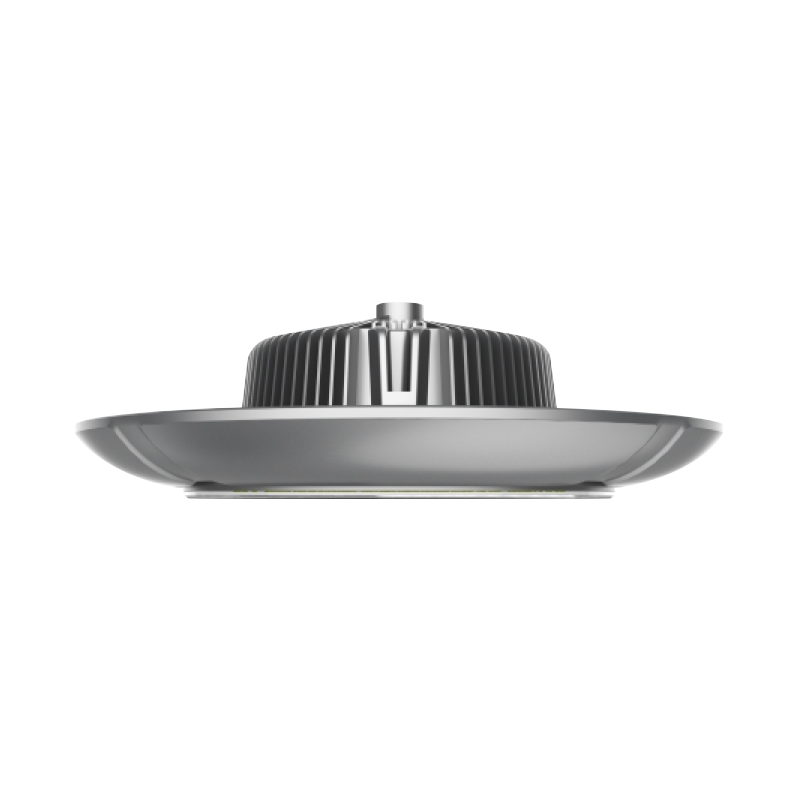
High Power LED Flood Light Fixture JD-HB031
Product Overview
The JD-HB031 is a high-power LED flood light fixture developed for applications that need strong, directional, and dependable outdoor illumination. It is available in two rated power configurations: 100W and 150W. These options allow buyers to select an appropriate output level according to mounting height, illuminated area, target brightness, and available electrical capacity.
The fixture uses 3030 LEDs. This LED package format is widely used in professional lighting because it can provide strong luminous output in a relatively compact footprint. When combined with suitable thermal management and optical design, 3030 LEDs can support efficient flood lighting without requiring an excessively large housing.
With a stated efficacy range of 140–150 lm/W, the JD-HB031 is positioned as an efficient high-power lighting solution. Efficacy expresses how much light is produced for each watt of electrical power consumed. A higher efficacy can help reduce energy consumption while maintaining the required illumination level. In large installations, even moderate improvements in efficacy can create meaningful savings over the operating life of the project.
The optical system is offered with 60°, 90°, and 120° lens angles. The 60° option is suitable when a more concentrated beam is needed, such as illuminating a defined area from a greater mounting height. The 90° option provides a balanced distribution for many general flood lighting applications. The 120° option produces broader coverage and can be useful when the fixture is mounted closer to the target area or when uniform spread is more important than long-distance projection.
The JD-HB031 is supplied in two housing sizes. The S-Size is Φ210 × 164 mm, while the M-Size is Φ257 × 164 mm. The compact form factor supports flexible installation and can help simplify transportation, mounting, and replacement work. The size selection can be matched to power configuration, project requirements, and preferred appearance.
Core Product Data
| Item | Specification |
|---|---|
| Product type | High-power LED flood light fixture |
| Model | JD-HB031 |
| Power options | 100W and 150W |
| LED package | 3030 |
| Rated efficacy | 140–150 lm/W |
| Lens angle options | 60°, 90°, and 120° |
| S-Size | Φ210 × 164 mm |
| M-Size | Φ257 × 164 mm |
| Primary application | Large-area and outdoor illumination |
| Customization support | OEM/ODM project services |
Actual project performance also depends on LED color temperature, driver selection, mounting angle, installation height, ambient temperature, power quality, maintenance conditions, and the reflectance of the illuminated surface. These parameters should be confirmed during the quotation and technical design stages.
Lighting Performance for Large Outdoor Areas
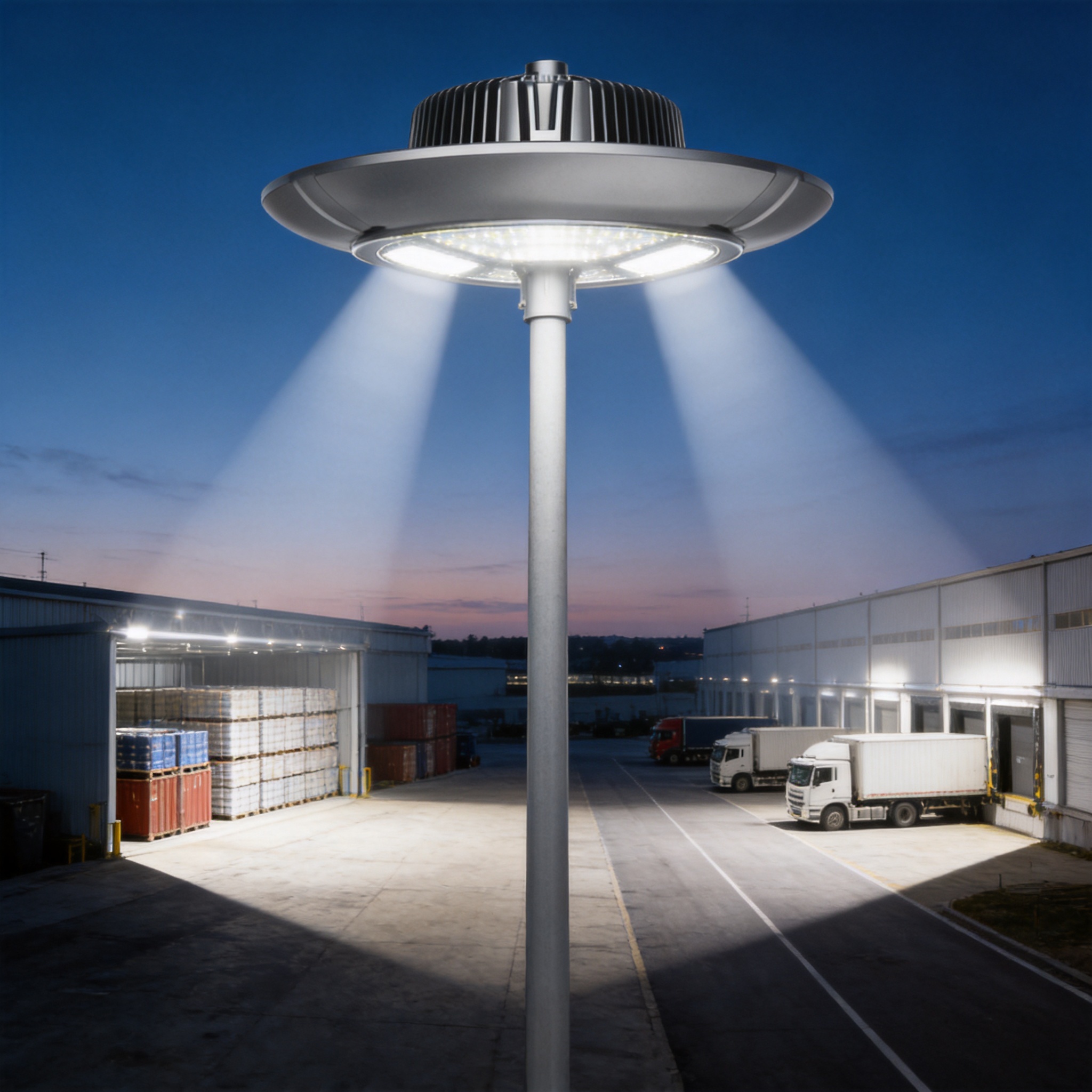
Flood lighting is often used where a broad surface must be illuminated from one or more elevated positions. Examples include industrial compounds, factory entrances, construction zones, parking areas, building walls, storage yards, sports grounds, logistics centers, and municipal spaces. In these situations, the lighting system must deliver sufficient horizontal and vertical illumination while avoiding excessive glare, dark zones, or unnecessary energy use.
The JD-HB031 is designed to provide a high-output solution in a relatively compact fixture. Its 100W and 150W configurations give project managers a choice between a moderate and a higher illumination level. Instead of using one oversized fixture for every location, a project can combine different power levels according to actual site conditions.
The 140–150 lm/W efficacy rating is one of the fixture’s important value points. Traditional high-power lighting systems may consume more electricity to achieve a comparable light level, particularly when older light sources or inefficient optical systems are used. A high-efficacy LED fixture can reduce the number of watts needed for a target lumen output. For an installation operating for many hours each night, this may help lower electricity costs and reduce the total energy demand of the lighting system.
Efficiency also has a relationship with thermal design. When less electrical power is needed to generate the required light output, the fixture may have a lower heat load for the same application result. However, the relationship is not automatic. Effective heat transfer still requires a well-designed housing, appropriate materials, reliable assembly, and suitable installation conditions.
Beam Angle Selection
The choice of lens angle is essential because the same wattage can produce very different results depending on how the light is distributed. A narrow or medium beam may project light farther and concentrate illumination on a defined zone. A wide beam can cover a larger nearby area but may require careful aiming to avoid light trespass or wasted output.
The 60° lens option may be considered for applications requiring a more concentrated pattern. It can be useful when the fixture is mounted at a relatively high position and aimed toward a road section, yard, façade zone, sign, or defined operating area. The 60° distribution can support stronger illumination on the intended target when compared with a very wide beam used at the same distance.
The 90° lens option offers a practical middle ground. It can be applied to general outdoor areas where a balance between coverage and concentration is required. Many industrial and commercial spaces have irregular layouts, and a medium beam may provide a flexible starting point for lighting design.
The 120° lens option is intended for broad distribution. It can be useful for lower mounting positions, open yards, building surroundings, pedestrian areas, and applications where the target surface is large and relatively close to the fixture. Wide distribution can also reduce the number of fixtures required in certain layouts, although this must be verified through photometric simulation.
A professional lighting plan should not select a beam angle based only on product labeling. Mounting height, setback distance, tilt angle, target dimensions, required illuminance, uniformity, glare limits, and surrounding properties must all be considered. DIALux or another lighting design platform can help compare different combinations before installation.
Advantages Compared with Basic Flood Light Products
The JD-HB031 offers several advantages over entry-level flood lights that are selected only according to nominal wattage. Its value comes from the combination of efficient LEDs, selectable optics, a purpose-built housing, scalable power options, and manufacturer-supported customization.
Efficient Light Output
Many basic flood lights are advertised by wattage but provide limited information about actual luminous efficiency. A 150W label does not by itself indicate how much useful light reaches the target area. The JD-HB031 provides a stated efficacy of 140–150 lm/W, giving buyers a more useful reference for comparing energy performance.
Higher efficacy can be particularly valuable in projects with long operating hours. Industrial yards, security areas, access roads, and public facilities may operate lighting throughout the night. Reducing power consumption while maintaining the required illumination can support lower operating expenses and a smaller electrical load.
Choice of Optical Distribution
Low-cost flood lights commonly use a single fixed optic, forcing installers to adapt the site to the product rather than selecting the product for the site. The JD-HB031 provides 60°, 90°, and 120° lens options. This range improves design flexibility and helps the buyer choose a distribution suited to the actual application.
Optical choice may also reduce over-lighting. A fixture with an unsuitable beam can place excessive light outside the target area, increase glare, and waste energy. Selecting a suitable lens angle can improve the proportion of light directed where it is needed.
Power Flexibility
The availability of both 100W and 150W versions allows the same product family to serve different project zones. A smaller area, lower mounting point, or secondary pathway may require the 100W configuration, while a larger yard or higher mounting position may benefit from the 150W version.
Using a common product family across a project can simplify procurement, spare parts management, installation training, and maintenance. It may also provide a more consistent appearance across the site.
Compact Housing Dimensions
Although the fixture is intended for high-power use, the listed housing sizes remain relatively compact. The S-Size measures Φ210 × 164 mm, and the M-Size measures Φ257 × 164 mm. A compact fixture can be easier to handle during installation, especially where mounting brackets, poles, façade structures, or access equipment have limited space.
Housing dimensions also influence wind loading, visual impact, and packaging efficiency. These factors matter in outdoor projects where fixtures are installed at height or on exposed structures. Final structural suitability should always be checked against local wind conditions and mounting hardware specifications.
Support for OEM and ODM Projects
Standard catalog products are useful for straightforward projects, but many international buyers require modifications. These may include a different driver arrangement, connector, cable length, mounting bracket, finish, logo, packaging format, color temperature, control interface, or project-specific optical configuration.
The manufacturer’s OEM/ODM capabilities allow the JD-HB031 platform to be considered for customized projects. Customization can be especially valuable for distributors, engineering contractors, lighting brands, and original equipment buyers that need a product aligned with their own specifications or market requirements.
Professional Manufacturing Infrastructure
A major difference between a project-oriented manufacturer and a simple trading source is the ability to control important production stages. Cixi HuaSheng Lighting Co., Ltd. operates with die-casting and CNC machines, aging lines, and goniophotometers. These capabilities support a more controlled process for housing production, mechanical finishing, electrical aging, and photometric evaluation.
The company also provides mold design and die-casting mold support. This can help customers develop customized housings or modify existing designs when a standard fixture does not fully meet a project requirement.
Thermal Management and Mechanical Durability
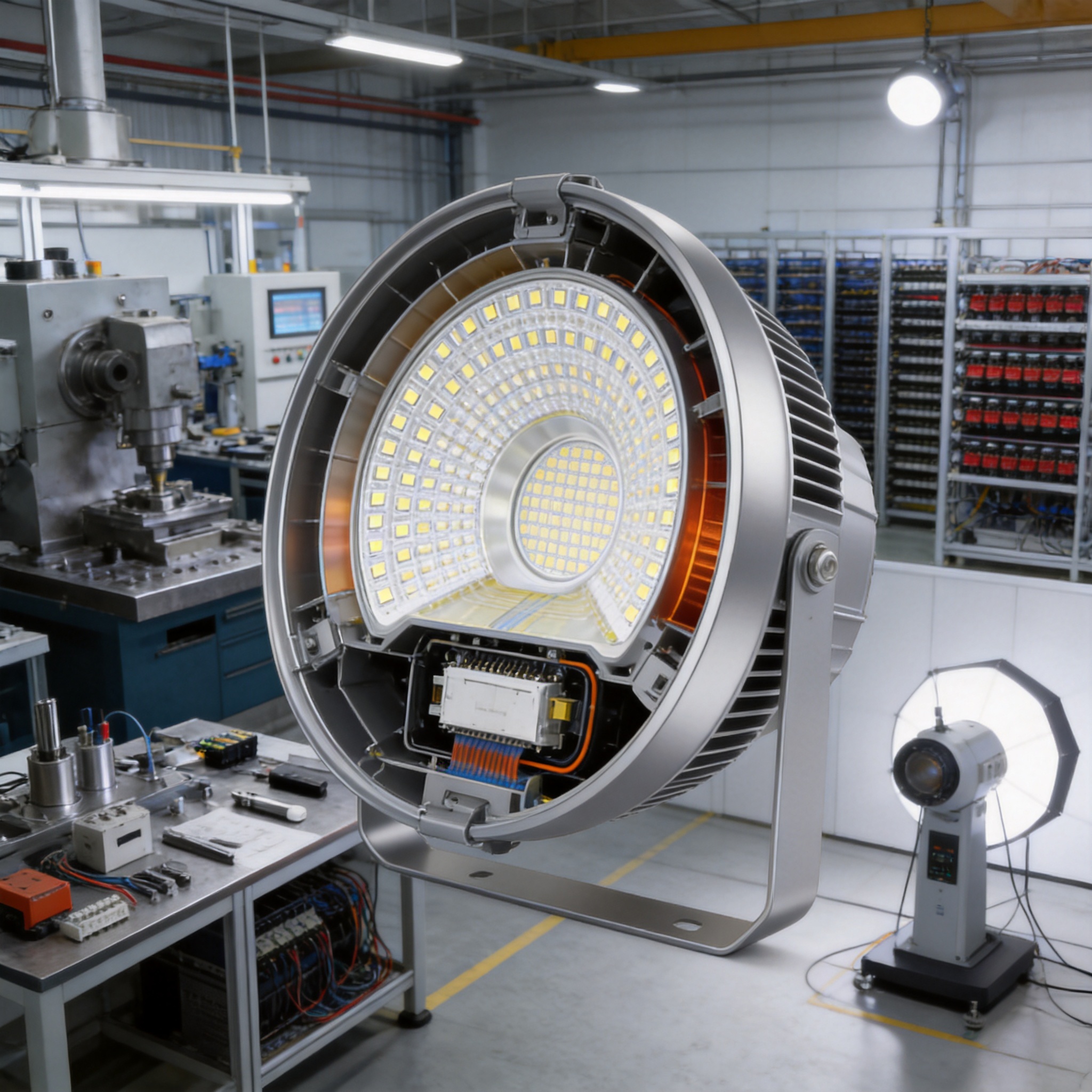
Thermal management is one of the most important factors in a high-power LED flood light. LEDs convert electrical energy into light and heat. If heat is not transferred away effectively, the LED junction temperature can rise, potentially affecting light output, color stability, component life, and long-term reliability.
The JD-HB031 uses a robust housing intended to support heat dissipation and durability in demanding environments. The housing serves several functions: it protects internal components, provides a mounting structure, contributes to thermal transfer, and helps maintain the fixture’s mechanical integrity during outdoor operation.
Die-cast metal housings are widely used in professional outdoor lighting because they can provide a combination of strength, dimensional consistency, and heat-transfer capability. The manufacturing quality of the casting is important. Consistent wall thickness, suitable fin or surface design, controlled machining, and accurate assembly can all influence the final performance of the fixture.
Heat Dissipation in Real Installations
Even a well-designed fixture requires correct installation. A flood light should not be covered by insulation, blocked by nearby structures, or installed where hot air cannot escape. Dust, debris, and accumulated contaminants can also affect thermal performance over time.
Mounting orientation should follow the manufacturer’s instructions. The fixture should be securely attached to a suitable bracket or structure, and the installation should allow heat to dissipate from the housing. In high-temperature climates, the project designer should review the ambient temperature range, driver rating, and expected operating schedule.
Thermal performance should be evaluated as part of the complete system rather than judged only by the presence of a metal housing. LED board attachment, thermal interface materials, driver placement, internal clearances, and assembly consistency all have an effect. A manufacturer with production and testing capabilities is better positioned to control these factors across batches.
Mechanical Service Considerations
Outdoor fixtures may be exposed to vibration, wind, rain, dust, temperature changes, and repeated thermal expansion and contraction. The housing, lens, brackets, fasteners, gaskets, cable entries, and driver compartment must work together to protect the electrical system.
For this reason, buyers should request complete information about ingress protection, impact resistance, operating temperature, surge protection, driver brand, warranty terms, and certification status for the exact configuration being purchased. The supplied product information identifies the JD-HB031 as a robust outdoor lighting fixture, but project-specific environmental ratings should be confirmed before final approval.
Manufacturing Strengths of the Supplier
The performance of a lighting product depends not only on its design but also on how consistently that design is manufactured. A capable supplier must be able to manage materials, tooling, assembly, testing, quality control, documentation, and delivery. Cixi HuaSheng Lighting Co., Ltd. presents a manufacturing structure intended to support these requirements.
Die-Casting and CNC Machining
Die-casting is an important process for producing repeatable metal housings and structural components. A well-designed die-casting process can support complex shapes, mounting features, heat-dissipation surfaces, and consistent dimensions. Repeatability is valuable when multiple fixtures must be installed across a large site or when a customer requires repeated production over several orders.
CNC machining can be used for precision finishing, hole placement, threaded sections, mounting interfaces, and other areas where casting alone may not provide the required dimensional accuracy. The combination of die-casting and CNC machining can help produce housings that fit brackets, covers, lenses, and internal components more consistently.
For OEM and ODM work, in-house or closely managed tooling and machining capabilities can shorten communication cycles. Design changes can be reviewed with an understanding of manufacturing limitations, tooling requirements, surface finishing, and production cost.
Mold Design and Die-Casting Tooling
Mold quality affects the appearance, strength, dimensions, and production consistency of a die-cast housing. Poorly designed tooling can create defects, uneven filling, dimensional variation, or unnecessary production waste. The supplier’s ability to provide mold design and die-casting mold services is therefore a relevant advantage for customers developing customized lighting products.
A project may require a modified housing for a special bracket, a different driver compartment, a custom brand mark, a new cable route, or an alternative visual appearance. By addressing tooling at the design stage, the supplier can help align the product with the customer’s installation and branding objectives.
Aging Lines and Production Testing
LED fixtures are exposed to electrical and thermal stress during operation. Aging, or burn-in, is commonly used to operate products for a controlled period before shipment. This process can help identify certain early failures, unstable connections, driver issues, or assembly problems before the products reach the customer.
An aging line provides a more organized approach than relying solely on random short-duration checks. The precise aging procedure, duration, temperature, load conditions, and acceptance criteria should be agreed upon as part of the quality plan. For large projects, buyers may request production inspection records or agreed sampling procedures.
Photometric Measurement
Goniophotometers are used to measure the distribution of light from a fixture. Photometric testing can provide data such as luminous flux, beam distribution, intensity curves, uniformity characteristics, and other information used in lighting design.
Photometric capability is especially important for a flood light because the lens angle and aiming direction have a direct effect on project results. A buyer can use the resulting photometric files or test data in lighting simulation software. This can make the design process more precise than relying on a basic lumen claim alone.
Testing also helps the manufacturer compare different optical configurations and verify whether a product performs according to its intended design. For export projects, documented photometric data can support technical submittals, consultant review, and tender documentation.
Quality and Environmental Management
The company identifies ISO 9001, ISO 14001, and ISO 45001 certifications. These standards relate respectively to quality management, environmental management, and occupational health and safety management. Certification does not replace product-specific testing, but it indicates that the organization has established formal management systems in these areas.
For international buyers, a structured management system can support clearer procedures for purchasing, production, inspection, corrective action, environmental responsibilities, and worker safety. These systems may also make it easier to communicate requirements for repeat orders and project documentation.
The company also identifies relevant product certifications including CB and CE for applicable products. Buyers should confirm that the exact JD-HB031 configuration, including its driver and electrical components, is covered by the required documentation for the target market.
Application Areas
Industrial Yards and Factory Compounds
Industrial yards often include vehicle routes, loading points, storage zones, maintenance areas, and building perimeters. These spaces can be large and may operate during nighttime hours. The JD-HB031 can be considered for area lighting where a powerful fixture and selectable beam distribution are required.
The 100W version may suit smaller zones or locations with lower mounting heights, while the 150W version may be considered for larger open areas. The final arrangement should be verified with a lighting calculation that considers forklift movement, worker visibility, security requirements, and the need to minimize glare.
Building Facades and Architectural Surfaces
Flood lights are frequently used to illuminate exterior walls, entrances, structural elements, and commercial buildings. The lens angle can be selected according to the height and width of the façade and the distance between the fixture and the wall.
A 60° beam may provide more concentrated highlighting of a defined architectural section. A 90° beam may offer balanced coverage for medium-width elevations. A 120° beam can be useful for broad surfaces where the fixture is positioned relatively close to the building. Proper aiming is essential to prevent light from entering windows or spilling into neighboring properties.
Parking Areas and Access Roads
Parking lots and access roads require adequate visibility for drivers and pedestrians. Fixtures may be mounted on poles, building structures, or dedicated brackets. The product’s compact housing and power options provide flexibility for different mounting arrangements.
Lighting design should address uniformity rather than only maximum brightness. Several properly aimed fixtures may provide a better result than a small number of very powerful units. The lens angle should be chosen to reduce dark zones and excessive overlap while keeping glare under control.
Construction and Temporary Work Zones
Construction areas may require strong portable or semi-permanent lighting during evening work. The JD-HB031 can be evaluated for fixed mounting on temporary structures or permanent buildings, subject to the required protection level and installation conditions.
Construction environments can expose fixtures to dust, vibration, impact risk, and changing layouts. Buyers should confirm the product’s environmental ratings, cable arrangement, mounting accessories, and protection requirements before using it in a temporary work zone.
Sports and Recreation Areas
Small sports courts, training areas, recreational grounds, and community facilities often require broad, controlled illumination. The appropriate solution depends on the activity, mounting height, glare limitations, and required uniformity. A wide lens may be useful for a nearby court, while a narrower lens may be more appropriate for a higher pole or longer throw distance.
For competitive sports, additional photometric requirements may apply. A professional lighting design should consider horizontal and vertical illuminance, camera visibility, glare, uniformity, and local standards.
Municipal and Public-Space Lighting
Municipal projects may include public buildings, parks, pedestrian areas, transit facilities, underpasses, and service compounds. Energy efficiency, maintenance access, safety, and long-term reliability are usually important selection criteria.
The JD-HB031 can form part of a broader outdoor lighting solution supplied by a manufacturer that also produces street lights, tunnel lights, garden lights, solar lights, high-bay lights, and other specialized fixtures. This broader product capability can make it easier for a project buyer to coordinate several lighting categories through one technical partner.
OEM and ODM Customization Opportunities
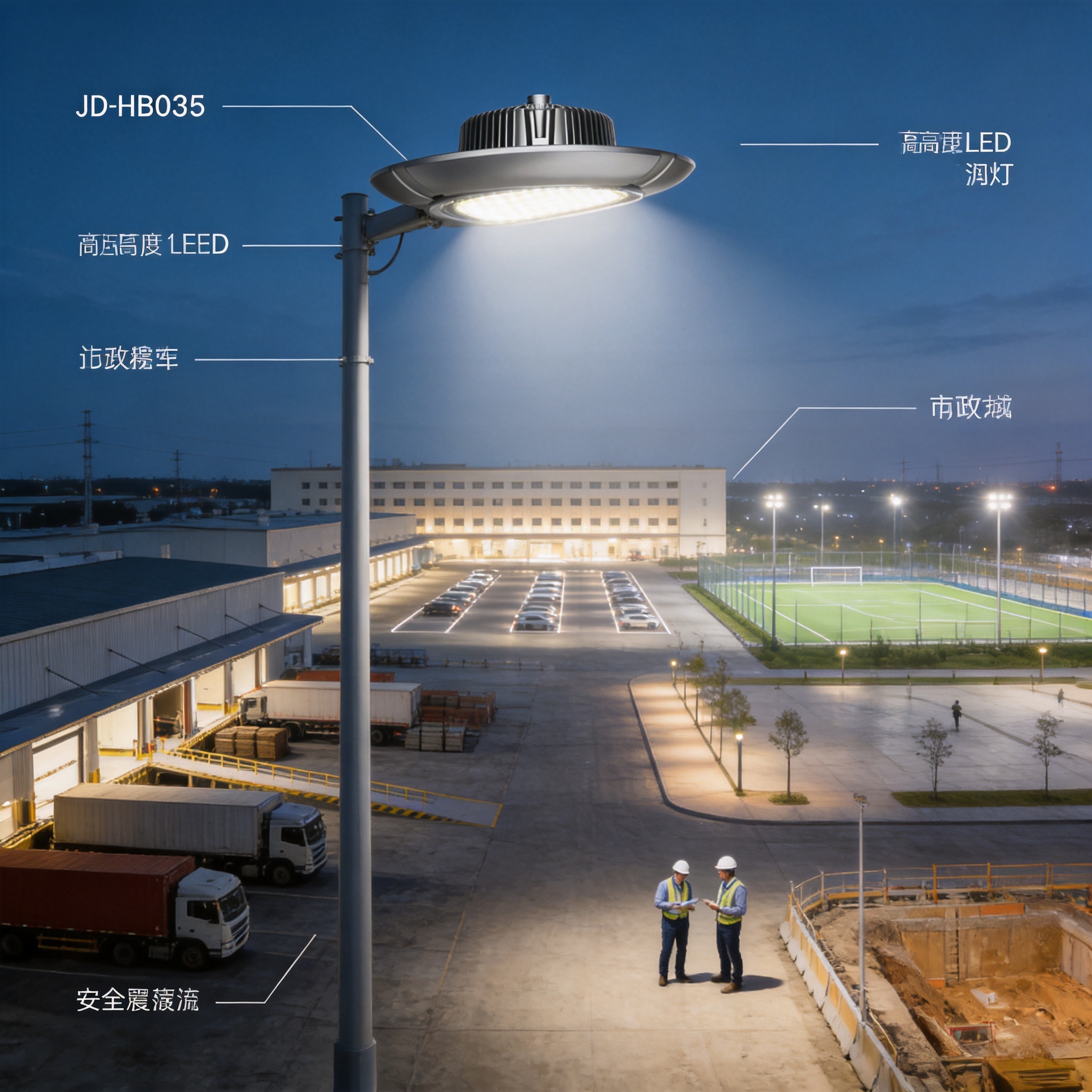
Different markets and projects may require different product configurations. A lighting distributor may need a private label. An engineering company may require a specific connector or mounting bracket. A municipal project may specify a particular color temperature, surge protection level, or control system. An industrial customer may require a customized cable length and packaging arrangement for an established maintenance process.
The JD-HB031 can be used as a starting platform for these discussions. Possible areas of customization may include housing finish, logo marking, packaging, mounting hardware, optical arrangement, driver selection, wiring, connector type, dimming interface, and color temperature. Each modification should be evaluated for technical feasibility, tooling impact, minimum order quantity, testing requirements, and delivery schedule.
Private Label and Distributor Requirements
Lighting distributors often need consistent branding across a product range. A supplier with manufacturing and mold capabilities can support product labels, cartons, manuals, nameplates, and other brand-related details. The customer should provide artwork, labeling rules, language requirements, and packaging standards at the beginning of the project.
Private label work is most effective when the technical specification is frozen before mass production. Changes made after tooling, certification, or packaging approval may affect cost and lead time. A clear approval process helps reduce the risk of mismatch between samples and production units.
Project-Specific Mounting
Outdoor fixtures are installed on many types of structures. A customer may need a special bracket for a pole, wall, beam, façade, truss, or industrial frame. Mounting geometry influences aiming range, load distribution, cable routing, and installation safety.
Customized mounting components should be evaluated for material, corrosion resistance, fastener compatibility, adjustment range, and wind loading. The fixture and bracket should be treated as one installation system rather than separate products.
Electrical and Control Options
Project requirements may include different input voltage ranges, dimming methods, photocell operation, motion sensing, remote control, or integration with a lighting management system. The exact availability of these options must be confirmed with the manufacturer because changes to the driver or control interface can affect certification and thermal performance.
Where intelligent controls are required, the lighting designer should verify compatibility between the fixture driver, control protocol, wiring method, and central management software. The control strategy should also consider fail-safe operation, commissioning, maintenance, and cybersecurity where networked systems are used.
Installation and Lighting Design Guidance
Correct installation is essential to obtain the expected value from a high-power flood light. Even an efficient fixture can produce poor results if the beam angle, mounting height, aiming direction, or spacing is incorrect.
Define the Lighting Objective
The first step is to define what the fixture must accomplish. The objective may be general safety lighting, security illumination, façade enhancement, loading-area visibility, vehicle movement, work-task lighting, or architectural emphasis. Each objective may require a different illuminance level, uniformity, color temperature, and glare strategy.
Designers should identify the target surface, operating hours, surrounding areas, maintenance conditions, and any nearby properties that could be affected by spill light. This information provides a foundation for selecting the power and beam angle.
Use Photometric Data
Photometric data should be requested for the selected 100W or 150W configuration and the chosen 60°, 90°, or 120° lens. The data can then be imported into lighting design software to calculate illuminance and uniformity.
Simulation is particularly useful when several fixtures are installed together. It can show areas of overlap, shadows, excessive brightness, and light spill. It also helps compare whether a smaller number of higher-power fixtures or a larger number of lower-power fixtures provides the better result.
Consider Glare and Spill Light
High-power fixtures can create glare when viewed directly by drivers, pedestrians, workers, or neighboring residents. The fixture should be aimed carefully, and the beam should be selected to suit the target area. In some applications, shielding or an additional visor may be appropriate.
Reducing spill light can improve visual comfort and support compliance with local outdoor lighting requirements. It can also increase efficiency because more of the available output is directed toward the intended target.
Check Electrical Conditions
Before installation, the project team should verify supply voltage, frequency, circuit capacity, earthing, protection devices, cable size, and surge conditions. Outdoor lighting circuits may be exposed to switching events and lightning-related surges. Appropriate protection should be selected according to the site risk and local electrical rules.
The driver and electrical configuration should match the approved technical submittal. Substituting components without approval can affect performance, certification, warranty, and safety.
Plan Maintenance Access
Even durable outdoor fixtures require inspection and cleaning. Dirt, dust, salt, insects, and industrial contaminants can accumulate on the lens or housing. Maintenance plans should consider how the fixture will be reached, how often it will be inspected, and whether replacement components will remain available.
A common product family with 100W and 150W options can simplify spare-parts planning. However, replacement units should match the original optical and electrical configuration when consistent photometric performance is required.
Procurement and Quality Evaluation
Buyers evaluating the JD-HB031 should assess more than the unit price. The total value of an outdoor flood light includes energy consumption, installation time, optical performance, serviceability, replacement availability, documentation, and expected operating life.
Request a Complete Technical Submittal
A complete technical submittal should identify the exact model, power, LED type, efficacy, lens angle, housing size, input range, driver information, color temperature, color rendering, operating temperature, ingress protection, impact resistance, surge protection, dimensions, weight, mounting details, and certifications.
Where a project has mandatory standards, the buyer should ask for test reports and declarations applicable to the exact configuration. General company certifications are useful, but they should not be treated as a substitute for product-specific compliance documentation.
Approve Samples Before Mass Production
For OEM, ODM, or large-volume orders, a sample approval process is recommended. The sample should be checked for appearance, dimensions, optical distribution, cable arrangement, mounting compatibility, labeling, packaging, and electrical performance.
If the sample is approved, the production specification should be documented. Any later change to the LED, driver, lens, housing, or assembly method should require technical review. This helps preserve consistency across deliveries.
Evaluate Production Consistency
Production consistency is especially important when fixtures are installed side by side. Differences in color, brightness, beam distribution, or housing finish can be visible across a large façade or yard. Quality control should therefore include incoming material inspection, assembly checks, electrical testing, aging, and final inspection.
The manufacturer’s production equipment and testing infrastructure provide a basis for these controls. Buyers may also define acceptance criteria, inspection levels, sampling plans, and documentation requirements in the purchase agreement.
Environmental and Sustainability Considerations
Energy efficiency is one of the clearest sustainability benefits of LED flood lighting. A fixture with an efficacy of 140–150 lm/W can help reduce electricity use compared with less efficient alternatives when it provides the required illumination with lower input power.
Longer service intervals can also reduce maintenance travel, replacement labor, packaging waste, and disposal requirements. These benefits depend on actual operating conditions, thermal management, driver quality, installation, and maintenance.
The company identifies ISO 14001 environmental management certification. An environmental management system can help organize responsibilities related to resource use, waste handling, emissions, and continual improvement. Buyers with environmental procurement policies may request supporting documentation and product material information.
Lighting design itself is also an environmental decision. Selecting the correct lens angle can reduce unnecessary spill light. Using photometric simulation can help avoid over-lighting. Controls such as dimming or scheduled operation may further reduce energy use when the application permits.
Why Work with an Experienced Outdoor Lighting Manufacturer
An experienced manufacturer can contribute more than a finished product. It can help interpret project requirements, select optics, evaluate thermal considerations, develop tooling, prepare photometric data, coordinate certification, and organize delivery.
Cixi HuaSheng Lighting Co., Ltd. supplies a broad range of outdoor and industrial lighting products, including street lights, tunnel lights, high-bay lights, linear lights, garden lights, solar lights, grow lights, explosion-proof lights, and related power products. This product breadth can be useful for customers managing several lighting applications at the same site or across multiple projects.
The company also provides one-stop services such as efficient lighting solutions, DIALux designs, mold design, OEM/ODM, SKD/CKD customization, and delivery support. These services can reduce the number of separate technical contacts required by a project buyer.
For international customers, manufacturing location is only one part of supplier evaluation. Communication, documentation, product consistency, response speed, testing capability, customization experience, and after-sales support are equally important. A supplier that can coordinate design and production may help reduce project risk, particularly when the order involves custom components or multiple product types.
Frequently Asked Questions
What is the rated power of the JD-HB031?
The JD-HB031 is available in 100W and 150W versions. The appropriate option depends on the mounting height, target area, required illumination, spacing, and project energy strategy.
What type of LED does the fixture use?
The fixture uses 3030 LEDs. The stated efficacy is 140–150 lm/W, although actual system performance should be confirmed for the selected configuration and operating conditions.
Which lens angles are available?
The available lens angles are 60°, 90°, and 120°. A 60° lens generally provides a more concentrated distribution, a 90° lens provides a balanced distribution, and a 120° lens provides broader coverage. Final selection should be based on a photometric design.
What are the fixture dimensions?
The S-Size is Φ210 × 164 mm, and the M-Size is Φ257 × 164 mm. The correct size should be confirmed together with the selected power configuration and mounting arrangement.
Where can this flood light be used?
Potential applications include industrial yards, factory compounds, building facades, parking areas, access roads, construction sites, sports grounds, municipal spaces, loading areas, and other large-area outdoor illumination projects.
Can the fixture be customized?
The manufacturer supports OEM and ODM services. Possible customization areas may include mounting hardware, optical selection, housing finish, logo, packaging, wiring, driver configuration, and other project-specific requirements. The exact scope, minimum order quantity, tooling cost, and certification implications should be confirmed before ordering.
Does the manufacturer provide lighting design support?
The company provides lighting solutions and DIALux design services. Buyers should submit site plans, mounting heights, target illuminance, operating conditions, and project requirements so that the proposed layout can be evaluated accurately.
How should the correct beam angle be selected?
The choice depends on the distance between the fixture and the target, mounting height, target dimensions, required uniformity, glare limits, and desired light distribution. Photometric simulation is recommended before final selection.
What manufacturing capabilities support this product?
The manufacturer identifies die-casting machines, CNC machines, aging lines, and goniophotometers. It also provides mold design and die-casting mold services, supporting both standard production and customized lighting development.
What certifications are available?
The company identifies ISO 9001, ISO 14001, and ISO 45001 management certifications and states that relevant products have CB and CE certifications. Buyers should request documentation for the exact JD-HB031 configuration and destination market.
Is the fixture suitable for extreme environments?
The JD-HB031 is designed as a robust outdoor fixture, but environmental suitability depends on the exact protection rating, ambient temperature, corrosion exposure, wind conditions, electrical protection, and installation method. These details should be confirmed for the project before purchase.
How can buyers obtain the best project result?
Buyers should define the lighting objective, request exact photometric data, select the correct power and lens, verify electrical and environmental specifications, approve samples, and establish inspection criteria before mass production.
Conclusion
The High Power LED Flood Light Fixture JD-HB031 is a practical solution for projects that require strong outdoor illumination, efficient operation, optical flexibility, and a durable housing. Its 100W and 150W versions provide application flexibility, while the 3030 LED platform and 140–150 lm/W efficacy support energy-conscious lighting design.
The availability of 60°, 90°, and 120° lens angles is a significant advantage over basic flood lights with a single fixed distribution. It allows the fixture to be adapted to different mounting heights, target areas, and coverage requirements. The compact S-Size and M-Size housings also support flexible installation in industrial, commercial, architectural, and municipal environments.
The product is further supported by the manufacturing capabilities of Cixi HuaSheng Lighting Co., Ltd. Die-casting, CNC machining, mold design, aging lines, and goniophotometric testing provide a foundation for controlled production and customized development. ISO management certifications, product certification support, DIALux design services, OEM/ODM capability, and a broad outdoor lighting portfolio add value for international project buyers.
For the best result, the JD-HB031 should be evaluated as part of a complete lighting system. Power, lens angle, mounting height, aiming, electrical protection, thermal conditions, maintenance access, and photometric performance should all be considered. When these factors are properly coordinated, the fixture can provide a reliable and efficient lighting solution for large-area outdoor applications.
References
1. Product specification sheet for High Power LED Flood Light Fixture JD-HB031, including power, LED type, efficacy, lens angles, and housing dimensions.
2. Manufacturer-provided company information concerning outdoor lighting production, OEM/ODM services, mold design, CNC machining, aging lines, and photometric testing.
3. ISO 9001, Quality Management Systems, International Organization for Standardization.
4. ISO 14001, Environmental Management Systems, International Organization for Standardization.
5. ISO 45001, Occupational Health and Safety Management Systems, International Organization for Standardization.
6. General principles of LED thermal management and luminaire performance evaluation for outdoor lighting applications.
7. Professional lighting design practices for flood lighting, glare control, uniformity, beam selection, and outdoor illumination planning.
Product: High Power LED Flood Light Fixture JD-HB031

YQF Group - World Leading One-Stop Lighting & Solar For the Global Partners
Custom & OEM Solutions for Global Lighting Brands
Copyright © Cixi HuaSheng Lighting Co., Ltd. All Rights Reserved.
Die-Casting Mould Supplier
