 English
 中文简体
 русский
 Français
 Español
 عربى
 Indonesia

Warehouse LED Lighting Fixture HS-HBU3: A High-Efficiency Solution for Modern Industrial Spaces
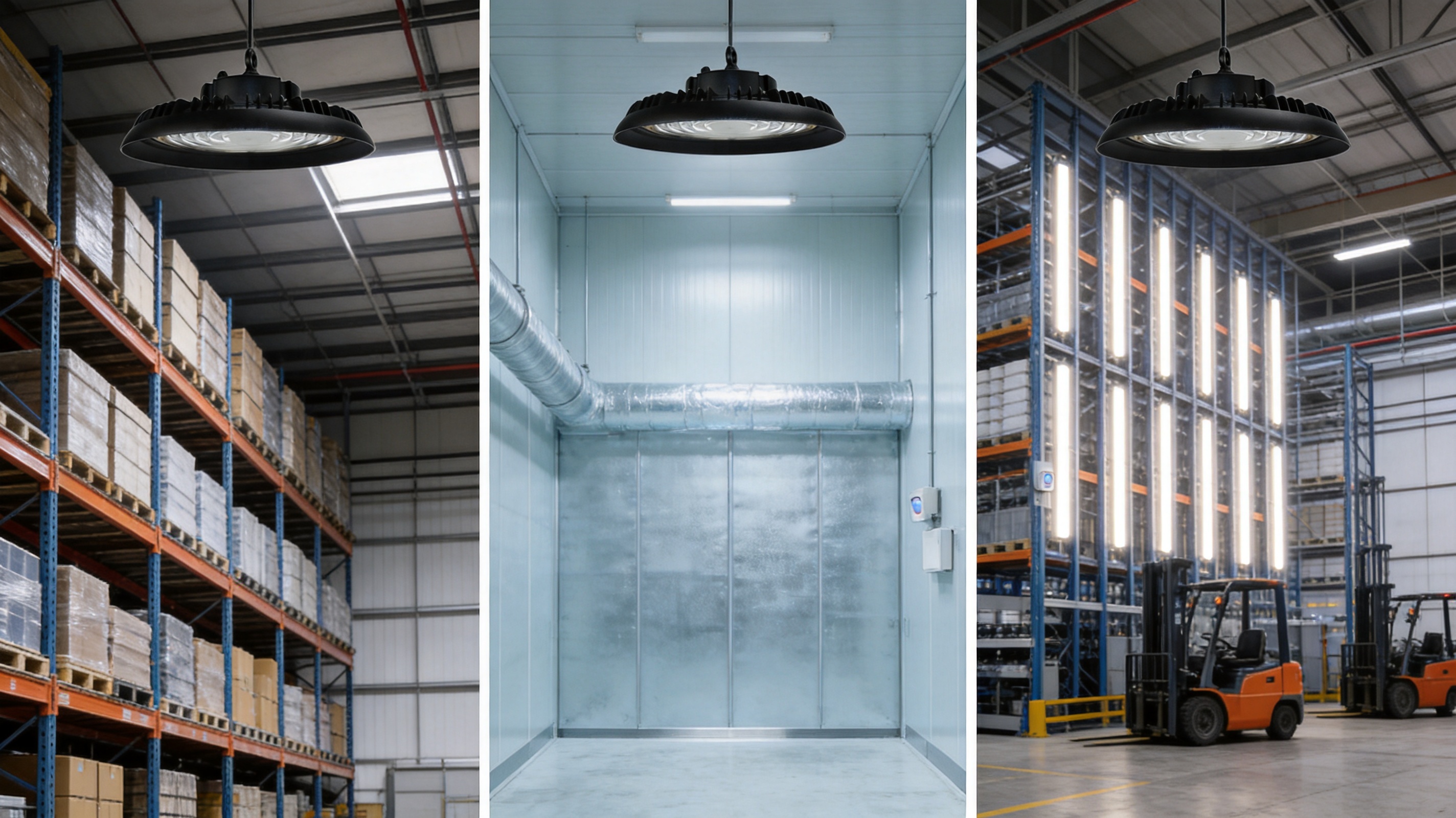
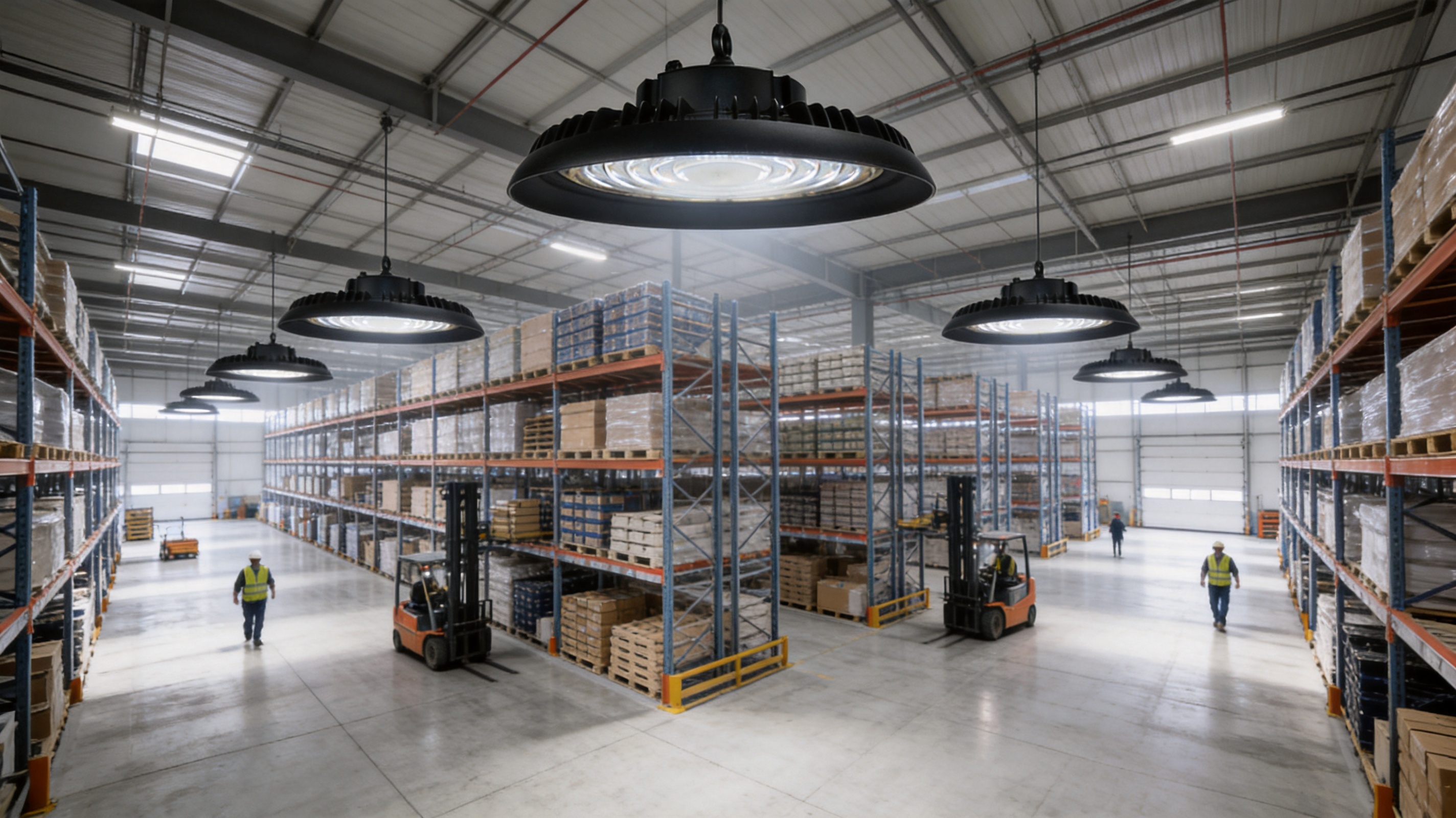
Modern warehouses, distribution centers, logistics hubs, and cold storage facilities require lighting that does more than simply illuminate a large interior. The lighting system must support safe movement, accurate picking, efficient inventory management, equipment operation, and continuous productivity. At the same time, warehouse operators need to control energy consumption, maintenance expenses, glare, downtime, and installation complexity. The Warehouse LED Lighting Fixture HS-HBU3 is designed to address these requirements through high luminous efficacy, robust protection, flexible power options, and an optical structure suitable for demanding industrial environments.
The HS-HBU3 belongs to the LED Industrial Lighting category and is engineered for applications where dependable illumination is essential. With an input power range of 100W to 200W, a rated light effect of up to 150 lm/W, IP66/IK08 protection, and a wide AC 100-305V input range, the fixture is suitable for many warehouse and industrial electrical environments. Its compact circular body, anti-glare lens design, and compatibility with customized controls allow it to be adapted to different ceiling heights, aisle layouts, rack arrangements, and operating schedules.
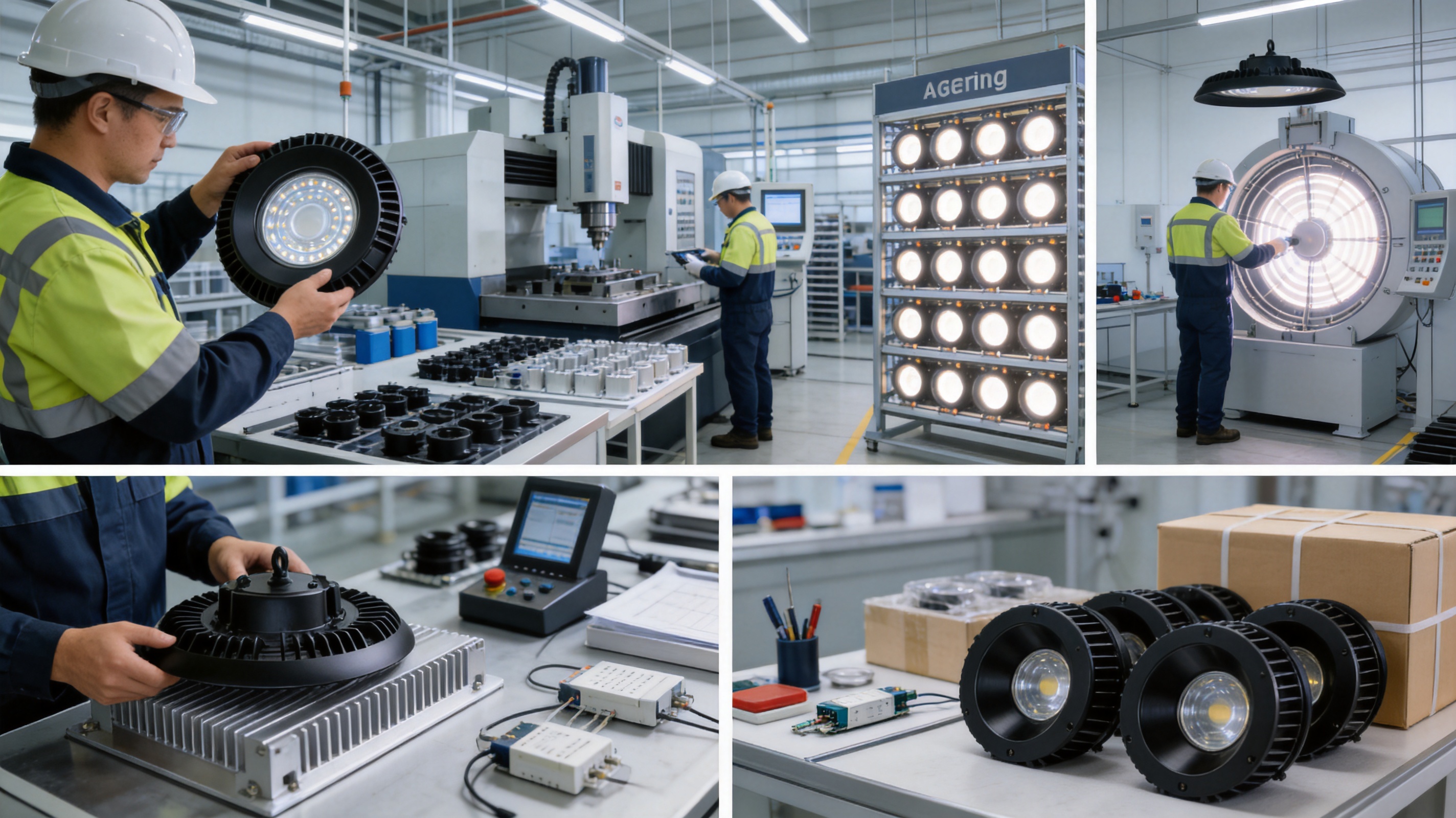
Beyond its electrical and optical specifications, the product benefits from an established manufacturing platform. Cixi HuaSheng Lighting Co., Ltd. combines die-casting, CNC machining, aging lines, photometric testing, mold design, and OEM/ODM engineering services to create lighting products for industrial, commercial, municipal, and residential applications. This integrated capability helps customers obtain not only a fixture, but also a complete lighting development and supply solution.
1. The Role of Lighting in Warehouse Performance
Warehouse lighting directly influences how quickly and accurately employees identify products, read labels, operate lifting equipment, inspect packaging, and move through aisles. Poorly planned lighting can create dark areas between racks, uncomfortable glare, uneven illumination, and visual fatigue. These issues may contribute to picking errors, slower operations, safety concerns, and unnecessary work interruptions.
Traditional high-intensity discharge fixtures can provide powerful illumination, but they often involve longer warm-up times, frequent lamp replacement, heat generation, and higher energy consumption. Conventional fluorescent systems may offer acceptable light quality in some facilities, yet they can require more fixtures, more maintenance, and more attention to disposal and replacement. Older lighting technologies may also perform less consistently in cold storage environments or under frequent switching conditions.
LED technology provides a more controllable and efficient alternative. LED fixtures can reach full brightness quickly, support frequent on-and-off operation, and offer long service expectations when properly designed. However, not every LED high-bay fixture is equally suitable for warehouse use. The quality of the driver, heat dissipation structure, optical lens, housing, sealing, component selection, and production control determines whether the fixture will deliver stable performance over time.
The HS-HBU3 is developed specifically around these practical requirements. Its purpose is not merely to replace an old lamp with an LED source. It is intended to provide an integrated lighting solution that improves aisle visibility, reduces wasted light, supports lower operating costs, and remains reliable in industrial conditions.
2. Product Overview of the HS-HBU3
The Warehouse LED Lighting Fixture HS-HBU3 is a circular industrial LED fixture available in three power configurations: 100W, 150W, and 200W. These versions allow the lighting system to be matched to different mounting heights, aisle widths, rack configurations, and target illuminance levels.
| Specification | HS-HBU3 Range |
| Application category | LED Industrial Lighting |
| Input wattage | 100W-200W |
| Light effect | Up to 150 lm/W |
| Protection grade | IP66 / IK08 |
| Input voltage | AC 100-305V |
| Available models | HS-HBU3-100W, HS-HBU3-150W, HS-HBU3-200W |
The fixture uses a high-efficiency LED system and an anti-glare optical design. This combination is important in storage facilities because a high lumen output alone does not guarantee a comfortable or effective working environment. The optical system must distribute light in a controlled manner and limit harsh brightness that can distract workers or create reflections on packaging, labels, polished floors, or machinery.
The product is also suitable for projects requiring customized integration. OEM/ODM services include sensor integration, mounting style customization, and color temperature adjustment. These options make the HS-HBU3 more adaptable than a fixed, off-the-shelf luminaire designed for only one warehouse configuration.
3. Main Advantages Compared with Conventional and Competing Fixtures
3.1 High luminous efficacy and reduced energy demand
A rated light effect of up to 150 lm/W indicates that the fixture can produce a high quantity of useful light from each watt of electrical input. This is one of the most important performance advantages in warehouses, where lighting may operate for long hours every day and where large floor areas require multiple fixtures.
Compared with older metal halide, high-pressure sodium, or inefficient fluorescent systems, a high-efficiency LED fixture can reduce the power required to achieve a similar or improved lighting level. The actual energy saving depends on the existing installation, operating schedule, mounting height, controls, and lighting design. Nevertheless, higher efficacy gives project designers more flexibility: they may achieve the required illumination with lower wattage, increase light levels without a proportional increase in energy use, or combine the fixture with occupancy sensors to reduce runtime in unused zones.
Lower energy consumption has two financial benefits. First, it can reduce the electricity cost associated with daily operation. Second, it can reduce the cooling burden in facilities where air conditioning or refrigeration is used. Although the total effect varies by building design, reducing unnecessary heat generation is particularly valuable in temperature-controlled warehouses and cold storage facilities.
3.2 Better suitability for aisle and rack lighting
Warehouse racking creates a unique lighting challenge. Tall racks can block light from traveling horizontally, while narrow aisles require illumination at the floor, shelf, and label levels. A general-purpose industrial lamp may produce a large amount of light but still leave vertical surfaces inadequately illuminated.
The HS-HBU3 is positioned as a fixture for storage environments and racking systems. Its anti-glare lens and controlled optical approach help direct light into useful areas rather than allowing excessive light to scatter toward the eyes or outside the working zone. Proper planning with mounting height, spacing, beam distribution, and fixture orientation can help improve aisle uniformity and make labels, barcodes, cartons, and storage locations easier to identify.
Uniformity is often more important than maximum brightness in a warehouse. Strong hot spots separated by dark zones can cause visual adaptation problems as employees move through the facility. A more balanced distribution helps workers maintain consistent visibility and may support faster, more accurate picking operations.
3.3 Wide input voltage range
The HS-HBU3 supports AC 100-305V input voltage. This wide operating range provides useful flexibility for international projects and facilities with voltage variation. It can simplify product selection when the same product family is being considered for different regional markets or for buildings with varying electrical conditions.
A wide input range does not eliminate the need for proper electrical design. The installation still requires suitable circuit protection, grounding, wiring, and compliance with local electrical codes. However, it can reduce the number of fixture variants required by a distributor or contractor and make project procurement more straightforward.
3.4 Protection against dust, water, and impact
Industrial lighting fixtures are exposed to more than normal indoor conditions. Warehouses may contain dust, airborne packaging fibers, condensation, cleaning water, forklift activity, and occasional impacts. Cold storage facilities may experience temperature changes and moisture during door openings, defrosting, or cleaning procedures.
The HS-HBU3 is rated IP66 and IK08. IP66 indicates a high level of protection against dust ingress and powerful water jets when the fixture is correctly installed and maintained. This makes the product more appropriate for demanding industrial interiors and semi-exposed locations than fixtures designed only for dry, clean rooms.
IK08 indicates resistance to a defined level of mechanical impact. It does not mean that the fixture is indestructible or suitable for direct collision with forklifts or heavy equipment. Instead, it indicates that the housing and protective structure are designed with a meaningful level of impact resistance for industrial use. The rating can provide additional confidence in areas where accidental contact, vibration, or handling activity is possible.
3.5 Anti-glare design for employee comfort
Glare is a major concern in warehouses because workers often look upward while locating inventory, operating equipment, reading rack labels, or checking overhead systems. A bright, poorly shielded LED source can create discomfort, reflections, and temporary visual distraction.
The HS-HBU3 incorporates an anti-glare lens design intended to make the light more comfortable and useful. The effectiveness of any anti-glare system depends on viewing angle, mounting height, lens geometry, ceiling reflectance, and the overall photometric layout. For this reason, the fixture should be evaluated as part of a complete lighting design rather than judged only by its wattage or lumen output.
When combined with a suitable lighting plan, reduced glare can support better working conditions and help employees maintain visual attention during repetitive tasks. This is particularly valuable in long aisles, picking areas, packaging zones, and spaces where workers frequently look between shelves and the ceiling.
3.6 Lower maintenance requirements
Lighting maintenance in a large warehouse can be expensive and disruptive. Replacing a fixture may require access platforms, lift equipment, aisle closures, production interruptions, and additional safety procedures. Fixtures installed above high racks can be especially difficult to service.
LED fixtures reduce the need for routine lamp replacement because the light source is integrated into a solid-state system rather than relying on a replaceable discharge tube or fluorescent lamp. The robust IP66 construction can also reduce the likelihood that dust or moisture will affect internal components when the fixture is correctly sealed.
Reduced maintenance does not mean maintenance-free operation. Periodic inspection, cleaning, electrical checks, and verification of mounting hardware remain important. However, a durable LED fixture can help extend service intervals and reduce the number of unplanned lighting failures that interrupt warehouse operations.
4. Model Selection and Dimensional Options
The HS-HBU3 family includes three models. Each model uses the same general product platform while offering a different power level and physical diameter. This approach allows project planners to select a suitable output without changing to an entirely different fixture design.
| Product model | Rated input power | Product size |
| HS-HBU3-100W | 100W | φ300 x 59 mm |
| HS-HBU3-150W | 150W | φ335 x 59 mm |
| HS-HBU3-200W | 200W | φ370 x 59 mm |
The 100W version can be considered for lower mounting heights, smaller warehouses, auxiliary storage spaces, work areas, or projects where moderate output is sufficient. The 150W model offers a balanced option for many standard industrial spaces. The 200W model is suitable for applications requiring greater output, such as higher mounting positions, larger open areas, or facilities with greater spacing between luminaires.
Final selection should be based on a photometric calculation rather than wattage alone. Important factors include ceiling height, aisle width, rack height, floor reflectance, required illuminance, desired uniformity, emergency lighting requirements, operating hours, and the presence of daylight. A professional lighting design using appropriate photometric files or project data can help determine fixture quantity and spacing.
The compact 59 mm body depth can simplify handling and contribute to a clean installation appearance. The circular housing is also familiar to contractors and suitable for common high-bay mounting concepts, although the exact suspension or mounting accessory should be confirmed according to the project requirements.
5. Application Environments
5.1 Distribution centers
Distribution centers operate under constant pressure to move goods quickly and accurately. Lighting must support inbound inspection, storage, picking, sorting, packing, and outbound loading. The HS-HBU3 can be used in high-bay areas, rack aisles, staging zones, and open working sections when the appropriate optical arrangement is selected.
Its high efficacy can help reduce the energy demand of large installations. Its anti-glare design can also make the environment more comfortable for employees who spend long periods locating products and reading labels.
5.2 General warehouses
General warehouses vary widely in ceiling height, storage density, and operating schedule. Some facilities contain low-level shelving, while others use tall pallet racks. The three available power levels give project designers a starting point for matching output to the space.
In mixed-use warehouses, different models may be used in different zones. A 100W fixture might serve a lower storage area, while 150W or 200W fixtures could be selected for higher rack aisles or open loading spaces. This zoning approach can prevent over-lighting and help improve overall energy efficiency.
5.3 Cold storage facilities
Cold storage facilities place additional demands on lighting products. Low temperatures, condensation, cleaning procedures, and frequent door opening can affect equipment reliability. A sealed, industrial-grade LED fixture with IP66 protection is better suited to these conditions than a basic indoor luminaire with limited environmental protection.
Project engineers should verify the fixture’s complete operating temperature range and confirm that the selected driver and materials are suitable for the actual cold-room conditions. The fixture should also be installed according to the manufacturer’s instructions, with attention to cable entry, sealing, condensation control, and maintenance access.
5.4 Manufacturing and industrial workspaces
Although developed with warehouse applications in mind, the HS-HBU3 can also be considered for selected manufacturing areas, workshops, assembly zones, and equipment storage rooms. Its wide input voltage range and protection rating make it useful where industrial durability is more important than decorative appearance.
In production environments, lighting design should consider machine shadows, reflective surfaces, moving equipment, inspection requirements, and the visual demands of workers. Color temperature customization can be useful when a project has specific preferences for visual atmosphere or task visibility.
6. Customization and OEM/ODM Capabilities
Industrial lighting projects frequently require customization. A warehouse may have a proprietary control system, unusual mounting structure, specific color temperature requirements, or a need to match existing fixtures. The HS-HBU3 can be adapted through OEM/ODM services that include sensor integration, mounting style customization, and color temperature adjustment.
6.1 Sensor integration
Occupancy and motion sensors can reduce energy consumption by dimming or switching fixtures when aisles or zones are not in use. In a warehouse with intermittent traffic, sensor-based control can produce significant additional savings beyond the efficiency of the LED source itself.
Sensor integration should be planned carefully. Detection range, response time, mounting height, aisle geometry, forklift movement, and control grouping all affect performance. In a high-rack facility, a sensor must be positioned and programmed so that it responds reliably to workers and equipment without causing unnecessary switching. Controls may also be configured with dimming levels or time delays to maintain safe, comfortable transitions.
6.2 Mounting customization
Different buildings use different suspension systems, brackets, conduits, and ceiling structures. Mounting customization can help contractors adapt the fixture to existing infrastructure or meet the requirements of a new building design. The mounting solution must provide adequate mechanical support and allow for safe installation, inspection, and future maintenance.
6.3 Color temperature adjustment
Color temperature influences the visual character of a space and may affect how surfaces, labels, and products appear. Some facilities prefer a neutral white appearance for general warehouse work, while others may request a cooler or warmer setting according to operational preferences and the surrounding environment.
Color temperature should be selected alongside color rendering, glare control, uniformity, and the visual requirements of the task. A customized specification can help maintain consistency across a large project or coordinate new fixtures with an existing lighting system.
7. Manufacturing Strengths Behind the Product
A high-quality industrial fixture depends on production capability as much as on its published specifications. The manufacturer of the HS-HBU3 operates as a professional lighting producer in Ningbo, China, with experience in outdoor lighting, industrial lighting, solar lighting, explosion-proof lighting, linear lighting, garden lighting, street lighting, tunnel lighting, and other LED products.
7.1 Die-casting capability
Die-casting is important for producing strong, dimensionally consistent metal housings and heat-dissipation components. A properly designed die-cast body can provide structural strength, support thermal management, and create a precise surface for sealing components, lenses, brackets, and electrical assemblies.
In LED lighting, thermal design has a direct relationship with reliability. The LED source and driver generate heat during operation. If that heat is not transferred away effectively, component temperatures may rise and reduce performance or service life. A well-produced metal housing can assist with heat distribution and dissipation, provided that the thermal design, material selection, assembly, and installation conditions are all appropriate.
7.2 CNC machining and dimensional control
CNC machining supports the production of accurate mounting interfaces, holes, threads, connection points, and other components requiring close dimensional control. Consistent machining can improve assembly fit, reduce variation between units, and support dependable installation.
For OEM and ODM projects, CNC equipment also gives the manufacturer greater flexibility when developing customized parts. This can shorten the transition from prototype to production and help customers obtain a more precise solution for their mounting or enclosure requirements.
7.3 Mold design and development
Lighting products often require specialized molds for housings, covers, lenses, brackets, and related components. In-house or closely managed mold design capabilities help coordinate product geometry, appearance, assembly, and manufacturability from the beginning of the project.
The company provides die-casting mold design and manufacturing services in addition to lighting products. This is an advantage for customers developing customized fixtures because the product and mold can be considered together. Better coordination may reduce design conflicts, improve repeatability, and support more efficient production for larger orders.
7.4 Aging lines and production stability
Aging is an important part of LED fixture production. Controlled aging operation can help identify certain early failures or unstable electrical components before products are shipped. It also allows production teams to observe the behavior of assembled fixtures under operating conditions.
Aging does not replace design verification or long-term reliability testing, but it forms part of a broader quality control system. Combined with incoming material inspection, process checks, assembly inspection, and final testing, it helps improve the consistency of finished products.
7.5 Photometric measurement
The manufacturer has goniophotometers and related testing resources for evaluating lighting distribution. Photometric measurement is essential when a fixture is intended for warehouse aisles and high-bay applications because the usefulness of the light depends on where the light goes, not only how much light is produced.
Photometric testing can help assess luminous flux, beam distribution, intensity, and other characteristics used in lighting design. The results can support DIALux planning and help project teams estimate fixture spacing, illuminance, and uniformity before installation.
7.6 Integrated production and supply services
Customers often face delays when product development, mold production, assembly, testing, packaging, and export coordination are handled by disconnected suppliers. An integrated manufacturer can simplify communication and improve responsibility across the supply chain.
The company offers one-stop services that include efficient lighting solutions, DIALux designs, mold design, OEM/ODM development, SKD/CKD customization, and delivery support. This broad capability is particularly useful for distributors, engineering contractors, and international project buyers who need a stable product platform rather than a one-time purchase.
8. Quality Management and Certifications
The manufacturer maintains ISO 9001, ISO 14001, and ISO 45001 management certifications. These standards relate respectively to quality management, environmental management, and occupational health and safety. Certifications do not replace product-specific evaluation, but they indicate that the company has established formal management systems covering important aspects of its operations.
Relevant products are certified by CB and CE according to applicable product requirements and market conditions. Buyers should confirm the exact certification scope, model coverage, test reports, and destination-market requirements for each project. Different countries and applications may require additional documentation, electromagnetic compatibility testing, electrical safety evidence, or local approvals.
The combination of management systems, product certification capability, testing equipment, and manufacturing resources gives the HS-HBU3 a stronger foundation than a generic fixture sourced solely on the basis of price. For industrial buyers, the ability to provide consistent documentation and technical support can be as important as the initial unit cost.
9. How the HS-HBU3 Supports Total Cost of Ownership
Purchase price is only one part of the economic evaluation of a warehouse lighting project. Total cost of ownership includes energy, installation, maintenance, replacement, downtime, control integration, and disposal. A product that costs slightly more at purchase may provide better value if it uses less energy, requires fewer replacements, and creates fewer operational interruptions.
The HS-HBU3 contributes to total cost management in several ways. Its high luminous efficacy can help lower electricity consumption. Its durable IP66/IK08 construction can support use in demanding environments. Its LED architecture can reduce routine lamp replacement. Its three power levels can help avoid unnecessary over-lighting. Its optional sensor integration can reduce operating hours in lightly occupied zones.
Maintenance planning is also important. Warehouses often have high ceilings and restricted access around racks. If a fixture fails, the labor and equipment required to reach it may be much more expensive than the replacement part itself. Reliable industrial construction and suitable environmental protection can therefore have a measurable value over the life of the installation.
Energy savings should be calculated using actual operating conditions. A project evaluation may compare existing fixture wattage, number of luminaires, annual operating hours, electricity price, expected control strategy, and maintenance costs. A lighting designer can then estimate the payback period and long-term savings for the selected HS-HBU3 configuration.
10. Installation and Lighting Design Considerations
The HS-HBU3 should be installed as part of a complete lighting plan. Before selecting fixture quantities, project teams should record ceiling height, rack height, aisle width, floor layout, storage density, work plane height, and the required light levels for each zone.
Photometric planning is especially important for tall racks. A fixture positioned directly above an aisle may provide good floor illumination but insufficient vertical light on rack faces. A designer may need to adjust spacing, mounting position, optical distribution, or fixture orientation to improve visibility at product locations.
Glare should be assessed from the normal viewing positions of workers, forklift operators, and equipment users. Bright fixtures that are comfortable from one angle may be uncomfortable from another. The anti-glare lens is an important product feature, but the final result still depends on installation height and layout.
Electrical installation should include appropriate circuit protection, grounding, surge considerations, cable selection, and compliance with local standards. In areas exposed to moisture or cleaning operations, cable entries and connection points must be sealed correctly. In cold storage applications, installers should follow the specified procedures for temperature, condensation, and enclosure integrity.
Mounting hardware should be selected according to the fixture weight, ceiling structure, vibration conditions, and applicable safety requirements. Safety cables or secondary retention may be required in some installations. Any customized mounting solution should be reviewed and tested before large-scale deployment.
11. Sustainability and Environmental Considerations
Energy-efficient lighting supports sustainability goals by reducing electricity demand and associated operational emissions. In a large facility with extended operating hours, even a modest reduction in wattage can produce meaningful annual savings.
The manufacturer’s ISO 14001 environmental management certification indicates a formal approach to environmental management within the organization. Sustainable performance should be evaluated across the product life cycle, including material use, manufacturing efficiency, packaging, shipping, operating energy, maintenance, and end-of-life handling.
Longer service intervals can reduce the number of replacement products, packaging materials, transport movements, and maintenance trips. LED technology also eliminates the need for certain lamp replacement practices associated with older technologies. Customers should follow local rules for electrical and electronic waste recycling and should not dispose of lighting equipment through unsuitable waste channels.
For facilities pursuing green building objectives, the HS-HBU3 can be considered alongside daylight harvesting, occupancy controls, zoning, smart building systems, and other measures that reduce unnecessary energy use. The best results typically come from combining efficient hardware with intelligent operation.
12. Project Support for International Buyers
International buyers often require more than a product catalog. They may need technical drawings, model comparisons, photometric information, customized specifications, samples, packaging details, certification documents, production schedules, and shipping coordination. A manufacturer with experience in global export can provide more effective support throughout the purchasing process.
Cixi HuaSheng Lighting Co., Ltd. exports lighting products worldwide and has developed strategic partnerships with international companies. Its product range covers several lighting categories, allowing customers to coordinate different project requirements through one supplier. For a warehouse development, this may include high-bay fixtures, outdoor perimeter lighting, solar lighting, emergency-related products, or specialized industrial luminaires.
OEM and ODM services can be valuable for distributors and lighting brands that need private-label products or project-specific designs. Customers may request adjustments to the housing, mounting, controls, color temperature, packaging, or documentation, subject to engineering review and order requirements.
SKD and CKD customization can also support regional assembly or distribution strategies. These approaches should be evaluated according to local regulations, labor capacity, quality control systems, logistics costs, and production volume. The manufacturer’s experience with die-casting, machining, assembly, testing, and delivery provides a foundation for discussing these options.
13. Recommended Evaluation Process for Buyers
Before placing a large order, buyers should define the operating conditions and performance requirements of the project. The following evaluation process can help reduce risk:
First, identify the facility type, ceiling height, rack arrangement, aisle dimensions, operating hours, temperature range, moisture exposure, dust level, and cleaning procedures.
Second, determine the target illuminance and uniformity requirements for storage aisles, picking areas, packing stations, loading docks, inspection zones, and auxiliary spaces.
Third, compare the 100W, 150W, and 200W models using a photometric design rather than relying only on nominal wattage or lumen output.
Fourth, evaluate the need for sensor integration, dimming, zoning, emergency operation, or compatibility with a building management system.
Fifth, review certification documents, test data, operating temperature information, installation instructions, warranty terms, packaging specifications, and spare-part support.
Sixth, request samples or pilot installations where possible. A pilot area can reveal glare, shadows, color appearance, mounting challenges, and control behavior before the full project is installed.
Finally, compare total cost of ownership, including electricity, maintenance access, replacement labor, downtime, and expected operating life. This approach provides a more meaningful comparison than unit price alone.
14. Frequently Asked Questions
Q1: What type of product is the HS-HBU3?
The HS-HBU3 is a high-efficiency LED industrial lighting fixture designed primarily for warehouses, distribution centers, storage facilities, racking systems, and cold storage environments. It can also be considered for selected manufacturing and industrial areas.
Q2: What power options are available?
The product family includes 100W, 150W, and 200W models. The 100W model measures φ300 x 59 mm, the 150W model measures φ335 x 59 mm, and the 200W model measures φ370 x 59 mm.
Q3: How efficient is the fixture?
The specified light effect is up to 150 lm/W. Actual system performance may vary according to the selected configuration, operating conditions, optical design, driver behavior, and testing method.
Q4: Is the HS-HBU3 suitable for dusty or wet industrial environments?
The fixture is rated IP66, which provides a high level of protection against dust and powerful water jets when correctly installed. It is also rated IK08 for impact resistance. The exact suitability should be confirmed against the facility’s environmental conditions and installation requirements.
Q5: Can the fixture be used in a cold storage facility?
The product is described as suitable for cold storage applications, but buyers should confirm the complete operating temperature range and installation requirements for the specific project. Special attention should be given to condensation, cable entry, sealing, and maintenance procedures.
Q6: Does the fixture reduce glare?
The HS-HBU3 includes an anti-glare lens design intended to improve visual comfort. Final glare performance depends on mounting height, viewing angles, rack layout, surface reflectance, fixture spacing, and the overall lighting design.
Q7: Can sensors be added?
Yes. Sensor integration is included among the available OEM/ODM customization services. The sensor type, detection range, dimming behavior, control grouping, and installation method should be specified during project development.
Q8: Can the mounting arrangement be customized?
Yes. Mounting style customization is available subject to engineering evaluation. The customized mounting method must provide sufficient mechanical strength, safe installation, reliable alignment, and convenient maintenance access.
Q9: Can the color temperature be customized?
Yes. Color temperature adjustment is available as an OEM/ODM option. The requested color temperature should be selected together with the project’s visual requirements, color rendering expectations, glare considerations, and existing lighting scheme.
Q10: What manufacturing capabilities support the product?
The manufacturer operates die-casting and CNC machining equipment, mold design resources, aging lines, and photometric testing equipment including goniophotometers. These capabilities support housing production, dimensional control, thermal design, quality verification, and customized product development.
Q11: Does the manufacturer provide lighting design support?
Yes. The company provides efficient lighting solutions and DIALux design support. Buyers can use this service to evaluate fixture quantity, spacing, illuminance, and uniformity for a specific warehouse layout.
Q12: What certifications and management systems are associated with the manufacturer?
The company maintains ISO 9001, ISO 14001, and ISO 45001 certifications. Relevant products are certified by CB and CE according to applicable requirements. Buyers should request current documents and confirm that the specific model and destination market are covered.
Q13: Is the product suitable for private-label or branded projects?
The manufacturer offers OEM/ODM services. Depending on the project, customers may discuss customized specifications, mounting, sensors, color temperature, packaging, product identification, and other requirements.
Q14: Should buyers select a fixture only according to wattage?
No. Wattage is only one selection factor. Buyers should also consider mounting height, aisle width, optical distribution, illuminance, uniformity, glare, operating temperature, controls, environmental exposure, certifications, installation method, and total cost of ownership.
15. Conclusion
The Warehouse LED Lighting Fixture HS-HBU3 is designed for industrial facilities that require efficient, durable, and visually comfortable illumination. Its 100W to 200W power range, light effect of up to 150 lm/W, AC 100-305V input, IP66/IK08 protection, anti-glare lens design, and customization options make it a flexible choice for warehouse and racking applications.
Its advantages extend beyond the fixture specification sheet. The product is supported by manufacturing resources that include die-casting, CNC machining, mold design, aging lines, and photometric testing. The manufacturer’s ISO management systems, international export experience, OEM/ODM services, DIALux support, and one-stop project capabilities provide additional value for distributors, contractors, engineers, and facility owners.
For the best result, the HS-HBU3 should be selected through a complete lighting design that considers ceiling height, rack arrangement, aisle geometry, target illuminance, glare, environmental conditions, and control requirements. When properly specified and installed, it can help warehouses improve visibility, reduce energy consumption, lower maintenance demands, and create a more dependable working environment.

Warehouse LED Lighting Fixture HS-HBU3
References
1. Manufacturer-provided product specifications for the Warehouse LED Lighting Fixture HS-HBU3.
2. Manufacturer-provided information regarding LED industrial lighting applications, OEM/ODM services, and customization options.
3. Manufacturer-provided information regarding die-casting, CNC machining, mold design, aging lines, and photometric testing.
4. ISO 9001 quality management system principles.
5. ISO 14001 environmental management system principles.
6. ISO 45001 occupational health and safety management system principles.
7. General guidance for IP ingress protection classifications.
8. General guidance for IK mechanical impact protection classifications.
9. General principles of warehouse illumination, high-bay lighting, glare control, and lighting uniformity.
10. General principles of DIALux-based industrial lighting design and photometric evaluation.
Product: Warehouse LED Lighting Fixture HS-HBU3

YQF Group - World Leading One-Stop Lighting & Solar For the Global Partners
Custom & OEM Solutions for Global Lighting Brands
Copyright © Cixi HuaSheng Lighting Co., Ltd. All Rights Reserved.
Die-Casting Mould Supplier
