 English
 中文简体
 русский
 Français
 Español
 عربى
 Indonesia

Weatherproof LED Street Lamp JD-1065: A Reliable and Efficient Road Lighting Solution

Modern road lighting must do more than illuminate a roadway. It must provide consistent visibility, support public safety, withstand changing weather conditions, control energy consumption, simplify maintenance, and adapt to the practical requirements of different municipal, commercial, and industrial projects. The Weatherproof LED Street Lamp JD-1065 has been developed to address these requirements through a combination of efficient LED technology, flexible power configurations, robust construction, thermal management, and manufacturing customization.
Available in power options from 30W to 300W, the JD-1065 is designed for a wide range of road and outdoor lighting applications. Its 3030 or 5050 LED configurations and rated efficacy of 130 to 160 lumens per watt enable project designers to balance brightness, energy consumption, mounting height, road width, and lighting uniformity. Three housing sizes provide additional flexibility for different output levels and installation conditions.
The fixture is manufactured by Cixi HuaSheng Lighting Co., Ltd., an outdoor lighting manufacturer based in Ningbo, China. The company supplies lighting products for municipal, industrial, commercial, and residential applications and supports customized production, OEM/ODM projects, mold development, die-casting, CNC machining, DIALux lighting design, SKD/CKD assembly, and international delivery.
This article examines the JD-1065 in detail, including its technical characteristics, performance advantages, manufacturing process, customization potential, installation considerations, maintenance benefits, and suitability for professional lighting projects.
1. The Role of Professional LED Street Lighting
Street lighting is an essential part of urban infrastructure. Roads, intersections, pedestrian areas, industrial access routes, parking areas, and commercial developments all require carefully planned illumination. A suitable street lamp must maintain adequate brightness while minimizing glare, excessive energy use, light pollution, and maintenance interruptions.
Traditional high-pressure sodium, metal halide, and other conventional lamps often require more energy to produce comparable illumination. They may also have longer start-up times, shorter practical service intervals, less controllable optical performance, and greater dependence on periodic lamp replacement. LED technology addresses many of these limitations by producing directional light, supporting precise optical design, and allowing flexible control through modern drivers and control systems.
However, not every LED street lamp offers the same level of value. Outdoor performance depends on more than the LED chip. The housing, heat dissipation structure, driver compatibility, sealing approach, optical arrangement, surface treatment, assembly quality, and inspection process all influence the final result.
The JD-1065 has been developed as a professional outdoor fixture rather than a simple replacement lamp. Its design combines multiple wattage options with a weather-resistant structure and a selection of LED packages. This approach allows lighting consultants, distributors, contractors, and project owners to select a configuration that matches the actual requirements of a road instead of using one fixed specification for every application.
2. Product Overview
The Weatherproof LED Street Lamp JD-1065 is intended for roadway and outdoor area lighting. It can be used in municipal streets, city roads, suburban roads, industrial parks, factory entrances, logistics areas, commercial parking areas, residential access roads, campuses, and other locations where reliable exterior illumination is required.
The product supports a broad power range of 30W to 300W. Lower-power versions can be used for smaller roads, paths, service roads, and low mounting heights, while higher-power versions are suitable for wider roadways, larger setbacks, and higher illumination requirements. The available range also allows a single product family to serve multiple project zones, simplifying procurement and visual coordination.
The fixture uses 3030 or 5050 LED packages. The selection between these configurations can be made according to the desired power level, optical arrangement, thermal design, and project performance target. With an efficacy range of 130 to 160 lumens per watt, the JD-1065 is designed to produce substantial light output while helping reduce electricity consumption compared with less efficient lighting technologies.
Three housing sizes are available:
| Configuration | Dimensions | Typical Application Consideration |
|---|---|---|
| Small size | 577 x 229 x 115 mm | Lower-power roads, access lanes, paths, and compact outdoor areas |
| Medium size | 639 x 260 x 115 mm | General municipal roads, parking areas, and commercial applications |
| Large size | 700 x 310 x 115 mm | Higher-output roads, wider streets, industrial zones, and large outdoor areas |
The housing size is not merely a cosmetic choice. Larger configurations can accommodate different LED arrangements and provide space for thermal management components, optical modules, and power-related elements. Matching the housing to the power level can contribute to stable operation and an orderly appearance across an entire project.
3. Core Technical Specifications
The JD-1065 is designed around a practical combination of output flexibility, optical efficiency, and mechanical durability. The main specifications supplied for the product are summarized below.
| Specification | Product Information |
|---|---|
| Product name | Weatherproof LED Street Lamp JD-1065 |
| Product category | LED Street Light |
| Power range | 30W to 300W |
| LED package options | 3030 or 5050 |
| Rated efficacy | 130 to 160 lumens per watt |
| Small housing | 577 x 229 x 115 mm |
| Medium housing | 639 x 260 x 115 mm |
| Large housing | 700 x 310 x 115 mm |
| Primary use | Municipal, commercial, industrial, and outdoor roadway lighting |
Actual lighting performance depends on the selected power, LED configuration, optical distribution, mounting height, pole spacing, road geometry, surface reflectance, and control settings. For this reason, professional planning should use a photometric file and project-specific simulation rather than relying only on nominal wattage.
4. Advantage One: Broad Power Selection
One of the most important advantages of the JD-1065 is its 30W to 300W power range. Many basic outdoor fixtures are offered in only one or two power levels, forcing buyers to use the same output for roads with significantly different requirements. This can result in over-lighting, under-lighting, unnecessary energy use, or inconsistent product appearance.
The JD-1065 product family provides a more adaptable approach. A lower-power unit may be selected for a narrow road, pedestrian connection, small parking area, or industrial walkway. A medium-power version can be used for ordinary urban roads and commercial developments. Higher-power configurations can address broad roads, larger mounting distances, and industrial access routes.
This range can simplify procurement for contractors and distributors. Instead of sourcing several unrelated fixtures, a buyer may use one product series across multiple areas of a project. A consistent housing style can improve visual coordination, while the selected wattage can be adjusted according to each location.
Power flexibility is also useful when a project is developed in stages. A municipal authority may begin with a small road improvement program and later expand into adjacent streets. A consistent product family makes future replacement and expansion easier because the visual design, installation approach, and supply relationship remain familiar.
5. Advantage Two: Efficient Light Output
The JD-1065 offers an efficacy range of 130 to 160 lumens per watt. Efficacy indicates how much visible light is produced for each watt of electrical power. A higher efficacy can help a lighting designer achieve a required illumination level with a lower installed load, provided that the optical distribution and layout are appropriate.
Lower power consumption can produce several benefits. It can reduce ongoing electricity costs, decrease the load placed on electrical infrastructure, and support energy-efficiency targets for public and commercial facilities. For large-scale road networks, even modest savings per fixture can become significant when multiplied across hundreds or thousands of luminaires and many operating hours.
Energy performance should be considered together with useful light distribution. A fixture that produces high lumens but sends excessive light outside the intended roadway may not deliver the best practical result. The value of the JD-1065 lies in combining efficient LED output with flexible optical design, allowing the light to be planned around the actual road layout.
When paired with appropriate operating schedules, dimming systems, photocells, timers, or intelligent controls, an efficient LED street lamp can support even greater energy savings. The fixture can provide the required illumination during active hours while allowing reduced output during periods of low traffic, subject to local regulations and project requirements.
6. Advantage Three: Flexible Optical Design
Roads are not uniform spaces. A narrow residential street, a broad industrial avenue, a curved access road, and a large parking area each have different lighting requirements. Pole spacing, mounting height, arm length, road width, lane arrangement, and pedestrian activity all influence the appropriate optical distribution.
The JD-1065 supports flexible optical design so that the fixture can be adapted to different roadway layouts. This is a major advantage over generic flood-style products that may create excessive brightness near the pole while leaving weaker illumination between poles. Proper optical planning can improve uniformity and reduce areas of insufficient visibility.
For a professional project, optical performance should be evaluated through a photometric calculation. The manufacturer can support DIALux designs and lighting analysis, helping buyers examine average illuminance, minimum illuminance, uniformity, glare considerations, pole spacing, and energy consumption before installation.
Project-specific design can also help avoid unnecessary over-specification. Instead of automatically selecting the highest wattage, a buyer can compare several configurations and determine which combination of power, optics, mounting height, and spacing provides the most appropriate result.
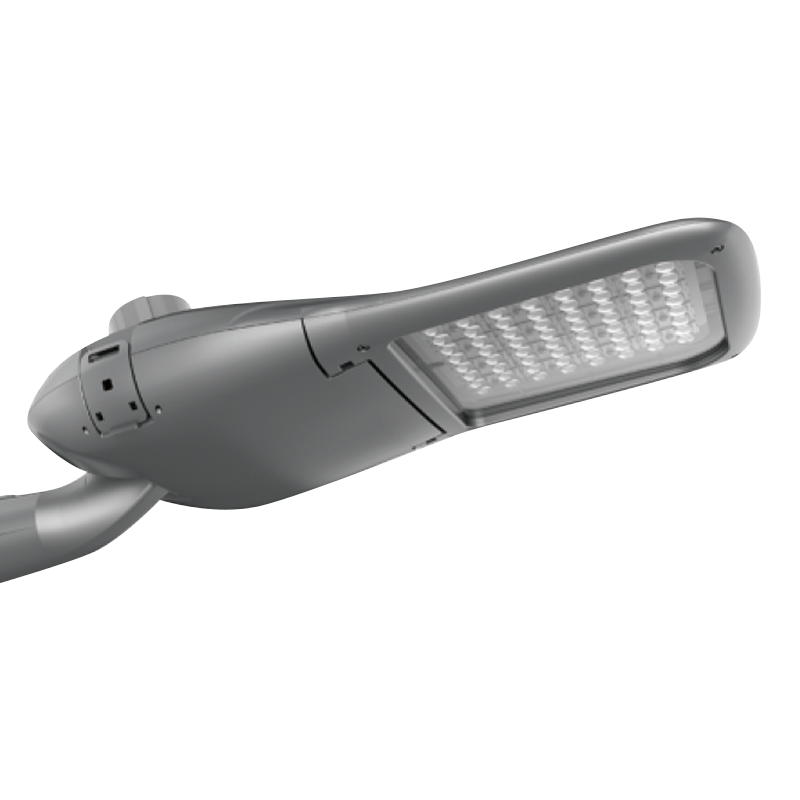
Weatherproof LED Street Lamp JD-1065
7. Advantage Four: Weather-Resistant Outdoor Construction
Outdoor street lamps are exposed to rain, humidity, dust, temperature changes, wind, ultraviolet radiation, and airborne contaminants. In coastal or industrial environments, salt or chemical particles may create additional corrosion concerns. A fixture that performs well indoors may not be suitable for long-term exterior use.
The JD-1065 is described as a weatherproof LED street lamp and is designed for stable operation in outdoor environments. Its robust structure and sealed outdoor-oriented construction help protect internal components from the conditions commonly encountered in roadway applications.
Weather resistance is not limited to the external housing. The complete fixture must be assembled carefully so that interfaces, covers, cable entry points, and driver compartments work together as a protective system. Manufacturing accuracy, gasket placement, fastening consistency, surface treatment, and inspection all contribute to the final reliability of the product.
The housing dimensions of 115 mm in height across the three size options provide a relatively compact profile for a roadway fixture. A streamlined form can reduce visual bulk on poles and may help limit wind exposure compared with unnecessarily deep housings. Final wind-load suitability must nevertheless be assessed according to the pole, bracket, installation height, local weather conditions, and applicable structural requirements.
For demanding environments, buyers should confirm the required ingress protection level, corrosion resistance, operating temperature range, impact resistance, surge protection, and electrical safety documentation for the exact configuration being ordered. The manufacturer can provide project-specific technical information where required.
8. Advantage Five: Thermal Management for Stable Operation
Heat management is one of the most important factors in LED fixture performance. LED chips, drivers, and electronic components generate heat during operation. If heat is not transferred away efficiently, component temperatures may rise, potentially affecting light output, color stability, driver life, and long-term reliability.
The JD-1065 is built with efficient thermal management as part of its outdoor design. The housing and internal arrangement are intended to help transfer heat away from the LED modules and other heat-producing components. This is particularly important for higher-power versions in the 200W to 300W range, where the thermal load is greater.
A sound thermal design can offer several benefits. It may help maintain more consistent light output over time, reduce thermal stress on electronic components, and support dependable operation in warm climates. It can also help protect the useful life of the LED system when the fixture is operated for long periods each night.
Thermal performance depends on the complete installation. The luminaire should be mounted according to the manufacturer’s instructions, with the heat-dissipating surfaces kept clear of obstruction. Accumulated dust, incorrect mounting angles, blocked ventilation paths, or installation inside an unsuitable enclosure can affect heat transfer.
HuaSheng’s manufacturing capabilities include die-casting and CNC machining equipment, which can support the production of accurately formed metal housings and mounting components. Consistent geometry is valuable because thermal interfaces, mounting points, and cover alignment depend on dimensional accuracy.
9. Advantage Six: 3030 and 5050 LED Options
The JD-1065 can be configured with 3030 or 5050 LED packages. These package options give buyers and project designers greater flexibility when balancing output, module layout, thermal characteristics, and fixture size.
LED package selection should be based on the intended power level, optical requirements, color specification, thermal design, and availability of replacement components. The 3030 and 5050 formats can be arranged in different ways to support the needs of various roadway designs. The correct selection may also depend on the desired luminous intensity distribution and the number of LED modules used in the fixture.
Using established LED package formats can support easier technical communication between the buyer, lighting designer, and manufacturer. It also allows the project team to compare configurations more clearly during the quotation and approval process.
Buyers should request the applicable LED binning information, color temperature, color rendering characteristics, lumen maintenance data, and test documentation for the chosen configuration. These details help ensure that the delivered product matches the design assumptions used in the lighting calculation.
10. Manufacturing Strengths Behind the Product
A professional street light is the result of coordinated design, material selection, production, assembly, and testing. The manufacturing capabilities of the supplier are therefore an important part of the product evaluation.
Cixi HuaSheng Lighting Co., Ltd. operates as an outdoor lighting manufacturer in Ningbo, China, with product exports to international markets. Its product range includes LED street lights, tunnel lights, high-bay lights, linear lights, garden lights, solar lights, grow lights, explosion-proof lights, and other lighting products.
The company’s manufacturing resources include die-casting machines, CNC machines, aging lines, and goniophotometers. Each type of equipment supports a different stage of product development and quality assurance.
10.1 Die-Casting Capability
Die-casting is commonly used to produce strong, repeatable metal housings for outdoor LED lighting. It can create complex shapes with integrated ribs, mounting features, structural supports, and heat-dissipation surfaces. Consistent die-cast geometry helps maintain a stable appearance and supports reliable assembly across production batches.
For the JD-1065, die-casting capability can contribute to the precision and strength of the lamp body. It also allows the manufacturer to develop housing variations for the small, medium, and large sizes while maintaining a coherent product design.
10.2 CNC Machining
CNC machining can be used for accurate finishing of mounting interfaces, threaded points, joining surfaces, and other components requiring close dimensional control. Precise machining is particularly useful for pole connections and cover interfaces, where poor alignment could complicate installation or create sealing difficulties.
By combining die-casting with CNC processing, a manufacturer can balance production efficiency with the precision required for critical areas. This is valuable for customized projects in which a customer requires a particular bracket, mounting angle, interface dimension, or enclosure modification.
10.3 Aging Lines
Aging is a controlled operating process used to identify potential early failures in electrical and electronic products before shipment. Lighting fixtures may be powered for a defined period under controlled conditions so that unstable components, assembly issues, or early driver problems can be detected.
An aging line supports more consistent quality control than relying only on visual inspection. It is especially relevant for LED street lamps because the products are often installed in locations where service access is difficult and replacement can require traffic management equipment or specialized maintenance crews.
10.4 Goniophotometer Testing
A goniophotometer measures the distribution of light from a luminaire at different angles. This information is used to create photometric files and evaluate the way light is directed onto roads and surrounding areas.
Access to goniophotometric testing helps the manufacturer support professional lighting design. DIALux calculations and similar planning tools depend on accurate photometric information. Reliable measurement can improve confidence in predicted illuminance and uniformity before a project is built.
11. Quality Management and Compliance Orientation
HuaSheng reports certification to ISO 9001, ISO 14001, and ISO 45001. These standards relate respectively to quality management, environmental management, and occupational health and safety management. Together, they indicate an organized approach to production control, environmental responsibility, and workplace safety.
ISO 9001 principles can support documented processes, corrective actions, traceability, customer feedback management, and continual improvement. For buyers, a structured quality system can make it easier to communicate technical requirements and manage repeat orders.
ISO 14001 reflects an environmental management framework. Outdoor lighting projects increasingly consider energy consumption, material use, packaging, production impacts, and end-of-life handling. A manufacturer with an environmental management system is better positioned to address these topics through controlled procedures.
ISO 45001 focuses on occupational health and safety. Safe manufacturing practices are important not only for employees but also for supply continuity and responsible sourcing. A stable production environment can reduce avoidable disruptions and support reliable delivery schedules.
The company also reports relevant product certifications including CB and CE for applicable products. Certification requirements vary according to the product configuration, destination market, electrical system, and applicable standards. Buyers should request current certificates and test reports for the exact JD-1065 version being purchased rather than assuming that one document applies to every variant.
12. Customization for Different Projects
Road lighting projects often involve requirements that cannot be met by an unchanged catalog product. Pole dimensions, arm designs, wiring systems, control methods, appearance, output levels, and packaging rules may differ between countries and projects.
The JD-1065 supports customized production, including wattage and appearance adjustments. This allows the buyer to discuss project-specific requirements with the manufacturer before mass production begins.
Wattage customization may be useful when the standard steps do not match a calculated lighting target. For example, a project may require a power level between two commonly offered configurations. Adjusting the LED quantity, drive current, or module arrangement may help achieve a more precise result, subject to engineering review.
Appearance adjustments may include surface color, logo treatment, housing details, labeling, packaging, or other visual elements. Custom appearance can help public authorities, property developers, and commercial operators maintain a consistent design language throughout a site.
The company also provides mold design, OEM/ODM, SKD/CKD customization, and one-stop project services. OEM and ODM support can be valuable for distributors that need their own product identity or require a fixture adapted to a specific market. SKD and CKD options may help customers organize local assembly, logistics, or final-stage production according to regional business arrangements.
Customization should be managed through an approved technical specification. The document should identify the power, LED package, color temperature, optical distribution, driver, surge protection, housing size, mounting interface, finish, control method, certifications, packaging, and inspection requirements. Clear documentation reduces misunderstandings between design approval and final delivery.
13. Comparison with Basic or Less Adaptable Street Lights
The JD-1065 has several practical advantages when compared with basic fixed-output street lights. The first is its broad output range. A fixed-output lamp may be acceptable for one road but unsuitable for another, while the JD-1065 product family allows the same general design to be selected across different applications.
The second advantage is the combination of efficacy and optical flexibility. Some low-cost luminaires focus primarily on initial purchase price and may offer limited optical choices. A professionally designed fixture can provide greater value when it produces useful, well-distributed illumination and reduces energy use over its operating life.
The third advantage is manufacturing depth. A supplier with die-casting, CNC machining, aging, and photometric testing capabilities can control more parts of the product lifecycle than a trading company that only assembles or resells imported components. Greater process control can support more consistent dimensions, better customization, and more direct technical communication.
The fourth advantage is project support. DIALux design assistance, mold development, OEM/ODM services, and customized production can reduce the technical burden on contractors and lighting distributors. These services are particularly useful for projects that require calculations, approval documents, special mounting arrangements, or repeated supply over time.
Cost should still be evaluated across the entire lifecycle. A low initial price may not represent the lowest total cost if the product consumes more electricity, requires frequent maintenance, produces uneven lighting, or becomes difficult to replace. The JD-1065 is positioned as a professional solution that considers operating performance, reliability, customization, and supply support together.
14. Applications
14.1 Municipal Roads
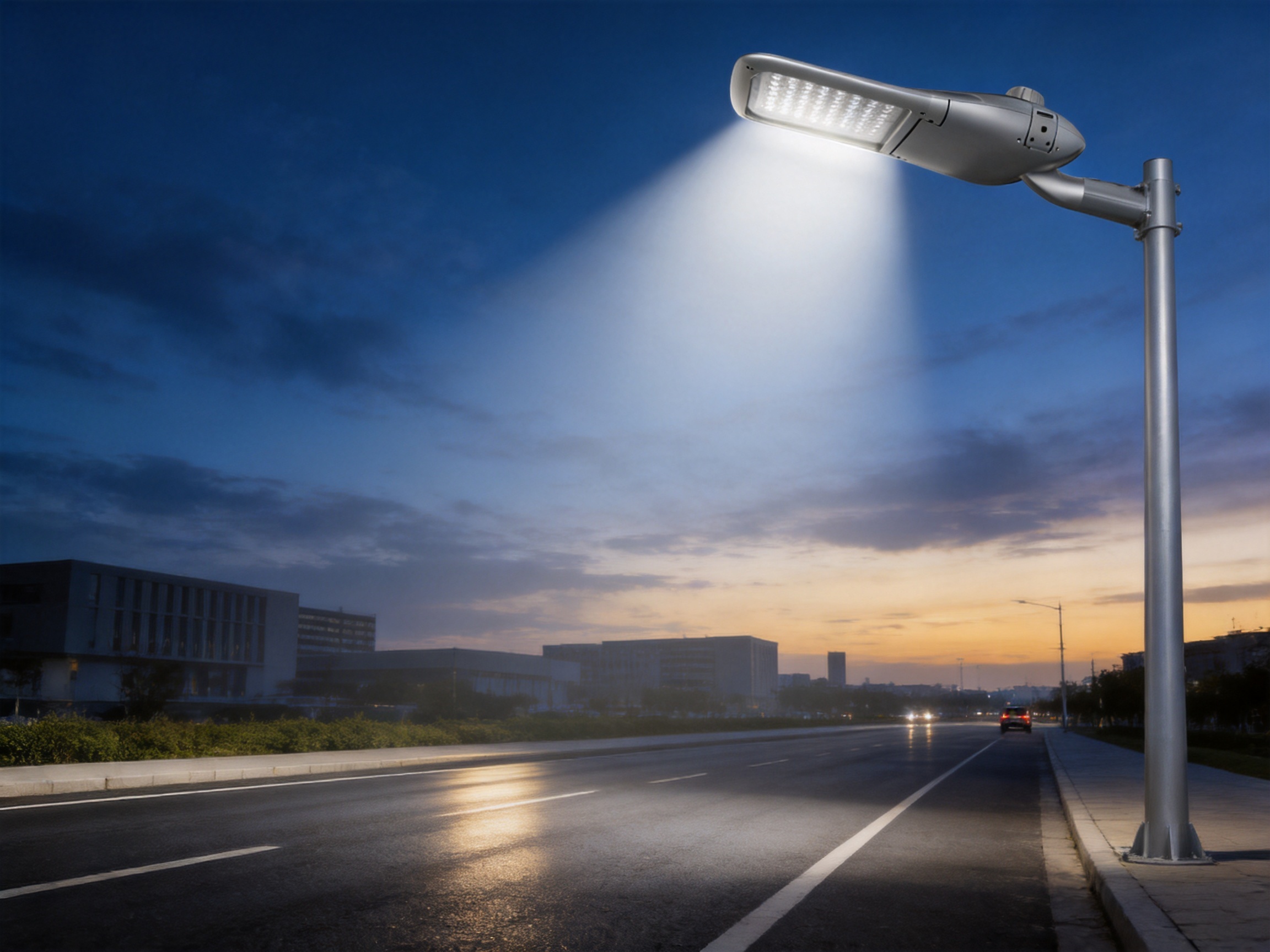
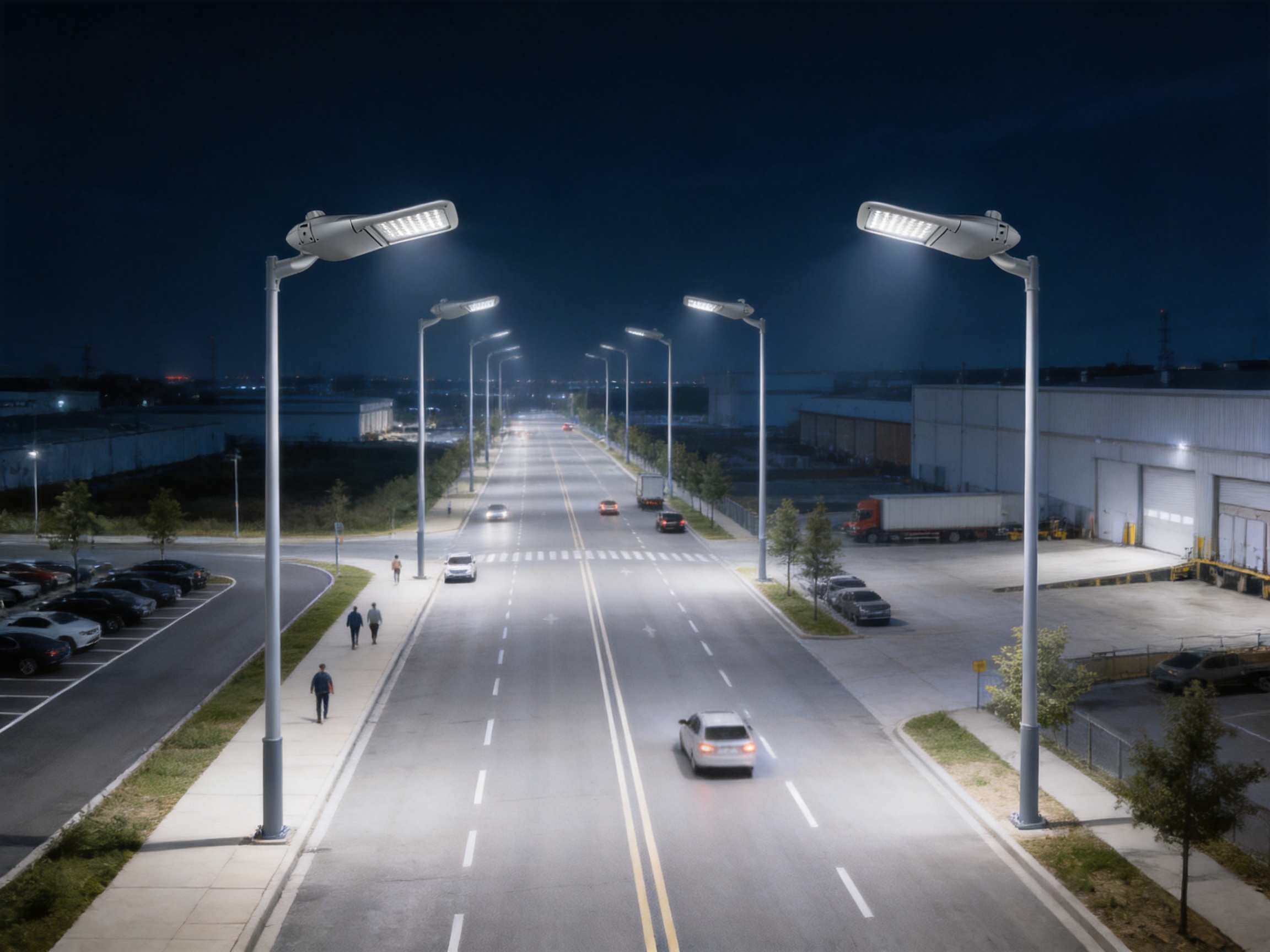
Municipal roads require dependable lighting that supports drivers, cyclists, pedestrians, and nearby properties. The JD-1065 can be selected in different wattages and sizes according to road width, pole height, traffic conditions, and spacing. Its weatherproof outdoor design is suitable for long-term public infrastructure applications when the complete specification meets local requirements.
14.2 Industrial Parks and Factory Areas
Industrial parks often include internal roads, loading areas, security entrances, employee parking, and large open yards. These spaces may operate throughout the night and can experience dust, vehicle activity, and demanding maintenance conditions. Efficient LED lighting can improve visibility while helping control operating expenses.
14.3 Commercial Developments
Shopping centers, office parks, hotels, warehouses, and commercial complexes require lighting that is functional and visually coordinated. The JD-1065’s appearance options and multiple housing sizes can help maintain a consistent outdoor design while allowing different output levels for roads, parking zones, and service entrances.
14.4 Residential and Community Roads
Residential roads require a balance between visibility, comfort, energy efficiency, and control of unwanted light. A suitable optical distribution can help illuminate the roadway without directing excessive light toward windows or neighboring properties. Lower-power versions may be appropriate for smaller internal streets and access lanes.
14.5 Parking Areas and Access Routes
Parking areas and access routes often have irregular layouts and mixed pedestrian and vehicle movement. The fixture can be used as part of a coordinated lighting plan, with wattage and optics selected according to pole arrangement, parking-bay geometry, and required illumination levels.
15. Project Design and Installation Considerations
Correct installation is essential for obtaining the intended performance from any LED street lamp. Before ordering, the project team should collect information about road width, pole spacing, pole height, mounting arm length, road surface, traffic patterns, surrounding buildings, trees, and existing electrical infrastructure.
The selected JD-1065 configuration should be evaluated using a photometric calculation. Important results include average illuminance, minimum illuminance, uniformity, glare, spill light, and total connected load. DIALux design support can help compare different wattages and optical distributions.
The pole and bracket must be capable of supporting the luminaire’s weight and wind load. The mounting interface should be checked for diameter, insertion depth, fastening method, and adjustment range. Any customized mounting component should be approved through a technical drawing before production.
Electrical compatibility must also be confirmed. The project specification should identify input voltage, frequency, driver characteristics, grounding requirements, surge protection, dimming method, photocell interface, and control system compatibility. If the road is located in an area with frequent lightning or unstable power, additional surge protection may be appropriate.
During installation, the fixture should be handled carefully to prevent damage to the housing, lens, cables, connectors, or surface finish. Fasteners should be tightened according to the approved instructions. The fixture should be aligned to the intended road direction and mounting angle so that the photometric design remains valid.
After installation, the contractor should inspect the connections, verify grounding, check the control system, confirm the lamp orientation, and perform an operational test. A night-time inspection can help identify unexpected shadows, glare, uneven illumination, or light trespass.
16. Maintenance and Lifecycle Benefits
LED street lamps are often installed in locations where maintenance is more difficult than in indoor facilities. Roads may require traffic control, lifting equipment, temporary closures, and additional safety procedures. For this reason, reliability and maintainability are important parts of total project value.
The JD-1065 is designed to support stable outdoor operation through efficient thermal management, robust construction, and controlled manufacturing. Consistent production can help reduce the risk of dimensional problems, loose assemblies, and early electrical failures.
Routine maintenance should include visual inspection of the housing, lens, mounting bracket, cable entry area, and pole connection. Dust, leaves, industrial deposits, or bird activity may accumulate on outdoor fixtures and affect appearance or thermal performance. In areas with heavy pollution or salt exposure, cleaning and corrosion checks may be required more frequently.
Electrical inspections should verify that connections remain secure and that protective devices are functioning. If a control system is installed, the operating schedule and dimming profile should be reviewed periodically. Keeping records of installation dates, configuration details, inspections, and replacement parts can improve long-term asset management.
Because the JD-1065 is available in a family of sizes and power ratings, future replacement may be easier when the project owner maintains accurate product records. Replacement fixtures can be matched to the original wattage, housing size, optical distribution, and mounting method.
17. Sustainability and Energy Management
Energy efficiency is increasingly important for municipalities, industrial companies, commercial property owners, and infrastructure investors. Street lighting can represent a significant recurring electricity load because luminaires may operate every night for many hours.
The JD-1065’s efficacy of 130 to 160 lumens per watt provides a foundation for reducing installed power while maintaining useful illumination. The final energy result depends on the lighting design, operating hours, dimming schedule, pole spacing, and maintenance condition.
LED systems also support more flexible control than many older lamp technologies. A project may use photocells for dusk-to-dawn operation, timers for scheduled reduction, or a networked control system for remote monitoring and adaptive dimming. These functions should be specified with the appropriate driver and control interface during the design stage.
Environmental responsibility also involves product manufacturing. HuaSheng reports an ISO 14001 environmental management system and manufactures products intended to support energy-efficient lighting applications. Buyers can further improve sustainability by selecting the correct wattage, avoiding unnecessary over-lighting, using durable products, planning maintenance, and managing end-of-life electrical equipment responsibly.
18. Procurement Guidance for Distributors and Project Buyers
Distributors should define the target market before selecting the JD-1065 configuration. Important factors include the required certification, voltage system, preferred LED package, common road types, pole dimensions, expected order quantities, packaging requirements, and the need for private labeling.
For project buyers, the procurement specification should be based on performance rather than wattage alone. The buyer should request photometric data, efficacy information, color characteristics, driver details, operating temperature data, electrical test documents, and environmental protection information for the exact model.
Sample approval is recommended before mass production. The sample should be examined for housing quality, finish, mounting fit, cable routing, optical performance, light color, labeling, and installation compatibility. If a customized appearance or mounting interface is required, approval should be completed before the production mold or tooling is finalized.
Quality agreements can define incoming inspection, production inspection, aging requirements, photometric testing, packaging standards, acceptable tolerances, and procedures for handling nonconforming goods. These controls are especially important for large infrastructure projects where many fixtures must perform consistently.
Buyers should also evaluate delivery capability and after-sales communication. The manufacturer’s ability to provide technical drawings, replacement parts, installation instructions, photometric files, and troubleshooting support can be as important as the initial product quotation.
19. Manufacturing Workflow from Design to Delivery
A professional product workflow usually begins with requirement analysis. The customer communicates the intended application, road layout, mounting conditions, output target, environmental conditions, market requirements, and customization needs. The manufacturer then evaluates whether an existing configuration is suitable or whether engineering changes are required.
The next stage is optical and mechanical design. The team selects the LED package, optical arrangement, housing size, heat-dissipation structure, driver location, mounting interface, and sealing details. DIALux calculations and photometric analysis can be used to compare performance under the proposed road layout.
Where new mechanical parts are needed, mold design and tooling preparation follow. Die-casting molds must be designed to support dimensional stability, material flow, structural strength, and efficient production. CNC machining may then be used to finish critical interfaces and mounting areas.
Component preparation includes LED modules, drivers, optics, gaskets, fasteners, cables, connectors, brackets, and housing parts. Incoming materials should be checked against approved specifications. Assembly personnel install the components according to controlled work instructions.
Electrical and visual inspections are carried out after assembly. The fixture may be checked for power, current, light output, color consistency, grounding, mechanical fit, and appearance. Aging tests can help identify early failures before the product is packed.
Photometric testing using a goniophotometer can verify the light distribution and generate data for professional lighting calculations. The final product is then packaged according to transportation requirements, with suitable protection for the housing, lens, mounting parts, and electrical connections.
For export orders, documentation and packaging can be adapted to the destination market. OEM/ODM projects may include customized labels, manuals, cartons, inspection records, and product identification. One-stop support can help customers coordinate engineering, production, testing, and delivery through one supplier.
20. Why Manufacturing Integration Matters
Manufacturing integration can reduce communication gaps between design, machining, assembly, and testing. When the supplier controls or closely coordinates these stages, technical changes can be reviewed more quickly and production feedback can be incorporated into the design.
For the JD-1065, integrated capabilities are particularly valuable because street lighting requires cooperation between mechanical structure, optical performance, electrical systems, and outdoor durability. A change to the housing may affect heat dissipation. A change to the LED arrangement may affect the optical distribution. A different bracket may affect installation angle and wind load. These relationships are easier to manage when the manufacturer has engineering and production experience across multiple disciplines.
Integrated manufacturing can also support repeatability. Once a customer-approved configuration has been established, production teams can use controlled drawings, tooling, inspection standards, and test procedures for future orders. This helps distributors and infrastructure owners maintain consistency across replacement and expansion projects.
21. Practical Performance Expectations
The JD-1065 is intended to provide stable and consistent illumination for outdoor road applications. Its performance should be understood as part of a complete lighting system rather than as an isolated number on a product sheet.
Light output will vary according to the chosen wattage and LED configuration. A 30W model cannot be expected to illuminate the same road geometry as a 300W model. Likewise, two fixtures with identical wattage may produce different results if their optics, mounting height, and spacing differ.
For best results, the project team should select the fixture after reviewing the road classification and lighting target. The manufacturer can assist with design calculations, but the final design should also comply with the relevant local roadway lighting standards and authority requirements.
When the product is correctly specified and installed, the combination of efficient LED output, weather-oriented construction, thermal management, and flexible optical design can provide a dependable alternative to older lighting systems and less adaptable LED fixtures.
22. Questions and Answers
What is the JD-1065?
The JD-1065 is a weatherproof LED street lamp designed for municipal, commercial, industrial, and other outdoor roadway lighting applications. It is available in power configurations from 30W to 300W.
What LED packages are available?
The product can use 3030 or 5050 LED packages. The appropriate option depends on the required power, optical arrangement, thermal design, and project specification.
What is the efficacy of the fixture?
The stated efficacy range is 130 to 160 lumens per watt. Actual system performance should be confirmed for the selected configuration and operating conditions.
Are different housing sizes available?
Yes. The product is available in small, medium, and large housing sizes. The small size measures 577 x 229 x 115 mm, the medium size measures 639 x 260 x 115 mm, and the large size measures 700 x 310 x 115 mm.
Can the wattage be customized?
Customized wattage is available subject to engineering review and production requirements. The buyer should provide the desired lighting target and project conditions so the manufacturer can recommend a suitable configuration.
Can the appearance be customized?
Yes. Appearance adjustments may be discussed for suitable projects. Options can include finish, color, labeling, visual details, packaging, and other approved design elements.
Can the product be used for industrial roads?
Yes. The JD-1065 can be considered for industrial parks, factory roads, logistics areas, loading zones, and access routes. The selected configuration should be evaluated against the site’s dust, temperature, traffic, corrosion, and illumination requirements.
Does the manufacturer provide lighting design support?
Yes. The company provides DIALux design and efficient lighting solution services. These services can help evaluate mounting height, pole spacing, optical distribution, illuminance, uniformity, and energy consumption.
What manufacturing capabilities support the product?
The company operates die-casting and CNC machining equipment and has aging lines and goniophotometers. These capabilities support housing production, precision finishing, pre-shipment operating tests, and photometric evaluation.
What certifications does the manufacturer report?
The company reports ISO 9001, ISO 14001, and ISO 45001 certification. It also reports relevant CB and CE certifications for applicable products. Buyers should request documentation for the exact product configuration and destination market.
What should be confirmed before placing an order?
Buyers should confirm wattage, LED package, optical distribution, color temperature, driver, input voltage, surge protection, mounting interface, housing size, finish, control requirements, environmental protection, certification, packaging, delivery schedule, and inspection procedures.
Is the JD-1065 suitable for replacement projects?
It may be suitable for replacement projects when the mounting dimensions, electrical requirements, optical performance, and local standards are compatible. A site survey and photometric review are recommended before replacing existing fixtures.
23. Conclusion
The Weatherproof LED Street Lamp JD-1065 is a flexible professional lighting solution for roads and outdoor areas. Its 30W to 300W power range enables project designers to select output according to the application, while the 3030 and 5050 LED options provide additional configuration flexibility. With an efficacy of 130 to 160 lumens per watt, the fixture is designed to support efficient operation and lower long-term energy consumption.
Its advantages extend beyond LED performance. The weatherproof outdoor-oriented construction, thermal management, three housing sizes, and flexible optical design make the product suitable for different roadway layouts and environmental conditions. Compared with basic fixed-output luminaires, the JD-1065 offers greater adaptability for municipal, commercial, industrial, and residential projects.
The manufacturing strengths behind the product add further value. Die-casting, CNC machining, aging lines, goniophotometric testing, mold design, OEM/ODM services, SKD/CKD customization, and DIALux support provide a broader project service than simple product resale. The manufacturer’s reported ISO management systems and relevant product certifications also demonstrate an organized approach to quality, environmental management, and production safety.
For the best result, buyers should treat the JD-1065 as part of a complete lighting design. Correct wattage, optics, mounting height, spacing, electrical compatibility, control strategy, and installation practice are essential. When these factors are properly coordinated, the fixture can provide reliable illumination, improved energy efficiency, simplified product selection, and a strong foundation for long-term outdoor lighting projects.
References
1. Product technical information for the Weatherproof LED Street Lamp JD-1065, including power range, LED package options, efficacy, and housing dimensions.
2. General principles of roadway lighting design, including illuminance, uniformity, glare control, optical distribution, and maintenance planning.
3. ISO 9001 quality management system principles and their application to manufacturing process control.
4. ISO 14001 environmental management system principles for responsible industrial production.
5. ISO 45001 occupational health and safety management system principles.
6. General LED luminaire thermal management and light-emitting diode reliability practices.
7. Professional photometric testing and lighting simulation practices using goniophotometers and DIALux software.
8. General guidance for outdoor luminaire installation, electrical compatibility, grounding, surge protection, and maintenance.
9. Manufacturer information regarding outdoor lighting production, die-casting, CNC machining, aging testing, customized manufacturing, and international project services.
Product: Weatherproof LED Street Lamp JD-1065

YQF Group - World Leading One-Stop Lighting & Solar For the Global Partners
Custom & OEM Solutions for Global Lighting Brands
Copyright © Cixi HuaSheng Lighting Co., Ltd. All Rights Reserved.
Die-Casting Mould Supplier
