 English
 中文简体
 русский
 Français
 Español
 عربى
 Indonesia

Why Isolated Constant-Power DALI-2 and D4i LED Drivers Are Transforming Outdoor Lighting
Outdoor lighting has moved far beyond the simple task of converting mains electricity into light. Modern roadways, public spaces, industrial campuses, tunnels, urban districts, and architectural facades require lighting systems that are efficient, programmable, interoperable, easy to commission, and reliable under difficult environmental conditions. At the center of these systems is the LED driver, which determines how effectively a luminaire manages electrical power, communicates with a control network, responds to thermal conditions, and maintains stable performance over its service life.
The U7+ isolated constant-power LED driver has been developed for precisely this modern lighting environment. It combines constant-power operation, NFC-based programming, DALI-2 and D4i compatibility, time-control dimming, a built-in 16 V DALI bus supply, and a 24 V auxiliary output in one programmable platform. Designed for outdoor and urban illumination, the series covers power ratings from 22 W to 200 W and provides multiple voltage and current combinations for different LED module configurations.
Its value is not limited to a broad electrical specification. The U7+ is also supported by the manufacturing capabilities of Cixi HuaSheng Lighting Co., Ltd., a Ningbo-based outdoor lighting manufacturer with experience in LED luminaires, power systems, die-casting, CNC machining, optical testing, assembly, and OEM/ODM services. This combination of driver technology and manufacturing infrastructure enables lighting manufacturers to source a programmable driver and develop a complete luminaire solution with greater consistency.
For competing products, the most important comparison is not simply rated wattage. A professional buyer must consider electrical stability, control compatibility, programming efficiency, safety architecture, thermal behavior, manufacturing quality, customization options, and long-term supply support. The U7+ series addresses each of these areas through an integrated design intended for professional outdoor lighting projects.
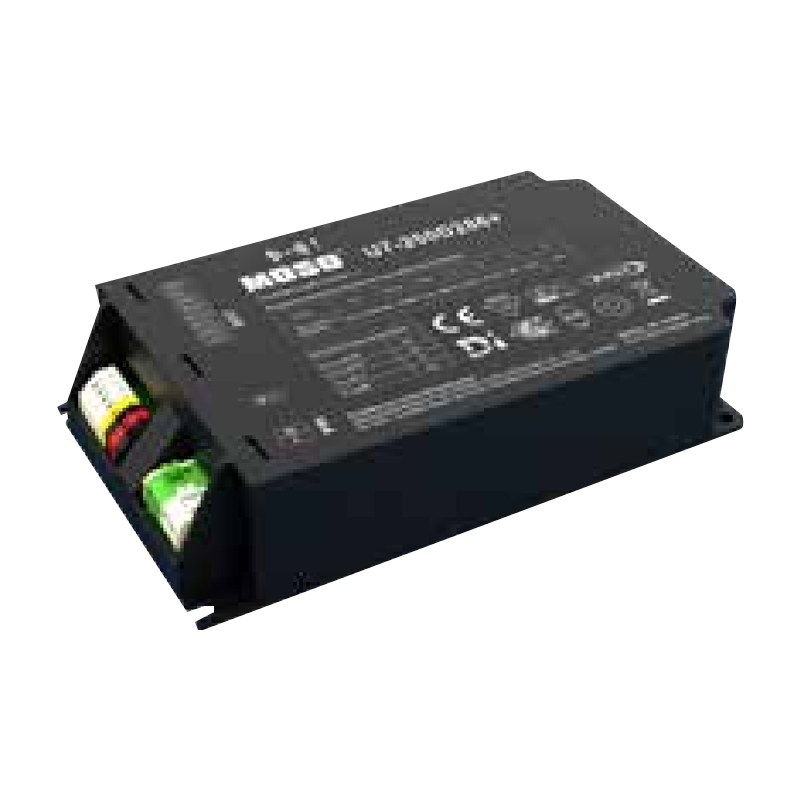
Isolated Constant Power DALI-2 / D4i LED Driver U7+
1. The Role of the LED Driver in Modern Outdoor Lighting
An LED luminaire is only as dependable as the system that powers it. LED chips require carefully controlled current and voltage. If the current fluctuates excessively, the light output may change, the color may shift, and the LED module may experience accelerated aging. If the driver operates inefficiently, unnecessary heat accumulates inside the housing. If the driver lacks suitable control interfaces, the luminaire may not integrate smoothly with a citywide management system.
Traditional fixed-output drivers can be suitable for simple installations, but they are increasingly limited in connected lighting projects. Road lighting networks often require scheduled dimming, remote management, energy reporting, fault detection, and compatibility with standardized control devices. Architectural and facade lighting projects may require different current settings for different LED boards. Industrial sites may demand stable operation despite voltage variation, high ambient temperatures, dust, vibration, or long operating hours.
The LED driver must therefore perform several functions at the same time. It must convert the input voltage efficiently, regulate the LED load accurately, protect the luminaire from electrical disturbances, support dimming commands, communicate with control equipment, and maintain predictable performance throughout changing operating conditions.
The U7+ series is designed around this multifunctional requirement. Instead of treating power conversion and intelligent control as separate components, it integrates programmable electrical output with DALI-2 and D4i communication capabilities. This reduces design complexity and allows the driver to become an active part of the luminaire management architecture.
1.1 Constant-power operation
Constant-power operation is particularly useful in outdoor luminaires with different LED voltage requirements. Rather than delivering only one fixed current across a narrow voltage condition, a constant-power driver can coordinate its output voltage and current within the specified range. This allows the luminaire designer to select a suitable operating point for the LED module while maintaining the intended power level.
For example, a 60 W model may support an output voltage range from 38 V to 86 V with an adjustable full-power current range of 0.70 A to 1.05 A. This gives manufacturers more flexibility when matching the driver with LED boards that have different series arrangements or forward-voltage characteristics.
The result is a more adaptable platform for luminaire development. Manufacturers do not need to create an entirely different driver architecture for every LED board configuration. Instead, they can select an appropriate U7+ model and program the output for the intended module.
1.2 Isolation for system safety and reliability
The U7+ is an isolated LED driver. Isolation separates the input-side electrical domain from the output-side lighting and control domain. In practical applications, this can improve safety design, simplify system integration, and reduce unwanted electrical interaction between the mains input and the LED load.
Isolation is especially valuable in outdoor luminaires, where long cable runs, metal housings, control networks, surge events, and changing environmental conditions can create additional electrical stress. A carefully designed isolated architecture supports a safer and more controlled relationship between the driver, LED module, auxiliary equipment, and DALI communication system.
For luminaire manufacturers, an isolated design can also make product development more manageable. It provides a clearly defined electrical structure for integrating LED boards, sensors, control interfaces, and auxiliary devices while helping engineers address insulation and system protection requirements during certification and testing.
2. Main Technical Advantages of the U7+ Series
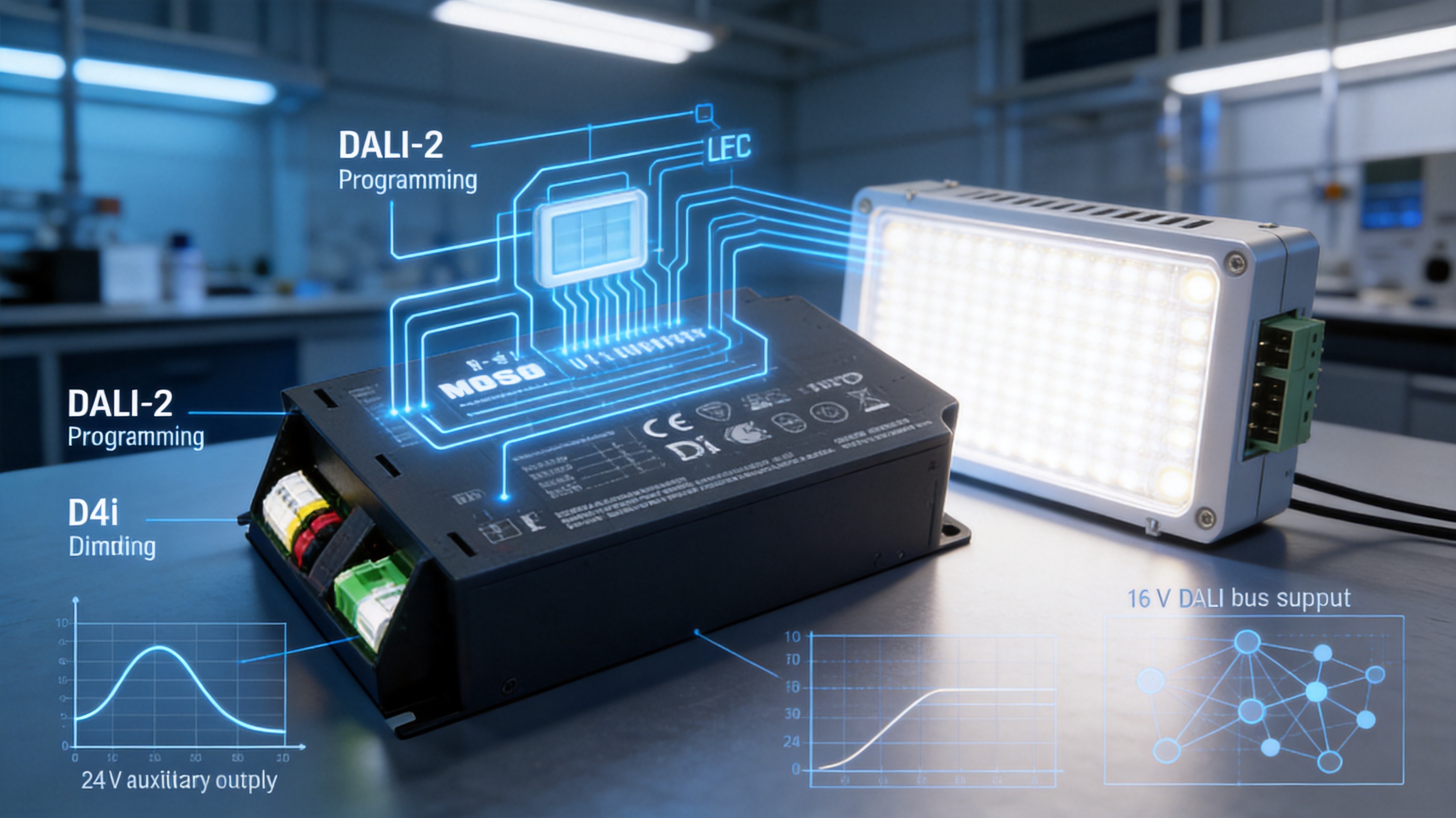
The U7+ series combines several functions that are often distributed across multiple components in less integrated solutions. Its main advantages include wide input operation, programmable output, standardized communication, built-in auxiliary supplies, low standby consumption, and multiple power options.
2.1 Wide input voltage compatibility
The driver operates from 176 Vac to 305 Vac. This input range is suitable for many 220–240 V outdoor lighting networks and provides useful tolerance for normal mains fluctuations. In real installations, supply voltage may vary according to grid loading, cable length, local distribution conditions, and changes in demand. A driver with insufficient input tolerance may experience shutdowns, flicker, reduced output, or premature stress.
By supporting a broad 176–305 Vac input range, the U7+ gives luminaire designers additional confidence when specifying products for different regions and outdoor infrastructure environments. It also reduces the need to redesign the driver platform for every local grid condition.
The wide input range should not be confused with unlimited protection from abnormal electrical events. Proper surge protection, grounding, wiring, enclosure design, and installation practice remain essential. However, the driver’s input capability forms an important part of a robust electrical system.
2.2 Programmable output through NFC
NFC programming allows output parameters to be configured without relying entirely on mechanical adjustment or complicated wiring. Manufacturers can set current values, prepare product-specific configurations, and streamline production-line programming before the luminaire is shipped.
This is a major advantage over fixed-current drivers. A factory can use one driver family for several luminaire models while programming each unit according to the relevant LED module. OEM and ODM customers can also establish a standardized configuration process for private-label products, reducing manual variation between production batches.
NFC programming can be beneficial during maintenance as well. When a luminaire requires replacement or configuration adjustment, service personnel may be able to apply the correct settings more efficiently than with a driver that requires extensive physical access or component replacement. The exact service procedure depends on the project’s control and maintenance policies, but the programmable architecture creates more options.
2.3 DALI-2 and D4i support
DALI-2 is a recognized digital lighting control protocol used for addressing, dimming, configuration, monitoring, and interoperability between lighting devices and control systems. D4i extends the DALI ecosystem with features suited to intelligent luminaires, including data, energy information, diagnostics, and sensor or control device integration.
The U7+ supports DALI-2 and D4i, including the stated DALI parts 150 and 250 through 253. This allows it to fit into advanced lighting systems that require more than a basic dimming signal. A compatible driver can participate in a structured control environment where each luminaire has an address, receives scheduled commands, and potentially reports operating information to a supervisory system.
For road lighting and urban illumination projects, protocol compatibility can reduce the risk of vendor lock-in. Lighting manufacturers and project developers can select control equipment from a broader ecosystem rather than depending on one proprietary communication method. Standardized communication also supports future expansion when a project adds sensors, gateways, energy management, or centralized monitoring.
Compared with a driver that only supports analog dimming or a proprietary control interface, a DALI-2 and D4i driver is better suited to connected lighting strategies. It provides a pathway from standalone luminaires to intelligent infrastructure.
2.4 Built-in 16 V bus supply and 24 V auxiliary supply
The U7+ includes a built-in 16 V DALI bus supply and a 24 V auxiliary supply. These integrated supplies can simplify the connection of compatible control and auxiliary devices, depending on the electrical requirements of the complete luminaire and project.
A built-in bus supply reduces the number of separate components that may otherwise be required in the luminaire. This can save space, reduce wiring complexity, and support a cleaner internal layout. It may also help manufacturers control the bill of materials and simplify assembly.
The 24 V auxiliary output is useful for approved auxiliary devices and control functions that require a low-voltage supply. Designers must always verify the available power, load requirements, wiring method, and applicable safety specifications before connecting additional equipment. Nevertheless, the presence of an integrated auxiliary supply gives the U7+ greater system value than a basic driver that only powers the LED board.
2.5 Time-control dimming
Time-control dimming allows lighting output to be reduced according to a planned operating schedule. This is valuable in road lighting, public areas, parking facilities, campuses, and industrial sites where full output is not necessary throughout the entire night.
A suitable dimming schedule can reduce energy use while maintaining the required level of safety and visibility. For example, a roadway may operate at a higher output during evening traffic peaks and at a lower output during periods of reduced traffic. Urban decorative lighting may also be dimmed after a designated time to reduce light pollution and operating costs.
Time-control functions can be used alongside DALI-2 or D4i systems, depending on the project architecture. The combination of scheduled control and digital communication allows operators to balance automatic operation with remote supervision and adjustment.
2.6 Low standby power
Standby power is an increasingly important consideration in connected lighting. A luminaire may spend many hours in a dimmed or standby state, and small losses across thousands of fixtures can become significant. The U7+ has standby power below 0.5 W, supporting the development of more energy-conscious lighting networks.
Low standby consumption is particularly relevant for intelligent luminaires that remain connected to control systems even when the LED output is low or switched off. It helps reduce the energy overhead associated with communication, monitoring, and scheduled control functions.
3. Model Range and Electrical Flexibility
The U7+ product family covers a wide range of output power levels, from compact 22 W versions to 200 W models. This range makes the platform suitable for multiple luminaire classes, including lower-power street lights, decorative fixtures, facade luminaires, industrial outdoor fittings, and higher-output roadway or area lighting.
| Model | Power | Output Voltage Range | Adjustable Full-Power Current Range | Typical Efficiency | Typical Power Factor | Dimensions |
|---|---|---|---|---|---|---|
| U7-022D072+ | 22 W | 24–72 Vdc | 0.30–0.50 A | 86% | 0.95 | 133 × 77 × 40 mm |
| U7-026D038+ | 26 W | 20–38 Vdc | 0.70–1.05 A | 86% | 0.95 | 133 × 77 × 40 mm |
| U7-032D112+ | 32 W | 45–112 Vdc | 0.30–0.50 A | 86% | 0.95 | 133 × 77 × 40 mm |
| U7-040D057+ | 40 W | 28–57 Vdc | 0.70–1.05 A | 88% | 0.98 | 133 × 77 × 40 mm |
| U7-060D086+ | 60 W | 38–86 Vdc | 0.70–1.05 A | 89% | 0.98 | 133 × 77 × 40 mm |
| U7-060D200+ | 60 W | 78–200 Vdc | 0.30–0.50 A | 89% | 0.98 | 133 × 77 × 40 mm |
| U7-080D115+ | 80 W | 35–115 Vdc | 0.70–1.05 A | 91% | 0.97 | 133 × 77 × 40 mm |
| U7-080D272+ | 80 W | 115–272 Vdc | 0.30–0.50 A | 91% | 0.97 | 133 × 77 × 40 mm |
| U7-120D172+ | 120 W | 75–172 Vdc | 0.70–1.05 A | 92% | 0.97 | 133 × 77 × 40 mm |
| U7-120D320+ | 120 W | 160–320 Vdc | 0.30–0.50 A | 92% | 0.97 | 133 × 77 × 40 mm |
| U7-165D236+ | 165 W | 115–236 Vdc | 0.70–1.05 A | 93% | 0.97 | 171 × 101 × 41 mm |
| U7-200D286+ | 200 W | 143–286 Vdc | 0.70–1.05 A | 93% | 0.97 | 171 × 101 × 41 mm |
The model structure shows that the family is not limited to one output-voltage pattern. Some versions are intended for lower-voltage, higher-current LED configurations, while others support higher-voltage, lower-current arrangements. This distinction is important because LED modules vary widely according to chip count, series-parallel topology, optical package, thermal design, and target luminous output.
The smaller models use a compact 133 × 77 × 40 mm housing, while the 165 W and 200 W versions use a 171 × 101 × 41 mm format. Consistent dimensional grouping across multiple models can help manufacturers standardize housing compartments, mounting features, and assembly procedures.
Typical efficiency rises with the higher-power models, reaching 93% for the 165 W and 200 W versions. Higher efficiency can reduce conversion losses, lower internal heat generation, and improve the thermal margin of the complete luminaire. It can also contribute to lower operating costs over a long project life.
Typical power factor values range from 0.95 to 0.98 across the series. A high power factor helps the lighting installation use the electrical supply more effectively and can reduce the reactive component of the input current. This is particularly relevant in large projects with many luminaires operating simultaneously.
3.1 Default settings and customization
Each model is supplied with a stated default output configuration, while the current range can be adjusted within the specified limits. This arrangement allows customers to receive a ready-to-use configuration while retaining flexibility for project-specific requirements.
The default settings also make production planning easier. A luminaire manufacturer can define a standard configuration for a particular product series, then request alternative programming when a project uses a different LED board or output target. Through OEM and ODM cooperation, branding, current ranges, interface details, and other product characteristics may be customized according to technical feasibility and agreed specifications.
Customization should be managed through controlled engineering documentation. The selected LED module, driver model, programmed current, optical system, thermal path, enclosure, and control settings should be validated together. This integrated approach prevents a common industry problem in which the driver is selected independently from the rest of the luminaire.
4. Advantages Compared with Less Integrated Driver Solutions
Many drivers in the market can provide stable power, but not all combine power conversion, programming, standardized control, auxiliary supplies, and production flexibility in one design. The U7+ has several advantages over simpler or less integrated alternatives.
4.1 More flexibility than fixed-output drivers
A fixed-output driver may be optimized for one LED board and one nominal current. This can be acceptable for a narrow product range, but it creates limitations when a manufacturer develops multiple wattages or sells the same luminaire platform in different markets.
The U7+ supports adjustable full-power current ranges and NFC programming. This allows one product family to serve several LED configurations without requiring a completely different control concept for every model. It can reduce engineering duplication and help manufacturers respond more quickly to customer requests.
4.2 More open control integration than proprietary systems
Proprietary control systems can deliver advanced functions, but they may restrict component selection and increase long-term dependence on one supplier. DALI-2 and D4i compatibility provides a more standardized path for connecting drivers with control units, sensors, gateways, and management platforms.
This is especially important in public infrastructure, where equipment may remain in service for many years. A standardized interface can make future replacement, expansion, and maintenance more manageable, provided that the complete system is designed and commissioned correctly.
4.3 Better system integration than a driver without auxiliary supplies
A conventional driver without integrated bus or auxiliary power may require separate power modules and additional wiring. That can increase component count, occupy valuable internal space, and introduce more points of failure.
The U7+ integrates a 16 V DALI bus supply and a 24 V auxiliary supply, helping manufacturers create a more compact and organized luminaire architecture. This does not eliminate the need to verify the power requirements of connected devices, but it can simplify the overall design.
4.4 More efficient commissioning than manually adjusted products
Manual potentiometers, resistor changes, or production-line hardware adjustments can introduce inconsistency. NFC configuration provides a digital method for setting output parameters, helping production teams follow a repeatable process.
For large orders, repeatability is a critical quality factor. Each driver should be programmed according to a controlled work instruction, checked against the target value, and recorded when project traceability is required. This approach is more suitable for scalable manufacturing than informal manual adjustment.
4.5 A broader platform for OEM and ODM programs
Lighting brands often need products that appear and operate as part of their own portfolio. The U7+ series supports OEM and ODM cooperation, allowing manufacturers to discuss branding, configuration, interface details, and product packaging according to project needs.
For a lighting company, this can shorten the path from concept to market. Instead of developing a driver completely from the beginning, the customer can build on an existing platform and focus engineering resources on the luminaire housing, optics, thermal system, installation method, and market-specific requirements.
5. Manufacturing Strengths Behind the Product
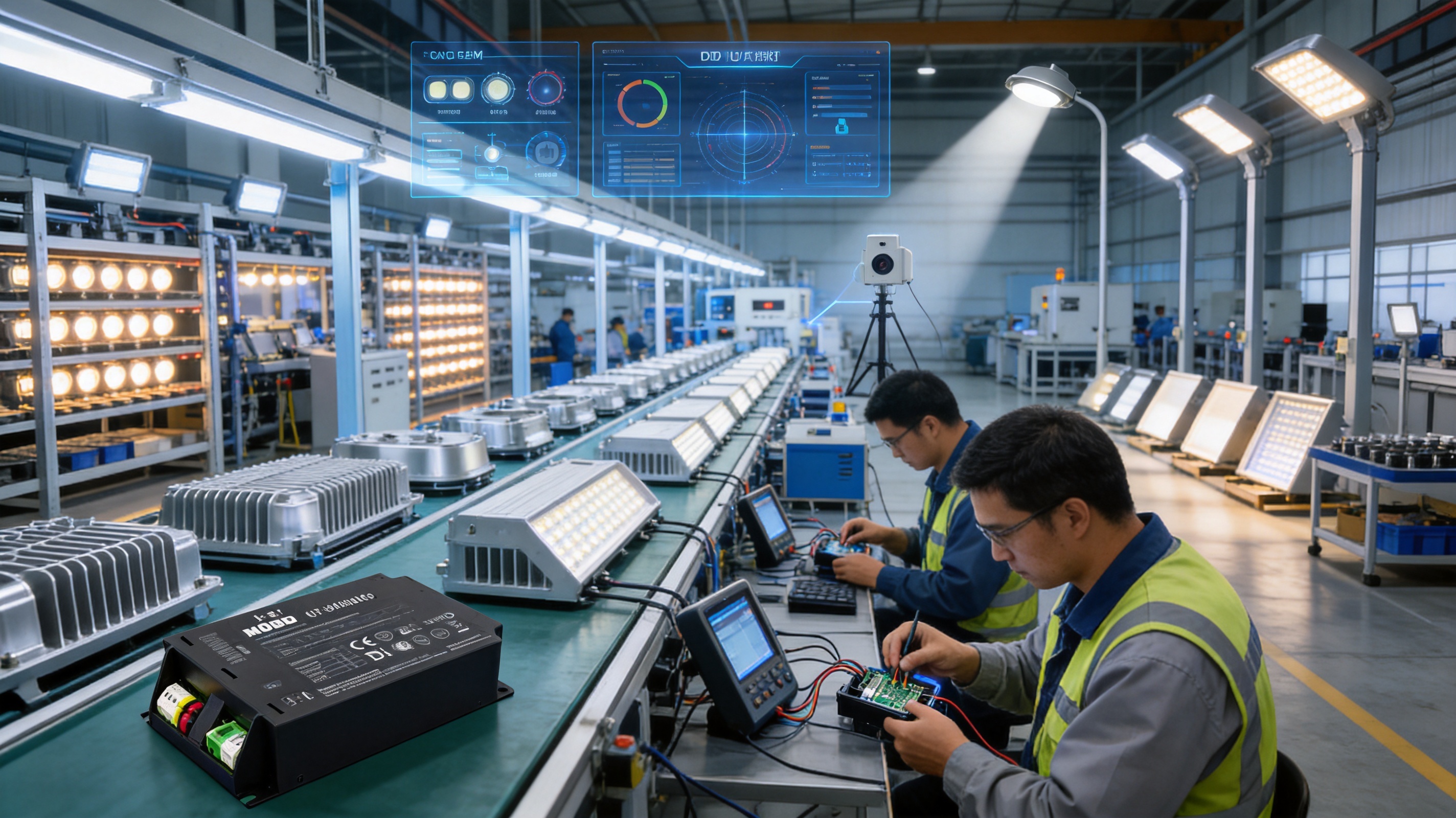
A technically capable driver is important, but manufacturing discipline determines whether product performance remains consistent across thousands of units. Cixi HuaSheng Lighting Co., Ltd. supports its lighting business with production and engineering resources that cover more than final assembly.
5.1 Experience in outdoor lighting products
The company is located in Cixi, Ningbo, Zhejiang, China, and specializes in outdoor lighting solutions for global markets. Its product scope includes LED street lights, tunnel lights, high-bay lights, linear lights, garden lights, solar lights, grow lights, explosion-proof lights, and other LED lighting products.
This product diversity is relevant to the U7+ driver because different lighting categories create different electrical and mechanical requirements. Street lights may emphasize control compatibility, surge protection, and long operating hours. Industrial high-bay luminaires may prioritize thermal management and continuous operation. Solar lighting products may require a different power architecture, while explosion-proof lighting demands careful attention to enclosure and safety design.
Experience across these categories helps a manufacturer understand that a driver cannot be evaluated separately from its application. The same electrical output may behave differently depending on housing volume, thermal interface, LED board layout, ambient temperature, optical structure, and installation position.
5.2 Die-casting and CNC machining
Die-casting is an important process for producing strong, repeatable aluminum lighting housings and heat sinks. A properly designed die-cast body can provide structural strength, controlled wall thickness, integrated mounting features, and an effective path for transferring heat away from internal components.
CNC machining complements die-casting by refining critical surfaces and dimensions. Mounting holes, sealing interfaces, cable openings, and other precision features may require machining after casting. This combination allows the manufacturer to balance production efficiency with dimensional accuracy.
For luminaires using a programmable driver, mechanical fit is especially important. The driver must be installed securely, with suitable clearance, wiring access, and thermal conditions. A well-controlled housing process helps maintain consistent internal space and mounting alignment from one production batch to another.
5.3 Aging lines and production verification
Aging is a useful manufacturing process for identifying early failures and confirming that assembled products operate under controlled conditions before shipment. Lighting products may be operated for a defined period while production teams monitor electrical behavior, temperature, light output, and abnormal conditions.
For driver-equipped luminaires, aging can help reveal wiring mistakes, poor connections, unstable output, communication problems, or thermal issues that may not appear during a short functional check. It is not a substitute for full reliability testing, but it is an important part of production quality control.
A structured production process should also include incoming inspection, assembly checks, electrical safety testing, functional verification, programming confirmation, visual inspection, and final packaging inspection. The exact test plan depends on the product and customer requirements, but the objective is consistent: prevent avoidable manufacturing variation from reaching the installation site.
5.4 Optical testing and goniophotometers
Lighting quality depends not only on electrical power but also on how light is distributed. The company’s use of goniophotometers supports photometric testing of luminaires. Such equipment can help evaluate luminous intensity distribution, beam shape, efficiency, and other optical characteristics.
This capability is valuable for road and area lighting, where the fixture must deliver light to the correct areas while limiting glare, wasted illumination, and unwanted spill. A driver with stable and programmable output provides the electrical foundation, while optical testing verifies that the complete luminaire achieves the intended photometric result.
Photometric data can also support DIALux designs and project planning. By combining measured luminaire data with site dimensions and lighting requirements, engineers can estimate spacing, mounting height, illuminance, uniformity, and energy performance before installation.
5.5 Quality and environmental management systems
The company identifies itself as certified to ISO 9001, ISO 14001, and ISO 45001. These standards relate respectively to quality management, environmental management, and occupational health and safety. Their value depends on how effectively the systems are implemented in daily operations, but they provide a structured framework for process control and organizational improvement.
ISO 9001 can support documented procedures, corrective actions, customer feedback management, and traceability. ISO 14001 can encourage more systematic control of environmental impacts, resource use, waste, and compliance obligations. ISO 45001 focuses on workplace safety and risk management.
For international buyers, a structured management system can be an important part of supplier evaluation. It does not replace product-specific verification, but it indicates that manufacturing, environmental, and safety responsibilities are addressed through formal processes.
5.6 Product certifications and international supply
The company states that relevant products have CB and CE certifications. Customers should always confirm the exact certificates, product scope, test standards, and applicable market requirements for the specific driver or luminaire being purchased.
International lighting projects often require documentation beyond a product label. Buyers may request technical datasheets, declarations, test reports, wiring diagrams, installation instructions, photometric files, packaging specifications, and quality records. A manufacturer with experience exporting worldwide is better positioned to organize this information and support project documentation.
6. Application Areas for the U7+ Driver
6.1 Road and street lighting
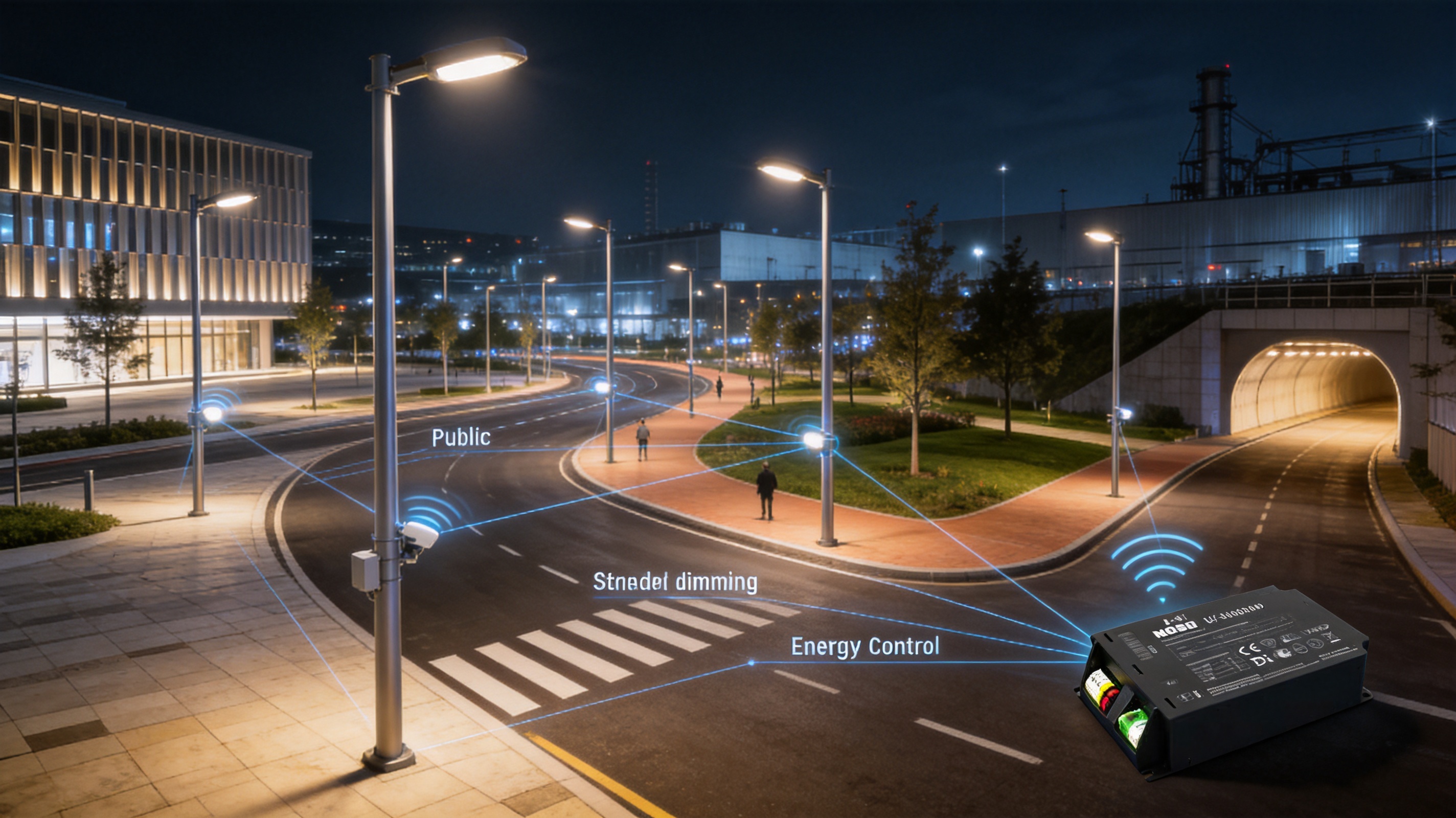
Road lighting is one of the strongest application areas for the U7+. Street luminaires must operate reliably for long periods, often in exposed locations that are difficult and expensive to access. A programmable driver allows the lighting output to be matched to the LED board and adjusted for different road classes or project requirements.
DALI-2 and D4i compatibility supports integration with control systems that can schedule dimming, monitor status, and coordinate lighting behavior across a roadway. The 16 V bus supply and 24 V auxiliary output can further support compatible control equipment within the luminaire.
Low standby power is also valuable in connected street lighting. Even when a luminaire is dimmed, the driver may remain available for communication and control. Reducing standby consumption helps improve the overall energy profile of the network.
6.2 Urban illumination and public spaces
Urban lighting projects often combine safety, visual comfort, aesthetics, and energy management. Parks, plazas, pedestrian areas, municipal buildings, and public pathways may require different output levels at different times of day.
Time-control dimming can provide a practical operating schedule, while DALI-2 and D4i allow the system to be adjusted as patterns of use change. A programmable driver also helps luminaire manufacturers create different forms and optical distributions around a common electrical platform.
6.3 Facade and architectural lighting
Facade lighting requires careful coordination between the visual design and the electrical system. Different facade sections may use LED modules with different voltage and current characteristics. The U7+ model range provides options for these different configurations, while digital control supports programmed scenes or scheduled operation where compatible systems are used.
Architectural lighting also benefits from low standby operation because decorative illumination may be reduced or disabled during late-night hours. The driver’s compact housing options can assist with integrating control electronics into space-limited luminaire designs.
6.4 Industrial and high-bay lighting
Industrial facilities require dependable lighting for warehouses, workshops, logistics centers, production lines, and loading areas. High-bay luminaires may operate for extended periods and often face elevated ambient temperatures or dust.
The higher-power U7+ models can support LED modules used in industrial luminaires, subject to correct thermal design and application validation. High efficiency helps reduce driver losses, while programmable current enables the luminaire manufacturer to balance output, energy use, and thermal performance.
6.5 Tunnel lighting
Tunnel lighting has special requirements because luminaires must operate continuously, tolerate challenging environments, and provide stable illumination for drivers. Dimming schedules may be used to coordinate lighting levels with traffic conditions, daylight at tunnel entrances, or maintenance requirements.
The U7+ platform can contribute to tunnel luminaire development through its wide model range, digital control compatibility, and constant-power output. As with all tunnel applications, the complete fixture must be validated for temperature, moisture, corrosion, vibration, ingress protection, emergency operation, and applicable safety requirements.
7. Engineering Considerations for a Complete Luminaire
Selecting a programmable driver is only one step in developing a reliable product. The driver, LED module, heat sink, housing, optical system, control network, and installation environment must be evaluated as a complete system.
7.1 Thermal management
Even an efficient driver produces some heat. The luminaire housing should provide an appropriate thermal path and sufficient ventilation or heat dissipation according to the product design. The driver should not be installed close to heat sources without evaluating the resulting temperature.
The LED board also requires effective thermal transfer. A driver programmed to a higher current may increase LED output, but it may also increase LED junction temperature. Manufacturers should validate the programmed setting through thermal testing under realistic ambient conditions.
7.2 Surge and environmental protection
Outdoor installations can be exposed to lightning-related surges, switching transients, unstable supply conditions, rain, condensation, dust, salt, and vibration. The driver is part of the protection strategy, but it should be combined with suitable surge protection devices, grounding, enclosure sealing, cable glands, and installation procedures.
The enclosure should be designed for the actual environmental classification of the project. Thermal cycling and moisture ingress can affect connectors, insulation, circuit boards, and control interfaces. A reliable luminaire is the result of coordinated electrical and mechanical protection rather than one isolated component.
7.3 DALI wiring and commissioning
Digital control systems require correct wiring, addressing, configuration, and commissioning. DALI lines should be installed according to applicable project requirements, with attention to polarity rules where relevant, cable length, voltage drop, separation from mains wiring, and bus loading.
Each luminaire should be tested for communication, dimming response, addressing, fault reporting, and scheduled operation. A driver may support a protocol, but the final user experience depends on the quality of the control system, gateway, software, and commissioning process.
7.4 NFC programming control
NFC programming should be managed as a controlled production activity. The factory should identify the exact model, LED board, target current, output limits, and project configuration before programming. Operators should verify the result and maintain records when traceability is required.
Programming mistakes can cause overcurrent, insufficient output, unexpected dimming behavior, or incompatibility with the LED module. A well-designed manufacturing workflow minimizes these risks through barcode control, digital work instructions, sample verification, and final inspection.
7.5 Matching output voltage and current
The driver model must be selected according to the forward voltage and operating current of the LED module. The module’s voltage should remain within the driver’s specified output range under cold, normal, and hot operating conditions. The programmed current should remain within both the driver’s capability and the LED manufacturer’s recommendation.
Constant-power operation does not remove the need for careful electrical matching. It provides flexibility, but the complete operating point still needs to be validated. Engineers should consider LED tolerance, temperature-related voltage changes, wiring loss, dimming behavior, and end-of-life conditions.
8. OEM and ODM Cooperation Benefits
Lighting companies increasingly require more than a standard catalog product. They may need a custom label, special output configuration, modified connector arrangement, unique packaging, private technical documentation, or a driver integrated into a complete luminaire platform.
The U7+ series supports this type of cooperation through OEM and ODM services. Customers can discuss branding, current ranges, interface details, and other project requirements while retaining the benefits of an established product architecture.
OEM cooperation is useful when a customer has already defined the electrical and mechanical design but wants a reliable manufacturing source. ODM cooperation is valuable when a customer needs assistance developing a luminaire or driver-based solution from a defined application requirement.
The manufacturer’s die-casting, CNC, assembly, aging, photometric testing, and export capabilities can support a more complete development process. Instead of coordinating multiple suppliers for housing, optics, assembly, and testing, a customer may be able to consolidate a larger portion of the project with one experienced partner.
Customization should be based on a clear technical agreement. Important subjects include rated input, output range, default current, dimming method, DALI and D4i functions, auxiliary power, connector type, dimensions, mounting method, operating temperature, environmental protection, labeling, packaging, production testing, and certification scope.
9. Why Manufacturing Capability Matters to Buyers
When purchasing LED drivers for a large project, buyers should evaluate more than the unit price. A low-cost driver may create hidden expenses if it requires additional components, has inconsistent programming, causes commissioning delays, or fails prematurely in the field.
A manufacturer with broad production capability can reduce these risks by coordinating design, machining, assembly, testing, and documentation. This is particularly important for outdoor projects in which replacing a failed driver may require a lift, road closure, traffic management, or specialized service equipment.
Repeatable mechanical dimensions help ensure that drivers fit the intended enclosure. Controlled programming helps maintain consistent light output. Aging and functional tests can reduce early failures. Photometric testing helps verify the final optical performance. Management systems support documented procedures and corrective actions.
These factors create value even when they are not visible in the product photograph. A professional driver is not simply a circuit board inside a box. It is the result of electrical engineering, thermal design, mechanical production, software or protocol integration, quality control, and supply-chain coordination.
10. Practical Selection Guide for Buyers
Before choosing a U7+ model, a buyer should prepare a complete electrical and application specification. The following questions can help determine the appropriate configuration.
10.1 What is the LED module power?
Identify the expected luminaire power under full output and confirm whether the selected model provides sufficient capacity. Avoid selecting only by nominal wattage; account for operating tolerance, thermal conditions, dimming behavior, and possible future configuration changes.
10.2 What are the LED module voltage and current requirements?
Measure or confirm the LED module’s forward-voltage range and recommended operating current. Select a driver whose output range covers the complete operating condition, not merely the nominal value printed on a basic datasheet.
10.3 Is digital control required?
If the project includes centralized management, sensors, scheduling, diagnostics, or energy reporting, DALI-2 and D4i compatibility may be an important requirement. Confirm the intended control architecture before ordering the driver.
10.4 Are auxiliary devices connected?
Determine whether the luminaire will include sensors, control modules, wireless gateways, or other equipment requiring a low-voltage supply. Verify that the 16 V bus and 24 V auxiliary outputs are suitable for the intended devices and loads.
10.5 What are the environmental conditions?
Review ambient temperature, humidity, dust, salt exposure, vibration, installation altitude, enclosure rating, and maintenance access. The driver and complete luminaire should be validated under conditions representative of the project.
10.6 What documentation is required?
International buyers may need technical drawings, test reports, certificates, wiring diagrams, DALI or D4i information, photometric files, installation instructions, and quality documentation. These requirements should be agreed before mass production.
11. Frequently Asked Questions
Q1: What is the main purpose of the U7+ LED driver?
The U7+ is an isolated constant-power LED driver for outdoor, urban, industrial, facade, road, and related lighting applications. It regulates power for LED modules and provides programmable output, digital control compatibility, time-control dimming, a DALI bus supply, and an auxiliary low-voltage supply.
Q2: Does the U7+ support both DALI-2 and D4i?
Yes. The product description states that the U7+ supports DALI-2 and D4i, including DALI Parts 150 and 250 through 253. The exact functions available in a project should be confirmed against the driver documentation and the selected control equipment.
Q3: What input voltage does the driver accept?
The operating input range is 176–305 Vac. This broad range is suitable for many 220–240 V outdoor lighting networks, although proper installation, surge protection, grounding, and system-level electrical design remain necessary.
Q4: Can the output current be adjusted?
Yes. The series provides adjustable full-power current ranges that vary by model. NFC programming can be used to configure the driver according to the selected LED module and luminaire design, subject to the stated limits.
Q5: What does constant-power operation mean?
Constant-power operation allows the driver to coordinate voltage and current within its specified output range to deliver the intended power level. This gives luminaire manufacturers greater flexibility when using LED modules with different voltage and current characteristics.
Q6: What is the standby power consumption?
The standby power is specified as below 0.5 W. This supports energy-conscious connected lighting systems in which the driver remains available for communication or control while the LED output is reduced or switched off.
Q7: Does the driver include auxiliary power?
Yes. The U7+ includes a 16 V DALI bus supply and a 24 V auxiliary supply. Connected devices must be checked for compatibility, current demand, wiring requirements, and applicable safety conditions.
Q8: Which power ratings are available?
The listed series includes 22 W, 26 W, 32 W, 40 W, 60 W, 80 W, 120 W, 165 W, and 200 W models. Different models provide different output voltage and current ranges for different LED module configurations.
Q9: Can the driver be used for street lighting?
Yes. The product is intended for applications including road lighting and urban illumination. Its programmable output, digital control compatibility, scheduled dimming, and low standby power are useful for connected street-lighting systems.
Q10: Can the driver be customized for OEM or ODM projects?
OEM and ODM services are available. Customers can discuss branding, current ranges, interface details, packaging, and other requirements according to technical feasibility and project specifications.
Q11: What manufacturing capabilities support the product?
The manufacturer operates with die-casting and CNC machining resources, aging lines, photometric equipment, goniophotometers, and production capabilities for various outdoor and industrial LED luminaires. These resources support mechanical quality, assembly consistency, optical verification, and complete product development.
Q12: Is the driver suitable for every outdoor environment?
Application suitability depends on the complete luminaire design. Engineers must verify operating temperature, moisture protection, surge protection, enclosure construction, thermal performance, vibration, wiring, and certification requirements for the specific installation.
12. Conclusion
The U7+ isolated constant-power DALI-2 and D4i LED driver is designed for lighting systems that require more than basic power conversion. Its combination of programmable output, NFC configuration, wide input voltage operation, digital control compatibility, time-control dimming, integrated bus power, auxiliary output, and low standby consumption gives it a strong position in modern outdoor lighting.
Its broad model range supports LED modules from compact lower-power configurations to 200 W industrial and roadway applications. The combination of lower-current, higher-voltage versions and higher-current, lower-voltage versions provides manufacturers with practical flexibility when developing different luminaire designs.
Compared with fixed-output or less integrated drivers, the U7+ can reduce design constraints, simplify commissioning, support standardized control networks, and provide a more adaptable foundation for OEM and ODM products. These advantages are especially relevant to street lighting, urban illumination, facade lighting, industrial facilities, tunnels, and other applications that require long service life and controlled energy use.
The product is further strengthened by the manufacturing capabilities of Cixi HuaSheng Lighting Co., Ltd. Die-casting, CNC machining, aging lines, photometric testing, goniophotometers, quality management systems, and experience across multiple LED lighting categories provide a practical foundation for producing complete, application-focused solutions.
For buyers, the most important step is to evaluate the driver together with the LED module, luminaire housing, thermal path, optical system, control network, and installation environment. When these elements are engineered as one system, the U7+ can help lighting manufacturers deliver more reliable, efficient, configurable, and market-ready outdoor luminaires.
References
1. DALI Alliance, Digital Addressable Lighting Interface principles and device interoperability guidance.
2. DALI Alliance, D4i specifications for intelligent, data-ready luminaires.
3. International Electrotechnical Commission, LED controlgear and general lighting equipment safety principles.
4. International Organization for Standardization, ISO 9001 quality management systems.
5. International Organization for Standardization, ISO 14001 environmental management systems.
6. International Organization for Standardization, ISO 45001 occupational health and safety management systems.
7. Manufacturer-provided U7+ product specifications and model information.
8. Manufacturer-provided information on outdoor lighting production, OEM/ODM services, testing resources, and management certifications.
Product: Isolated Constant Power DALI-2 / D4i LED Driver U7+

YQF Group - World Leading One-Stop Lighting & Solar For the Global Partners
Custom & OEM Solutions for Global Lighting Brands
Copyright © Cixi HuaSheng Lighting Co., Ltd. All Rights Reserved.
Die-Casting Mould Supplier
