 English
 中文
中文 Pусский
 French
 Español
 عربى
عربى
High-Brightness Arena Lighting for Professional Sports and Large-Scale Venues
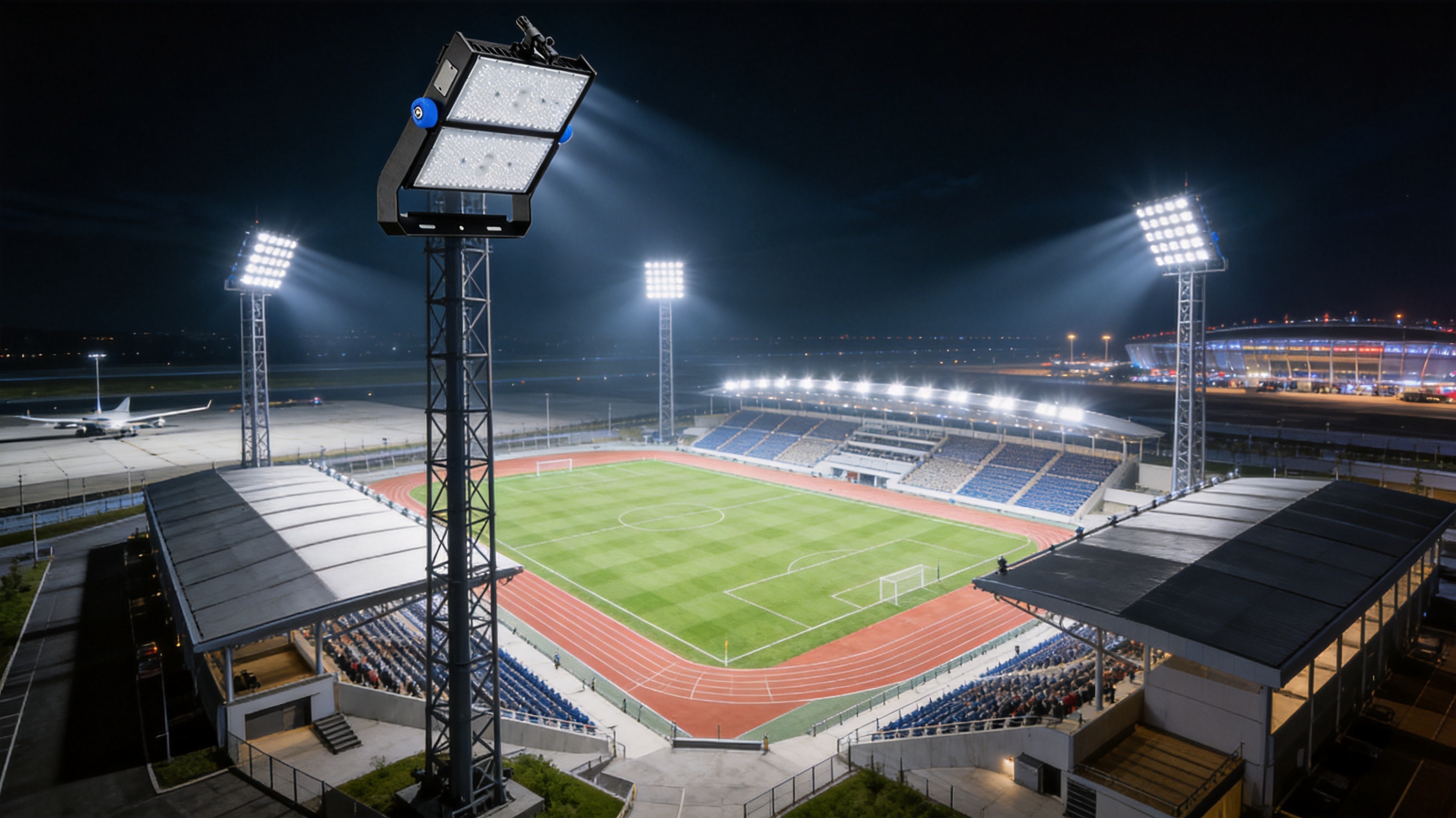
Professional arenas, stadiums, airports, and event venues require lighting that performs reliably under demanding visual, environmental, and operational conditions. A high-output fixture must do more than produce a large amount of light. It must distribute illumination evenly, control glare, withstand outdoor exposure, support different mounting arrangements, and maintain dependable performance throughout long operating cycles. The High Brightness Arena Light HS-JG, developed as part of the Aurora Series, is designed around these requirements.
The product is a professional LED stadium light intended for applications where high brightness, accurate beam control, and robust construction are essential. Available in power configurations from 250W to 2500W, it can be specified for a wide range of arenas and large-area lighting projects. Its multiple lens options allow designers to select a suitable beam distribution for the height, distance, and layout of a venue. This flexibility is particularly valuable when a project combines different mounting positions, playing areas, spectator zones, access roads, and surrounding structures.
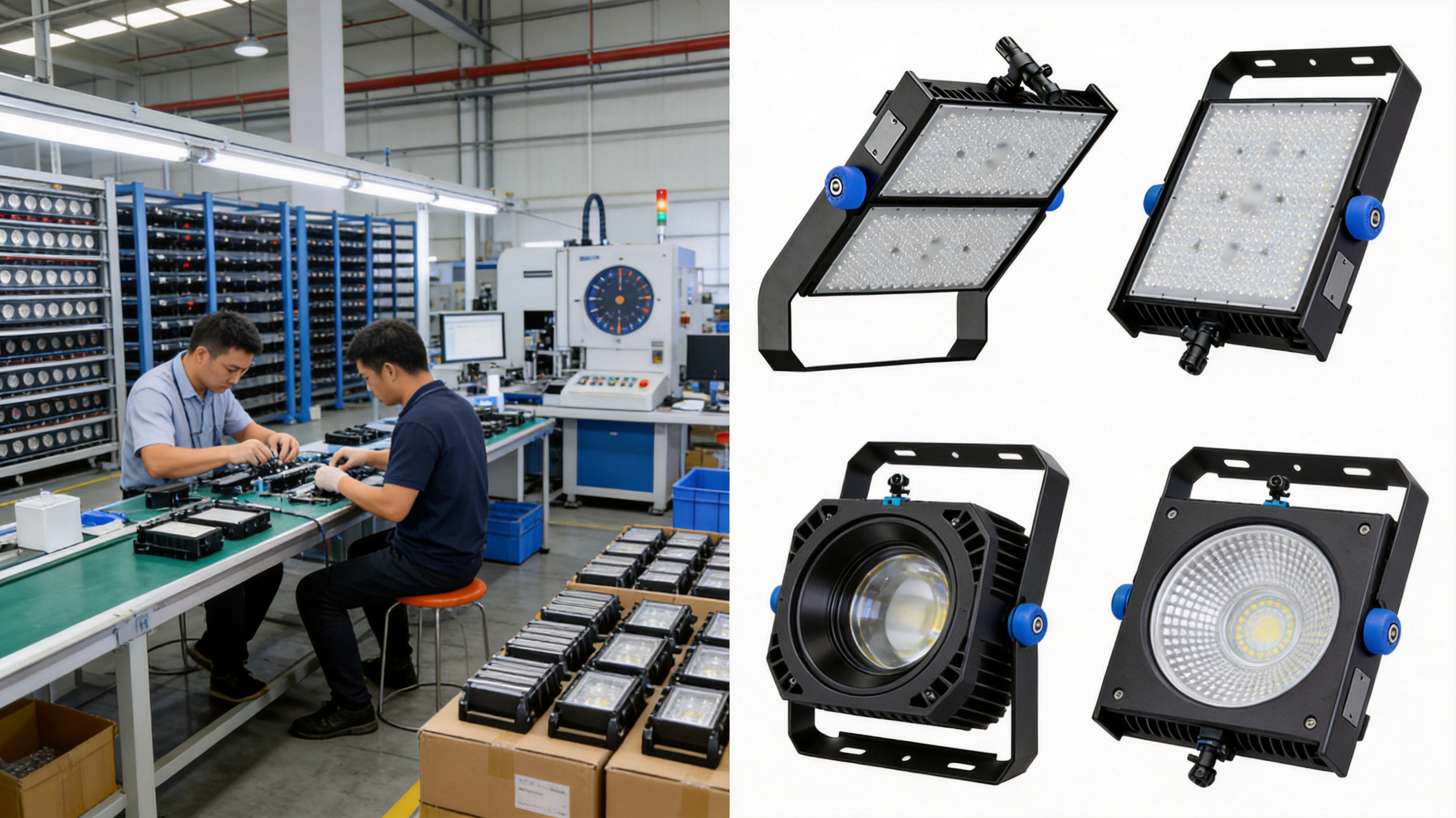
Manufactured by Cixi HuaSheng Lighting Co., Ltd. in Ningbo, China, the product benefits from an established lighting production environment that includes die-casting, CNC machining, aging lines, and photometric testing equipment. The manufacturer also provides optical system tuning, housing customization, power configuration, DIALux design support, and OEM/ODM services. These capabilities allow customers to obtain more than a standard fixture: they can develop a lighting solution adapted to the technical and commercial needs of a specific project.
Why High-Brightness Arena Lighting Requires a Specialized Design
Arena lighting is fundamentally different from ordinary outdoor area lighting. A general-purpose floodlight may provide sufficient brightness for a yard, warehouse exterior, or construction area, but professional sports and event venues impose stricter requirements. Light must reach the intended surface with adequate intensity while avoiding excessive glare for athletes, officials, spectators, nearby residents, drivers, and cameras.
The fixture must also support uniform coverage. Bright spots and dark zones can reduce visibility and create an uncomfortable viewing experience. In sports applications, uneven light may affect the ability of players to track a ball, judge speed, identify teammates, or respond quickly to changing action. In broadcast environments, inconsistent illumination can influence image quality and make camera exposure more difficult to manage.
Large venues create additional challenges because mounting points may be positioned far from the target area. A fixture installed on a high mast, roof structure, tower, or perimeter column needs an optical system that sends light accurately over a considerable distance. At the same time, it should limit unwanted spill light beyond the property boundary or into occupied areas. These needs explain why lens selection and beam control are central features of the Aurora Series.
High-power lighting also generates significant thermal and mechanical demands. The housing must support heat dissipation, protect internal components, and maintain structural stability during outdoor operation. Wind, rain, dust, temperature changes, vibration, and repeated maintenance activities can all influence service life. A professional arena fixture therefore requires a coordinated approach involving optical design, electrical configuration, mechanical engineering, and manufacturing quality control.
Product Overview
The High Brightness Arena Light HS-JG is designed for arenas requiring extremely high brightness and uniform coverage. Its primary applications include sports arenas, airports, stadiums, and large event venues. The Aurora Series offers a broad power range, enabling project planners to match fixture output to mounting height, target dimensions, illumination objectives, and the number of lighting points available.
The product supports AC100V-250V at 50Hz and also lists DC24V as an input option. This broad electrical specification can help accommodate different project requirements, although the final configuration should be confirmed with the manufacturer before ordering. The available control modes are switch control and PMX512 control, providing a basic operating option as well as a control-oriented option for projects requiring coordinated adjustment.
Class I and Class III security levels are listed for the product. The applicable electrical protection arrangement should be confirmed according to the selected model, installation method, local regulations, and project specifications. The fixture uses a brand-name power supply, supporting the manufacturer’s emphasis on dependable electrical configuration for high-output applications.
| Product Name | High Brightness Arena Light HS-JG |
| Series | Aurora Series |
| Primary Category | LED Stadium Light |
| Typical Applications | Sports arenas, airports, stadiums, large event venues |
| Input Voltage | AC100V-250V, 50Hz / DC24V |
| Security Level | Class I / Class III |
| Drive System | Brand-name power supply |
| Control Mode | Switch control / PMX512 control |
| Available Power Range | 250W to 2500W |
| Lens Options | 15°, 30°, 45°, 60°, 90°, and 120° |
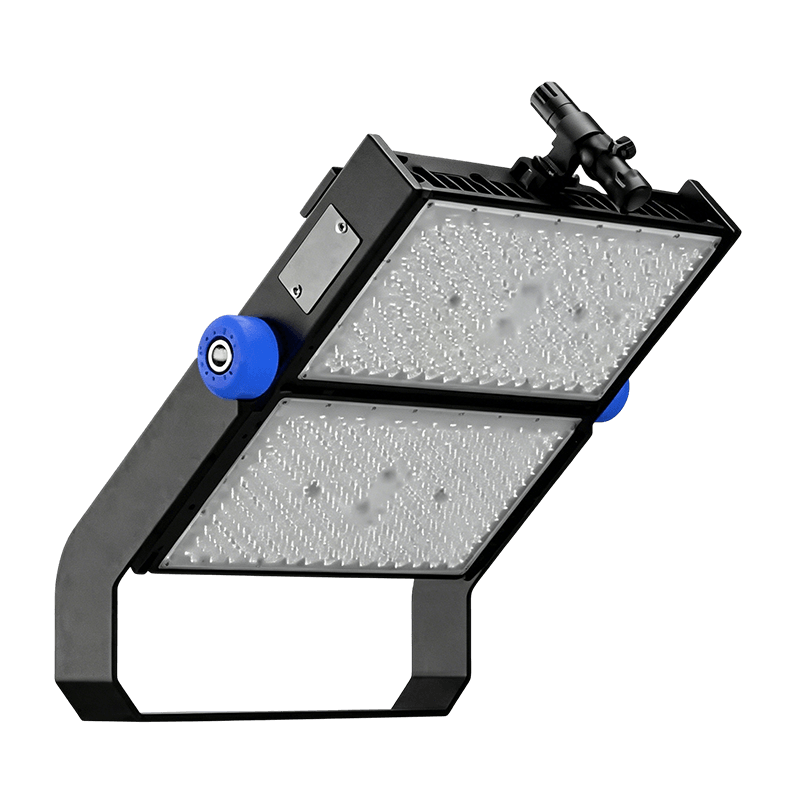
High Brightness Arena Light HS-JG
Power Options for Different Venue Requirements
One of the most practical advantages of the Aurora Series is its range of power configurations. The series begins at 250W and extends through 500W, 750W, 1000W, 1250W, 1500W, 2000W, and 2500W. This allows a lighting designer to select a suitable output level instead of treating every installation as if it had the same height, area, or illumination target.
The lower-power 250W model may be suitable for selected secondary areas, compact sports facilities, access zones, or installations where the fixture is positioned relatively close to the target surface. The 500W, 750W, and 1000W models provide progressively greater output for medium and large applications. The 1250W model extends the range for demanding illumination plans without immediately requiring the largest fixture configuration.
The 1500W, 2000W, and 2500W models are intended for very high-output requirements. They may be considered for large stadiums, high mounting positions, broad playing surfaces, major event spaces, and other areas where a substantial quantity of light is needed from each installation point. The correct choice should be made through a complete photometric study rather than wattage alone.
Using a range of power options can provide several project benefits. First, it enables more accurate system planning. Different zones can be illuminated with different fixture sizes rather than relying on a single oversized model. Second, it can support more balanced energy management. A fixture that is correctly matched to the area may avoid unnecessary over-lighting. Third, it simplifies the development of a consistent product platform for venues with multiple lighting requirements.
The broad range also supports phased construction. A venue may initially require lighting for a training field, parking zone, or partial seating area and later expand to additional courts, stands, or event facilities. Using a product series with multiple power levels can make future expansion more coherent in terms of appearance, controls, maintenance procedures, and spare parts planning.
| Product Power | Product Weight | Product Dimensions | Packaging Dimensions |
| 250W | 4.7 kg | 436 × 284 × 163 mm | 330 × 430 × 170 mm |
| 500W | 11.5 kg | 436 × 499 × 183 mm | 520 × 485 × 180 mm |
| 750W | 15.7 kg | 464 × 689 × 183 mm | 710 × 485 × 180 mm |
| 1000W | 20.1 kg | 464 × 879 × 182 mm | 900 × 485 × 180 mm |
| 1250W | 24.5 kg | 464 × 1069 × 183 mm | 1090 × 485 × 180 mm |
| 1500W | 31.4 kg | 865 × 692 × 189 mm | 710 × 906 × 180 mm |
| 2000W | 40.2 kg | 865 × 882 × 189 mm | 900 × 906 × 180 mm |
| 2500W | 49 kg | 865 × 1072 × 189 mm | 1090 × 906 × 180 mm |
Multi-Angle Lens Selection and Beam Control
The Aurora Series supports lens angles of 15°, 30°, 45°, 60°, 90°, and 120°. This selection is important because the best beam angle depends on the mounting location and the area to be illuminated. A narrow beam can project light over a longer distance and may be useful when the fixture is installed far from the target. A wider beam can spread illumination across a broader nearby area.
A 15° lens is generally associated with concentrated long-distance projection. It may be considered for high masts, towers, or applications where the target area is relatively distant from the fixture. The 30° and 45° options provide intermediate distributions that may support a balance between reach and coverage. The 60° lens can be useful when the fixture must cover a wider area while retaining a meaningful degree of directionality.
The 90° and 120° options provide broader coverage. These angles may be appropriate for nearby surfaces, large open zones, perimeter areas, or installations where a wide distribution is preferred. The choice should be based on the lighting layout, mounting height, aiming angle, required uniformity, and surrounding conditions.
Multi-angle availability can provide an advantage over products offered with only one standard beam. With a single beam option, designers may need to use more fixtures, accept poor uniformity, or tolerate excessive spill light. By contrast, a configurable optical platform can be adapted more closely to the venue geometry. This does not eliminate the need for professional lighting calculations, but it gives the designer more tools for achieving the desired result.
Optical customization is also available through OEM/ODM cooperation. The manufacturer states that optical system tuning is included among its customization capabilities. For a major stadium or specialized venue, this can support adjustments to the distribution, lens arrangement, and power configuration in accordance with a project’s photometric objectives.
Improving Uniformity Across the Target Area
Uniformity is affected by fixture spacing, mounting height, beam angle, aiming direction, fixture output, and the reflectance of surrounding surfaces. A high-brightness product does not automatically create uniform lighting if it is positioned incorrectly. The Aurora Series is therefore best used as part of a coordinated design process in which each fixture is selected and aimed according to its location.
For example, a field may require narrow beams from distant towers and wider beams from lower perimeter positions. Different power levels may also be combined to address areas that are closer or farther from the mounting structure. This approach can help reduce bright central zones and underlit edges, improving the overall visual balance of the installation.
The company’s ability to provide DIALux designs can support this process. A digital lighting study can help evaluate illuminance, uniformity, beam overlap, glare-related considerations, and the effect of fixture placement before installation begins. Actual project requirements should still be verified through the applicable standards, local regulations, and on-site commissioning procedures.
Construction for Outdoor and High-Output Applications
Professional arena lighting is frequently installed in exposed locations. Fixtures may be mounted on towers, roofs, poles, façades, or structural frames where they encounter wind, rain, airborne dust, temperature changes, and maintenance-related mechanical stress. The HS-JG includes a reinforced outdoor protection design intended for demanding environments.
A reinforced housing can provide important practical benefits. It helps protect the optical and electrical components during transport, installation, and operation. It also supports the mechanical stability of the fixture when it is mounted at height or exposed to vibration. The exact environmental protection rating, corrosion treatment, operating temperature range, and impact rating should be confirmed for each configuration, because these values are not specified in the supplied product information.
The listed product dimensions show that the physical size increases with power. This is a logical arrangement for a high-output series because larger power configurations generally require a larger optical and thermal platform. The dimensions and weights should be incorporated into structural calculations before installation. Mounting brackets, bolts, support arms, lifting equipment, and access systems should all be selected according to the weight and wind-loading conditions of the specific model.
For large fixtures, installation planning is particularly important. A 2500W model has a listed product weight of 49 kg, while the 2000W model weighs 40.2 kg. These products may require coordinated lifting procedures and suitable access equipment. The packaging dimensions also support logistics planning, including container loading, warehouse storage, elevator access, and transportation to the installation site.
Thermal and Electrical Reliability
High-output LEDs convert a significant portion of electrical power into heat. Managing this heat is necessary to protect the LED modules, power supply, optical materials, and surrounding components. A professionally designed housing, appropriate heat-dissipation structure, and controlled electrical system work together to support stable operation.
The product uses a brand-name power supply, which is an important part of the overall fixture system. Power supply quality can influence starting behavior, output stability, protection functions, and long-term reliability. For projects with strict operating schedules, dependable drivers are especially valuable because the lighting system may be required for training, competition, concerts, broadcasts, and public events throughout the year.
The listed input range of AC100V-250V at 50Hz offers compatibility with a broad range of electrical environments. The DC24V option may be relevant to special configurations or integrated control systems. However, input conditions, grounding, protection devices, cable selection, and installation procedures must be confirmed with the manufacturer and the project electrical engineer.
The product lists switch control and PMX512 control. Switch control is straightforward and may be appropriate for installations that require basic on-and-off operation. PMX512 control can support more coordinated management, depending on the project’s control architecture and the exact implementation supplied. A control system may be used to establish operating schedules, event scenes, reduced-output modes, or separate lighting zones, subject to system compatibility.
Operational Benefits of Appropriate Control
Control flexibility can improve the way a venue uses its lighting. A stadium may not require maximum output during cleaning, setup, training, or routine maintenance. A lower-output mode can potentially reduce unnecessary energy consumption while still providing adequate working illumination. During a professional event, the system may be configured for full output, while non-event periods may use selected zones.
In airports and large public spaces, scheduled control can help align illumination with operating hours and traffic levels. In event venues, different lighting groups can be activated according to rehearsals, performances, security needs, and audience movement. The benefits depend on the wider control system, but the availability of more than one control mode gives project planners greater flexibility than a fixture limited to manual switching alone.
Manufacturing Capabilities Behind the Product
The performance of an arena light depends not only on its specification sheet but also on the processes used to manufacture it. Cixi HuaSheng Lighting Co., Ltd. operates as a professional outdoor lighting manufacturer in Ningbo, China, with experience in producing LED street lights, tunnel lights, high-bay lights, linear lights, garden lights, solar lights, grow lights, explosion-proof lights, and other lighting products.
This product range gives the manufacturer experience across multiple lighting environments. Outdoor road lighting requires attention to weather exposure and optical distribution. Tunnel lighting demands controlled luminance and dependable operation. High-bay lighting requires thermal and optical performance at elevated mounting heights. Solar and explosion-proof products require additional attention to system integration and application-specific safety considerations. Experience across these categories can support a broader understanding of LED fixture engineering.
Die-Casting and CNC Machining
Die-casting is an important manufacturing process for many LED lighting housings. It can create repeatable metal structures with integrated ribs, mounting features, and component interfaces. A well-designed die-cast housing can support mechanical strength and heat dissipation while maintaining consistent dimensions across production batches.
CNC machining complements die-casting by enabling precise processing of selected surfaces, holes, threads, mounting points, and interfaces. This is useful when a fixture requires accurate alignment between the housing, lens system, driver compartment, and installation hardware. The manufacturer’s ability to combine die-casting with CNC equipment can support both high-volume production and customized component development.
These capabilities are also relevant to OEM/ODM projects. Customers may require a different housing shape, a special mounting arrangement, a modified cable entry, or a brand-specific enclosure. Die-casting mould design and CNC machining can help translate these requirements into manufacturable parts. The company also identifies die-casting mould manufacturing as one of its strengths, which may be valuable for customers seeking an integrated development partner.
Aging Lines and Production Stability
Aging lines are used to operate products or components for a controlled period before shipment. This type of process can help identify certain early-stage electrical or assembly problems and provide an additional quality-control step. For high-output arena lights, aging is relevant because the power system and LED modules may experience substantial thermal and electrical stress during operation.
Aging does not replace design validation, component qualification, environmental testing, or proper installation. It is one part of a broader quality system. Nevertheless, the presence of aging equipment indicates that the manufacturer has invested in a production process designed to evaluate products before they reach the customer.
Photometric Measurement and Goniophotometers
Goniophotometers are used to measure how a luminaire distributes light in different directions. This information is important for stadium lighting because beam control, uniformity, spill light, and aiming calculations depend on accurate photometric data. A manufacturer with goniophotometric equipment can evaluate optical performance and support lighting design with more reliable distribution information.
Photometric measurement can also assist with product development. When a lens angle, reflector structure, LED arrangement, or housing component is changed, testing can help determine how the modification affects the light distribution. This is particularly relevant to OEM/ODM work, where the customer may request a special optical system or a different balance between reach and coverage.
For project customers, available photometric information may include luminous intensity distributions, beam diagrams, efficiency data, and files for lighting simulation. The exact data package should be requested for the selected HS-JG configuration. Designers can then use the information to prepare a DIALux model and evaluate the proposed installation before final approval.
Advantages Compared with Less Specialized Alternatives
The High Brightness Arena Light HS-JG is positioned for applications where ordinary floodlights may not provide sufficient optical flexibility or output. Its principal advantages arise from the combination of high power, multiple beam options, reinforced outdoor construction, selectable control modes, and manufacturer-supported customization.
Compared with a basic fixed-beam floodlight, the HS-JG offers more lens choices. This can help reduce the compromises associated with using one distribution for every mounting position. A fixed-beam product may produce acceptable results in one location but excessive spill or weak coverage in another. The Aurora Series gives designers the ability to select a beam that better corresponds to the installation geometry.
Compared with a narrow product range, the HS-JG provides more power levels. A compact venue and a large stadium do not have identical lighting requirements. A series extending from 250W to 2500W enables a more consistent product strategy across different zones and project sizes.
Compared with a general-purpose outdoor fixture, the HS-JG is specifically described for high-brightness arena use. Its design purpose is therefore aligned with long-distance projection, high-visibility environments, and uniform coverage. This application focus can be an advantage for buyers who need a product developed around the demands of sports and event venues rather than adapting a standard area light.
Compared with products that are available only as finished catalog items, the manufacturer’s OEM/ODM services provide additional development options. Optical system tuning, housing customization, and power configuration can help customers address project-specific requirements. This is useful for contractors, lighting brands, distributors, stadium developers, and engineering companies that need a differentiated product or an integrated project solution.
| Evaluation Area | HS-JG Aurora Series Benefit | Project Value |
| Brightness | Power options from 250W to 2500W | Supports different venue sizes and mounting conditions |
| Optical flexibility | Six listed lens-angle choices | Helps adapt beam distribution to distance and coverage requirements |
| Outdoor use | Reinforced outdoor protection design | Supports demanding exposed installations |
| Control | Switch control and PMX512 control | Allows basic or coordinated operating strategies |
| Customization | Optical, housing, and power configuration services | Supports OEM/ODM and project-specific development |
| Manufacturing support | Die-casting, CNC machining, aging lines, and photometric equipment | Provides an integrated production and development platform |
Applications in Sports Arenas and Stadiums
Sports lighting is the most direct application for this product. Outdoor football fields, athletic tracks, tennis courts, basketball facilities, baseball fields, training grounds, and multi-purpose stadiums may all require high-output lighting. The correct design depends on the sport, field dimensions, viewing direction, competition level, camera requirements, and local standards.
For a stadium with high lighting towers, narrow or medium beam angles may help direct light toward the playing surface. Fixtures can be aimed from several sides to create overlapping coverage and improve uniformity. Wider lenses may be used for nearby spectator areas, walkways, entrance zones, or adjacent facilities. Combining power levels and lens angles can produce a more balanced overall scheme.
Training facilities often have different operating requirements from competition venues. They may need dependable illumination without the same maximum level required for televised events. The HS-JG power range and control options can support separate lighting groups or different operating schedules, provided the system is designed and commissioned correctly.
For spectator comfort, the lighting plan should consider glare. A high-output fixture must be aimed carefully, and the selected lens should match the viewing angles of athletes and spectators. Shielding, mounting height, tilt angle, and fixture placement may all be required to control direct view of the LED source. The product’s optical flexibility is useful, but professional design remains essential.
Applications in Airports and Event Venues
Airports contain large outdoor areas such as aprons, service roads, parking facilities, loading zones, terminal approaches, and maintenance areas. These locations require clear visibility and dependable operation. Lighting must be coordinated with vehicle movement, pedestrian access, security systems, and airport operating procedures.
The HS-JG can be considered for large-area airport lighting where high output and directed coverage are required. Lens selection can help distinguish between long-distance illumination of an open apron and wider coverage of a nearby access zone. Control integration may also support lighting schedules and operational zoning.
Large event venues include exhibition grounds, concert spaces, festival areas, fairgrounds, and temporary or permanent entertainment complexes. These environments may change configuration frequently. A high-output fixture with multiple beam options and adaptable controls can support different layouts and operating conditions.
Event venues also place importance on appearance and integration. Fixtures may be visible from public areas, so housing design, mounting arrangements, cable routing, and finish requirements can influence the overall project. Housing customization and OEM/ODM support can help address these considerations when a standard configuration is not sufficient.
OEM and ODM Cooperation
Many professional lighting buyers need more than a standard product. A stadium contractor may need a specific bracket or cable arrangement. An international lighting brand may require its own housing design and label system. A municipal project may specify a particular input configuration or control protocol. A distributor may want a product platform that fits its regional market and installation practices.
The manufacturer offers OEM/ODM support covering optical system tuning, housing customization, and power configuration. These services can be valuable during the transition from project concept to mass production. Instead of coordinating separate suppliers for moulds, housing parts, optical components, and assembly, a customer may work with one manufacturing partner for a larger portion of the product-development process.
Optical system tuning may involve selecting or modifying beam distributions according to the project’s target area. Housing customization may include changes to dimensions, mounting interfaces, branding surfaces, heat-dissipation structures, or component access. Power configuration may address output requirements, electrical conditions, driver arrangements, or different versions within a product family.
Successful customization requires a clear technical process. The customer should provide target performance, installation conditions, preferred materials, control requirements, certification expectations, packaging needs, and estimated volumes. The manufacturer can then evaluate feasibility, prepare drawings or samples, conduct testing, and establish production specifications. Samples should be reviewed carefully before approving volume production.
Die-Casting Mould Development
For a customized housing, the mould is a major engineering investment. Proper mould design affects dimensional consistency, surface quality, production efficiency, and the ability to integrate mounting and cooling features. The company’s die-casting mould capability can simplify this stage for customers developing a specialized arena-light housing.
CNC machining can be used after casting to refine selected areas and achieve accurate tolerances. This combination allows the housing to retain the efficiency of die-casting while receiving the precision required at critical interfaces. It can also help create repeatable production results across larger orders.
Quality, Certification, and Responsible Manufacturing
Cixi HuaSheng Lighting Co., Ltd. states that it is certified to ISO 9001, ISO 14001, and ISO 45001. These management systems address quality management, environmental management, and occupational health and safety respectively. Certification does not by itself guarantee that every individual product will meet every project requirement, but it indicates that the manufacturer has established structured management processes in these areas.
The company also states that relevant products have CB and CE certifications. Customers should confirm which certificates apply to the exact HS-JG model, power level, driver configuration, and destination market. Certification documents should be reviewed as part of the procurement process, especially when a stadium, airport, or public infrastructure project has formal compliance requirements.
Environmental responsibility is increasingly important in lighting procurement. LED technology can provide efficient illumination compared with older conventional technologies, but total environmental performance also depends on product life, energy use, packaging, maintenance, and end-of-life handling. The manufacturer’s ISO 14001 certification provides a framework for environmental management, while project owners should evaluate the complete lifecycle of the selected system.
Occupational safety is also significant in the manufacture and installation of large lighting fixtures. The ISO 45001 framework relates to workplace health and safety management. For the customer, safe installation remains a shared responsibility involving competent personnel, suitable lifting equipment, electrical isolation, structural assessment, and compliance with local regulations.
Project Planning and Specification Guidance
Before selecting an HS-JG configuration, the project team should collect accurate site information. This includes the dimensions of the playing or illuminated area, mounting positions, mounting heights, aiming limitations, surrounding buildings, viewing directions, electrical supply, control requirements, environmental conditions, and maintenance access.
The lighting objectives should also be defined. A training field, community sports area, professional competition venue, broadcast stadium, airport apron, and concert ground may each require different illuminance and uniformity targets. The required performance should be identified through the applicable national, international, sports, aviation, or municipal standards.
Photometric modeling is recommended before final selection. The designer can compare different power levels, lens angles, fixture quantities, and mounting layouts. The model should examine not only average illumination but also uniformity, glare-related risks, spill light, energy use, and maintenance factors.
Electrical planning should address circuit loading, surge protection, grounding, cable length, voltage drop, driver access, control wiring, emergency procedures, and compatibility with the venue management system. If PMX512 control is required, the project team should confirm the control architecture and the exact interface details before procurement.
Mechanical planning should include fixture weight, wind exposure, bracket strength, structural loading, vibration, corrosion conditions, and access for maintenance. The 1500W, 2000W, and 2500W models are substantial products, so the support structure must be designed for both static weight and environmental loads. Installation drawings and fastening recommendations should be confirmed with the manufacturer.
Installation and Maintenance Considerations
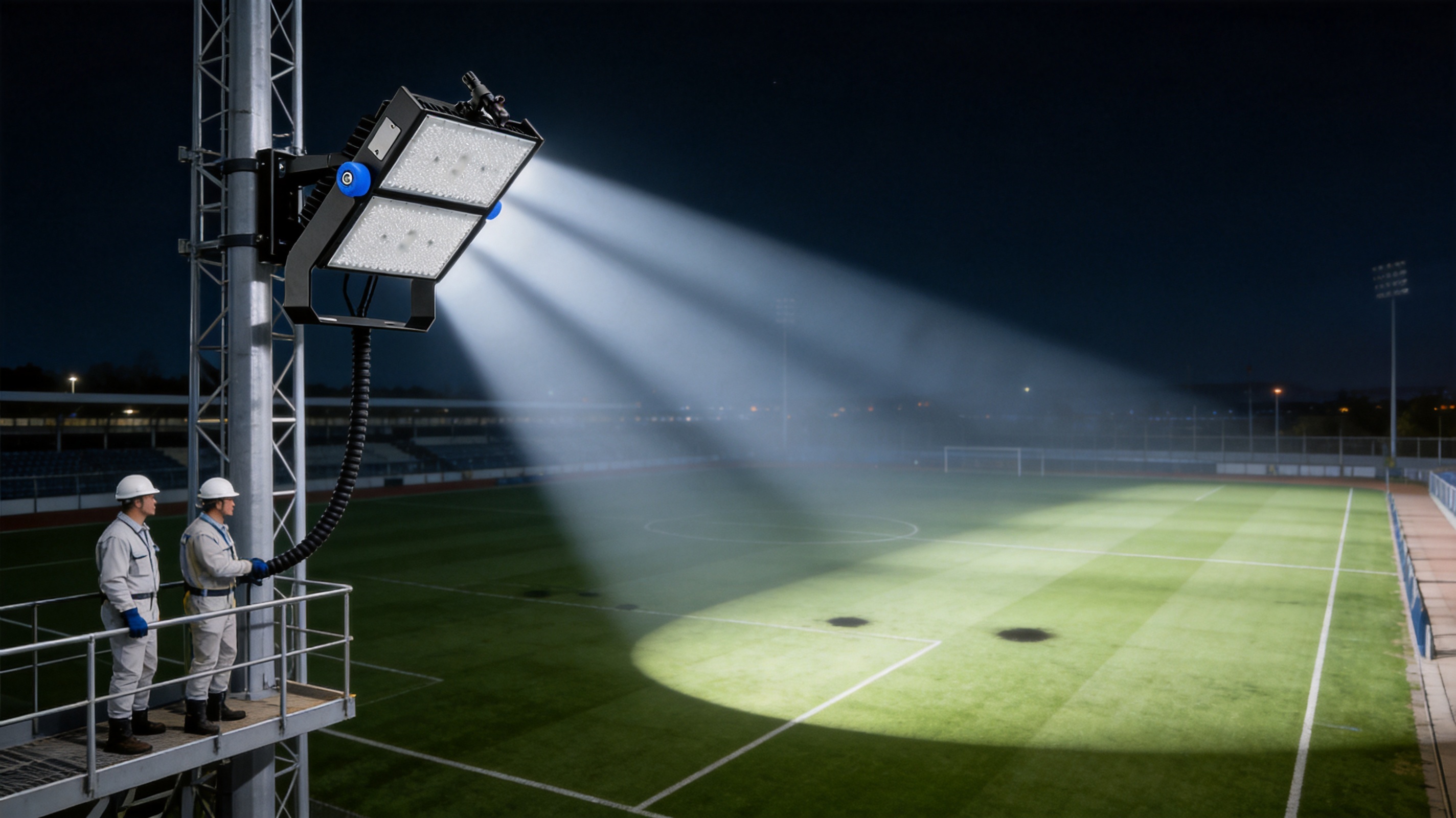
Installation should be performed by qualified personnel familiar with high-power outdoor luminaires. The fixture should be inspected for transport damage before mounting. All fasteners, brackets, cable glands, connectors, and grounding points should be checked according to the approved installation documentation.
Aiming is a critical stage. Even a well-designed optical system can produce poor results if the fixture is pointed incorrectly. The installation team should use the approved aiming schedule, verify the orientation of each luminaire, and record final angles for future maintenance. If the venue uses multiple lens types, each fixture should be clearly identified in the maintenance documentation.
After installation, the lighting system should be commissioned. Commissioning may include electrical checks, control checks, functional testing, aiming verification, visual inspection, and measured illumination where required. For major facilities, the owner may wish to compare measured results with the approved photometric model.
Maintenance should include periodic inspection of the housing, lens, mounting structure, cable connections, and control system. Dust and environmental deposits can reduce optical output over time, especially in industrial or heavily trafficked areas. Cleaning procedures should follow the manufacturer’s recommendations to avoid damaging optical surfaces or protective finishes.
Because the product is available in multiple sizes and weights, spare-part planning should identify the exact model and power level. Replacement drivers, optical components, brackets, and other parts should be matched to the original configuration. Maintaining accurate product records can reduce downtime and simplify future service work.
Energy and Total Cost Considerations
When evaluating a high-brightness arena light, buyers should consider more than the initial purchase price. Total cost includes energy consumption, installation, control equipment, maintenance access, replacement parts, downtime, and expected operating life. A fixture with appropriate optical control may help direct more of its output toward the intended surface, potentially reducing wasted light and unnecessary fixture quantities.
The available power range supports a more tailored system design. In some projects, using several correctly selected mid-power fixtures may provide better uniformity than using fewer oversized units. In other projects, high-power models may reduce the number of mounting points and simplify the structure. The best solution depends on the photometric design, installation cost, energy tariff, maintenance strategy, and venue schedule.
Control capability can also influence operating costs. A venue may use maximum output only during competitions or major events, while lower levels can be used during training and routine operations. Zoning and scheduling can help align lighting operation with actual occupancy and activity, although the effectiveness of these measures depends on the complete control system and management practices.
Why Choose an Integrated Manufacturing Partner
Large lighting projects often involve multiple stakeholders, including owners, architects, electrical engineers, sports consultants, contractors, distributors, and maintenance teams. An integrated manufacturer can help reduce communication gaps between product design, optical performance, mechanical construction, electrical configuration, testing, packaging, and delivery.
Cixi HuaSheng Lighting Co., Ltd. provides lighting products for outdoor, industrial, municipal, residential, and specialized applications. Its production resources include die-casting and CNC machines, aging lines, and goniophotometers. These facilities support a combination of manufacturing, testing, and product-development work.
The company also provides one-stop services such as efficient lighting solutions, DIALux designs, mould design, OEM/ODM, SKD/CKD customization, and delivery. This service range can be useful for international clients that require technical assistance as well as physical products. SKD and CKD options may support regional assembly or localized distribution strategies, subject to project feasibility and applicable regulations.
For international customers, export experience is another practical consideration. The company is located in Ningbo, a major manufacturing and logistics area, and states that it exports products worldwide. Customers should still confirm packaging standards, shipping marks, documentation, destination certifications, warranty terms, and after-sales procedures for each order.
Recommended Selection Process
Step One: Define the Site
Document the dimensions, mounting points, height, surrounding structures, environmental conditions, and electrical infrastructure. Include photographs, drawings, coordinates, and access information when possible.
Step Two: Define the Lighting Objective
Identify whether the project is intended for training, recreation, professional competition, broadcasting, public access, airport operation, industrial activity, or event use. Establish the required illuminance, uniformity, glare control, and operating schedule.
Step Three: Compare Power and Lens Options
Evaluate the 250W to 2500W configurations together with the 15° to 120° lens choices. Do not select a fixture based only on nominal wattage. Consider mounting distance, beam overlap, target dimensions, and the number of available fixtures.
Step Four: Prepare a Photometric Design
Use accurate photometric data in a DIALux or equivalent calculation. Review the results with the project engineer and compare them with the applicable standards. Request customized optical tuning if the standard options do not meet the project objective.
Step Five: Confirm Electrical and Mechanical Details
Verify voltage, frequency, control mode, driver configuration, grounding, protection, fixture weight, mounting hardware, wind loading, and maintenance access. Confirm whether the required certification applies to the final product configuration.
Step Six: Approve Samples and Documentation
For customized projects, review drawings, samples, photometric information, labels, packaging, and test records before mass production. Establish inspection criteria and acceptance procedures in writing.
Frequently Asked Questions
What is the High Brightness Arena Light HS-JG designed for?
The product is designed for high-brightness and uniform-coverage applications, including sports arenas, airports, stadiums, and large event venues. It is intended for professional environments where beam control, output, and outdoor durability are important.
What power levels are available?
The Aurora Series includes 250W, 500W, 750W, 1000W, 1250W, 1500W, 2000W, and 2500W configurations. The appropriate model depends on the venue size, mounting height, lighting target, beam angle, and project design.
Which lens angles can be selected?
The listed lens options are 15°, 30°, 45°, 60°, 90°, and 120°. Narrower angles are generally used for more concentrated long-distance projection, while wider angles provide broader coverage. The final selection should be based on photometric calculations.
Can the product be customized?
Yes. The manufacturer states that OEM/ODM services include optical system tuning, housing customization, and power configuration. Customers should provide detailed technical requirements and approve samples or drawings before production.
What input voltage does the product support?
The listed input specification is AC100V-250V at 50Hz and DC24V. The exact input arrangement should be confirmed for the selected model and project before ordering.
What control systems are available?
The product lists switch control and PMX512 control. Basic switch control may be suitable for simple operation, while PMX512 control may support more coordinated lighting management. Compatibility should be verified with the complete venue control system.
Is the product suitable for outdoor installation?
The product includes a reinforced outdoor protection design and is intended for outdoor applications. Environmental ratings, corrosion protection, operating temperature, and installation details should be confirmed for the exact configuration and site conditions.
How should the correct power level be selected?
Selection should be based on a complete lighting design rather than wattage alone. The designer should consider target illuminance, uniformity, mounting height, beam angle, fixture spacing, aiming direction, operating schedule, and applicable standards.
Does the manufacturer provide lighting design assistance?
The company provides efficient lighting solutions and DIALux design services. Customers can request photometric data and design assistance for the selected product configuration.
What manufacturing capabilities support the product?
The manufacturer operates die-casting and CNC machines, aging lines, and goniophotometers. These resources support housing production, precision machining, pre-shipment testing, and photometric evaluation.
What certifications does the company report?
The company states that it is certified to ISO 9001, ISO 14001, and ISO 45001. It also states that relevant products have CB and CE certifications. Buyers should request and verify documents applicable to the exact model and destination market.
Are the larger models difficult to install?
The larger models have significant weights, including 31.4 kg for the 1500W model, 40.2 kg for the 2000W model, and 49 kg for the 2500W model. Installation requires suitable structural support, lifting equipment, fastening systems, and qualified personnel.
Can different models be used in one project?
Yes, different power levels and lens angles may be combined when appropriate. A photometric study should determine the best arrangement for each zone, mounting point, and viewing condition.
Conclusion
The High Brightness Arena Light HS-JG is a flexible professional lighting platform for stadiums, arenas, airports, and large event venues. Its main strengths are the broad 250W to 2500W power range, six listed lens-angle options, reinforced outdoor protection design, switch and PMX512 control options, and support for OEM/ODM development.
Its value is further supported by the manufacturer’s production and engineering capabilities. Die-casting, CNC machining, aging lines, and goniophotometric equipment provide a foundation for repeatable housing production, precision component processing, pre-shipment testing, and optical evaluation. ISO management certifications, reported CB and CE product certifications, and a wider portfolio of outdoor and industrial lighting products add to the company’s ability to serve international projects.
For customers comparing high-brightness lighting solutions, the most important advantage is not simply maximum output. It is the ability to match output, beam distribution, construction, controls, and project support to the actual venue. With professional photometric design, suitable installation planning, and correct maintenance, the Aurora Series can provide a scalable approach to demanding large-area lighting applications.
References
1. Product specification information for the High Brightness Arena Light HS-JG, Aurora Series.
2. Manufacturer-provided information on product applications, lens options, power configurations, controls, and OEM/ODM services.
3. Manufacturer-provided information on die-casting, CNC machining, aging lines, and goniophotometric testing.
4. General principles of sports lighting design, including illuminance, uniformity, glare control, and aiming coordination.
5. General guidance for outdoor luminaire installation, electrical safety, structural support, maintenance access, and commissioning.
6. ISO 9001 quality management system principles.
7. ISO 14001 environmental management system principles.
8. ISO 45001 occupational health and safety management system principles.
Product: High Brightness Arena Light HS-JG
Custom & OEM Solutions for Global Lighting Brands
Copyright © Cixi HuaSheng Lighting Co., Ltd. All Rights Reserved.
Die-Casting Mould Supplier
