 English
 中文
中文 Pусский
 French
 Español
 عربى
عربى
Architectural LED Wall Washer GZD-XQD-3226/3226D: Precision Façade Lighting for Modern Buildings
Architectural lighting has become an essential part of contemporary building design. A well-lit façade does more than make a structure visible after sunset. It reveals architectural form, emphasizes materials, improves wayfinding, strengthens landmark identity, and contributes to the atmosphere of public spaces. For these applications, the lighting fixture must combine accurate optical control, dependable construction, efficient operation, installation flexibility, and long-term resistance to outdoor conditions.
The Architectural LED Wall Washer GZD-XQD-3226/3226D is designed to meet these requirements. It is a professional façade lighting solution for architectural contouring, decorative wall illumination, and controlled building highlighting. Its compact linear form, multiple beam-angle options, low-voltage operation, and durable aluminum housing make it suitable for cultural buildings, museums, commercial complexes, hotels, public facilities, landscape structures, and landmark projects.
Unlike a conventional floodlight that often produces broad, uncontrolled illumination, this wall washer is designed to direct light along architectural surfaces. The result is a more deliberate lighting composition, with improved visual depth and a stronger relationship between the fixture, the building façade, and the surrounding environment. The GZD-XQD-3226/3226D can be specified for projects that require consistent light output, controlled glare, and a professional appearance during both daytime and nighttime operation.
1. Product Overview
The GZD-XQD-3226/3226D belongs to the LED wall washer category and is intended primarily for exterior architectural lighting. It uses high-quality LED sources from recognized options such as Epileds, Bridgelux, Epistar, Osram, or Cree, depending on project requirements and production configuration. The available input voltage is DC12-24V, while the rated power range is 12-24W.
The product is available in two related configurations: GZD-XQD-3226 and GZD-XQD-3226D. Both versions share core characteristics, including a DC12-24V input, 12-24W power range, approximately 80 lm/W light output ratio, 1800-6500K correlated color temperature range, steady control mode, an operating temperature range of -20°C to 45°C, and IP65 protection.
Depending on the selected configuration, the fixture can be supplied in different light colors and beam distributions. Listed color options include red, green, blue, yellow, warm white, and white. The product information also identifies multiple beam choices, including 10×45 degrees, 10×65 degrees, 60 degrees, 90 degrees, and 110 degrees, subject to the selected model and optical configuration.
This range enables designers to select an optical pattern according to the building elevation, installation distance, wall texture, mounting height, and required lighting effect. A narrow or asymmetric distribution may be used to emphasize vertical lines or project light across a relatively tall surface. Wider distributions may be more appropriate for broad walls, low mounting positions, or installations where even coverage is preferred.
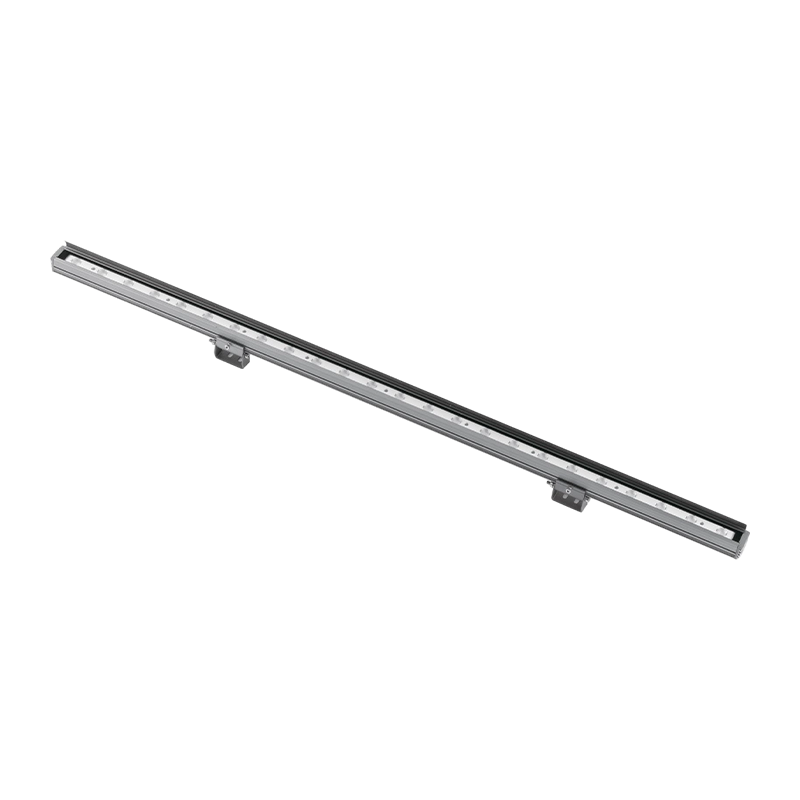
Architectural LED Wall Washer GZD-XQD-3226/3226D
2. Why Architectural Wall Washing Requires Specialized Equipment
Architectural façade lighting is more demanding than general area lighting. The purpose is not simply to produce a high quantity of light. Instead, the lighting must interact with architectural geometry. Columns, pilasters, window frames, cornices, textured stone, curtain walls, metal cladding, and recessed details all respond differently to illumination.
A general-purpose floodlight may create excessive brightness near the fixture while leaving distant sections of the façade underlit. It may also produce unwanted spill light, visible glare, hard shadows, or bright spots that distract from the building itself. These problems can reduce the perceived quality of an otherwise well-designed project.
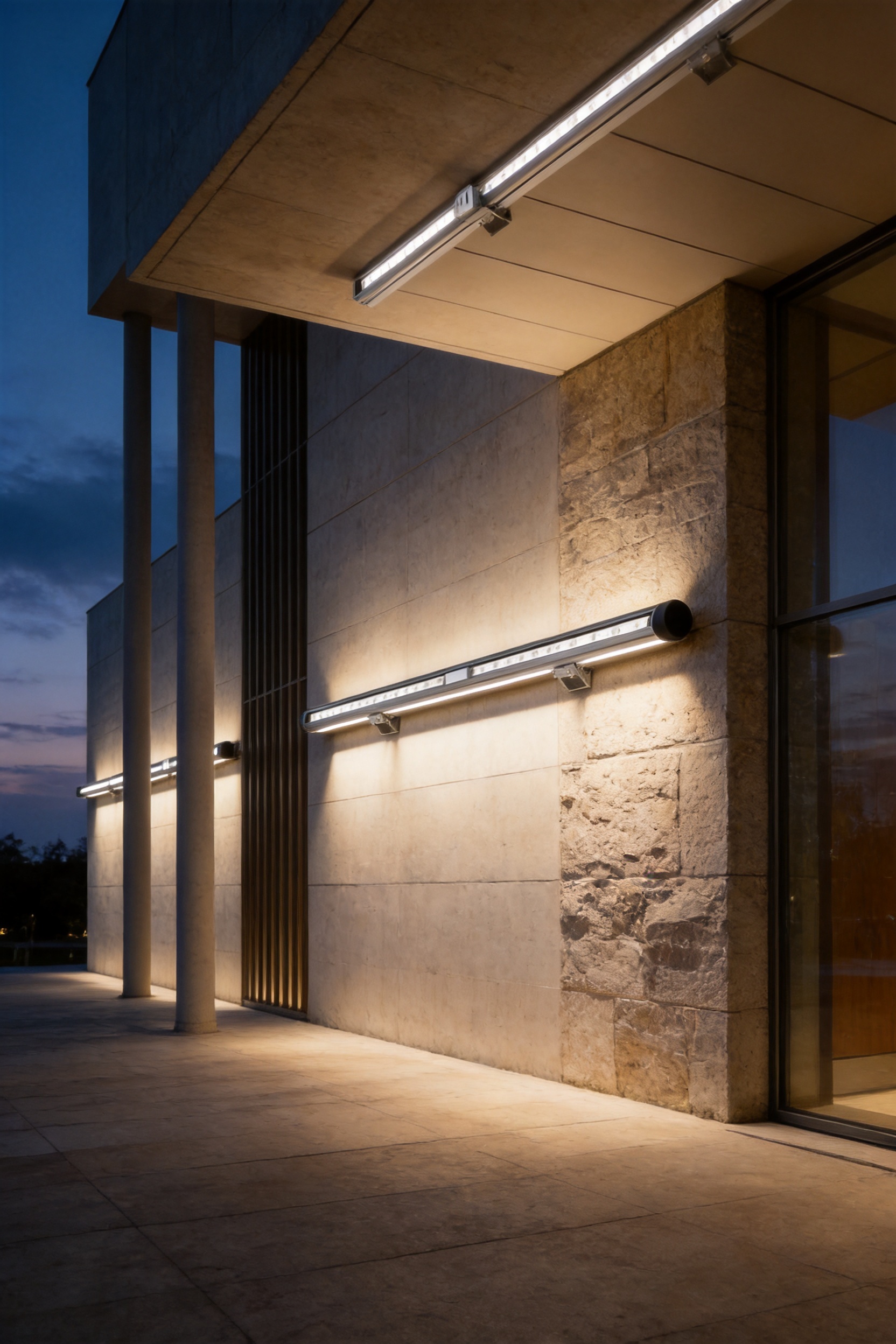
A dedicated wall washer addresses these challenges through a more focused optical system and a form factor intended for linear architectural applications. By positioning the fixture close to a wall, along a parapet, beneath an overhang, or beside a vertical feature, the installer can create a continuous or repeated lighting rhythm. The result is a more uniform visual presentation and a clearer expression of the building’s lines.
The GZD-XQD-3226/3226D is particularly useful where the design objective is to enhance the façade without visually overpowering it. Its controlled output can help distinguish architectural edges, reveal surface texture, and create layers of light and shadow. For projects with strong geometric forms, multiple fixtures can be arranged in a consistent line to produce a carefully coordinated composition.
2.1 Controlled Light Distribution
Beam control is one of the most important differences between a wall washer and a basic floodlighting product. The GZD-XQD-3226/3226D offers multiple beam-angle options, allowing the designer to match the distribution to the target surface.
A narrower beam can concentrate light on a column, pilaster, sign band, or vertical section of a façade. A wider beam can cover a broader wall area with fewer visible transitions between fixtures. The listed 10×45-degree and 10×65-degree distributions are useful where an elongated or asymmetric pattern is required, while 60-degree, 90-degree, and 110-degree options support broader coverage conditions.
Correct selection is important. A beam that is too narrow may create noticeable bright strips and dark gaps. A beam that is too wide may illuminate adjacent areas unnecessarily and reduce the visual contrast of the intended feature. For this reason, lighting designers should consider the distance from the fixture to the wall, the fixture spacing, the wall height, surface reflectance, and the desired uniformity before choosing the optical version.
2.2 Reduced Glare Compared with Conventional Flood Lighting
Glare is a major concern in public and commercial environments. A fixture that is visible from pedestrian routes, roads, neighboring properties, or upper floors can cause discomfort and reduce the quality of the nighttime environment. Uncontrolled floodlights are especially likely to direct light toward viewers rather than toward the intended façade.
The wall washer format supports better control over fixture placement and light direction. When correctly installed, the GZD-XQD-3226/3226D can keep the primary light distribution on the building surface and reduce unnecessary light above or beyond the target area. This does not eliminate the need for careful aiming, shielding, and photometric planning, but it gives the project team a more suitable starting point than a broad-area fixture.
For sensitive locations, the product can be integrated into a lighting design that considers viewing angles, neighboring buildings, road users, and local light-pollution requirements. The goal is to make the building visible while keeping the surrounding environment comfortable.
3. Main Technical Characteristics
The following table summarizes the principal product information supplied for the two configurations.
| Technical Item | GZD-XQD-3226 | GZD-XQD-3226D |
|---|---|---|
| Light Source | Epileds, Bridgelux, Epistar, Osram, or Cree | Epileds, Bridgelux, Epistar, Osram, or Cree |
| Input Voltage | DC12-24V | DC12-24V |
| Power | 12-24W | 12-24W |
| LED Color | Red, green, blue, yellow, warm white, or white | Red, green, blue, yellow, warm white, or white |
| Beam Angle | 10×45°, 10×65°, 60°, 90°, or 110° | 10×65°, 45°, 60°, 90°, or 110° |
| Light Output Ratio | 80 lm/W | 80 lm/W |
| Color Temperature | 1800-6500K | 1800-6500K |
| Control Mode | Steady | Steady |
| Environment Temperature | -20°C to 45°C | -20°C to 45°C |
| Ingress Protection | IP65 | IP65 |
The specifications show that the two versions are suitable for low-voltage architectural applications where the project requires a stable, steady lighting effect. The available color-temperature range of 1800-6500K supports warm decorative illumination, neutral architectural presentation, and cooler white effects, subject to the selected LED configuration.
Project teams should confirm the final LED color, optical distribution, power selection, dimensions, cable arrangement, mounting accessories, and driver requirements before production. These details can influence the lighting result and should be matched to the complete installation environment.
4. Optical Performance for Architectural Contouring
Architectural contouring requires more than brightness. It requires the light to follow the intended visual structure. A façade can contain horizontal bands, vertical divisions, recessed windows, projecting balconies, and irregular textures. The lighting system must therefore be selected according to the architectural drawing rather than treated as a generic electrical accessory.
The GZD-XQD-3226/3226D supports this design process by offering multiple optical configurations. Designers can specify a narrow distribution for strong linear emphasis or a wide distribution for larger surface coverage. Where a façade includes repeated vertical elements, fixtures can be positioned in a regular sequence to establish rhythm and balance. Where a building has a long horizontal edge, a series of wall washers can provide continuity across the elevation.
The approximate 80 lm/W light output ratio provides a practical balance between energy use and illumination performance. In a large project, the difference between a carefully selected optical system and an inefficient broad-beam installation can affect both operating costs and the number of fixtures required. Efficient distribution helps place light where it is needed instead of compensating for poor control with excessive power.
For light-colored stone, concrete, painted metal, and other reflective materials, a moderate output may create a strong visual effect. Dark brick, rough stone, and highly textured surfaces may require closer spacing or a higher-output configuration. The correct solution should be validated through sample installation, photometric analysis, or a DIALux-based design before mass deployment.
4.1 Warm, Neutral, and Cool White Applications
The 1800-6500K range gives the product considerable flexibility. Warm color temperatures can create a welcoming and historic atmosphere for hotels, restaurants, cultural buildings, heritage sites, and hospitality projects. Neutral white can provide a balanced appearance for offices, commercial buildings, public institutions, and modern façades. Cooler white may be selected for contemporary structures, high-tech facilities, or designs that require a crisp and energetic appearance.
Color selection should take into account the façade material and nearby lighting. Warm light can emphasize natural stone and wood tones, while neutral or cool white can bring out the clean geometry of glass, steel, and pale architectural panels. If multiple sections of one building are illuminated with different color temperatures, the transition should be intentional so that the composition does not appear inconsistent.
4.2 Color Options for Decorative Effects
In addition to white-light configurations, the product information lists red, green, blue, and yellow options. These colors can be used for decorative events, seasonal scenes, entertainment venues, cultural programs, or identity-focused architectural presentations.
For permanent installations, colored light should be applied carefully. Excessive saturation may reduce the visibility of architectural details or create visual fatigue. However, when used selectively on columns, entrance features, rooflines, or building edges, color can strengthen a project’s identity and create a memorable nighttime image.
5. Low-Voltage Operation and Project Flexibility
The DC12-24V input specification is an important feature for architectural projects. Low-voltage systems can offer installation flexibility, especially in locations where designers want to reduce exposure to higher operating voltages near accessible areas. They may also simplify integration with suitable power supplies, control cabinets, and distributed lighting systems.
Low-voltage operation does not remove the need for professional electrical design. Voltage drop, cable length, power-supply capacity, circuit protection, grounding, waterproof connections, and maintenance access must all be evaluated. The installation team should confirm the correct driver or power supply arrangement for the selected fixture quantity and cable layout.
When a project uses long runs of fixtures, voltage drop can produce differences in brightness if the circuit is not properly designed. A qualified installer should calculate cable size and circuit length, divide fixtures into appropriate groups, and ensure that connections are protected against moisture. These measures help preserve stable output across the complete façade.
The low-voltage architecture also supports certain OEM and ODM configurations. Custom project requirements may include different lengths, RGB options, wiring arrangements, mounting solutions, or smart dimming integration. Such customization should be reviewed during the technical design phase so that optical, mechanical, and electrical characteristics remain compatible.
6. Durable Aluminum Housing for Outdoor Use
Outdoor façade fixtures are exposed to rain, dust, temperature changes, ultraviolet radiation, wind, vibration, and pollutants. The housing must protect the LED system and maintain mechanical stability over time. The GZD-XQD-3226/3226D uses a durable aluminum housing, a material widely selected for architectural lighting because it offers a useful combination of strength, weight control, corrosion resistance, and thermal conductivity.
Aluminum can help transfer heat away from the LED components when the housing is correctly designed. Thermal management is essential because excessive heat can accelerate LED depreciation, affect color consistency, and shorten the service life of electronic components. A properly manufactured housing, combined with suitable LED selection and internal design, supports more stable operation.
The aluminum body also provides a professional appearance that can be integrated into modern architectural environments. Depending on the project finish, the fixture may be coordinated with façade colors, concealed within architectural details, or installed as a visible linear element that contributes to the overall design language.
6.1 IP65 Protection
The product is rated IP65. This indicates protection against dust ingress and protection against water jets from limited directions. IP65 is appropriate for many outdoor architectural applications, including building façades, covered exterior areas, landscape structures, and commercial elevations.
However, an IP rating applies to the product under defined test conditions. The final installation must maintain the integrity of the housing, cable glands, connectors, end caps, and mounting points. Cutting cables, drilling the housing, using unsuitable connectors, or leaving joints exposed can reduce the actual protection level of the installed system.
In locations subject to standing water, direct high-pressure cleaning, coastal salt exposure, or severe weather, the project team should evaluate whether additional protection, special coatings, sealed junction boxes, or enhanced product configurations are required. Proper drainage and mounting orientation are also important for long-term reliability.
7. Manufacturing Strengths of the Supplier
Cixi HuaSheng Lighting Co., Ltd. is an outdoor lighting manufacturer based in Ningbo, China. Its product portfolio includes LED street lights, tunnel lights, high-bay lights, linear lights, garden lights, solar lights, grow lights, explosion-proof lights, and other lighting products. This broad product experience is relevant to façade lighting because it demonstrates familiarity with different outdoor environments, optical requirements, thermal conditions, and project specifications.
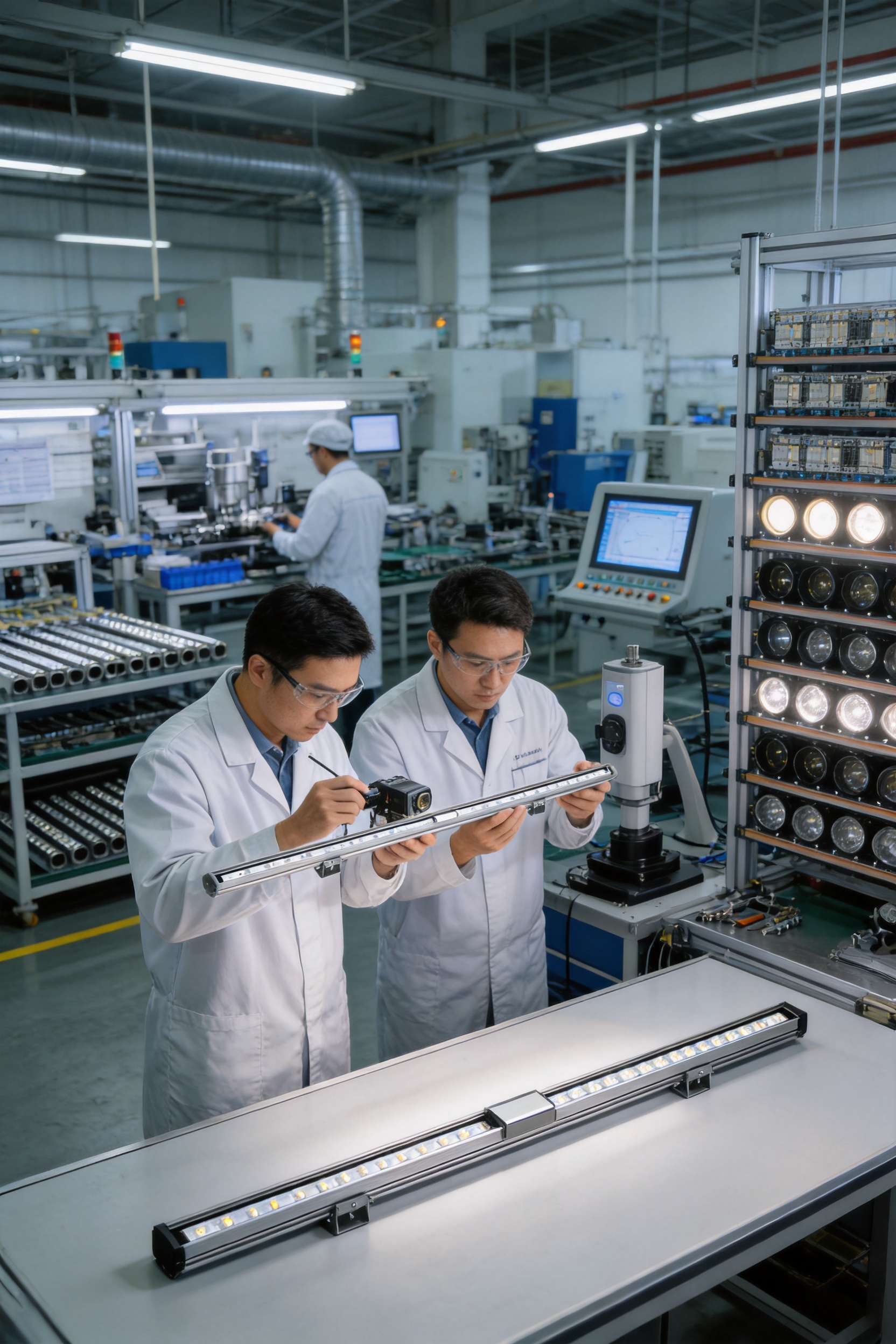
The company combines lighting production with die-casting and CNC machining capabilities. This integrated manufacturing background can improve control over the mechanical components of a wall washer. Housing dimensions, mounting interfaces, surface details, and structural tolerances are important to installation quality, particularly when fixtures are placed in continuous rows or integrated into architectural details.
Die-casting is valuable for producing repeatable aluminum housings with consistent geometry. A well-controlled die-casting process can support efficient production of complex shapes, heat-dissipation features, mounting structures, and protective profiles. Consistent housing dimensions also help reduce variation during assembly and installation.
CNC machining provides additional precision for components that require accurate holes, interfaces, threads, channels, or finishing surfaces. This is especially useful for customized orders, low-volume engineering samples, and projects where the fixture must fit a specific mounting structure. The combination of die-casting for efficient production and CNC machining for precision adjustment provides a practical foundation for OEM and ODM development.
7.1 Mould Design and Die-Casting Capabilities
Lighting performance depends partly on the quality of the housing and optical alignment. Mould design influences the consistency of the body, the position of internal components, the quality of exterior surfaces, and the repeatability of production. A supplier with mould-development experience can respond more effectively when a customer requires a modified length, a new mounting interface, or a project-specific enclosure.
Die-casting also supports efficient manufacturing for repeat orders. Once the mould and process parameters have been validated, repeated production can achieve more consistent dimensions and reduce unnecessary variation between batches. For façade projects, this consistency matters because small differences in fixture length, angle, or mounting position can become visible across a large building elevation.
Customers seeking customized products should provide architectural drawings, target dimensions, installation details, desired beam patterns, cable specifications, and environmental conditions at the beginning of the project. Early technical communication helps determine whether an existing platform can be adapted or whether a new mould and optical solution are necessary.
7.2 CNC Processing and Component Accuracy
CNC equipment can be used for precision processing of aluminum and other components. Accurate machining supports reliable assembly, correct alignment, clean mounting, and repeatable installation. It can also improve the fit between housing sections, brackets, end caps, and connection components.
For a wall washer, mechanical accuracy is closely related to optical consistency. If the LED board, lens, reflector, or internal support is not correctly positioned, the beam may shift or vary between fixtures. Controlled machining and assembly procedures help maintain the intended optical relationship from one unit to another.
7.3 Aging Lines and Reliability Screening
The company operates aging lines for lighting products. Aging or burn-in procedures are commonly used to identify early failures, unstable electrical connections, abnormal temperature behavior, or component issues before shipment. Although aging cannot predict every field condition, it is an important part of production quality control.
For architectural projects, early failure can create substantial maintenance costs. Accessing a façade may require lifts, traffic control, scaffolding, or special permits. A manufacturing process that includes reliability screening can help reduce the risk of installing units with immediately detectable problems.
7.4 Goniophotometer-Based Lighting Evaluation
The company also has goniophotometers for photometric evaluation. A goniophotometer measures the distribution of light emitted by a luminaire across different angles. The resulting data can support the analysis of luminous intensity, beam shape, efficiency, and other optical characteristics.
This capability is valuable for architectural wall washers because beam distribution directly affects the final façade appearance. Photometric testing can help verify whether a selected optical configuration produces the intended pattern and can provide information for lighting calculations and DIALux design work.
For professional projects, photometric data may be used to estimate illuminance on the wall, fixture spacing, overlap between units, and energy consumption. It also supports more reliable communication between the manufacturer, lighting designer, contractor, and building owner.
8. Quality Management and Product Certification
Cixi HuaSheng Lighting Co., Ltd. is described as holding ISO 9001, ISO 14001, and ISO 45001 certifications. These management systems address quality management, environmental management, and occupational health and safety respectively. Certification does not replace product testing, but it indicates that the organization has established documented management procedures in these areas.
ISO 9001 can support consistent processes for purchasing, production, inspection, corrective action, and customer communication. For an OEM or ODM customer, a structured quality system may make it easier to define acceptance criteria, manage revisions, and trace production records.
ISO 14001 reflects attention to environmental management. Lighting manufacturers may need to manage energy use, material handling, waste, chemical processes, packaging, and regulatory responsibilities. Environmental controls are increasingly important for international buyers and public projects that include sustainability requirements.
ISO 45001 focuses on occupational health and safety. Manufacturing operations involving die-casting, CNC machining, electrical testing, assembly, and logistics require controlled work practices. A safety-oriented production environment supports operational continuity and responsible supply-chain management.
The company also identifies relevant products as certified by CB and CE. Customers should request the applicable certificates, test reports, and product-specific documentation for the exact GZD-XQD-3226/3226D configuration being purchased. Certification scope can vary by model, voltage, component selection, and market requirement.
9. Advantages over Conventional Floodlights and Basic Wall Washers
9.1 More Purposeful Architectural Illumination
The main advantage of a dedicated wall washer is that its purpose is aligned with the needs of architectural lighting. Instead of spreading light broadly in every direction, it is selected to illuminate a façade or architectural feature. This can produce a more refined appearance and reduce wasted light.
9.2 Greater Optical Selection
The range of beam-angle choices gives designers more control than a single-pattern floodlight. Different façade conditions can be addressed with different distributions, helping improve uniformity and reduce unwanted spill. This can be especially valuable on complex buildings where one optical pattern cannot serve every elevation.
9.3 Low-Glare Potential
When installed at the correct angle and position, the linear wall washer format can reduce direct view of the light source and keep light focused on the building. This supports a more comfortable nighttime environment than poorly aimed floodlights.
9.4 Flexible Color and Color Temperature
The available white-light range and colored LED options allow the same product family to serve different architectural concepts. Warm, neutral, cool, and decorative color options can be selected according to the building material, brand identity, event program, or local design objectives.
9.5 Efficient Low-Voltage Platform
DC12-24V operation supports flexible system design and is suitable for many low-voltage façade installations. With correct power distribution and wiring design, the platform can be integrated into different project layouts.
9.6 Customization Support
The supplier offers OEM and ODM services, including customized lengths, RGB options, and smart dimming integration. These capabilities can be important for projects where standard fixtures do not match the façade module, mounting zone, control system, or visual effect required by the designer.
9.7 Manufacturing Integration
Die-casting, CNC machining, aging lines, and photometric equipment provide a more complete manufacturing foundation than simple assembly-only operations. Integrated capabilities can improve development speed, component consistency, and technical communication during customized projects.
10. Applications in Different Building Types
10.1 Cultural Buildings and Museums
Museums, galleries, libraries, and cultural centers often require lighting that presents architectural details without overwhelming the surrounding site. Warm white light can create a dignified atmosphere, while carefully selected neutral white can reveal modern materials and geometric forms. Narrow distributions can highlight entrances, columns, or roofline features.
10.2 Commercial Complexes
Shopping centers, mixed-use developments, and retail streets use façade lighting to improve nighttime visibility and create a recognizable public identity. The GZD-XQD-3226/3226D can be used along façade bands, entrance portals, vertical fins, and decorative structures. Different color temperatures or selected color effects can distinguish zones within a large complex.
10.3 Hotels and Hospitality Projects
Hotels, resorts, restaurants, and entertainment venues often depend on atmosphere. Warm white illumination can make exterior materials appear inviting, while carefully controlled accent lighting can guide visitors toward entrances and outdoor amenities. The fixture’s compact architectural format allows it to be positioned along canopies, terraces, walls, and landscape boundaries.
10.4 Public and Municipal Buildings
Government buildings, transportation facilities, civic centers, and public plazas may use façade lighting to improve visibility and strengthen civic identity. A steady lighting mode is suitable for projects that require reliable, uncomplicated operation. Multiple fixtures can be arranged to create a consistent pattern across large elevations.
10.5 Landmark Structures
Landmark buildings require visual impact, but the lighting must remain technically controlled. Beam selection, color consistency, installation spacing, and maintenance planning become particularly important when the building is visible from a distance. The GZD-XQD-3226/3226D can serve as part of a layered lighting strategy that combines wall washing with concealed linear lighting, accent lighting, and roofline illumination.
11. Installation and Design Recommendations
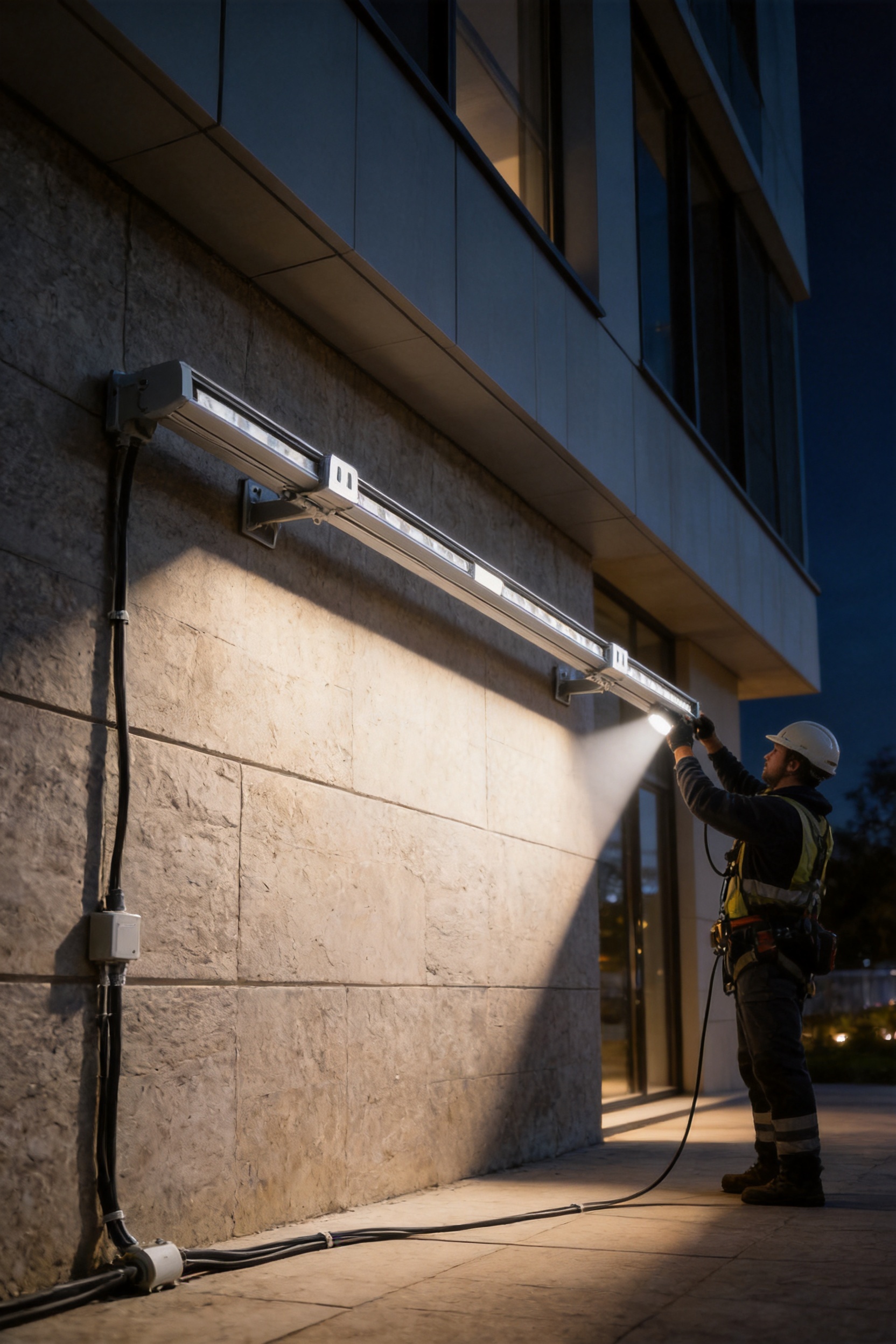
Before installation, the project team should review the façade drawings and identify the exact surfaces to be illuminated. The mounting distance from the wall should be evaluated together with the beam angle. A short distance and wide beam may produce rapid falloff or excessive overlap, while a long distance and narrow beam may create visible gaps.
Fixture spacing should be determined through photometric calculation or on-site mock-up. The recommended spacing depends on the optical pattern, output level, wall reflectance, surface texture, mounting height, and desired uniformity. A sample installation is especially useful for historic, textured, or highly reflective façades.
The mounting structure must support the fixture securely under wind and vibration. Brackets should be aligned so that the intended beam direction remains stable after installation. If the fixture is installed on a sloped or irregular surface, the design should include adjustment provisions.
All electrical connections should use compatible low-voltage equipment and outdoor-rated connectors. The power supply should have adequate capacity and should be located where it can be inspected and replaced. Cable routes should be planned to avoid sharp edges, standing water, excessive heat, and unnecessary exposure to mechanical damage.
The IP65 rating should be preserved throughout the installation. Cable entries, end caps, connectors, and junction boxes must be properly sealed. After installation, the system should be inspected for water paths, loose covers, damaged insulation, and incorrect cable strain relief.
Where the building is located near the coast or in an industrial environment, additional attention should be given to corrosion. The selected finish, fasteners, brackets, connectors, and cleaning schedule should be compatible with the local atmosphere.
12. OEM and ODM Development Options
Architectural projects often have dimensions and technical conditions that differ from standard catalog requirements. The supplier’s OEM and ODM services can support customized lengths, RGB configurations, smart dimming integration, and other project-specific requirements.
Customized lengths can help reduce visible gaps between fixtures and improve continuity along architectural modules. A project may require a fixture to fit beneath a parapet, inside a narrow recess, along a curved wall, or between structural elements. The feasibility of a customized length should be confirmed with regard to LED spacing, heat dissipation, power input, transport, and maintenance.
RGB options can support dynamic or decorative effects when the control system is properly specified. Designers should define whether the project needs simple color selection, synchronized color changes, scene programming, or integration with a centralized building-management system. The control protocol, power supply, addressing method, and installation topology should be agreed before production.
Smart dimming integration may help reduce energy consumption and adapt the façade to different operating periods. For example, a building may use higher output during evening arrival hours and lower output later at night. Dimming can also support special events or maintenance modes. The compatibility between the fixture, driver, controller, and software must be tested as a complete system.
For customized projects, the development process should normally include a technical brief, preliminary drawings, optical discussion, sample production, testing, approval, and mass production. Clear documentation reduces the risk of differences between the approved sample and the final shipment.
13. Maintenance and Lifecycle Considerations
Although LED fixtures generally require less maintenance than traditional discharge or halogen systems, exterior architectural installations still require periodic inspection. Dust, pollution, bird activity, construction residue, and mineral deposits can reduce optical performance. Cleaning should be performed using methods compatible with the housing finish, lens, seals, and local environmental conditions.
Maintenance teams should inspect brackets, fasteners, cables, connectors, power supplies, and junction boxes. Any sign of water ingress, corrosion, loose mounting, cracked components, or abnormal flicker should be addressed promptly. Early intervention can prevent a small defect from affecting an entire lighting row.
Large façade projects should maintain an installation record showing fixture locations, circuit groups, power-supply positions, optical configurations, and replacement details. This documentation simplifies future maintenance and helps ensure that replacement units match the original color, beam angle, and power specification.
Because the GZD-XQD-3226/3226D is available with multiple LED sources and configurations, replacement planning should include the exact model and optical specification. Using a different beam angle or color temperature may create visible inconsistency across the façade, even if the replacement fixture has a similar physical appearance.
14. Energy and Environmental Benefits
LED technology provides a practical foundation for energy-conscious façade lighting. Compared with many conventional sources, LED fixtures can deliver controlled illumination at lower power and can be switched or dimmed more flexibly. The approximately 80 lm/W light output ratio of this product supports an efficient architectural lighting approach when the optical system and fixture spacing are properly selected.
Energy performance depends on the whole system rather than the fixture alone. Efficient design includes selecting the correct beam angle, avoiding excessive overlap, using appropriate operating schedules, maintaining clean optical surfaces, and applying dimming where suitable. A poorly planned system can consume unnecessary energy even when it uses efficient LED hardware.
The supplier’s ISO 14001 environmental management certification also reflects an organizational approach to environmental control. Customers with sustainability targets should request detailed product information, packaging data, material declarations, and project-specific energy calculations when required by the tender or building certification process.
15. How to Select the Correct Configuration
The first selection factor is the target surface. Narrow architectural elements usually require a concentrated beam, while broad walls may benefit from a wider distribution. The second factor is the distance between the fixture and façade. The third is the desired visual effect, such as uniform wall washing, line emphasis, grazing, accenting, or decorative color.
The required color temperature should be selected after considering the building material and nearby lighting. Warm light is often effective on stone, brick, and hospitality façades. Neutral white is versatile for commercial and civic buildings. Cool white may suit modern glass and metal structures. Colored options should be reserved for clearly defined decorative or identity purposes.
Power selection should be based on the required illuminance, mounting height, surface reflectance, and operating schedule. The 12-24W range allows the product to be adapted to different lighting levels, but the final output should be confirmed through calculation or sample testing.
The environmental conditions should also be reviewed. IP65 protection is suitable for many outdoor conditions, while coastal, high-pollution, high-humidity, or mechanically exposed locations may require additional protective measures. The project team should also confirm the ambient temperature range of -20°C to 45°C against the actual installation environment.
Finally, the client should confirm whether a steady lighting mode is sufficient or whether the project requires dimming, RGB control, or integration with a smart lighting system. The standard information lists steady control, while additional control functions may be available through customized OEM or ODM development.
16. Project Planning from Concept to Delivery
A successful wall-washing project begins with a clear design brief. The brief should identify the building location, façade materials, elevation drawings, installation zones, desired brightness, color temperature, operating hours, control method, local weather conditions, and maintenance strategy.
The manufacturer can then help evaluate the appropriate product configuration. Photometric data and DIALux design services can support decisions about fixture spacing, beam angle, output, and energy consumption. For complex elevations, a small-scale mock-up can provide valuable information about glare, shadowing, color appearance, and surface uniformity.
After the optical and mechanical design is approved, the customer should review the product drawings, wiring diagrams, mounting details, and inspection requirements. If a customized length or mould is required, sample approval becomes especially important.
During production, quality control should cover incoming components, LED source consistency, housing quality, electrical assembly, optical alignment, waterproof construction, burn-in, and final inspection. Test records and packing documentation should be maintained for project traceability.
At delivery, the installation team should check the shipment against the approved specification. Fixture model, quantity, color, beam angle, power, cables, accessories, and labels should be verified before installation. This process helps prevent avoidable delays at the construction site.
17. Frequently Asked Questions
What is the primary purpose of the GZD-XQD-3226/3226D?
It is a professional LED wall washer for architectural façade lighting, contouring, decorative wall illumination, and highlighting building lines or structural features.
Where can this product be used?
It can be used on cultural buildings, museums, commercial complexes, hotels, public buildings, landmark structures, landscape features, and other outdoor architectural surfaces.
What input voltage does the product use?
The listed input voltage is DC12-24V. The complete project should include a compatible power supply and properly designed low-voltage wiring system.
What power options are available?
The listed power range is 12-24W. The appropriate selection depends on the façade material, mounting distance, target brightness, beam angle, and lighting design.
Which beam angles are available?
The listed options include 10×45 degrees, 10×65 degrees, 60 degrees, 90 degrees, and 110 degrees, with the exact availability depending on the selected model and configuration.
Can the product provide warm white and cool white light?
Yes. The listed correlated color temperature range is 1800-6500K, allowing warm, neutral, and cool white configurations subject to the selected LED version.
Are colored LED options available?
Yes. The supplied product information lists red, green, blue, and yellow options in addition to warm white and white.
Does the standard product support dynamic lighting control?
The listed standard control mode is steady. OEM and ODM services may support RGB options and smart dimming integration, but the exact control protocol and system compatibility should be confirmed before ordering.
What is the outdoor protection rating?
The product is rated IP65, providing dust protection and protection against water jets under defined test conditions. Correct installation and sealed connections are essential to maintain outdoor performance.
What operating temperature range is specified?
The listed environmental temperature range is -20°C to 45°C. Project teams should compare this range with the actual local climate and installation conditions.
What LED sources can be selected?
The listed LED source options include Epileds, Bridgelux, Epistar, Osram, and Cree. The final source should be confirmed in the purchase specification because component availability and project requirements may vary.
Can the fixture length be customized?
Customized lengths are included among the supplier’s OEM and ODM services. Technical feasibility should be reviewed in relation to LED spacing, heat dissipation, power input, optical performance, mould requirements, and transport.
How does this wall washer compare with a conventional floodlight?
The wall washer is designed specifically for façade illumination and provides more optical options, a more architectural linear format, and better potential for controlled light placement. A conventional floodlight may be less precise and may produce more unwanted spill or glare if not carefully selected and aimed.
Does the manufacturer provide lighting design support?
The company provides one-stop services that include efficient lighting solutions and DIALux designs. Customers should supply accurate architectural information so the proposed design can reflect actual site conditions.
What manufacturing capabilities support this product?
The company has die-casting and CNC machines, aging lines, and goniophotometers. These resources support housing production, precision machining, reliability screening, and photometric evaluation.
What certifications and management systems are associated with the supplier?
The company is described as ISO 9001, ISO 14001, and ISO 45001 certified. Relevant products are also identified as certified by CB and CE. Buyers should request current, model-specific documentation for their market.
18. Recommended Buyer Checklist
Before placing an order, buyers should confirm the exact model, fixture length, power, LED source, color, color temperature, beam angle, input voltage, control mode, cable length, connector type, mounting accessories, and IP protection requirements.
The buyer should also provide the intended installation height, wall distance, façade material, site climate, operating schedule, and control-system details. This information allows the manufacturer to recommend a more appropriate configuration and reduces the risk of performance differences between the design concept and the completed installation.
For large or high-profile projects, the buyer should request product drawings, photometric files, sample units, test documents, inspection procedures, packing details, and installation guidance. If the project requires compliance with a particular national standard, the relevant testing and certification requirements should be defined before production.
For customized projects, the purchase agreement should identify the approved sample, tolerances, color requirements, optical acceptance criteria, electrical test conditions, and replacement policy. These details help protect both the buyer and the manufacturer during delivery and project handover.
19. Conclusion
The Architectural LED Wall Washer GZD-XQD-3226/3226D is a flexible solution for projects that need precise, durable, and visually controlled façade lighting. Its principal strengths include multiple beam-angle choices, DC12-24V operation, a 12-24W power range, approximately 80 lm/W light output ratio, a broad 1800-6500K color-temperature range, colored LED options, aluminum construction, IP65 protection, and compatibility with customized OEM and ODM development.
Its value is not limited to the fixture specification. The product is supported by a manufacturer with die-casting, CNC machining, aging, photometric testing, mould design, lighting design, and international project experience. These capabilities can help customers move from an architectural concept to a practical lighting system with stronger control over mechanical quality, optical performance, production consistency, and delivery requirements.
Compared with conventional flood lighting, a dedicated wall washer offers a more suitable approach to architectural contouring. It can emphasize building lines, create visual depth, reduce uncontrolled spill, and support a cleaner nighttime presentation. When the beam angle, installation position, color, power, and control system are selected correctly, the GZD-XQD-3226/3226D can contribute to attractive and efficient illumination for cultural, commercial, municipal, hospitality, and landmark projects.
For the best result, each project should be evaluated as a complete system. Proper photometric planning, sample testing, low-voltage electrical design, waterproof installation, structural mounting, and maintenance planning are essential. With these elements in place, the GZD-XQD-3226/3226D can provide a dependable architectural lighting platform for both standard and customized façade applications.
References
1. Illuminating Engineering Society. Lighting Handbook: Reference and Application.
2. Commission Internationale de l’Éclairage. Principles of Exterior Architectural Lighting.
3. International Electrotechnical Commission. Degrees of Protection Provided by Enclosures for Electrical Equipment.
4. International Organization for Standardization. Quality Management Systems: Requirements.
5. International Organization for Standardization. Environmental Management Systems: Requirements with Guidance for Use.
6. International Organization for Standardization. Occupational Health and Safety Management Systems: Requirements with Guidance for Use.
7. CIE. Guide to the Lighting of Urban Areas and Outdoor Public Spaces.
8. Manufacturer technical information for Architectural LED Wall Washer GZD-XQD-3226/3226D.
9. Manufacturer information concerning LED lighting production, die-casting, CNC machining, aging, photometric evaluation, OEM, and ODM services.
Product: Architectural LED Wall Washer GZD-XQD-3226/3226D
Custom & OEM Solutions for Global Lighting Brands
Copyright © Cixi HuaSheng Lighting Co., Ltd. All Rights Reserved.
Die-Casting Mould Supplier
