 English
 中文简体
 русский
 Français
 Español
 عربى
 Indonesia

Compact Outdoor Flood Light GZD-TGD-R: Flexible, Durable, and Efficient Illumination for Modern Projects

Compact Outdoor Flood Light GZD-TGD-R
Outdoor lighting projects increasingly require fixtures that combine strong illumination, compact dimensions, dependable weather resistance, and flexible installation. Designers, contractors, distributors, and property owners are no longer looking only for maximum wattage. They also need products that fit restricted mounting areas, reduce structural loads, simplify wiring, support different lighting effects, and remain reliable in changing outdoor conditions. The Compact Outdoor Flood Light GZD-TGD-R has been developed to address these practical requirements in one adaptable lighting solution.
Available in 9W, 15W, 24W, and 36W versions, the GZD-TGD-R is a space-saving LED flood light for residential outdoor areas, commercial entrances, gardens, architectural details, small public spaces, and other applications where a compact fixture must provide useful and controlled illumination. Its small form factor makes it easier to position than many larger floodlights, while its aluminum housing and LED technology support efficient operation and long-term serviceability.
The product is designed for more than basic area lighting. With several beam angles, multiple color options, broad color temperature selection, and DMX512 or steady control, it can be used for functional lighting, accent lighting, facade highlighting, landscape illumination, and decorative color effects. This flexibility allows a single product family to support a wide range of project specifications.
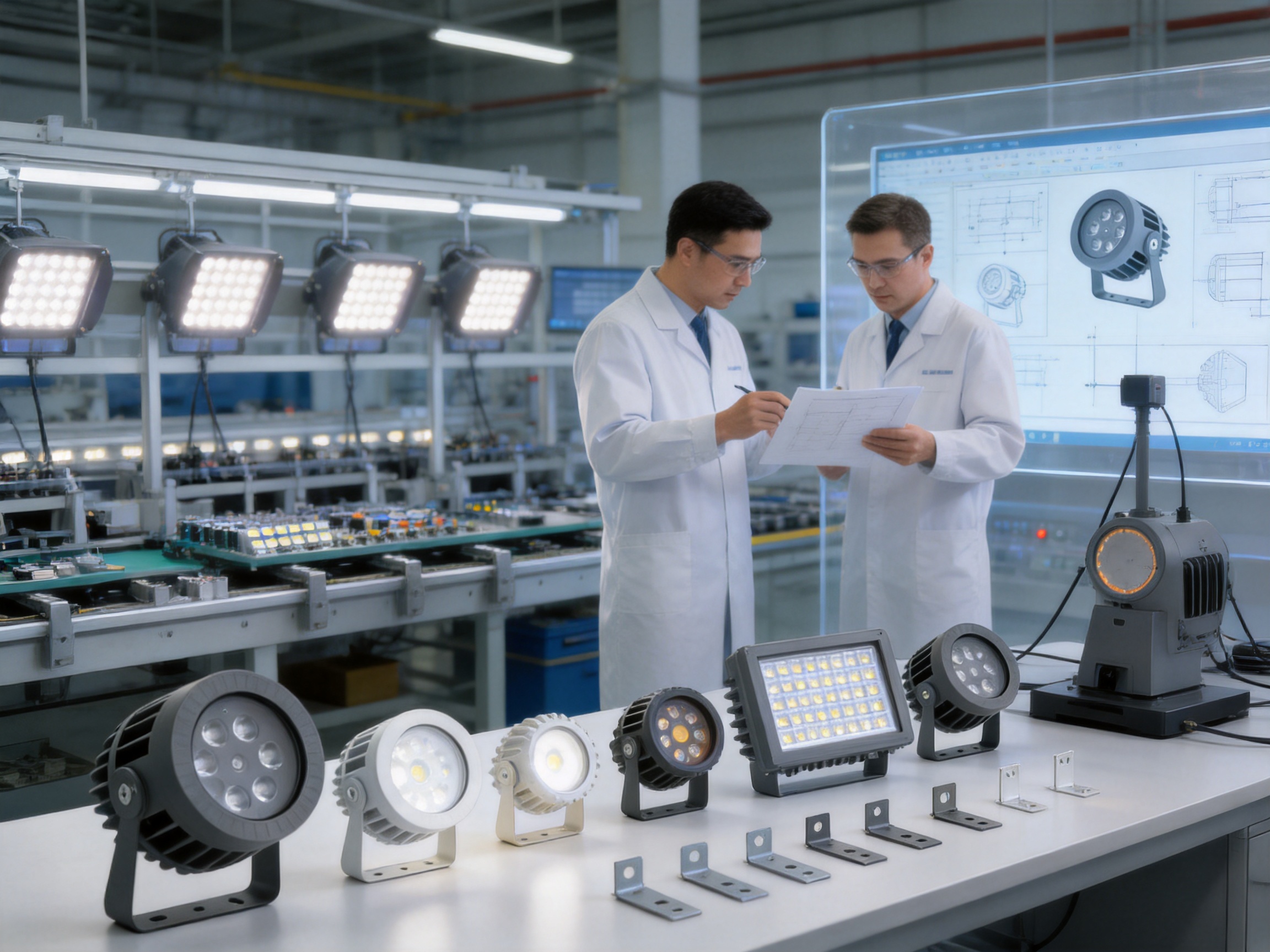
Manufactured by Cixi HuaSheng Lighting Co., Ltd., a professional outdoor lighting manufacturer in Ningbo, China, the product benefits from an established production system that includes die-casting and CNC equipment, aging lines, photometric testing facilities, and integrated OEM and ODM services. The company’s manufacturing capabilities allow buyers to discuss customized mounting, product dimensions, beam configuration, packaging, and other project-specific requirements.
Understanding the Compact Outdoor Flood Light GZD-TGD-R
The GZD-TGD-R is an LED flood light engineered for locations where installation space is limited or where a large fixture would be visually intrusive. A compact flood light can be especially valuable in residential gardens, building entrances, balconies, low-rise commercial developments, decorative walls, signage areas, and small landscape installations. In these locations, the lighting fixture must provide adequate performance while remaining proportionate to the surrounding architecture.
The product is offered in four nominal power levels: 9W, 15W, 24W, and 36W. This range helps users select a suitable output according to mounting height, illuminated area, required brightness, and energy budget. Lower-power versions can be used for small decorative features, pathways, garden elements, and entrance details. Higher-power versions can cover broader surfaces or deliver stronger accent illumination to facades, signs, walls, and landscape structures.
The light source can be configured with Epileds, Bridgelux, Epistar, Osram, or Cree LED options. This provides procurement flexibility for different project budgets, performance expectations, and regional requirements. The selected LED package can influence luminous efficiency, color consistency, reliability, and overall project positioning. Offering multiple source options also helps distributors and engineering partners develop product configurations for different markets.
The GZD-TGD-R supports DC12-24V and AC85-265V input voltage options. This broad electrical compatibility allows the fixture to be integrated into different power systems, including low-voltage installations and standard alternating-current networks. The correct version should always be selected according to the project’s electrical design, wiring method, driver arrangement, and local safety requirements.
In addition to white and warm white options, the product can be supplied in red, green, blue, yellow, RGB, or RGBW configurations. This makes the fixture suitable for both practical illumination and visual design. White light can support general outdoor visibility, while warm white can create a softer architectural appearance. RGB and RGBW versions can be used for seasonal displays, hospitality areas, entertainment venues, landscape features, and dynamic facade lighting.
Core Product Specifications
The technical characteristics of the GZD-TGD-R provide a useful foundation for comparing it with other compact outdoor flood lights. The following table summarizes the principal specifications supplied for the product family.
| Specification | GZD-TGD-R Product Information |
|---|---|
| Product category | LED Flood Light |
| Available power | 9W, 15W, 24W, and 36W |
| Light source options | Epileds, Bridgelux, Epistar, Osram, or Cree |
| Input voltage | DC12-24V or AC85-265V |
| Color options | Red, green, blue, yellow, white, warm white, RGB, and RGBW |
| Beam angle options | 10°, 30°, 45°, and 60° |
| Light output ratio | 80 lm/W |
| Color temperature | 1800-6500K |
| Control modes | DMX512 or steady operation |
| Operating temperature | -20°C to 45°C |
| Ingress protection | IP65 |
| Customization | OEM and ODM support for selected product features and packaging |
These specifications show that the fixture is not limited to one narrow application. Instead, it functions as a configurable platform for different lighting environments. However, final project selection should consider the actual mounting height, surface reflectance, required illumination level, ambient conditions, power supply, control system, and local installation standards.
Compact Design as a Practical Competitive Advantage
Large floodlights can provide high output, but size is not always an advantage. In many projects, a large fixture creates additional installation challenges. It may require a stronger bracket, occupy valuable facade space, affect the appearance of a building, or be difficult to conceal within a landscape design. The compact design of the GZD-TGD-R offers a more balanced approach for applications that need targeted light from a smaller housing.
A compact fixture can reduce the physical burden placed on walls, poles, brackets, and decorative structures. This is particularly useful when lighting older buildings, lightweight architectural elements, garden features, or small commercial installations. Reduced dimensions may also simplify transport, storage, handling, and positioning during installation.
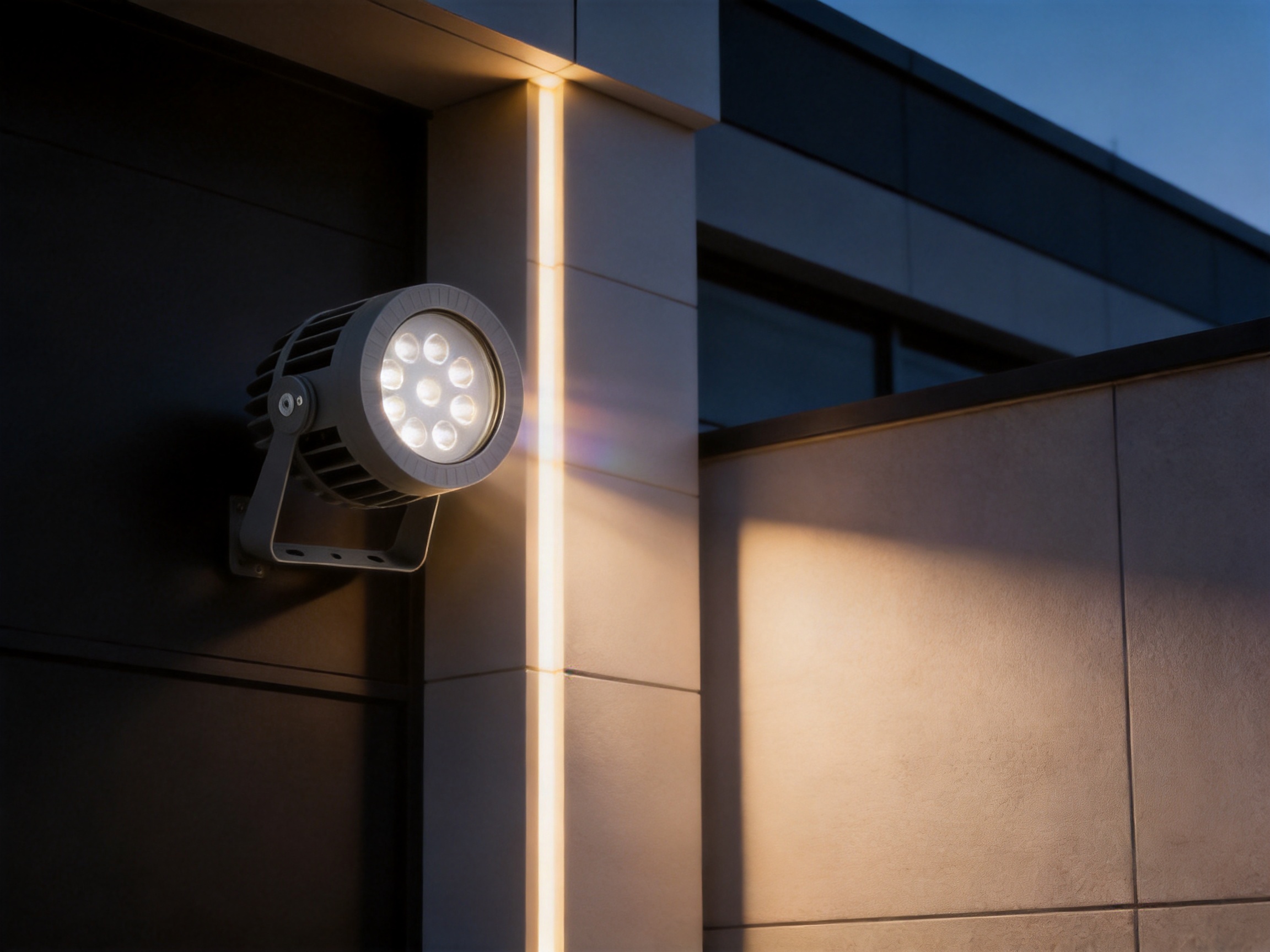
The product’s compact structure supports flexible mounting strategies. Installers can position it in areas where a conventional floodlight would be too large or difficult to align. It can be used near entrances, under roof edges, beside pathways, on garden walls, around landscape structures, or on small facade sections. Its size also helps designers maintain a cleaner visual environment during daylight hours.
Compared with generic compact floodlights that may offer only one power rating or one beam pattern, the GZD-TGD-R combines a compact body with several electrical, optical, and color configurations. This combination can reduce the need to source multiple unrelated fixtures for one project. A common product platform can simplify product selection, spare-part planning, installation training, and future expansion.
Efficient LED Performance for Smaller Outdoor Areas
LED technology provides a practical alternative to older outdoor light sources because it can deliver useful illumination with lower energy consumption, longer service potential, and more flexible optical control. The GZD-TGD-R offers a stated light output ratio of 80 lm/W, supporting efficient lighting design for its intended range of applications.
Efficiency is especially important when a project contains many individual fixtures. A garden, facade, residential complex, or commercial property may use dozens of compact lights. Even a modest reduction in power consumption per fixture can produce meaningful savings across the complete installation. Lower operating power may also help reduce the capacity requirements of power supplies, control equipment, and electrical distribution components.
The four available wattages allow designers to avoid excessive over-lighting. A 9W fixture may be sufficient for a small sign, plant, doorway, or decorative object, while a 24W or 36W model may be more appropriate for a wider wall or stronger architectural accent. Selecting the smallest suitable wattage can improve energy performance while maintaining the desired visual effect.
LED light sources also support rapid switching and precise control. When connected to a compatible control system, the GZD-TGD-R can form part of a scheduled or dynamic lighting scene. This can be useful for properties that want different lighting levels or colors during operating hours, special events, holidays, or nighttime security periods.
Optical Flexibility with Multiple Beam Angles
One of the most important factors in floodlight selection is beam distribution. The wrong beam angle can create excessive spill light, dark areas, glare, or uneven illumination. The GZD-TGD-R is available with 10°, 30°, 45°, and 60° beam angles, giving designers more control over how light is distributed across a target surface.
A 10° beam angle is suited to narrow and concentrated illumination. It can be used to highlight a column, sculpture, tree trunk, sign, architectural feature, or other relatively small target that requires emphasis from a distance. The concentrated beam can help create a stronger visual focal point without using a large fixture.
A 30° beam angle provides a moderately focused distribution. It can be useful for medium-width facade sections, garden features, wall details, and entrance areas where the designer needs a balance between intensity and coverage. This beam option can also support accent lighting where some surrounding spill is acceptable.
A 45° beam angle offers broader coverage for walls, landscape areas, and small outdoor spaces. It can help create a more even distribution when the target is wider or when the fixture is mounted relatively close to the illuminated surface.
A 60° beam angle is appropriate when wider coverage is required. It may be used for general outdoor illumination, broader facade surfaces, small courtyards, pathways, or landscape areas. The final selection should be based on lighting calculations and on-site conditions rather than beam angle alone.
This range of optical options is a competitive advantage over basic floodlights that provide only one fixed distribution. It allows the same product family to serve different distances, surfaces, and design intentions. For professional projects, this flexibility can simplify the luminaire schedule and reduce compromises during installation.
Color Options for Functional and Decorative Applications
Outdoor lighting is increasingly used to communicate identity, create atmosphere, and shape the appearance of buildings after dark. The GZD-TGD-R supports red, green, blue, yellow, white, warm white, RGB, and RGBW configurations, making it suitable for both ordinary illumination and decorative effects.
White light is a practical option for entrances, access areas, signs, small commercial sites, and general visibility. Warm white light, with a lower color temperature, can create a welcoming appearance around homes, restaurants, hotels, gardens, and heritage-style buildings. The broad 1800-6500K range provides additional flexibility for projects that require a particular visual tone.
Colored light can be used to emphasize a brand environment, support seasonal decoration, identify different landscape zones, or create a more dramatic facade appearance. Red, green, blue, and yellow versions can be selected for specific design themes. RGB configurations can produce multiple colors, while RGBW systems add a dedicated white channel for more refined white-light performance alongside color effects.
Because color perception is influenced by the surrounding surface, viewing distance, ambient light, and camera exposure, designers should evaluate samples or lighting simulations before final approval. The product’s available color configurations nevertheless provide a broad starting point for creative and architectural lighting programs.
DMX512 and Steady Control Options
The GZD-TGD-R can operate in steady mode or be configured for DMX512 control. Steady operation is appropriate for installations that require a fixed light level or fixed color. This mode is simple to manage and can be suitable for residential lighting, basic security illumination, standard entrance lighting, and uncomplicated landscape projects.
DMX512 control expands the fixture’s role in dynamic lighting systems. It allows compatible luminaires to be addressed and coordinated through a control network. Designers can create color changes, timed sequences, gradual transitions, synchronized effects, and scene-based programming, depending on the selected model and control architecture.
For a facade, public space, garden, hospitality venue, or entertainment area, DMX512 can transform a group of compact floodlights into a coordinated visual system. Different fixtures can illuminate separate architectural elements while remaining part of one programmed scene. This capability is particularly valuable for projects where lighting must change according to events, seasons, or operating schedules.
Control system compatibility should be reviewed during the design stage. The project team should confirm addressing requirements, cabling, power distribution, controller capacity, waterproofing, signal routing, and commissioning procedures. When properly planned, DMX512 compatibility gives the GZD-TGD-R a level of operational flexibility that is not normally available from simple single-mode outdoor lights.
Aluminum Housing and Thermal Management
Outdoor LED luminaires must manage heat effectively. Excessive heat can affect LED performance, driver reliability, color stability, and service life. The GZD-TGD-R uses a lightweight aluminum housing with optimized thermal management to help dissipate heat from the LED assembly during operation.
Aluminum is widely used in professional lighting because it offers a useful combination of low weight, mechanical strength, and thermal conductivity. A lightweight housing can make installation easier and reduce the load on brackets and mounting surfaces. At the same time, a properly designed metal body helps transfer heat away from internal components.
Thermal performance depends on more than material selection. Housing geometry, heat dissipation surfaces, internal component layout, LED operating current, driver efficiency, ambient temperature, and installation clearance all influence the final result. The manufacturer’s focus on optimized thermal management reflects the need to consider the complete fixture structure rather than relying only on the LED chip specification.
For best results, installers should avoid covering ventilation or heat-dissipation surfaces and should follow the recommended mounting orientation. The product is designed for an environment temperature of -20°C to 45°C. Projects operating outside this range should be reviewed with the manufacturer before order confirmation.
IP65 Protection for Outdoor Environments
The GZD-TGD-R has an IP65 ingress protection rating. This indicates that the enclosure is designed to provide protection against dust ingress and water projected by jets from various directions. IP65 is a common and useful protection level for many outdoor lighting applications, including building exteriors, gardens, entrances, landscape structures, and small commercial sites.
Weather resistance is important because outdoor fixtures may be exposed to rain, airborne dust, humidity, temperature changes, and cleaning activities. A sealed enclosure helps protect internal electrical components from environmental contamination and supports consistent operation when the product is correctly installed.
IP65 does not mean that the fixture is intended for underwater use or permanent immersion. Installation should prevent water from pooling around cable entries, connectors, and mounting points. Cables should be routed in a way that avoids creating a direct water path into the housing. Any supplied seals, glands, or connectors should be used according to the manufacturer’s instructions.
When compared with indoor-rated or lightly protected decorative lights, an IP65 outdoor floodlight offers a stronger foundation for long-term exterior use. This protection level is one of the reasons the GZD-TGD-R can be applied across residential, commercial, municipal, and landscape environments.
Applications in Residential Outdoor Lighting
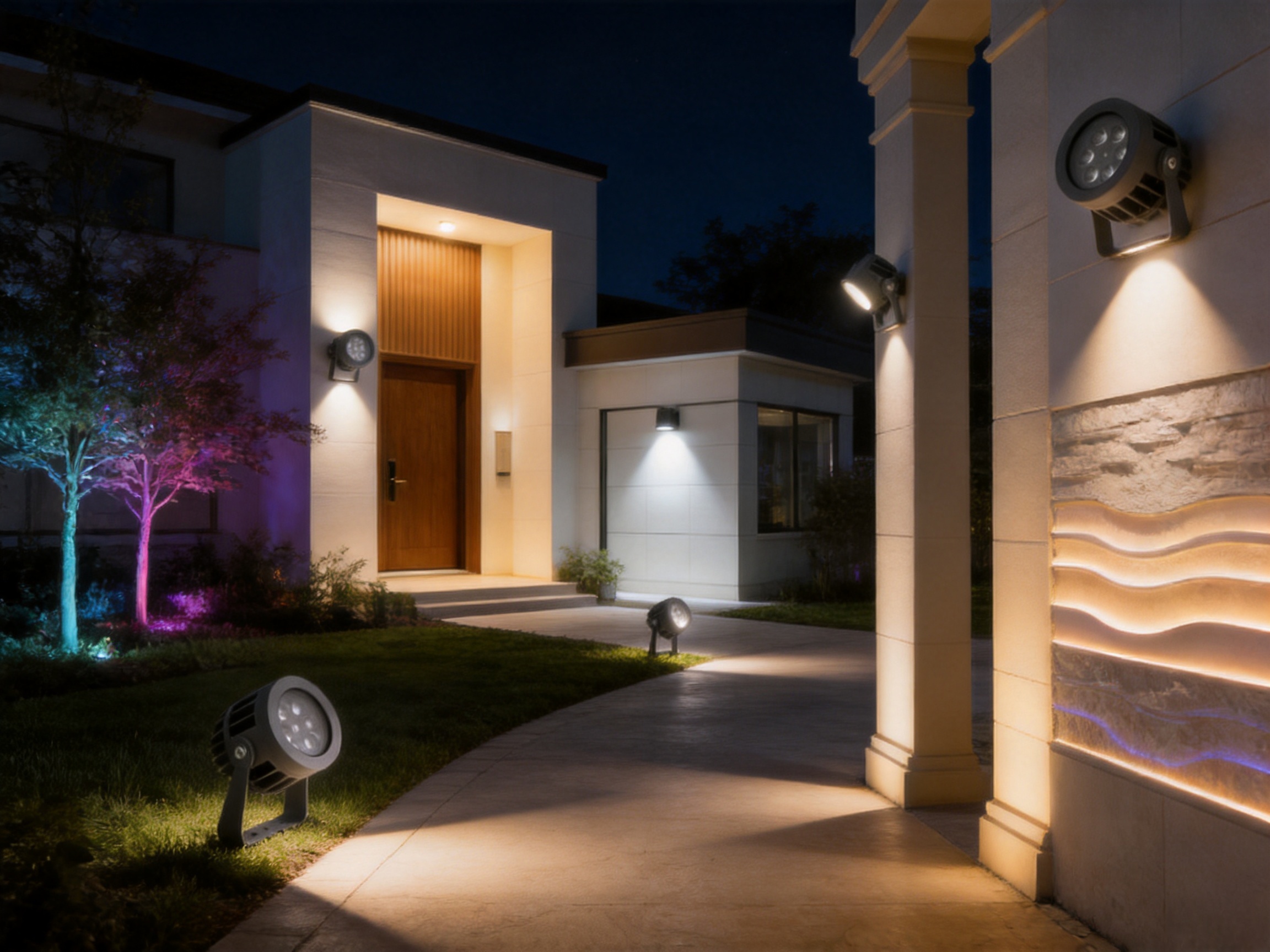
Residential properties often require lighting that is effective without appearing oversized or industrial. The compact dimensions of the GZD-TGD-R make it suitable for gardens, driveways, terraces, entrances, boundary walls, patios, and decorative landscape elements. It can provide a focused beam for a tree or facade detail while remaining visually discreet during the day.
For home entrances, a warm white version can create a comfortable and welcoming atmosphere. A wider beam angle can provide useful illumination around a doorway or small porch. For gardens, narrower beams can highlight plants, sculptures, water features, or architectural textures. The selection of 9W, 15W, 24W, and 36W options allows homeowners and designers to match output to the size of each feature.
In residential projects, ease of installation is often a major priority. A compact, lightweight fixture can be easier for installers to position and adjust. Lower power requirements can also simplify the electrical design, especially in small landscape lighting systems. Where low-voltage operation is preferred, the DC12-24V option can be considered as part of a properly designed low-voltage installation.
Applications in Commercial Entrances and Small Sites
Small commercial properties need outdoor lighting that supports appearance, wayfinding, safety, and customer experience. The GZD-TGD-R can be used around storefronts, restaurants, offices, hotels, clinics, retail entrances, and small plazas. Its beam options help users illuminate signs, entry doors, columns, wall textures, and landscaping without installing large high-output fixtures.
For businesses that update their visual presentation throughout the year, RGB or RGBW versions can provide additional design possibilities. A stable white setting can be used during normal operation, while colored scenes can support promotional events, holidays, or special campaigns. DMX512 control can help coordinate multiple fixtures across a property.
The compact format is also valuable when the building facade has limited mounting locations. A large luminaire may interfere with signage or architectural details, whereas a smaller fixture can be placed beneath ledges, beside columns, or within landscape beds. This flexibility supports a cleaner appearance and can reduce the need for extensive mounting structures.
Applications in Facade and Architectural Lighting
Architectural lighting depends on accurate positioning and controlled beam distribution. A facade may include different materials, elevations, windows, columns, recesses, and decorative surfaces. The GZD-TGD-R can be selected with different beam angles and color temperatures to address individual architectural features.
Narrow beams can emphasize vertical columns, textured surfaces, sculptures, and building details. Medium beams can illuminate sections of a wall or entrance surround. Wider beams can create a more continuous wash across a broader facade. By combining different wattages and distributions, designers can create visual hierarchy without requiring a single oversized floodlight.
Color temperature selection also affects the perceived character of a building. Warm light can emphasize brick, stone, wood, and traditional architecture. Neutral or cooler white light may suit modern glass, metal, and concrete structures. RGB and RGBW versions can introduce dynamic visual effects when architectural lighting is intended to become part of a public or entertainment experience.
Applications in Gardens and Landscape Projects
Landscape lighting requires careful balance. The fixture should provide enough light to reveal paths, plants, structures, and level changes, but it should not dominate the garden or cause unnecessary glare. The compact GZD-TGD-R can be positioned around planting areas, garden walls, pergolas, water features, statues, and other outdoor elements.
Its adjustable application range makes it suitable for both subtle and dramatic landscape effects. A low-power, narrow-beam unit can create a gentle highlight on a small tree or ornament. A higher-power, wider-beam unit can illuminate a garden wall, courtyard, or larger landscape feature. Warm white light is often selected for relaxed residential gardens, while RGB or RGBW can be used in hospitality and event landscapes.
Landscape environments can be exposed to moisture, dust, soil, irrigation spray, and changing weather. The IP65 enclosure helps support outdoor use when installation is performed correctly. Designers should still consider drainage, irrigation direction, cable protection, maintenance access, and the possibility of plant growth obscuring the fixture over time.
Applications in Small Industrial and Municipal Installations
Although the GZD-TGD-R is compact, it can support selected industrial and municipal applications where a smaller floodlight is appropriate. Examples include equipment highlights, small utility structures, pedestrian areas, public art, service entrances, sign illumination, and localized facility lighting. The 24W and 36W versions may be useful where more output is required than a decorative fixture can provide.
The product should be distinguished from specialized high-bay, tunnel, street, or hazardous-area luminaires. Large industrial sites may require products with higher output, different photometric distributions, impact ratings, surge protection, or special certifications. The GZD-TGD-R is most suitable for localized outdoor lighting tasks rather than replacing every type of industrial fixture.
This clear application positioning is beneficial for distributors and project planners. It allows the product to be specified where its compact size, optical flexibility, and control options provide genuine value. Correct application selection is an important part of achieving better performance than a generic competitor product used outside its intended purpose.
Advantages Over Basic Competing Floodlights
The outdoor lighting market includes many low-cost floodlights with limited configuration options. These products may provide a basic light source, but they often require compromises in installation flexibility, beam control, color selection, or customization. The GZD-TGD-R offers several advantages that can help it compete in professional and project-based applications.
First, the product combines compact construction with four power levels. Buyers do not have to choose between a very small low-output lamp and a large high-output fixture. They can select a size and wattage that better matches the illuminated feature.
Second, the four beam angle choices improve optical planning. Many entry-level floodlights provide a broad, uncontrolled beam that can create spill light and glare. The GZD-TGD-R gives designers more control over concentration and coverage.
Third, the product supports both fixed and dynamic lighting. Steady operation is suitable for simple installations, while DMX512 provides a pathway to coordinated color and scene control. This dual approach enables the same product family to serve basic and advanced projects.
Fourth, the available color range is broader than that of standard white-only floodlights. White and warm white support practical architectural lighting, while red, green, blue, yellow, RGB, and RGBW configurations support creative and event-based applications.
Fifth, the IP65 aluminum construction is suitable for many outdoor environments and provides a professional foundation for durability. Combined with thermal management and LED source options, the product is positioned for buyers who need more than a short-term decorative lamp.
Finally, OEM and ODM support can create an advantage for distributors, contractors, and brand owners. Custom size adjustments, mounting solutions, beam configurations, and packaging branding can help buyers develop a product that better fits their sales channel or project requirements.
Manufacturing Strengths Behind the Product
Product performance is influenced by manufacturing capability as much as by the published specification. Cixi HuaSheng Lighting Co., Ltd. operates as an outdoor lighting manufacturer in Ningbo, China, with experience in producing LED street lights, tunnel lights, high-bay lights, linear lights, garden lights, solar lights, grow lights, explosion-proof lights, and other lighting products.
This broad product experience can support the development of compact floodlights because different lighting categories require knowledge of thermal design, optical systems, sealing, electrical integration, structural parts, and quality control. Experience across several product families can also help the manufacturer understand the practical requirements of industrial, residential, commercial, and municipal customers.
The company maintains ISO 9001, ISO 14001, and ISO 45001 certifications. ISO 9001 relates to quality management, ISO 14001 relates to environmental management, and ISO 45001 relates to occupational health and safety management. These management systems provide a structured framework for manufacturing, environmental responsibility, workplace safety, documentation, and continuous improvement.
Relevant products are certified by CB and CE according to the supplied company information. Certification requirements should always be confirmed for the exact model, voltage configuration, market, and project specification. Nevertheless, access to recognized certification processes can support international procurement and help buyers organize compliance documentation.
Die-Casting and CNC Manufacturing Capabilities
Die-casting is important in lighting production because it can create repeatable metal housings with consistent dimensions and integrated structural features. For a compact floodlight, accurate housing geometry helps support assembly, heat dissipation, mounting, and enclosure sealing. A well-controlled die-casting process can also improve consistency across production batches.
CNC machining provides additional precision for selected components and finishing operations. It can be used to refine mounting surfaces, threaded areas, connection points, and other parts where dimensional accuracy is important. The combination of die-casting and CNC processing can create a practical balance between production efficiency and component precision.
For OEM and ODM customers, in-house or closely coordinated tooling and machining capabilities can shorten communication cycles. Instead of relying entirely on unrelated outside suppliers, the manufacturer can discuss housing modifications, mounting changes, and mechanical details through a more integrated production process. This is useful when a customer requires a special bracket, a revised body dimension, a customized logo area, or a different installation method.
Die-casting mould design is another valuable capability. Tooling quality affects surface consistency, dimensional stability, production repeatability, and the feasibility of future product changes. A manufacturer with die-casting mould experience can assess whether a proposed customization is suitable for mass production and can help balance development cost against expected order volume.
Aging Lines and Reliability-Oriented Production
LED lighting products contain electronic components that should be checked under operating conditions before shipment. Aging lines allow products to run for a controlled period so that assembly issues, unstable connections, abnormal heat behavior, or early component failures can be identified. Aging is not a substitute for every required test, but it is a useful part of a structured quality process.
For a compact floodlight, aging can help verify the interaction among the LED board, driver, housing, seals, wiring, and control components. It may also help identify problems that are not visible during a simple appearance inspection. A systematic aging process gives the production team an opportunity to isolate and correct defects before products reach the customer.
Quality control should also include incoming material inspection, assembly checks, electrical testing, appearance inspection, and final packaging verification. The exact testing plan may vary according to the product configuration, customer requirements, and applicable standards. Buyers requiring specific test reports should discuss them before production begins.
Photometric Testing and DIALux Support
Lighting performance should be evaluated through more than nominal wattage. Beam distribution, luminous output, uniformity, glare, mounting height, surface reflectance, and spacing all influence the result. The manufacturer’s access to goniophotometers supports the measurement of photometric characteristics and helps create data for professional lighting design.
A goniophotometer can be used to measure the distribution of light emitted by a luminaire across different angles. The resulting photometric data can support lighting calculations, product comparison, project documentation, and simulation. This is particularly useful for the GZD-TGD-R because the product is available with multiple beam angles and several output levels.
The company also provides DIALux design support. DIALux is commonly used by lighting designers and engineers to simulate illumination levels, uniformity, glare considerations, and fixture placement. A project-specific simulation can help determine the number of fixtures, mounting positions, wattage, beam angle, and spacing required for a particular facade, garden, entrance, or outdoor area.
Using lighting design software before installation can reduce guesswork. It can also help customers compare different configurations and avoid purchasing too many or too few luminaires. For distributors and contractors, DIALux support can add value to a product quotation by demonstrating how the proposed fixtures will perform in the intended environment.
OEM and ODM Customization Services
Different markets often require different product details. A distributor may need private-label packaging, while an architectural project may require a special mounting bracket. A contractor may need a certain beam angle or cable arrangement, while an importer may prefer a standardized configuration for a regional product line. OEM and ODM services allow the GZD-TGD-R platform to be adapted to some of these requirements.
Available customization areas include size adjustment, mounting solutions, beam configuration, and packaging branding. Size changes should be evaluated carefully because they can affect heat dissipation, internal space, tooling, weight, and certification. Mounting modifications should consider structural strength, adjustment range, corrosion resistance, and installation instructions.
Beam configuration changes may involve lens selection, optical components, LED arrangement, or housing integration. These changes should be verified through photometric testing before mass production. Packaging branding can be a simpler customization, but it still requires accurate artwork, labeling, product information, barcodes, manuals, and regulatory markings.
For larger projects, the manufacturer can also discuss SKD or CKD customization where appropriate. Such arrangements may help customers manage local assembly, logistics, import requirements, or regional production strategies. The exact scope depends on the order, destination market, product configuration, and technical agreement.
Quality, Environmental, and Supply Chain Considerations
Professional buyers increasingly evaluate lighting suppliers according to more than product price. They may review quality management, environmental procedures, worker safety, production capacity, documentation, lead time, after-sales support, and customization capability. The manufacturer’s ISO 9001, ISO 14001, and ISO 45001 certifications provide a structured basis for these areas.
Environmental management is relevant to LED lighting because the product’s operating efficiency, material selection, packaging, production processes, and end-of-life handling all affect its environmental profile. LED products can support reduced energy use during operation, while responsible manufacturing practices can help reduce waste and improve process control.
Supply reliability is also important when a project requires many identical fixtures. Consistent moulds, controlled assembly procedures, component sourcing, and production testing can help reduce variation between batches. Customers should confirm the availability of their selected LED source, color, beam angle, driver, control mode, and packaging before placing a repeat order.
For international projects, buyers should establish clear documentation requirements. These may include product datasheets, installation instructions, photometric files, certificates, test reports, packing lists, commercial invoices, and spare-part recommendations. Early agreement on documentation can reduce delays during project approval and import procedures.
Installation Planning and Best Practices
Correct installation is essential to achieving the expected performance of any outdoor floodlight. Before mounting the GZD-TGD-R, the installer should review the product rating, input voltage, wiring diagram, control method, mounting surface, cable route, and environmental conditions. The chosen fixture should match the project’s electrical and lighting design.
Mounting height and distance from the target surface affect the visible beam width and illumination level. A narrow beam mounted close to a wall may create a bright concentrated spot, while the same beam mounted farther away may highlight a taller feature. A wide beam may be more appropriate for close-range wall washing or general area coverage.
The mounting bracket should be securely fixed to a suitable surface. The weight and wind exposure of the complete assembly should be considered, especially on exposed facades, poles, roof edges, and elevated structures. The fixture should be aligned before final tightening, and the adjustment mechanism should not be forced beyond its designed range.
Electrical connections should be protected from water and mechanical damage. For low-voltage versions, the power supply should be correctly sized for the total connected load and cable length. For AC versions, wiring and protection should comply with applicable electrical codes. Where DMX512 is used, signal cables and network topology should be planned to reduce communication problems.
Although the product has an IP65 rating, the installation should not place it in a location where it is continuously submerged, buried without drainage, or exposed to conditions beyond its stated operating environment. Regular inspection can help identify loose brackets, damaged cables, blocked heat-dissipation surfaces, or contamination that affects light output.
Maintenance and Long-Term Value
LED floodlights generally require less routine maintenance than many traditional light sources, but outdoor fixtures should still be inspected periodically. Dust, pollen, leaves, insects, pollution, and irrigation deposits can accumulate on the front lens and reduce the amount of light reaching the target. Cleaning should be performed with suitable materials that do not scratch or damage the lens or seals.
Maintenance teams should also check the fixture position. Vibration, accidental contact, weather, or landscaping work may change the beam direction. A small shift can be noticeable when the fixture is used for accent lighting. Reconfirming alignment helps preserve the original design intent.
For DMX512 installations, maintenance should include checking communication connections and confirming that programmed scenes remain synchronized. If a single fixture behaves differently from the rest of the group, the cause may involve addressing, signal wiring, power supply, or the luminaire itself.
The long-term value of the GZD-TGD-R comes from the combination of energy efficiency, compact construction, configurable optics, outdoor protection, and serviceable project support. A low purchase price alone does not guarantee good value if the fixture is difficult to install, produces uncontrolled light, or requires frequent replacement. A more adaptable product can reduce design compromises and support future changes.
How to Select the Correct Configuration
Project teams should begin by identifying the target object and the desired lighting effect. Is the fixture intended to provide general visibility, highlight a narrow feature, wash a wall, create a color-changing display, or illuminate a small area? The answer will guide the choice of wattage, beam angle, color, and control mode.
Next, confirm the electrical system. The DC12-24V version may suit low-voltage outdoor networks, while the AC85-265V version may suit standard mains installations. The power supply and driver arrangement must be matched to the selected configuration. For a large installation, the total connected load and voltage drop should be calculated before finalizing the product schedule.
Mounting conditions should then be reviewed. Consider the available space, bracket type, adjustment direction, cable entry, maintenance access, wind exposure, and distance from the illuminated surface. The compact design helps in restricted areas, but the fixture still needs adequate clearance and a secure mounting point.
Finally, select the control method and color. Steady operation is appropriate for fixed lighting. DMX512 is more suitable for coordinated scenes and dynamic effects. White or warm white may be sufficient for functional and architectural projects, while RGB or RGBW may be appropriate for decorative and entertainment applications.
Why the Manufacturer Is Suitable for Project-Based Buyers
Project-based buyers often need more than a catalogue product. They may require technical consultation, lighting calculations, sample evaluation, customized packaging, production scheduling, inspection support, and shipment coordination. Cixi HuaSheng Lighting Co., Ltd. presents itself as a one-stop lighting supplier capable of supporting these stages.
The company’s product range covers outdoor, industrial, solar, facade, garden, linear, high-bay, tunnel, grow, and explosion-proof lighting. This broad portfolio can help customers consolidate sourcing when a project contains several lighting categories. It also provides a basis for coordinated product selection across different areas of a site.
Its production equipment, including die-casting and CNC machines, aging lines, and goniophotometers, supports both manufacturing and testing. The company also offers efficient lighting solutions, DIALux designs, mould design, OEM/ODM services, SKD and CKD customization, and delivery support. These services can be valuable for importers, engineering contractors, wholesalers, property developers, and private-label lighting brands.
International buyers should still conduct their own qualification process. This may include reviewing certificates, requesting samples, confirming test data, inspecting production capability, defining quality standards, and agreeing on warranty and replacement procedures. A clear technical agreement helps ensure that the delivered product matches the approved configuration.
Q&A: Compact Outdoor Flood Light GZD-TGD-R
What is the GZD-TGD-R used for?
The GZD-TGD-R is used for compact outdoor illumination, facade highlighting, garden lighting, building entrances, small commercial sites, landscape features, signs, and selected localized industrial or municipal applications. It is particularly useful where installation space is limited and a large floodlight would be unsuitable.
What power options are available?
The product is available in 9W, 15W, 24W, and 36W versions. The correct wattage depends on mounting height, target size, required brightness, beam angle, surface reflectance, and the overall lighting design.
Can the fixture be used for both low-voltage and mains-voltage projects?
Yes. The product information lists DC12-24V and AC85-265V input voltage options. Buyers should specify the required version before production and ensure that the selected voltage matches the project’s power supply and installation standards.
Which beam angles can be selected?
The available beam angles are 10°, 30°, 45°, and 60°. Narrower beams concentrate light on smaller features, while wider beams provide broader coverage. Photometric calculations should be used to confirm the best choice.
Is the GZD-TGD-R suitable for color-changing lighting?
Yes. The product can be supplied in RGB or RGBW versions, as well as red, green, blue, yellow, white, and warm white configurations. DMX512 control can be used for compatible dynamic lighting systems.
What does the IP65 rating mean?
IP65 indicates protection against dust ingress and water projected by jets from different directions. It supports many outdoor applications, but it does not mean the fixture can be permanently submerged or installed without proper drainage and cable protection.
What is the operating temperature range?
The stated environmental temperature range is -20°C to 45°C. Projects outside this range should be reviewed with the manufacturer to confirm suitability and any required modifications.
What LED source brands are available?
The listed LED source options include Epileds, Bridgelux, Epistar, Osram, and Cree. The chosen source should be confirmed according to the required performance, availability, project budget, and market expectations.
Can the product be customized?
OEM and ODM customization is available for selected features, including size adjustment, mounting solutions, beam configuration, and packaging branding. Custom requests should be evaluated for technical feasibility, tooling requirements, minimum order quantity, certification, and production cost.
Does the manufacturer provide lighting design support?
Yes. The company provides efficient lighting solutions and DIALux design support. Photometric data and project information should be supplied so the lighting arrangement can be evaluated accurately.
Is this product a replacement for high-bay or explosion-proof lighting?
Not necessarily. The GZD-TGD-R is a compact outdoor flood light. High-bay, tunnel, and explosion-proof products have different design requirements and should be selected for applications that specifically need those characteristics. The GZD-TGD-R is best used for localized outdoor and architectural lighting tasks within its stated specifications.
What should buyers confirm before ordering?
Buyers should confirm power, input voltage, LED source, color, color temperature, beam angle, control mode, cable and connector requirements, mounting method, packaging, certifications, photometric files, quantity, delivery schedule, and any customization details. Written confirmation helps prevent configuration errors.
Conclusion
The Compact Outdoor Flood Light GZD-TGD-R is designed for customers who need a small but adaptable outdoor lighting fixture. Its 9W to 36W power range, multiple beam angles, broad color selection, DMX512 compatibility, aluminum housing, thermal management, and IP65 protection make it suitable for a wide variety of residential, commercial, landscape, facade, and localized industrial applications.
Its principal advantage over basic competing floodlights is the balance between compact size and configuration flexibility. Rather than offering only one output, one beam, and one color, the product family can be adapted to different visual and technical requirements. This helps designers reduce installation compromises and enables distributors to serve several market segments with a common platform.
The manufacturing capabilities of Cixi HuaSheng Lighting Co., Ltd. further support the product’s project value. Die-casting, CNC machining, aging lines, goniophotometric testing, DIALux support, certification experience, and OEM/ODM services provide a foundation for professional procurement. Buyers can work with the manufacturer not only to purchase a standard fixture but also to develop a more suitable lighting solution for a specific application.
For the best result, the GZD-TGD-R should be selected through a complete project evaluation that considers illumination objectives, mounting conditions, electrical supply, beam distribution, environmental exposure, controls, and maintenance. When correctly specified and installed, it offers a practical way to achieve efficient, durable, and visually controlled outdoor lighting in areas where space, appearance, and flexibility matter.
References
1. Product specification information for the Compact Outdoor Flood Light GZD-TGD-R, including power, input voltage, LED source, beam angle, color, control, temperature, and ingress protection data.
2. General principles of LED luminaire thermal management and aluminum housing design for outdoor lighting applications.
3. General guidance on IP ingress protection classifications for electrical enclosures.
4. General lighting design practices for facade, landscape, entrance, and architectural floodlighting.
5. General principles of DMX512-based lighting control systems.
6. General principles of photometric testing using goniophotometers and lighting simulation using DIALux software.
7. Company-provided information regarding ISO 9001, ISO 14001, ISO 45001, CB, CE, die-casting, CNC machining, aging lines, OEM/ODM, SKD, CKD, and lighting design services.
Product: Compact Outdoor Flood Light GZD-TGD-R

-
LED Lawn Light Supports Flexible Landscape Design
-
YQF Global Exhibition Journey: Connecting World Markets with Excellence in Lighting and Supply Chain Strength
-
YQF Achieves Three Major System Certifications and Receives Philips Partnership Authorization
-
Can an LED Indoor Lighting Factory Handle Custom Sizes?
YQF Group - World Leading One-Stop Lighting & Solar For the Global Partners
Custom & OEM Solutions for Global Lighting Brands
Copyright © Cixi HuaSheng Lighting Co., Ltd. All Rights Reserved.
Die-Casting Mould Supplier
