 English
 中文简体
 русский
 Français
 Español
 عربى
 Indonesia

Courtyard Solar LED Light for Comfortable, Efficient, and Low-Maintenance Outdoor Spaces
Outdoor lighting has evolved from a basic nighttime safety feature into an important part of residential design, landscape planning, and energy-conscious living. Homeowners, property developers, garden designers, and project contractors increasingly seek lighting products that combine visual comfort, dependable operation, straightforward installation, and reduced dependence on grid electricity. The Courtyard Solar LED Light ZC-TYD1109-1 is designed for precisely this type of application. It provides a practical lighting solution for courtyards, villas, residential gardens, small parks, pathways, and private outdoor areas where atmosphere, appearance, and operating efficiency matter equally.
Instead of requiring a conventional underground power connection, the ZC-TYD1109-1 integrates a solar panel, rechargeable battery, and LED light source into one outdoor lighting system. During the day, the solar panel collects available sunlight and charges the battery. After sunset, the stored energy is used to power the LED chips and produce ambient illumination. This operating concept helps simplify installation while supporting lower electricity consumption in suitable outdoor environments.
The product is built around a die-casting aluminum structure, a high-capacity 3.2V/48000mAh battery, a 5V/33W solar panel, and 120 LED chips. Its color temperature range of 3000K to 6500K allows the lighting appearance to be adapted from warm and relaxing to cooler and more functional. With a size of 505*505*H910mm, the fixture has a substantial presence while remaining suitable for common courtyard and garden layouts.
Understanding the Courtyard Solar LED Light ZC-TYD1109-1
The ZC-TYD1109-1 is a solar garden light intended for home outdoor use and small-scale landscape applications. Its product positioning is different from that of large-area solar street lights, industrial floodlights, or high-output municipal fixtures. It is designed to create a comfortable outdoor environment rather than to provide maximum illumination over a large roadway or industrial site.
This distinction is important when comparing lighting products. A courtyard fixture must respond to aesthetic and residential requirements. It should fit naturally into a garden or villa setting, offer pleasant light, withstand normal outdoor exposure, and avoid the complexity of electrical trenching wherever possible. The ZC-TYD1109-1 addresses these needs through an integrated solar configuration, a decorative yet durable aluminum housing, and a light output arrangement based on 120 LED chips.
The fixture can be used around entrances, patios, terraces, lawn edges, walkways, courtyard seating zones, garden borders, and small recreational spaces. It may also be considered for guesthouses, low-rise residential developments, private clubs, boutique landscape projects, and other locations where decorative outdoor lighting is required without a complicated wiring network.
Its simple installation structure is one of its practical advantages. Because the fixture is solar powered, many installations can avoid extensive cable routing and electrical excavation. This can reduce disruption to finished landscapes and may make the product more suitable for renovation projects, garden upgrades, and locations where access to grid power is limited.

Courtyard Solar LED Light ZC-TYD1109-1
Key Product Specifications
Product specifications provide the foundation for evaluating whether a solar garden light is suitable for a particular project. The following table summarizes the principal data supplied for the ZC-TYD1109-1.
| Specification | Details |
|---|---|
| Product type | Courtyard solar LED light |
| Model | ZC-TYD1109-1 |
| Application category | Solar garden light |
| Housing material | Die-casting aluminum |
| Solar panel | 5V/33W |
| Battery | 3.2V/48000mAh |
| LED chips | 120 pieces |
| Charging time | 3–5 hours |
| Color temperature | 3000–6500K |
| Product size | 505*505*H910mm |
The combination of a 33W solar panel and a 48000mAh battery provides the core energy-storage system for the product. Actual performance in the field will depend on solar availability, installation orientation, seasonal weather, ambient temperature, battery condition, and operating settings. For this reason, project planners should evaluate the local solar resource and expected lighting schedule before final installation.
The 3000–6500K range offers flexibility in visual appearance. Warm light around 3000K is generally associated with a welcoming, relaxed, and residential atmosphere. Higher color temperatures can provide a clearer, cooler appearance that may be preferred for pathways, entrances, or areas where greater visual definition is desired. The ability to support different color-temperature preferences makes the product more adaptable than a fixture restricted to one fixed light appearance.
Advantages of Solar Power for Courtyard Applications
Courtyard and garden lighting often presents different challenges from commercial or industrial lighting. Outdoor areas may be separated from the main building, finished paving may already be in place, and landscape features may make trenching inconvenient. Installing a grid-connected fixture can involve electrical conduits, junction boxes, cable protection, excavation, and coordination with an electrician. A solar product can reduce many of these installation requirements.
The ZC-TYD1109-1 collects solar energy during daylight hours and stores it for nighttime use. This operating method can help reduce electricity consumption because the lighting energy is generated locally rather than purchased entirely from the grid. For homeowners and property managers seeking a lower-energy outdoor lighting strategy, this can be an attractive feature.
Solar operation also provides flexibility in site planning. A light can be positioned according to the needs of the landscape instead of being placed only where a cable is available. This is useful for garden paths, isolated seating areas, driveway edges, decorative planting zones, and courtyards where the building’s electrical infrastructure does not extend conveniently.
Another benefit is reduced dependence on a continuous grid supply. In areas that experience occasional power interruptions, a correctly designed solar fixture may continue to provide outdoor illumination as long as sufficient energy has been stored. The product should not be considered a replacement for emergency lighting unless it has been specifically tested and approved for that purpose, but its independent energy source can still be valuable for ordinary nighttime outdoor use.
Solar lighting can also support environmental objectives. By using renewable solar energy and efficient LED technology, the system contributes to a lower-energy lighting approach. The environmental benefit is influenced by product life, battery replacement requirements, operating conditions, and responsible end-of-life recycling, but the basic architecture supports more sustainable outdoor lighting planning.
LED Performance and Comfortable Illumination
LED technology is well suited to solar lighting because LEDs can deliver useful illumination with relatively low energy consumption. The ZC-TYD1109-1 uses 120 LED chips to distribute light across the fixture. A multi-chip arrangement can support balanced light distribution and provide design flexibility within the housing.
For a courtyard, the objective is usually not simply to produce the highest possible brightness. Excessively strong or poorly controlled light can create glare, disturb residents, reduce visual comfort, and detract from the landscape. Ambient illumination should help people see pathways, steps, entrances, and outdoor furnishings while preserving a pleasant nighttime atmosphere. The ZC-TYD1109-1 is positioned for this type of comfortable residential and garden use.
The selectable color-temperature range is especially relevant to atmosphere. Warm white light can complement wood, stone, plants, walls, and outdoor seating. A cooler setting may create a more contemporary appearance around modern architecture or improve perceived clarity near access points. The preferred setting will depend on the property design and the intended visual effect.
Lighting designers should still consider spacing, mounting position, surrounding surfaces, plant growth, and the reflectance of paving materials. A well-designed installation uses the product as part of a complete outdoor lighting composition. Fixtures should be positioned to avoid direct glare toward windows, neighboring properties, and approaching pedestrians. Where multiple units are used, consistent spacing and orientation can improve visual continuity.
Die-Casting Aluminum Housing and Structural Value
The housing is made from die-casting aluminum, a material widely used in professional lighting products because it offers a strong combination of structural rigidity, design flexibility, and heat-transfer capability. For an outdoor fixture, the housing must protect internal electrical components while maintaining its shape through changes in temperature and normal environmental exposure.
Die-casting allows manufacturers to create detailed housing forms with consistent dimensions. This is useful for products that require precise integration between the body, cover, mounting components, battery compartment, and solar panel assembly. Consistent housing geometry can support repeatable production and help simplify assembly and inspection.
Aluminum is also useful for thermal management. LED components and power-control parts produce heat during operation. If heat is not managed effectively, it can affect component stability and service life. A well-designed aluminum body can help transfer heat away from internal components and release it to the surrounding air. Actual thermal performance depends on the internal design, surface area, environmental conditions, and operating current, but the material provides a strong foundation for outdoor fixture construction.
The die-casting process also supports a refined appearance. Courtyard lights are visible architectural elements, not hidden industrial components. Their shape, proportions, and surface finish influence the overall appearance of a property during both daytime and nighttime. A carefully manufactured aluminum body can provide a more substantial and finished appearance than lightweight housings intended only for temporary or low-demand use.
For buyers comparing products from different suppliers, material quality and housing construction deserve close attention. A lower-cost fixture may use thinner materials or less controlled forming processes. Such differences can affect rigidity, assembly fit, thermal behavior, and long-term appearance. The die-casting aluminum construction of the ZC-TYD1109-1 supports a more professional product position for residential and landscape projects.
Battery Capacity and Solar Charging Design
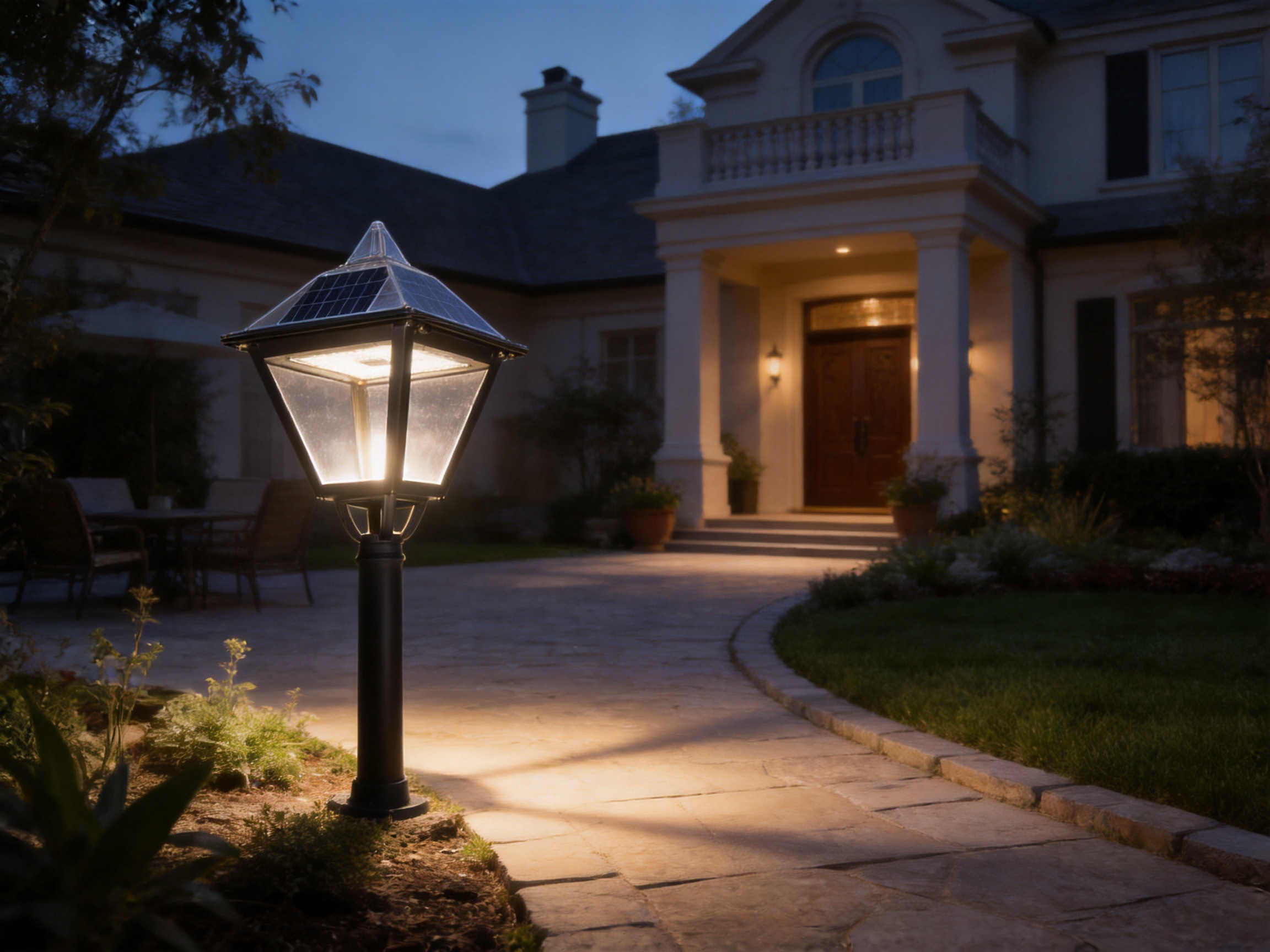
The ZC-TYD1109-1 is equipped with a 3.2V/48000mAh battery. Battery capacity is one of the most important specifications in a solar lighting system because it determines how much energy can be stored for nighttime operation. A higher nominal capacity can provide greater energy reserves, although actual usable energy depends on battery chemistry, control strategy, temperature, age, discharge limits, and charging conditions.
The product information specifies a charging time of 3–5 hours. This provides a useful reference for planning, but real charging time can vary according to sunlight intensity, cloud cover, panel orientation, shading, seasonal daylight, and surface cleanliness. For optimum performance, the solar panel should be installed where it can receive direct sunlight for as much of the day as possible.
Shadows from trees, walls, roof edges, signs, and nearby buildings can significantly reduce solar collection. Landscape growth should also be considered because branches and leaves may gradually change the amount of light reaching the panel. Periodic inspection and cleaning can help maintain energy collection, particularly in dusty, coastal, or pollen-heavy environments.
Battery performance is affected by operating conditions. Very high or low temperatures can influence charging efficiency and available capacity. A suitable control system should manage charging and discharge to protect the battery from harmful operating conditions. Buyers should request relevant technical details when planning large installations or projects in climates with severe temperature variation.
The energy balance of a solar light is a relationship between daily solar collection and nighttime consumption. The panel must collect enough energy during the available daylight period to support the intended operating schedule. The battery must then store that energy safely and deliver it consistently. The ZC-TYD1109-1’s solar panel and battery specifications provide a practical platform for courtyard lighting, while site-specific planning remains essential for dependable results.
How the Product Compares with Conventional Competitors
The most relevant comparison is not always between one brand and another. It is often between different lighting architectures. Conventional grid-powered garden lights may offer continuous electrical supply, but they require wiring and professional electrical work. Small decorative solar lights may be easy to install, but they may use smaller panels, lower-capacity batteries, fewer LED chips, or less robust housings. The ZC-TYD1109-1 occupies a middle position that combines solar independence with a more substantial construction approach.
Compared with very small decorative solar products, the ZC-TYD1109-1 offers a larger 5V/33W solar panel, a 3.2V/48000mAh battery, 120 LED chips, and a die-casting aluminum body. These specifications indicate a product designed for more serious courtyard and garden applications rather than purely ornamental accent lighting.
Compared with grid-connected fixtures, the product can simplify installation in locations where trenching or electrical extension would be expensive or disruptive. It may be particularly competitive for garden renovation, remote courtyard corners, landscaped hospitality properties, and small outdoor developments where the lighting points are distributed across the site.
Compared with high-powered solar street lights, the ZC-TYD1109-1 is better aligned with residential atmosphere and decorative landscape use. It is not necessary to over-specify a street-lighting product for a private garden. A courtyard fixture should be selected according to the desired visual environment, mounting scale, and illumination requirements.
The product also has an advantage in customization potential. OEM/ODM services include housing style, brightness adjustment, and branding options. This can be useful for distributors, property developers, landscape contractors, hospitality groups, and lighting brands that need a product adapted to a specific project or market.
OEM and ODM Customization Opportunities
Different markets often require different product appearances, light settings, packaging formats, and commercial identities. A standard product can meet many general requirements, but customization may be important for projects that have a distinct architectural language or brand image.
For the ZC-TYD1109-1 platform, the stated OEM/ODM options include housing style, brightness adjustment, and branding. Housing customization may allow a customer to request changes to the external form, proportions, surface treatment, or decorative details. Such changes should be evaluated in relation to tooling cost, structural performance, heat dissipation, solar-panel exposure, and production volume.
Brightness adjustment can help adapt the product to different environments. A private courtyard may require softer light, while a pathway or entrance may need a stronger setting. The appropriate control method should be confirmed during technical development because brightness affects energy consumption, battery discharge, operating duration, and overall lighting performance.
Branding options can support private-label distribution and project identity. A customized mark, product label, packaging system, or documentation package can help distributors present a consistent product range. Professional OEM/ODM development should include design review, sample approval, electrical testing, pilot production, and final quality inspection.
Customers considering customization should provide clear information about target markets, annual quantity, desired light appearance, installation environment, packaging requirements, and compliance expectations. Early communication helps the manufacturer determine whether the requested change can be achieved through existing tooling or requires new mould development.
Advanced Manufacturing Capabilities
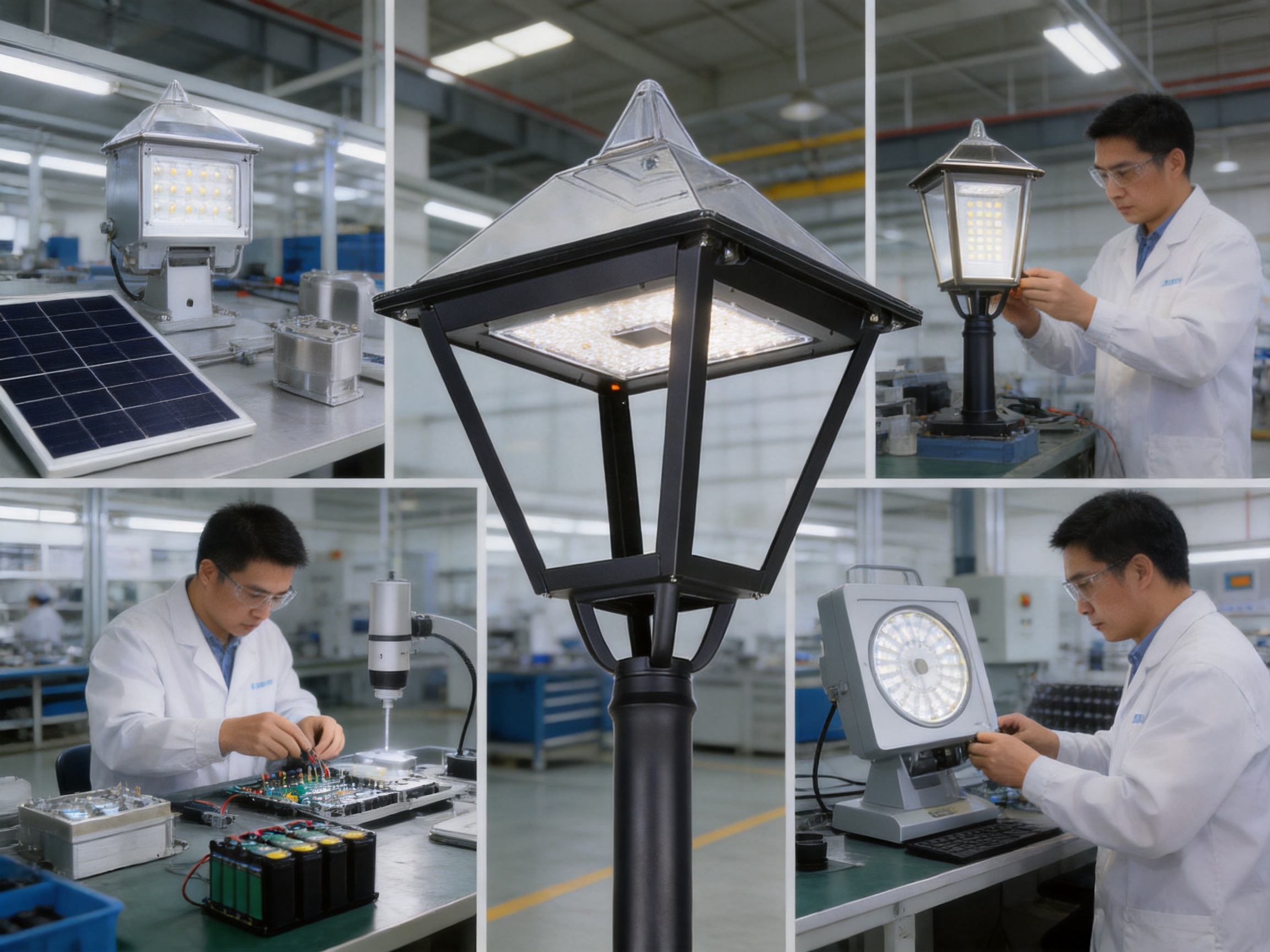
The performance of an outdoor lighting product depends not only on its published specifications but also on the manufacturing system used to produce it. Cixi HuaSheng Lighting Co., Ltd. operates as an outdoor lighting manufacturer in Ningbo, China, with capabilities that include die-casting, CNC machining, aging lines, and goniophotometer testing. These resources support a more integrated approach to product development and quality control.
Die-casting equipment is important for producing aluminum housings with repeatable dimensions. The process requires control of mould design, metal temperature, injection conditions, cooling, trimming, and surface finishing. Consistent die-casting can improve the fit between components and reduce variation from one production batch to another.
CNC machining provides precision processing for selected housing surfaces, mounting features, threads, holes, and connection areas. Not every part of a lighting body requires CNC machining, but precision machining can be valuable where dimensional accuracy affects assembly, sealing, alignment, or mechanical stability.
Aging lines are used to operate products or components under controlled conditions before shipment. Aging can help identify early failures related to electrical connections, drivers, LED boards, control components, or assembly quality. It is not a guarantee that a product will never fail, but it is an important quality-control step for detecting certain manufacturing defects before products reach the customer.
Goniophotometers are used to measure the photometric performance of lighting fixtures. This type of equipment can evaluate light distribution, luminous intensity, beam characteristics, and related optical data. Photometric measurement is especially useful when products are supplied for professional projects that require lighting calculations, product comparison, or DIALux-based planning.
These manufacturing resources support a one-stop development process. Instead of treating the housing, electrical system, optical performance, and final assembly as entirely separate activities, the manufacturer can coordinate multiple stages within one organization. This may improve communication, shorten development cycles, and make customization more manageable.
Quality Systems and Certification Support
The manufacturer identifies ISO 9001, ISO 14001, and ISO 45001 certifications as part of its management system. ISO 9001 is associated with quality-management processes, ISO 14001 with environmental-management practices, and ISO 45001 with occupational health and safety management. These systems help establish organized procedures for production, documentation, corrective action, environmental control, and workplace safety.
The company also states that relevant products are certified by CB and CE. Certification requirements vary according to the product, destination market, electrical design, and applicable standards. Buyers should confirm that the exact product configuration and intended market are covered by the relevant documentation before placing an order.
For international customers, certification and documentation are important elements of supplier evaluation. A professional supplier should be able to discuss test reports, declarations, product labels, technical files, packaging information, and market-specific compliance needs. Such preparation can reduce delays during import, project approval, and distribution.
Quality management also extends beyond final inspection. It includes incoming-material control, process monitoring, assembly procedures, component traceability, electrical testing, appearance inspection, aging, packing, and shipment verification. A consistent system is especially important for solar lighting because the product combines mechanical parts, solar collection, energy storage, LED electronics, and outdoor environmental exposure.
Applications in Residential and Landscape Projects
The ZC-TYD1109-1 is suitable for many applications where soft, independent outdoor lighting is required. In a private villa, it can illuminate a garden entrance, driveway edge, terrace, or pathway. Around a courtyard, it can define the boundary of a seating area and make the outdoor space more inviting after dark.
Residential gardens often contain a mixture of planting beds, lawns, paving, walls, and water features. A solar light can be positioned in a way that complements these elements without requiring new underground electrical infrastructure. The product’s 910mm height can provide a visible vertical element that helps organize a landscape composition.
Small parks and community gardens may also benefit from solar courtyard lights. In such locations, the product can be considered for low-rise pathways, rest areas, garden entrances, and decorative zones. The final application should be based on the required illumination level, local safety rules, spacing, and maintenance plan.
Hospitality facilities such as guesthouses, boutique hotels, restaurants, and resorts may use courtyard lighting to create a welcoming arrival experience. Warm color temperatures can support a relaxed atmosphere around outdoor dining, gardens, and pedestrian routes. The ability to select a cooler color temperature may be useful for functional access areas.
Property developers and landscape contractors can use the product as part of a broader outdoor lighting package. It can be combined with solar street lights, wall lights, bollards, floodlights, or decorative fixtures, provided that the different products are coordinated in terms of color temperature, mounting height, brightness, and visual style.
Installation Planning and Best Practices
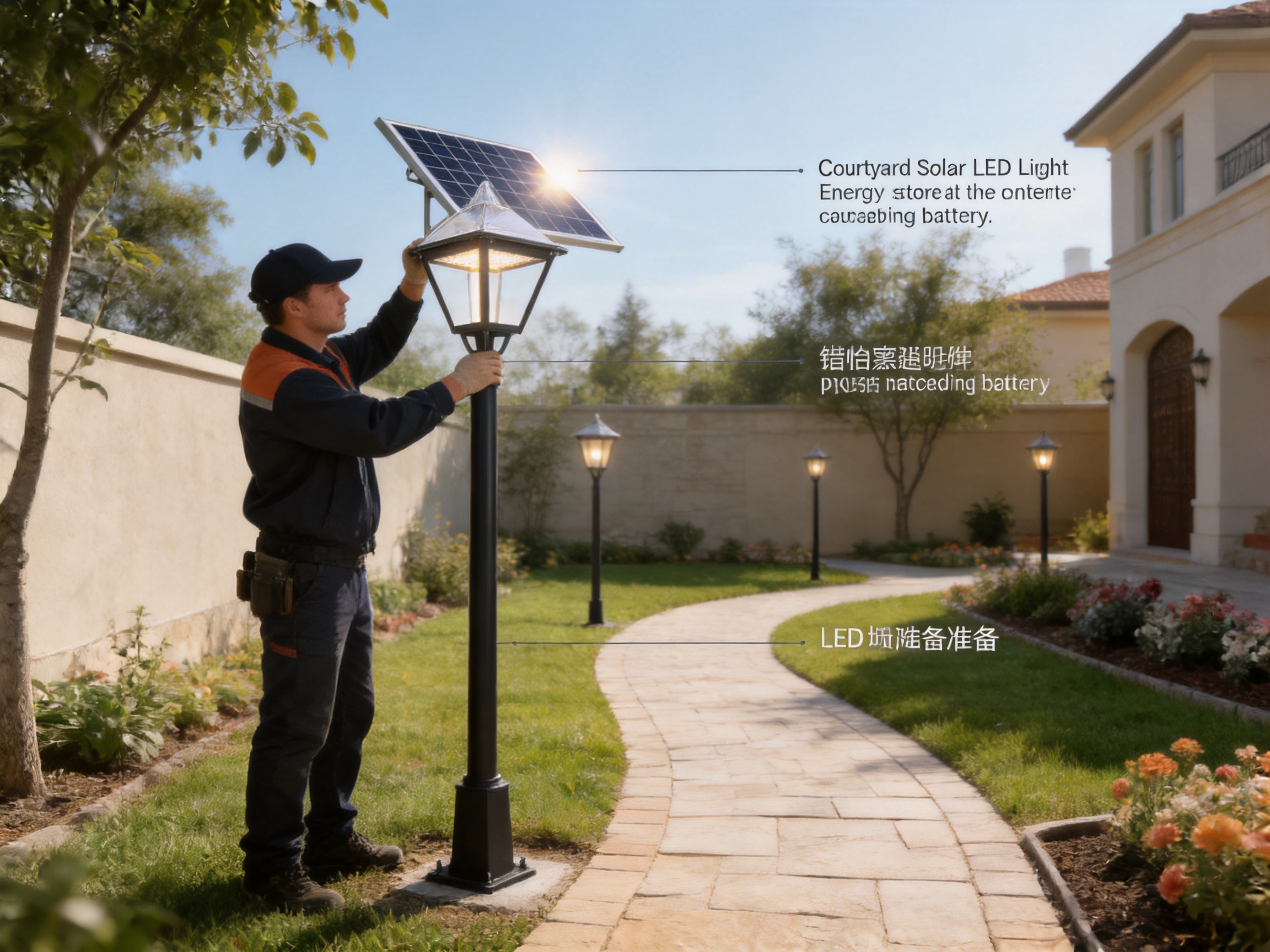
Correct installation is essential to the performance of any solar lighting product. The solar panel should have a clear view of the sky and should not be placed under permanent shade. Before installation, planners should examine the path of the sun throughout the day and consider how nearby buildings, trees, fences, and seasonal vegetation may affect solar collection.
The fixture should be installed on a stable and level foundation appropriate for its size and weight. The mounting area must be able to withstand wind, vibration, rain, and normal outdoor use. Fasteners and foundation details should be selected according to local conditions and the recommendations provided with the product.
Spacing should be determined by the desired lighting effect, the area to be covered, the surrounding reflectance, and the product’s photometric data. Without a photometric layout, placing fixtures too far apart may create dark areas, while placing them too close may produce excessive brightness or an unbalanced appearance.
Installers should avoid positioning the product where vehicle impact is likely unless protective measures are used. The fixture should also be kept away from locations where irrigation sprays, chemical runoff, or maintenance equipment could cause unnecessary stress. Although outdoor products are designed for exterior use, proper site planning can improve service life.
After installation, the solar panel should be checked for protective film, dust, packaging residue, or other obstructions. The light should be tested through a full day-night cycle when possible. This allows the installer to verify charging, automatic operation, brightness, and the overall visual result.
Maintenance and Long-Term Ownership
Solar lighting is generally simple to maintain, but it is not maintenance-free. The solar panel should be inspected periodically and cleaned when dirt, dust, leaves, bird deposits, or other material reduces sunlight transmission. Cleaning frequency depends on the local environment.
The aluminum housing should be checked for visible damage, corrosion, loose fittings, or coating deterioration. Fasteners should be inspected where appropriate. Any damaged component should be repaired or replaced according to the manufacturer’s instructions rather than modified with unsuitable parts.
Battery condition should be monitored over the life of the product. Rechargeable batteries naturally experience capacity changes through repeated cycles and environmental exposure. If operating duration becomes significantly shorter after adequate sunlight and panel cleaning, the battery or control system may require inspection.
Maintenance records can be useful for larger residential developments, hospitality properties, and commercial landscapes. Recording installation dates, cleaning activity, inspection results, and component replacement can help property managers identify recurring issues and plan future service work.
At the end of the product’s useful life, electrical components and batteries should be handled through appropriate recycling or disposal channels. Responsible disposal reduces the environmental impact of electronic products and supports the recovery of useful materials.
Why Manufacturing Integration Matters to Buyers
Customers purchasing outdoor lighting are not buying only a lamp body. They are purchasing a complete system that must combine structural design, solar collection, battery charging, LED performance, thermal management, control logic, assembly quality, packaging, and after-sales support.
An integrated manufacturer can coordinate these elements more effectively than a supplier that only trades finished products. When a customer requests a housing change, the effect on mould design, heat dissipation, solar-panel placement, internal space, and assembly can be reviewed in one development process. When a lighting distribution issue is identified, photometric equipment can support measurement and redesign.
Manufacturing capability is also valuable for consistency. A supplier with die-casting, CNC, aging, and photometric resources can establish clearer process controls and carry out more direct verification. This is particularly important for repeat orders, where customers expect later production batches to match approved samples.
For international buyers, supplier stability can reduce project risk. A manufacturer with experience in outdoor, industrial, municipal, and residential lighting may understand the different requirements of distributors, contractors, engineers, and end users. The ability to offer DIALux designs, mould development, OEM/ODM, SKD/CKD customization, and delivery services further supports project-based procurement.
Selection Guidance for Distributors and Project Buyers
Before selecting the ZC-TYD1109-1 for a project, buyers should define the intended application clearly. Important questions include the size of the area, expected operating schedule, local sunlight conditions, desired color temperature, mounting surface, maintenance access, and required level of illumination.
Distributors should consider how the product fits within their existing portfolio. Its strongest position is likely to be in residential and landscape applications that value solar operation, decorative appearance, integrated energy storage, and a substantial aluminum housing. Product literature should clearly explain the difference between courtyard lighting and high-output street or industrial lighting.
Project contractors should request installation information, product drawings, sample units, and relevant certification documents. A sample installation can help evaluate the appearance of the housing, the color temperature, the brightness, and the relationship between the fixture and the surrounding landscape.
For larger quantities, buyers should discuss production lead times, packaging, spare parts, warranty terms, battery replacement procedures, inspection standards, and container loading arrangements. OEM/ODM projects should include an agreed approval process for drawings, samples, colour, markings, and packaging before mass production.
It is also advisable to evaluate total ownership cost rather than only the purchase price. Installation labor, electrical trenching, energy consumption, maintenance access, replacement parts, and expected product life all influence the real value of an outdoor lighting solution.
Frequently Asked Questions
What is the primary use of the ZC-TYD1109-1?
The product is intended for courtyard and home outdoor lighting. Typical applications include villas, residential gardens, small parks, pathways, patios, private yards, and other landscaped areas that require ambient nighttime illumination.
Does the product require grid electricity?
The product is designed as a solar lighting system. Its solar panel collects energy during the day and its battery stores energy for nighttime operation, reducing the need for a conventional power connection at the lighting point.
What material is used for the housing?
The housing is made from die-casting aluminum. This material supports structural strength, dimensional consistency, heat transfer, and a substantial outdoor appearance.
What are the solar panel and battery specifications?
The stated solar panel specification is 5V/33W, and the battery specification is 3.2V/48000mAh. Actual operating performance depends on sunlight, temperature, installation conditions, control settings, and battery condition.
How many LED chips are included?
The product uses 120 LED chips. The multi-chip configuration supports the fixture’s intended courtyard and garden illumination design.
How long does charging take?
The listed charging time is 3–5 hours. Actual charging time can vary with sunlight intensity, weather, panel orientation, shading, temperature, and panel cleanliness.
Can the color temperature be customized?
The stated color-temperature range is 3000–6500K. The preferred setting should be confirmed for the specific product configuration and project requirement.
Can the housing be customized?
OEM/ODM services include housing-style customization. The feasibility of a specific design depends on tooling, production volume, structural requirements, heat dissipation, solar exposure, and technical approval.
Can brightness be adjusted?
Brightness adjustment is listed among the OEM/ODM options. Buyers should confirm the available control method, adjustment range, operating schedule, and effect on battery performance during the product-development stage.
Is the product suitable for industrial lighting?
The ZC-TYD1109-1 is categorized as a solar garden light and is intended primarily for courtyards, residences, gardens, and small outdoor areas. Industrial sites requiring high illuminance, hazardous-area certification, or specialized optical performance should use products specifically designed for those conditions.
What should be considered before installation?
The installation location should provide sufficient sunlight, a stable foundation, suitable spacing, and protection from avoidable impact or obstruction. Buyers should also consider maintenance access and local outdoor electrical and construction requirements.
What manufacturing capabilities support this product?
The manufacturer reports capabilities including die-casting, CNC machining, aging lines, and goniophotometers. These resources support housing production, precision processing, reliability screening, and photometric evaluation.
Can the product be supplied under a private label?
Branding options are included in the stated OEM/ODM services. Private-label requirements should be discussed in relation to minimum order quantity, packaging, labels, product markings, documentation, and approval samples.
Conclusion
The Courtyard Solar LED Light ZC-TYD1109-1 is a practical solution for residential and landscaped outdoor spaces that require comfortable illumination without relying entirely on grid electricity. Its solar panel, high-capacity battery, 120 LED chips, die-casting aluminum housing, and adjustable 3000–6500K color-temperature range provide a balanced platform for courtyard and garden applications.
Its advantages over smaller decorative solar products include a more substantial housing, a larger energy system, and a product structure suited to professional landscape use. Compared with conventional grid-connected courtyard lighting, its solar architecture can simplify installation and reduce dependence on wired electricity. Compared with high-powered street or industrial fixtures, it is better aligned with atmosphere, residential scale, and decorative outdoor design.
The product is further supported by the manufacturer’s die-casting, CNC machining, aging, photometric testing, quality-management systems, certification support, and OEM/ODM capabilities. These manufacturing strengths provide value for distributors, landscape contractors, property developers, hospitality businesses, and project buyers seeking a configurable outdoor lighting partner.
As with every solar lighting product, successful performance depends on correct site assessment, adequate sunlight, suitable installation, regular maintenance, and realistic expectations. When selected and installed according to its intended application, the ZC-TYD1109-1 can help create welcoming courtyards, attractive gardens, and energy-conscious outdoor environments.
References
1. Product specification sheet for Courtyard Solar LED Light ZC-TYD1109-1, including model, material, solar panel, battery, LED quantity, charging time, color temperature, and dimensions.
2. Manufacturer-provided product information for solar garden lighting applications and OEM/ODM customization.
3. General principles of solar photovoltaic lighting system design, including solar-resource assessment, battery storage, charging conditions, and installation orientation.
4. General LED lighting engineering principles concerning color temperature, thermal management, light distribution, and outdoor application planning.
5. ISO 9001 quality-management system principles applicable to manufacturing and process control.
6. ISO 14001 environmental-management system principles applicable to responsible industrial production.
7. ISO 45001 occupational health and safety management principles applicable to manufacturing facilities.
8. General photometric testing practices using goniophotometers for evaluation of lighting distribution and optical performance.
9. General guidance for responsible management, recycling, and disposal of rechargeable batteries and electronic lighting products.
Product: Courtyard Solar LED Light ZC-TYD1109-1

YQF Group - World Leading One-Stop Lighting & Solar For the Global Partners
Custom & OEM Solutions for Global Lighting Brands
Copyright © Cixi HuaSheng Lighting Co., Ltd. All Rights Reserved.
Die-Casting Mould Supplier
