 English
 中文简体
 русский
 Français
 Español
 عربى
 Indonesia

Outdoor LED Garden Lamp BTLED-607: A Flexible and Durable Solution for Modern Landscape Lighting
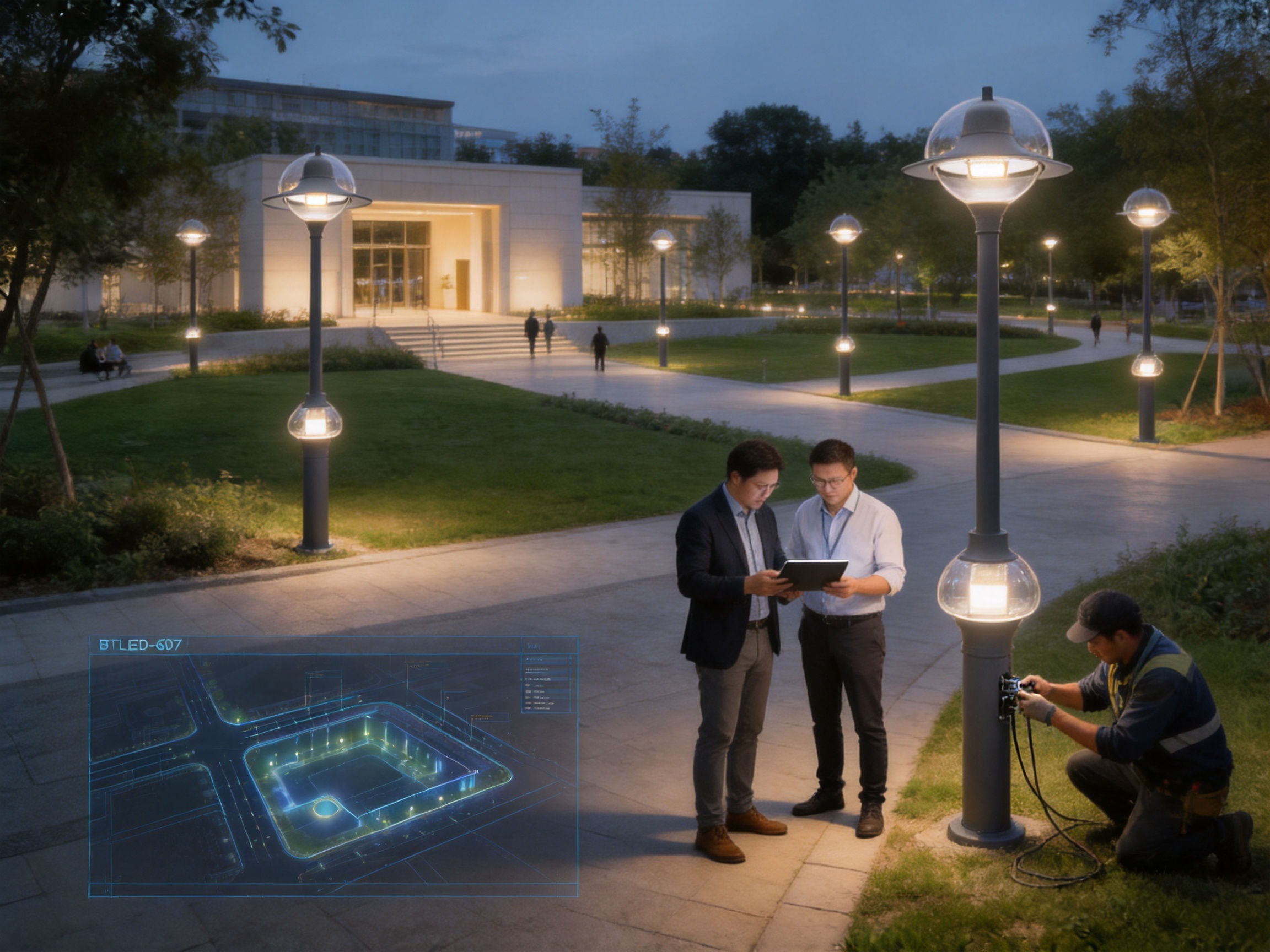
Introduction
Outdoor lighting is no longer limited to providing basic visibility after sunset. In residential communities, commercial developments, public parks, hospitality projects, pathways, gardens, and municipal landscapes, lighting also contributes to safety, atmosphere, visual identity, and property value. The right fixture must therefore combine reliable illumination with attractive design, efficient operation, durable construction, and practical installation requirements.
The Outdoor LED Garden Lamp BTLED-607 is designed for this broad range of landscape and outdoor applications. With a power range of 20W to 90W, it provides project planners and lighting distributors with flexibility when selecting an appropriate configuration. Rather than being restricted to one fixed wattage, the product can support different lighting requirements across gardens, walkways, courtyards, residential areas, parks, and other outdoor spaces.
The fixture uses LED technology to provide energy-conscious illumination, while its durable structure supports dependable use in outdoor environments. Its purpose is not only to brighten an area, but also to help create a comfortable and visually balanced environment through consistent light distribution. For suppliers, contractors, and project developers, the product offers an opportunity to combine decorative value with practical performance.
Another important advantage is the availability of OEM and ODM services. Housing design, power configuration, and lighting distribution can be customized according to project requirements. This is particularly valuable for wholesalers, engineering companies, municipal suppliers, and lighting brands that need a product adapted to their own specifications rather than a completely standard fixture.
Behind the product is a manufacturing organization with experience in outdoor lighting, die-casting, CNC machining, testing, assembly, and international supply. Its wider product portfolio includes street lights, tunnel lights, high-bay lights, linear lights, solar lights, grow lights, explosion-proof lights, and other LED luminaires. This product breadth supports a more integrated approach to lighting projects, allowing customers to source multiple categories from one experienced manufacturer.
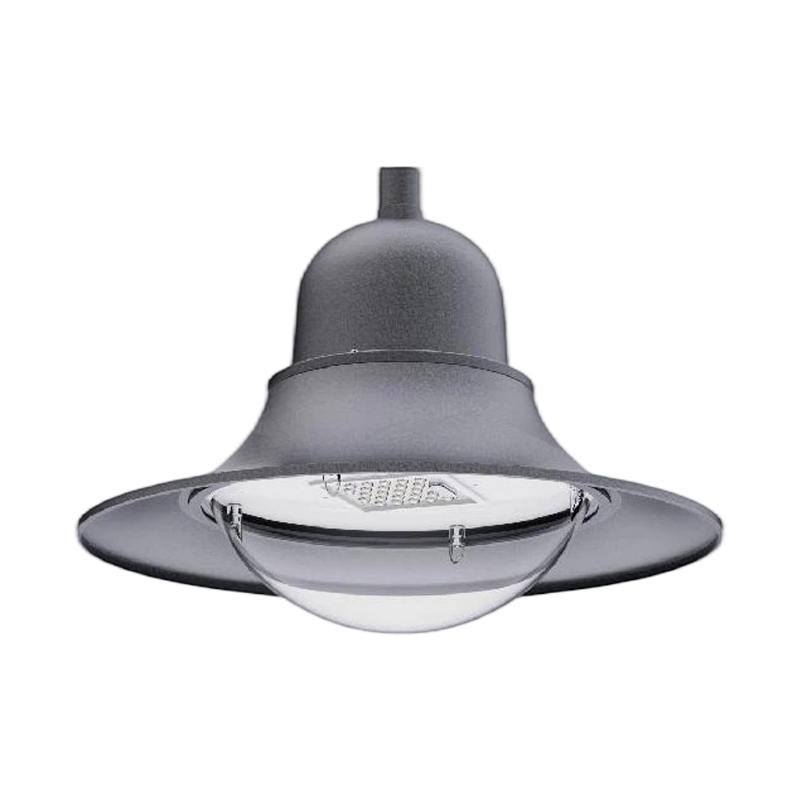
Outdoor LED Garden Lamp BTLED-607
Product Overview
The BTLED-607 is an outdoor LED garden lamp intended for decorative and functional landscape illumination. It is suitable for areas where lighting must be attractive enough for public-facing environments while also being stable enough for long-term outdoor service. The fixture can be considered for gardens, pedestrian routes, residential compounds, hotel grounds, commercial courtyards, parks, campuses, and other landscaped environments.
Its stated power range is 20W to 90W. This wide range gives the product a practical role in projects with different mounting heights, spacing plans, illumination targets, and area sizes. Lower-power configurations may be suitable for compact garden paths or low-density decorative applications, while higher-power configurations can support larger outdoor zones or areas requiring stronger illumination. The final configuration should be selected after reviewing the site layout, pole height, mounting arrangement, required illuminance, and local regulations.
| Product name | Outdoor LED Garden Lamp BTLED-607 |
| Product category | LED Garden Light |
| Application type | Decorative and functional outdoor area illumination |
| Power range | 20W–90W |
| Customization | OEM and ODM support for housing, power, and lighting distribution |
| Primary users | Lighting distributors, project suppliers, contractors, developers, and lighting brands |
The product description emphasizes uniform brightness, reduced maintenance requirements, and dependable lighting performance. These qualities are central to outdoor garden lighting because a fixture is often installed in locations where frequent service is inconvenient or disruptive. A stable luminaire can help reduce the need for repeated replacement and maintenance visits, supporting a more manageable lifecycle for property owners and facility operators.
Unlike purely decorative products that may focus mainly on appearance, the BTLED-607 is positioned as a balance between visual design and engineering practicality. It is intended to improve the atmosphere of an outdoor environment while providing useful illumination for movement, orientation, and general visibility. This balance makes it relevant to both design-led and performance-led projects.
Design Value in Outdoor Environments
Garden lighting plays an important role in shaping how an outdoor space is perceived. A pathway can appear more welcoming when it is evenly illuminated. A landscaped courtyard can become more usable after dark when lighting is distributed without excessive contrast. A residential development can achieve a stronger sense of identity when its exterior fixtures are coordinated with the surrounding architectural and landscape design.
The BTLED-607 is designed as a garden lamp rather than a purely industrial luminaire. This means that its role includes contributing to the visual character of the location. It can be incorporated into landscape concepts where fixtures need to appear orderly, attractive, and appropriate for public or semi-public environments.
Good garden lighting should avoid the impression of isolated bright points surrounded by deep darkness. It should also avoid unnecessary glare that could reduce visual comfort for pedestrians, residents, drivers, or nearby occupants. The product’s emphasis on uniform brightness supports the goal of creating a more balanced outdoor lighting experience. Final results, however, depend on the optical system, installation height, spacing, mounting angle, surrounding surfaces, and selected power configuration.
In comparison with basic outdoor fixtures that offer limited configuration options, a product available in a 20W to 90W range can provide more flexibility during the design stage. A project team can select a suitable output level instead of forcing every location to use the same wattage. This may assist with zoning, energy planning, and visual consistency across areas with different lighting needs.
The product may be used in a variety of environments, including:
• Garden paths and pedestrian walkways
• Residential communities and apartment landscapes
• Hotel, resort, and hospitality grounds
• Commercial courtyards and shopping areas
• Public parks and recreational spaces
• School and university campuses
• Office parks and corporate landscapes
• Municipal beautification and streetscape projects
• Entrance areas, courtyards, and outdoor gathering spaces
Because the fixture is suitable for both decorative and functional applications, it can be integrated into layered lighting schemes. For example, a project may use garden lamps for general pathway illumination, complementary floodlights for feature trees or façades, and low-level accent lights for planting beds. The BTLED-607 can therefore form part of a coordinated outdoor lighting system rather than being treated as an isolated product.
Energy-Conscious LED Performance
LED technology has become a standard choice for modern outdoor lighting because it can provide useful illumination with lower energy consumption than many traditional light sources. The BTLED-607 uses LED technology to support energy-efficient operation and long-term project value. Lower operating energy can be especially significant in applications where lamps operate every evening for extended periods.
Energy efficiency should be evaluated as part of a complete lighting design rather than by wattage alone. The actual result depends on light output, optical distribution, operating schedule, control systems, mounting arrangement, and the amount of light delivered to the intended area. A well-designed 20W or 40W LED configuration may provide a more useful result than a higher-wattage fixture with poor distribution or excessive spill light.
The BTLED-607’s range from 20W to 90W gives lighting professionals the opportunity to match output more closely to project requirements. This can help prevent over-lighting, which wastes energy and may create glare, as well as under-lighting, which can compromise safety and visual quality. The ability to select a suitable configuration is one of the product’s practical advantages for project-based procurement.
LED fixtures also support modern control strategies. Depending on the selected driver and project configuration, an outdoor lighting system may be integrated with timers, photocells, dimming systems, motion sensors, or centralized management platforms. Any such control compatibility should be confirmed during technical discussions and specified before production.
Reduced energy use can produce benefits beyond utility savings. It may reduce the required capacity of electrical infrastructure, lower the operating burden on facility managers, and support environmental targets for residential, commercial, and municipal developments. For customers pursuing green building objectives or sustainable landscape strategies, efficient LED garden lighting can contribute to a broader energy management plan.
Durability and Reduced Maintenance
Outdoor fixtures must work in an environment that is more demanding than a typical indoor installation. Temperature changes, humidity, dust, rain, ultraviolet exposure, insects, vibration, and accidental contact can all affect product performance. The BTLED-607 is designed with a durable structure intended to support reliable outdoor operation.
The value of a durable fixture is not limited to the physical strength of its housing. Long-term performance also depends on the quality of the LED components, driver, thermal management, electrical connections, sealing method, assembly accuracy, and final inspection. A reliable outdoor lighting product must be treated as a complete system in which mechanical and electrical elements work together.
The product description highlights reduced maintenance requirements. For project owners, this can be a meaningful advantage over lower-quality fixtures that require frequent driver replacement, loose connection repairs, corrosion treatment, or complete unit replacement. Maintenance work in gardens and public areas may involve access equipment, traffic control, landscaping disruption, or temporary closure of pedestrian routes. A more stable product can help reduce these indirect costs.
Maintenance planning should still include regular visual inspection, cleaning where necessary, electrical checks, and confirmation that the fixture remains correctly positioned. Outdoor lighting is exposed to environmental conditions, and no luminaire should be considered maintenance-free. The goal is to make routine maintenance predictable and less frequent, not to eliminate responsible inspection.
For distributors and contractors, durability also affects reputation. A product that performs consistently can reduce warranty claims, emergency service requests, and customer dissatisfaction. It can help suppliers build confidence among property developers and project consultants who are seeking stable quality for repeated installations.
Flexible Power Selection
The 20W to 90W power range is one of the most important features of the BTLED-607. Outdoor sites rarely have identical lighting needs in every zone. A narrow garden walkway, a broad entrance plaza, a residential driveway, and a park interior may require different power levels even when they use the same general style of garden lamp.
Flexible power options can simplify product selection and improve visual consistency. Instead of using several unrelated lamp designs across one project, a customer may be able to select different power configurations within the same product family. This can help maintain a coordinated appearance while accommodating different illumination requirements.
Power flexibility is also useful for export distributors. Different markets and project types may have different preferences regarding wattage, light levels, pole spacing, and energy consumption. A manufacturer that can support multiple configurations may provide a more useful product platform than a supplier offering only one fixed specification.
Project teams should consider the following factors when selecting the appropriate power level:
• Mounting height and fixture orientation
• Distance between fixtures
• Width and geometry of the illuminated area
• Surface reflectance and surrounding vegetation
• Required illuminance and uniformity
• Pedestrian and vehicle movement patterns
• Local lighting standards and environmental policies
• Operating schedules and energy targets
Photometric planning is recommended before finalizing the configuration. A professional lighting designer can use the fixture’s photometric file and project dimensions to evaluate illuminance, uniformity, glare, and light spill. The manufacturer’s support for DIALux designs can assist customers that require a more detailed planning process.
Customization for OEM and ODM Projects
Standard products are useful for straightforward projects, but many professional buyers require adjustments to suit their own brand, market, or application. The BTLED-607 is available with OEM and ODM support, including customization of housing, power, and lighting distribution. This makes the product suitable for customers that need more than a catalog purchase.
Housing customization may involve adjustments to shape, dimensions, mounting interfaces, surface treatment, branding areas, or visual details. Such changes can help a lighting brand create a distinctive product family or allow a project supplier to match a particular architectural concept. Housing design must be developed together with thermal, mechanical, optical, and manufacturing considerations so that visual changes do not compromise performance.
Power customization can support different electrical requirements and market preferences. A customer may need a particular wattage, driver arrangement, voltage range, dimming method, or control interface. These specifications should be confirmed in a technical requirement document because they affect component selection, testing, certification, and production scheduling.
Lighting distribution customization is especially valuable in landscape projects. The same garden lamp may need different beam patterns or optical arrangements for a narrow pathway, an open courtyard, a driveway, or a larger public space. Modifying the distribution can help place light where it is needed and limit unnecessary spill toward neighboring properties, roads, windows, or the night sky.
ODM cooperation can also include support during product development. The customer may provide a concept, drawing, performance requirement, or target market specification, while the manufacturer contributes engineering advice, mold design, sample development, prototype evaluation, and mass-production planning. This approach can shorten the path between an initial idea and a production-ready luminaire.
Customization must be managed carefully. Changes to the body, optics, driver, or power can influence heat dissipation, electrical safety, photometric results, certification status, packaging, and cost. A responsible manufacturer should therefore review each modification through design verification and sample testing before approving mass production.
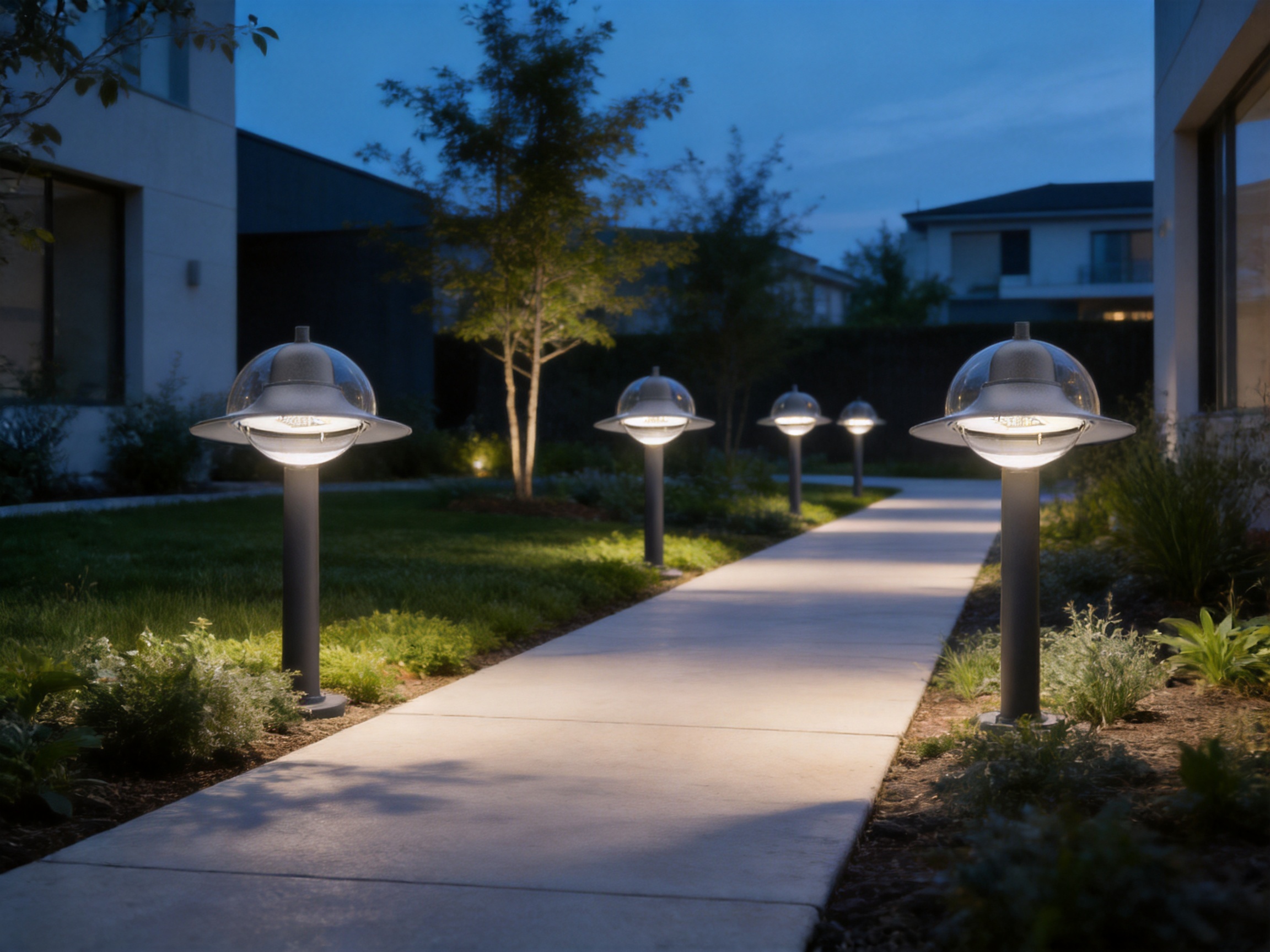
Advanced Manufacturing Capabilities
The performance of an outdoor garden lamp is strongly connected to the manufacturing process used to produce it. The company behind the BTLED-607 operates die-casting and CNC machining equipment, aging lines, and goniophotometers. These facilities support several important stages of luminaire development and quality control.
Die-Casting Production
Die-casting is commonly used to manufacture lighting housings and structural components that require consistent dimensions, strength, and repeatable production. A controlled die-casting process can create complex forms while maintaining stable geometry across multiple units. This is important when the housing must accommodate LED boards, drivers, heat-dissipation structures, mounting parts, and protective covers.
For an outdoor garden lamp, dimensional consistency affects more than appearance. It can influence the fit between housing sections, the positioning of optical components, the alignment of mounting interfaces, and the reliability of sealing arrangements. Stable die-casting quality can therefore contribute to more predictable assembly and field performance.
Die-casting also supports efficient mass production. Once a mold has been designed and validated, repeated production can help maintain consistency across larger orders. This is beneficial for distributors and project suppliers that require multiple batches with a uniform appearance and compatible installation dimensions.
CNC Machining
CNC machining provides a high level of control for selected housing surfaces, interfaces, holes, threads, and precision features. After die-casting, machining may be used to refine areas where close dimensional accuracy is important. This can improve the fit of components and support more consistent assembly.
The combination of die-casting and CNC machining is a valuable manufacturing strength for customized lighting products. Die-casting can provide an efficient structural form, while CNC processing can achieve the precision required at critical connection points. This combination may be especially useful for OEM and ODM projects that require modifications to mounting structures or housing details.
Aging and Reliability Testing
Aging lines are used to support production testing by operating luminaires for a controlled period before shipment. This process can help identify certain early-stage failures or abnormal behavior that may not be visible during a short functional check. While aging is not a substitute for complete product validation, it is an important part of manufacturing quality control.
For outdoor lighting suppliers, aging tests can provide additional confidence that products have passed an initial operating assessment before they enter the supply chain. This is particularly relevant for projects with strict delivery schedules, where discovering a batch issue after installation could cause significant delay and additional labor costs.
Photometric Measurement
Goniophotometers are used to measure the light distribution of luminaires. They can help generate photometric data for evaluating luminous intensity, beam distribution, symmetry, and other lighting characteristics. This information is important for designers using lighting simulation software and for engineers assessing whether a fixture is suitable for a particular application.
Photometric measurement also supports product development. When an optical component or LED arrangement is changed, testing can show how the modification affects distribution and performance. This makes it possible to compare different optical solutions rather than relying only on visual judgment.
Access to photometric testing is a significant advantage over suppliers that provide limited technical documentation. Professional project buyers increasingly require reliable data for lighting calculations, tender submissions, energy analysis, and compliance reviews. A manufacturer capable of supporting these processes can contribute more value than a supplier focused only on product delivery.
Quality Management and Certification Support
The company is reported to hold ISO 9001, ISO 14001, and ISO 45001 certifications. These management systems correspond respectively to quality management, environmental management, and occupational health and safety. Together, they indicate an organized approach to controlling production activities, environmental responsibilities, and workplace safety processes.
ISO 9001 is relevant to customers seeking repeatable quality and documented procedures. A quality management system can support processes such as incoming material control, production inspection, nonconformity handling, corrective action, traceability, and customer feedback management. These systems are especially valuable when a supplier is producing customized products for different international customers.
ISO 14001 reflects attention to environmental management. Lighting manufacturing involves metals, plastics, electronic components, packaging, energy consumption, and production waste. An environmental management framework can help a manufacturer identify and control these impacts while improving process efficiency and regulatory awareness.
ISO 45001 addresses occupational health and safety. Manufacturing operations involving casting, machining, assembly, testing, and logistics require appropriate procedures to protect employees and control workplace risks. A structured safety system supports more responsible and sustainable production.
The company also reports that relevant products have CB and CE certifications. These certifications can support international market access and provide evidence that applicable requirements have been addressed. Certification scope should always be checked for the exact product model, configuration, rated input, driver, and destination market. Customized versions may require additional evaluation if key components or electrical characteristics change.
For professional buyers, certification documentation should be requested during the quotation or technical approval stage. This may include test reports, declarations, driver documentation, product drawings, installation instructions, photometric files, and warranty terms. A complete technical file helps reduce uncertainty during project review.
Integrated Engineering Services
The manufacturer provides more than finished lighting fixtures. Its services include efficient lighting solutions, DIALux designs, mold design, OEM and ODM development, SKD and CKD customization, and delivery support. This broader service capability can be useful for customers managing complex projects or developing a private-label lighting range.
Efficient Lighting Solutions
A lighting solution should begin with the application rather than with a predetermined product. The manufacturer can assist customers in reviewing project conditions, selecting suitable luminaires, and considering the relationship between power, spacing, mounting height, and lighting distribution. The BTLED-607 may be used alongside other product categories when a project requires a complete outdoor lighting system.
DIALux Design Support
DIALux planning can help visualize how a lighting product will perform in a defined space. Designers can use photometric data to examine illuminance levels, uniformity, light distribution, and energy-related parameters. For garden projects, simulation can be particularly useful because pathways, vegetation, buildings, walls, and irregular terrain can affect the final result.
Design support may also help customers compare configurations within the 20W to 90W range. Instead of choosing a wattage based only on experience or visual estimation, a project team can evaluate multiple scenarios and select the configuration that best balances lighting performance, operating energy, and fixture spacing.
Mold Design and Development
Mold design is a critical part of die-cast product development. The mold must support the intended housing shape while accounting for material flow, wall thickness, draft angles, cooling, machining allowances, assembly features, and production repeatability. Experience in mold design can reduce development problems and improve the transition from prototype to mass production.
For customers requesting a customized garden lamp, in-house or closely integrated mold capability can simplify communication. Design changes can be reviewed with both product engineers and manufacturing specialists, helping identify potential production issues before the mold is finalized.
SKD and CKD Customization
SKD and CKD arrangements may help customers with local assembly, regional packaging, import planning, or market-specific production strategies. In a semi-knocked-down model, major components may be supplied for assembly in the destination market. In a completely knocked-down model, a larger number of components may be shipped separately for local assembly.
These arrangements require clear documentation, component identification, assembly instructions, quality standards, and responsibility allocation. When managed properly, they can provide flexibility for customers that have local facilities or specific supply-chain objectives.
Advantages for Project Suppliers and Distributors
Project suppliers often need to balance price, performance, delivery, customization, documentation, and after-sales support. The BTLED-607 addresses several of these priorities through its flexible power range, outdoor-oriented design, and available engineering services.
First, the product can be adapted to different applications without changing the overall product category. This helps suppliers prepare proposals for multiple customers, including residential, commercial, hospitality, and municipal projects. A supplier may be able to offer different power levels or lighting distributions while keeping a consistent design language.
Second, the product is supported by a manufacturer with a broad outdoor lighting portfolio. If a project also requires street lights, tunnel lights, high-bay fixtures, solar lights, or explosion-proof luminaires, the supplier can communicate with one experienced source for multiple categories. This may simplify technical coordination, purchasing, packaging, and delivery management.
Third, manufacturing resources such as die-casting, CNC machining, aging lines, and photometric equipment support a more controlled development process. These resources can be important when a customer needs a customized product, private labeling, or a repeat order with consistent specifications.
Fourth, the company’s international orientation and certification experience may be useful for export customers. Global projects often require more than a product sample. They may require technical files, test information, packaging specifications, quality procedures, and communication across different time zones and regulatory environments.
Compared with a low-cost supplier that offers only a basic fixture and limited documentation, an integrated manufacturer may provide better support throughout the product lifecycle. The initial purchase price is only one part of the total cost. Design support, installation efficiency, product consistency, maintenance requirements, and replacement availability can all affect the final project value.
Applications in Residential and Commercial Landscapes
In residential developments, garden lamps can illuminate internal roads, footpaths, entrances, green areas, and communal courtyards. The BTLED-607 can contribute to a more welcoming appearance while helping residents navigate the site after dark. Appropriate spacing and distribution are important to ensure that lighting is comfortable and does not create excessive glare toward apartments or neighboring properties.
In hotels and resorts, outdoor lighting influences the guest experience. Paths between buildings, gardens surrounding restaurants, poolside areas, and entrance zones all require carefully coordinated illumination. A decorative garden fixture with configurable power can support different zones while preserving a consistent visual theme.
Commercial properties can use garden lighting to improve the appearance of courtyards, restaurant terraces, retail exteriors, office campuses, and pedestrian areas. Lighting may encourage evening use, increase visual orientation, and support property branding. The BTLED-607 can be specified as part of a larger system that includes façade, sign, pathway, and parking-area lighting.
Public parks and municipal landscapes require fixtures that can withstand regular outdoor exposure and repeated use. Maintenance access, vandal resistance, energy management, and long-term product availability are often important procurement considerations. A durable LED platform with several power options can be useful when a municipality is upgrading existing lighting in stages.
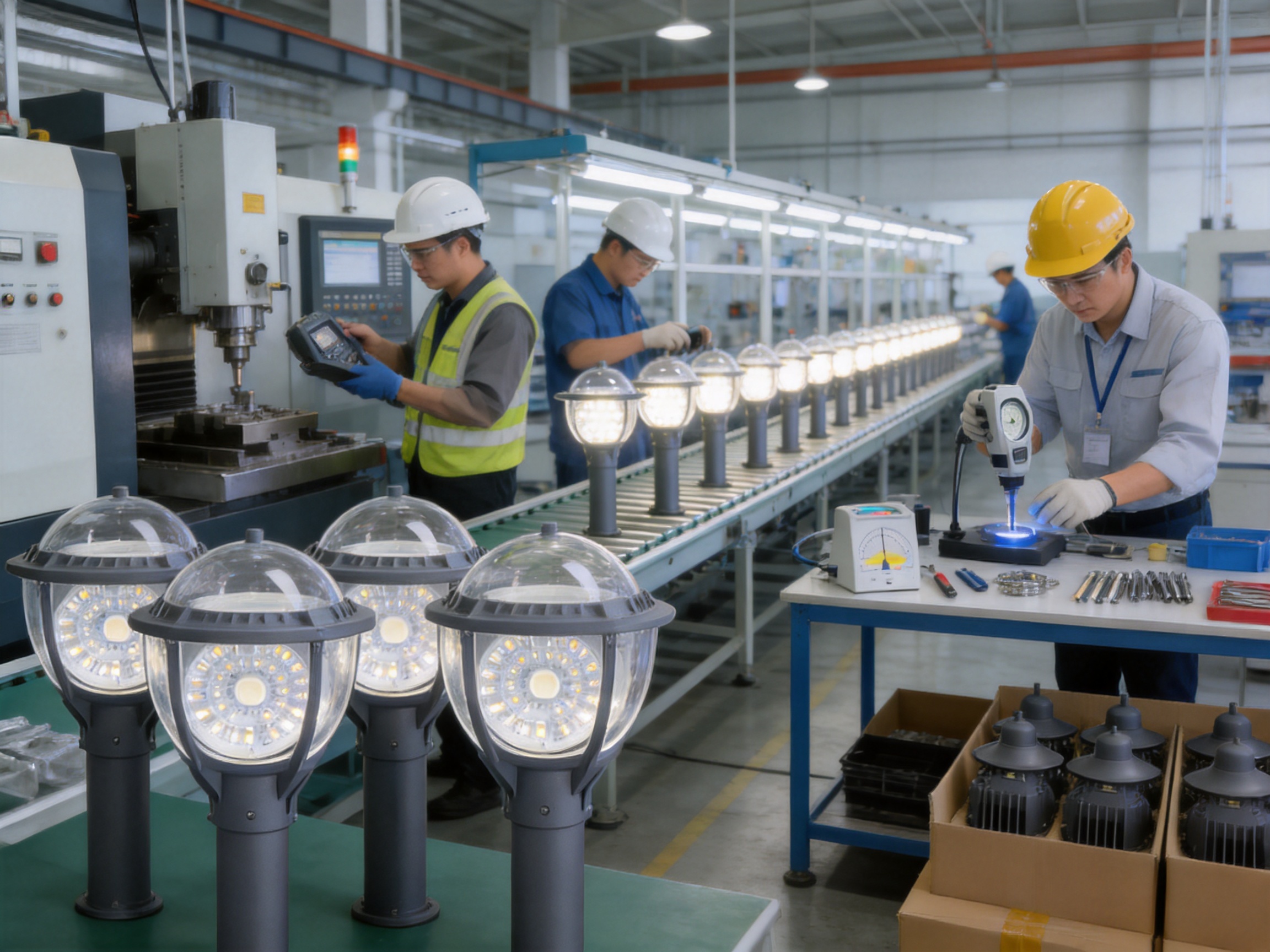
Installation and Project Planning Considerations
Successful lighting performance depends on correct installation as much as on the quality of the luminaire. Before ordering, customers should confirm the mounting method, pole or support dimensions, cable entry arrangement, supply voltage, control requirements, environmental conditions, and access for future inspection.
The installation location should be reviewed for drainage, water exposure, nearby irrigation systems, soil conditions, vegetation growth, and potential physical impact. Although the fixture is designed for outdoor use, the complete installation must be planned so that water does not accumulate around electrical connections and maintenance access remains practical.
Lighting layout should be developed using actual site dimensions. Designers should consider the distance between lamps, paths of travel, changes in elevation, obstacles, tree canopies, walls, and areas where light may be unwanted. Photometric simulation is recommended for projects where uniformity, glare control, or energy performance is important.
Electrical installation should be completed by qualified personnel in accordance with local codes. Cable sizing, grounding, surge protection, circuit loading, and control equipment should be reviewed as part of the electrical design. The exact driver and input specifications must be confirmed with the manufacturer for the selected configuration.
For projects in areas with sensitive wildlife or dark-sky objectives, customers should discuss color temperature, operating schedules, optical distribution, and dimming possibilities during the design stage. These details can help reduce unnecessary ecological and visual impact.
Maintenance and Lifecycle Management
LED garden lighting can offer a long service life, but responsible lifecycle management remains essential. Routine inspection should check for physical damage, loose components, cable deterioration, corrosion, unusual flicker, reduced brightness, and changes in alignment. Cleaning may be required where dust, pollen, salt, or pollution accumulates on optical surfaces.
Vegetation should be managed so that growing branches and leaves do not block the light distribution. Irrigation systems should be adjusted to avoid continuous direct spraying on the fixture or electrical connections. In coastal environments, project owners may need a more frequent inspection schedule because salt exposure can accelerate corrosion on exposed surfaces.
Maintaining records of installation dates, product configurations, driver information, and service actions can help facility managers plan replacements and identify recurring issues. For large developments, a spare-parts strategy may be established before installation. The manufacturer’s ability to support OEM production and repeat orders can be valuable when a project requires matching replacements several years later.
Reduced maintenance is one of the BTLED-607’s stated benefits, but actual maintenance intervals depend on the operating environment and product configuration. A clean installation, suitable surge protection, stable power supply, and appropriate thermal conditions can all contribute to longer and more consistent service.
Comparison with Basic Outdoor Lighting Alternatives
When evaluating outdoor garden lamps, buyers often compare an integrated LED product with conventional lamps, low-cost unbranded fixtures, or highly specialized luminaires. Each option may have a place, but the BTLED-607 offers several practical advantages for customers seeking a flexible and professionally supported product.
| Evaluation factor | BTLED-607 approach | Potential project benefit |
| Power selection | 20W–90W range | Better matching of output to different outdoor zones |
| Light source | LED technology | Energy-conscious operation and modern control potential |
| Application | Decorative and functional garden illumination | Suitable for landscape projects requiring both appearance and utility |
| Customization | Housing, power, and lighting distribution options | Adaptation for private-label and project-specific requirements |
| Manufacturing support | Die-casting, CNC machining, aging, and photometric testing | More controlled development and production verification |
| Engineering services | DIALux designs, mold design, OEM/ODM, SKD/CKD | Support from concept development through delivery |
| Product portfolio | Multiple outdoor and industrial lighting categories | Potentially simpler sourcing for complete lighting projects |
Conventional light sources may have familiar replacement procedures, but they can be less efficient or less flexible in modern control environments. Low-cost fixtures may appear attractive at the quotation stage, yet inconsistent components, limited documentation, and weak after-sales support can increase the total cost of ownership. Highly specialized products may deliver excellent performance in one application but may not offer the same adaptability for a diverse project portfolio.
The BTLED-607 is therefore positioned as a balanced option. It is not defined only by maximum output or the lowest purchase cost. Its value lies in the combination of configurable power, outdoor suitability, decorative design, manufacturing support, and customization potential.
Manufacturing Quality as a Competitive Strength
A lighting manufacturer’s competitive position depends heavily on its ability to control the complete product process. Product design, mold development, casting, machining, component assembly, aging, photometric testing, packaging, and delivery all influence customer satisfaction.
The manufacturing capabilities associated with the BTLED-607 provide a foundation for more consistent production. Die-casting supports repeatable housing manufacture. CNC machining supports precision at selected interfaces. Aging lines provide an additional operating check before shipment. Goniophotometers provide data for evaluating light distribution and supporting professional design work.
This integrated approach can offer advantages over fragmented supply chains in which the housing is produced by one company, the optical assembly by another, and testing is handled without direct connection to production. When engineering and manufacturing are closely coordinated, feedback from testing can be used more efficiently during product improvement and customization.
Quality control is also important for repeat orders. A lighting project may be built in phases, or a distributor may reorder the same product for different customers. Consistent dimensions, color, mounting arrangements, optical performance, and electrical behavior help avoid installation problems and visual inconsistencies between batches.
For private-label customers, manufacturing control protects brand reputation. The end customer may see only the distributor’s brand, not the factory behind the product. A reliable OEM partner is therefore essential to ensure that the finished fixture meets approved samples and technical specifications.
Environmental and Operational Responsibility
Modern lighting projects increasingly consider environmental impact in addition to initial cost and illumination. LED technology can help reduce operational energy demand. Efficient product design can also support lower replacement frequency, which may reduce material use and waste over the life of an installation.
The reported ISO 14001 certification indicates that environmental management is included within the company’s organizational framework. This is relevant to buyers with sustainability requirements, although customers should request specific environmental documentation when a project has detailed procurement criteria.
Environmental responsibility also involves avoiding excessive light spill and unnecessary operation. A suitable power level, well-designed distribution, and appropriate control schedule can reduce energy use and protect surrounding areas. The BTLED-607 should be integrated into a lighting plan that considers both human needs and the character of the nighttime environment.
Packaging and logistics are additional areas where responsible planning can create benefits. Proper packaging protects fixtures during transport and reduces damage-related waste. SKD and CKD supply options may also allow customers to review regional assembly and shipping strategies where those arrangements are commercially appropriate.
Recommended Procurement Process
Customers considering the BTLED-607 should begin by defining the project application. Information such as site drawings, mounting height, spacing, target illuminance, supply voltage, operating schedule, environmental conditions, and expected quantity will help the manufacturer recommend a suitable configuration.
The next stage should address technical selection. Buyers should confirm the preferred power level within the 20W to 90W range, lighting distribution, driver requirements, control method, housing finish, mounting interface, and any branding or packaging needs. If the project is using a specific local standard, that requirement should be communicated before quotation.
For customized projects, the customer should approve drawings, samples, photometric information, and electrical specifications before mass production. Any change made after sample approval should be documented because even a small alteration to the housing, LED board, driver, or optical system may affect certification and performance.
Quality documents should be collected before shipment. Depending on the project, these may include inspection records, test reports, certificates, product labels, installation instructions, packing lists, and warranty information. Clear documentation helps contractors install the product correctly and assists facility managers during future maintenance.
Delivery planning should account for production lead time, mold development if required, sample approval, packaging, transportation, customs, and local installation schedules. Early communication is particularly important for large landscape projects with fixed opening dates or phased construction programs.
Questions and Answers
What is the BTLED-607 designed for?
The BTLED-607 is an outdoor LED garden lamp designed for decorative and functional illumination in gardens, pathways, residential developments, parks, commercial landscapes, hospitality properties, campuses, and other outdoor areas.
What power options are available?
The stated power range is 20W to 90W. The appropriate selection depends on the site layout, mounting height, fixture spacing, required illuminance, optical distribution, and project energy objectives.
Can the product be used for both decorative and practical lighting?
Yes. The product is intended to contribute to the visual atmosphere of a landscape while also providing useful illumination for pedestrian movement, orientation, and general outdoor visibility.
Does the manufacturer provide customization?
Yes. OEM and ODM services are available for housing, power, and lighting distribution customization. Customers should provide detailed technical requirements so that the proposed design can be evaluated for thermal, optical, electrical, manufacturing, and certification considerations.
Can the light distribution be adapted to a specific project?
The product offering includes lighting distribution customization. The final optical solution should be confirmed through technical review and, where necessary, photometric testing and DIALux simulation.
What manufacturing equipment supports production?
The company operates die-casting and CNC machines, aging lines, and goniophotometers. These resources support housing production, precision machining, pre-shipment operating checks, and photometric evaluation.
Why is die-casting useful for an outdoor garden lamp?
Die-casting can provide a repeatable housing structure with consistent dimensions and integrated mechanical features. This supports efficient mass production and reliable fitting of internal components when the mold and process are properly designed.
What is the role of CNC machining?
CNC machining can refine critical surfaces, holes, threads, and mounting interfaces after casting. It supports dimensional accuracy and can be especially useful for customized housing designs.
Does the manufacturer support lighting calculations?
Yes. The company provides DIALux design support and photometric services. Customers should supply project drawings and performance targets so that an appropriate lighting layout can be developed.
Which certifications are associated with the company and its products?
The company is reported to hold ISO 9001, ISO 14001, and ISO 45001 certifications, while relevant products are reported to have CB and CE certifications. The exact certification scope should be confirmed for the selected BTLED-607 configuration and destination market.
Is the product suitable for export projects?
The manufacturer exports lighting products worldwide and provides OEM, ODM, SKD, and CKD services. Export buyers should confirm applicable standards, labeling, packaging, voltage, documentation, and certification requirements for their market.
Can the BTLED-607 be combined with other lighting products?
Yes. The manufacturer produces several categories, including street lights, tunnel lights, high-bay lights, linear lights, solar lights, grow lights, explosion-proof lights, façade lighting, and other outdoor luminaires. This allows the product to be considered as part of a broader project lighting package.
What information should be provided when requesting a quotation?
Useful information includes the application, project location, quantity, site drawings, mounting height, fixture spacing, desired power, supply voltage, lighting distribution, control requirements, housing finish, certification needs, packaging expectations, and whether OEM or ODM customization is required.
Is outdoor lighting completely maintenance-free?
No outdoor fixture should be considered completely maintenance-free. Regular inspection, cleaning, vegetation management, electrical checks, and alignment review remain advisable. The BTLED-607 is designed to support reliable performance and reduced maintenance requirements, but actual service needs depend on installation and environmental conditions.
Conclusion
The Outdoor LED Garden Lamp BTLED-607 is a flexible lighting solution for projects that require more than basic outdoor illumination. Its 20W to 90W range allows project teams to select different output levels for different landscape zones. Its LED technology supports energy-conscious operation, while its durable structure is intended to provide stable performance and reduced maintenance requirements.
The product’s strongest advantage is the combination of practical application flexibility and manufacturing support. Housing, power, and lighting distribution can be customized through OEM and ODM cooperation. Die-casting, CNC machining, aging lines, and goniophotometric testing provide a technical foundation for controlled product development and production. DIALux design, mold development, SKD, and CKD services further extend the manufacturer’s role from product supplier to project partner.
For distributors, contractors, developers, and lighting brands, this combination can reduce the difficulty of sourcing a suitable garden lamp for different markets and applications. The product can support residential landscapes, parks, hospitality developments, commercial courtyards, campuses, and municipal projects while maintaining a coordinated outdoor lighting concept.
As with any professional luminaire, final selection should be based on project-specific evaluation. Customers should confirm electrical parameters, photometric data, certification scope, mounting details, environmental requirements, and customization effects before placing a production order. When properly specified and installed, the BTLED-607 can provide an attractive, efficient, and dependable foundation for modern outdoor landscape lighting.
References
1. Product specification information for the Outdoor LED Garden Lamp BTLED-607, including the stated 20W–90W power range and OEM/ODM customization options.
2. Company manufacturing information concerning die-casting, CNC machining, aging lines, goniophotometers, mold design, and lighting engineering services.
3. International Organization for Standardization, ISO 9001: Quality Management Systems.
4. International Organization for Standardization, ISO 14001: Environmental Management Systems.
5. International Organization for Standardization, ISO 45001: Occupational Health and Safety Management Systems.
6. International Electrotechnical Commission, general principles for LED lighting performance, safety, and photometric evaluation.
7. Professional guidance on outdoor lighting design, glare control, uniformity, energy management, and landscape illumination planning.
Product: Outdoor LED Garden Lamp BTLED-607

YQF Group - World Leading One-Stop Lighting & Solar For the Global Partners
Custom & OEM Solutions for Global Lighting Brands
Copyright © Cixi HuaSheng Lighting Co., Ltd. All Rights Reserved.
Die-Casting Mould Supplier
