 English
 中文简体
 русский
 Français
 Español
 عربى
 Indonesia

Outdoor Solar Garden Light ZC-TYD1105: Reliable, Efficient, and Customizable Lighting for Modern Landscapes
Outdoor lighting plays an important role in the safety, appearance, and usability of gardens, parks, courtyards, pathways, residential communities, and commercial landscapes. As property owners and project contractors look for more sustainable alternatives to conventional grid-connected fixtures, solar-powered garden lighting has become an increasingly practical solution. The Outdoor Solar Garden Light ZC-TYD1105 is designed to provide dependable nighttime illumination while reducing wiring requirements, installation complexity, and ongoing electricity consumption.
The ZC-TYD1105 combines a durable die-cast aluminum and PC construction, a high-capacity battery, an integrated solar panel, and 160 LED chips in a compact garden-light format. Its design is intended for general outdoor use where reliable illumination, simple installation, weather resistance, and efficient operation are important. It can be used in private gardens, public parks, courtyards, landscape zones, pedestrian areas, hospitality properties, and other outdoor environments that require basic decorative and functional lighting.
Unlike traditional garden lights that depend on underground cables and a permanent electrical connection, this solar model generates and stores energy during the day for use at night. This makes it particularly suitable for locations where trenching is expensive, grid access is limited, or installation speed is a priority. The product also provides opportunities for OEM and ODM customization, including design adjustments, LED selection, and branding support.
Product Overview
The Outdoor Solar Garden Light ZC-TYD1105 is engineered as a standalone solar lighting fixture for outdoor landscape applications. During daylight hours, its solar panel converts sunlight into electrical energy. That energy is stored in the integrated battery, and the stored power is then used to operate the LED light source after dark. This operating principle allows the fixture to function without a direct connection to the municipal electricity network.
The product is suitable for customers seeking an economical and straightforward outdoor lighting solution. It does not require complex cabling between each light and a central power source. As a result, it can simplify project planning and reduce the number of installation steps. In locations where the landscape may be redesigned in the future, a self-contained fixture can also offer greater flexibility than a fixed wired system.
The ZC-TYD1105 has a diameter of approximately 530 millimeters and a height of approximately 580 millimeters. This size gives it a visible presence in outdoor spaces while remaining suitable for garden and landscape applications. Its proportions can complement planting beds, pathways, courtyards, entrance areas, and other zones where a low or medium-height decorative fixture is preferred.
| Product | Outdoor Solar Garden Light |
| Model | ZC-TYD1105 |
| Application Category | Solar Garden Light |
| Housing Material | Die-casting aluminum and PC |
| Solar Panel | 5V/28W |
| Battery | 3.2V/36000mAh |
| LED Quantity | 160 LED chips |
| Charging Time | Approximately 3–5 hours |
| Color Temperature | 3000–6500K |
| Dimensions | Diameter 530 mm × height 580 mm |
| Customization | Design adjustment, LED selection, and branding support |
Core Advantages of Solar Garden Lighting
Independent Solar Operation
The most important advantage of the ZC-TYD1105 is its independent solar power system. A conventional outdoor garden light normally requires a cable connection, electrical conduit, junction boxes, and protection equipment. These requirements increase the amount of civil work needed before the fixture can be installed. Solar operation removes much of this infrastructure from the project.
Because the ZC-TYD1105 collects energy directly from the sun, it can be installed in areas where connecting to the grid would be inconvenient or costly. This includes remote garden sections, landscape features, temporary project areas, rural properties, parks with limited electrical infrastructure, and newly developed sites where utility systems are not yet complete. The absence of long power cables can reduce excavation work and help preserve existing landscaping.
Solar independence can also support more flexible project design. Lighting points can be selected according to the layout of the space rather than the position of underground cables. Contractors may therefore have greater freedom when positioning fixtures near plants, walkways, seating areas, water features, gates, or architectural elements.
Reduced Operating Electricity Costs
The ZC-TYD1105 uses solar energy collected during the daytime rather than relying on continuous electricity supplied by the grid. Once installed, the fixture can operate with limited routine energy expense. This can be beneficial for property owners who are seeking to control long-term operating costs across multiple outdoor lighting points.
For large gardens, residential developments, parks, and commercial landscaping projects, energy savings can become more significant as the number of fixtures increases. A solar lighting system also provides a way to support sustainability targets by reducing dependence on conventional electricity sources. Although actual performance depends on sunlight conditions, installation orientation, weather, and operating settings, the solar architecture provides a strong foundation for low-energy outdoor lighting.
Fast and Simple Installation
Traditional wired garden-lighting projects may require electrical design, cable routing, trench preparation, conduit installation, backfilling, and final connection work. The ZC-TYD1105 is designed to make the installation process more straightforward because the fixture integrates its own solar energy collection and storage system.
This simplified installation can reduce labor requirements and shorten project schedules. It may also help reduce disruption to lawns, paving, planting areas, and other finished surfaces. For renovation projects, the ability to install lighting without extensive excavation is especially useful. Property owners can improve lighting in an existing landscape while minimizing damage to established trees, shrubs, decorative stone, and irrigation systems.
Installation teams should still evaluate the site carefully. The solar panel should receive adequate direct sunlight, and nearby buildings, trees, walls, and other structures should not create excessive shade. Correct placement is essential for maximizing daytime charging and supporting consistent nighttime operation.
Durable Outdoor Materials
The product uses die-cast aluminum together with PC components. This material combination is appropriate for outdoor lighting because it balances structural strength, weather resistance, appearance, and manufacturing flexibility. Die-cast aluminum can provide a firm housing structure and can help protect internal components from mechanical impact and outdoor exposure.
Aluminum is also widely used in professional lighting because it can support heat dissipation from LED and electrical components. Effective heat management is important for maintaining stable LED performance and extending component service life. The PC material can be used for protective or optical parts where impact resistance, light transmission, and design flexibility are required.
Material selection is only one part of outdoor durability. Product performance also depends on correct sealing, assembly quality, surface treatment, component selection, and inspection. The manufacturing capabilities of the supplier are therefore important when evaluating the long-term value of a solar garden light.
Wide Color Temperature Range
The ZC-TYD1105 supports a color temperature range from 3000K to 6500K. This range allows the product to serve different design preferences and application requirements. Warmer light around 3000K can create a comfortable, welcoming, and decorative atmosphere in residential gardens, hospitality spaces, courtyards, and landscape settings.
Higher color temperatures can provide a whiter appearance that may be preferred for pathways, entrances, public areas, or projects requiring a more contemporary visual effect. The available range gives project designers greater flexibility when coordinating lighting with building façades, paving materials, planting schemes, and other outdoor elements.
Color temperature selection should be considered together with the purpose of the space. Warm light may be appropriate for relaxation and visual comfort, while cooler light may assist with visibility and a modern architectural appearance. OEM and ODM customers can discuss suitable LED options and visual requirements during the product development stage.
High LED Chip Quantity
The product incorporates 160 LED chips. A large number of LED chips can support more uniform light distribution across the illuminated area when combined with suitable optical design and circuit control. It can also help create a balanced luminous appearance, reducing the likelihood of harsh bright points or uneven lighting.
LED technology is well suited to solar applications because LEDs can generate useful illumination with relatively low energy consumption compared with many traditional light sources. Their compact size also allows designers to integrate multiple chips into a controlled housing while maintaining a modern and decorative product profile.
The final lighting effect depends on more than the number of chips. Optical components, LED quality, current control, thermal management, battery condition, and solar charging performance all contribute to actual results. A professional lighting manufacturer must therefore coordinate the complete system rather than treating the LED quantity as an isolated specification.

Outdoor Solar Garden Light ZC-TYD1105
Battery and Solar Charging System
5V/28W Solar Panel
The ZC-TYD1105 is equipped with a 5V/28W solar panel. The panel is responsible for converting available sunlight into electrical power during the daytime. Its capacity is designed to support the charging needs of the integrated battery under suitable solar conditions.
Solar charging performance varies according to geographic location, season, panel orientation, shading, cloud cover, dirt accumulation, and local weather conditions. For that reason, site evaluation remains important even when the product is technically suitable for outdoor use. A fixture installed in an open area with good solar exposure will generally have a better opportunity to charge effectively than one placed under dense trees or beside a tall building.
Regular visual inspection of the panel can also help maintain performance. Dust, leaves, bird deposits, and other surface contamination may reduce the amount of sunlight reaching the photovoltaic cells. Keeping the panel reasonably clean is a simple maintenance action that can support more consistent charging.
3.2V/36000mAh Battery
The battery specification is 3.2V/36000mAh. This high-capacity energy storage system is intended to retain energy collected during daylight hours for nighttime lighting operation. Battery capacity is a key factor in solar lighting because it influences how much energy can be stored and how the fixture may perform when sunlight is limited.
A larger battery capacity can provide a greater energy reserve than a small-capacity design, particularly when the fixture must operate through longer nights or periods of variable weather. However, actual nighttime performance depends on several connected factors, including LED power consumption, operating duration, charging conditions, temperature, battery age, and control strategy.
Battery management is therefore an important part of product engineering. Charging and discharging must be controlled to support safe operation and to help protect the battery from unsuitable electrical conditions. Professional production and testing processes can help ensure that the battery, solar panel, LED system, and control components work together as an integrated system.
Approximately 3–5 Hours of Charging
The stated charging time is approximately 3–5 hours. This specification gives customers a general reference for the amount of effective sunlight needed under suitable conditions. Charging time in actual installations may vary. Full sunlight, seasonal changes, shading, panel orientation, temperature, and atmospheric conditions can all affect charging results.
When planning a solar garden-lighting project, it is helpful to consider the local climate and expected sunlight availability rather than relying only on nominal charging figures. Professional project planning can include a review of the site, the desired operating schedule, the number of fixtures, and the expected environmental conditions.
For locations with strong solar exposure, the combination of the 28W panel and 36000mAh battery can provide an effective energy collection and storage foundation. In areas with frequent cloud cover or long winter nights, project designers may need to consider fixture spacing, lighting schedules, installation orientation, and other system factors to achieve the desired results.
Applications in Outdoor Environments
Residential Gardens
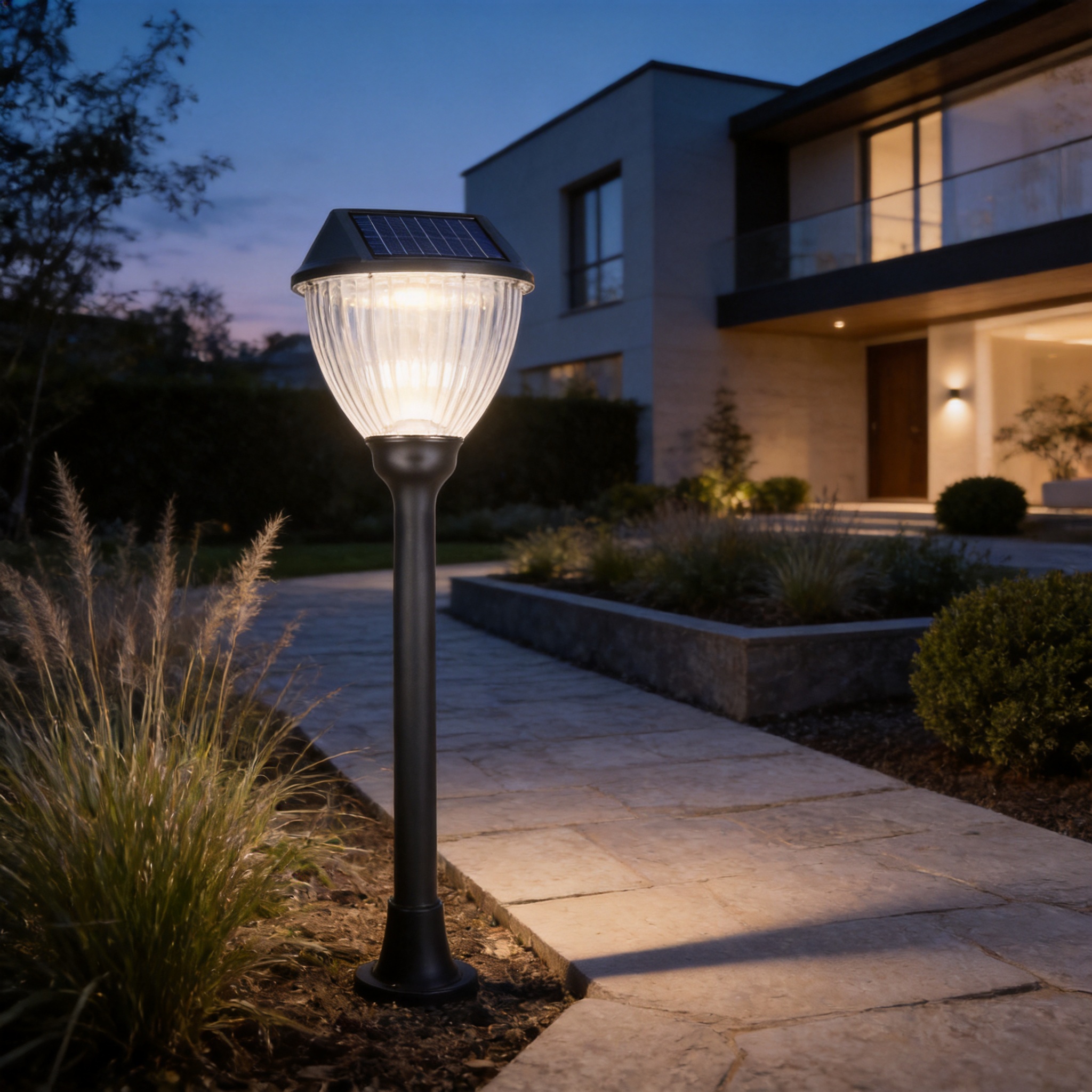
The ZC-TYD1105 can be used in private gardens to improve visibility and create a more attractive outdoor environment after sunset. It may be positioned near pathways, seating areas, lawns, planting beds, entrances, or decorative features. Because it does not require long underground cables, homeowners and landscape contractors can add lighting with less disruption to completed gardens.
Warm color temperatures can help create a comfortable residential atmosphere, while a more neutral or cool appearance may be selected for contemporary properties. The fixture can support both functional and decorative objectives, depending on its location and the distribution of surrounding light.
Parks and Public Landscapes
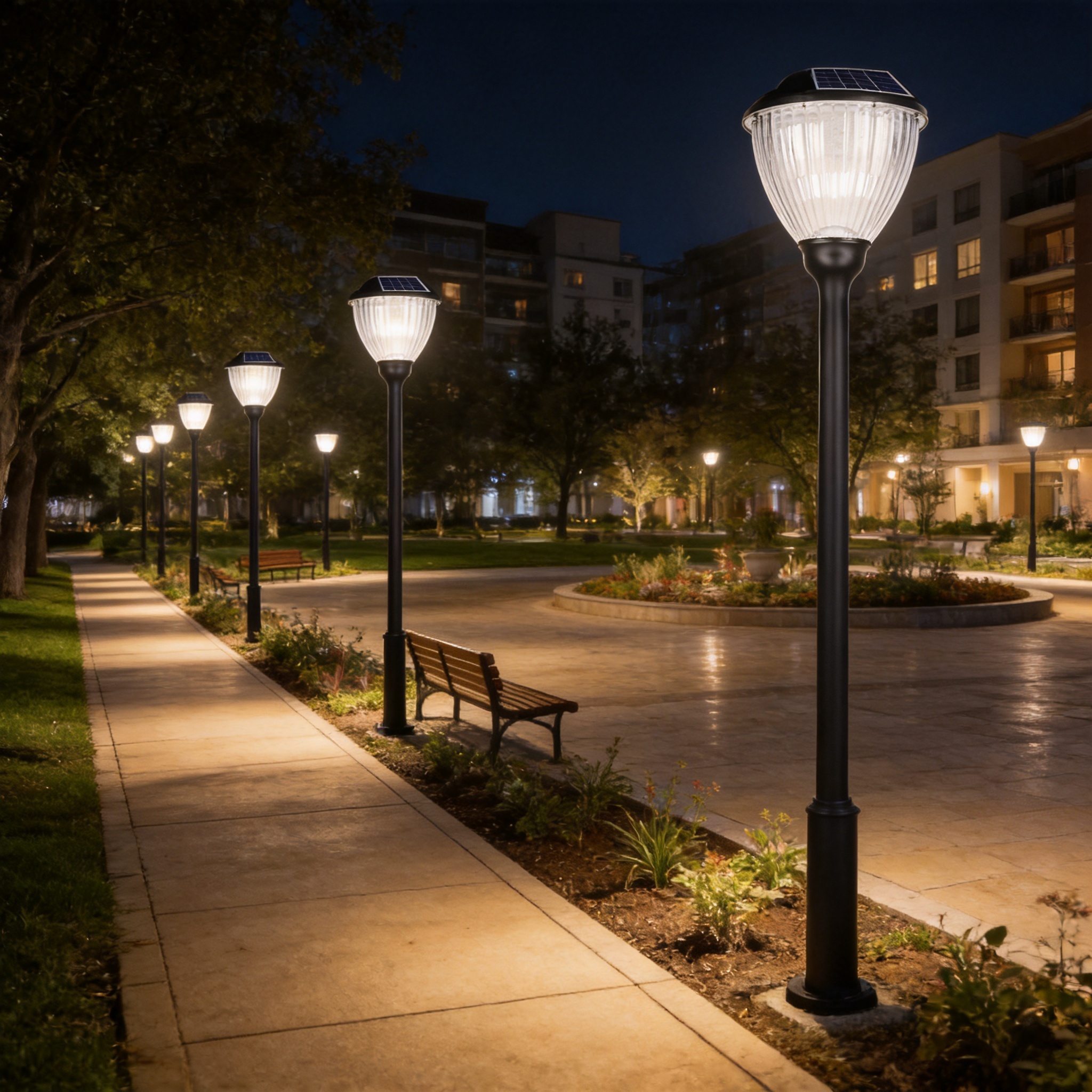
Public parks and landscape areas often contain pathways, open lawns, planting zones, benches, and recreational spaces that require practical nighttime visibility. Solar garden lights can offer a way to add lighting where grid connection is unavailable or where extensive cabling would disturb public landscaping.
For public projects, design teams should consider fixture spacing, pedestrian movement, maintenance access, solar exposure, and the desired relationship between lighting and surrounding architecture or vegetation. A consistent lighting layout can improve visual orientation, while the independent power structure can simplify installation in large or irregularly shaped sites.
Courtyards and Residential Communities
Courtyards, apartment communities, villas, and shared residential spaces can use the ZC-TYD1105 to illuminate internal landscape zones and pedestrian routes. The product can be positioned in areas where residents need basic nighttime visibility without requiring the installation of new grid-connected infrastructure.
Solar garden lighting can be especially attractive in new developments where the landscape plan is still being finalized. Developers and contractors can coordinate fixture placement with pathways and planting designs while avoiding extensive changes to the electrical layout. The fixture may also support a consistent visual identity when multiple units are installed across a community.
Hotels, Resorts, and Hospitality Areas
Hospitality properties often use lighting to influence the appearance and atmosphere of gardens, entrances, terraces, paths, and outdoor gathering spaces. The ZC-TYD1105 can contribute to a welcoming environment while supporting energy-conscious operation.
Color temperature selection is particularly important in hospitality applications. Warm light can help create a relaxed and comfortable mood around outdoor seating and landscape features. The product’s customizable LED options may allow hospitality operators to coordinate the light appearance with their broader interior and exterior design strategy.
Commercial and Landscape Projects
Commercial gardens, office campuses, retail properties, and mixed-use developments may use solar garden lights to improve outdoor presentation and basic visibility. The product can be evaluated for entrance zones, landscaped walkways, courtyards, and decorative areas.
For contractors and project procurement teams, the simplified installation model can support faster deployment. The absence of extensive cabling may also be useful when a project must preserve finished paving or avoid interference with existing utilities. Before large-scale installation, a sample area or pilot installation can help confirm the desired lighting appearance and solar exposure.
Manufacturing Strengths and Engineering Capabilities
Integrated Product Development
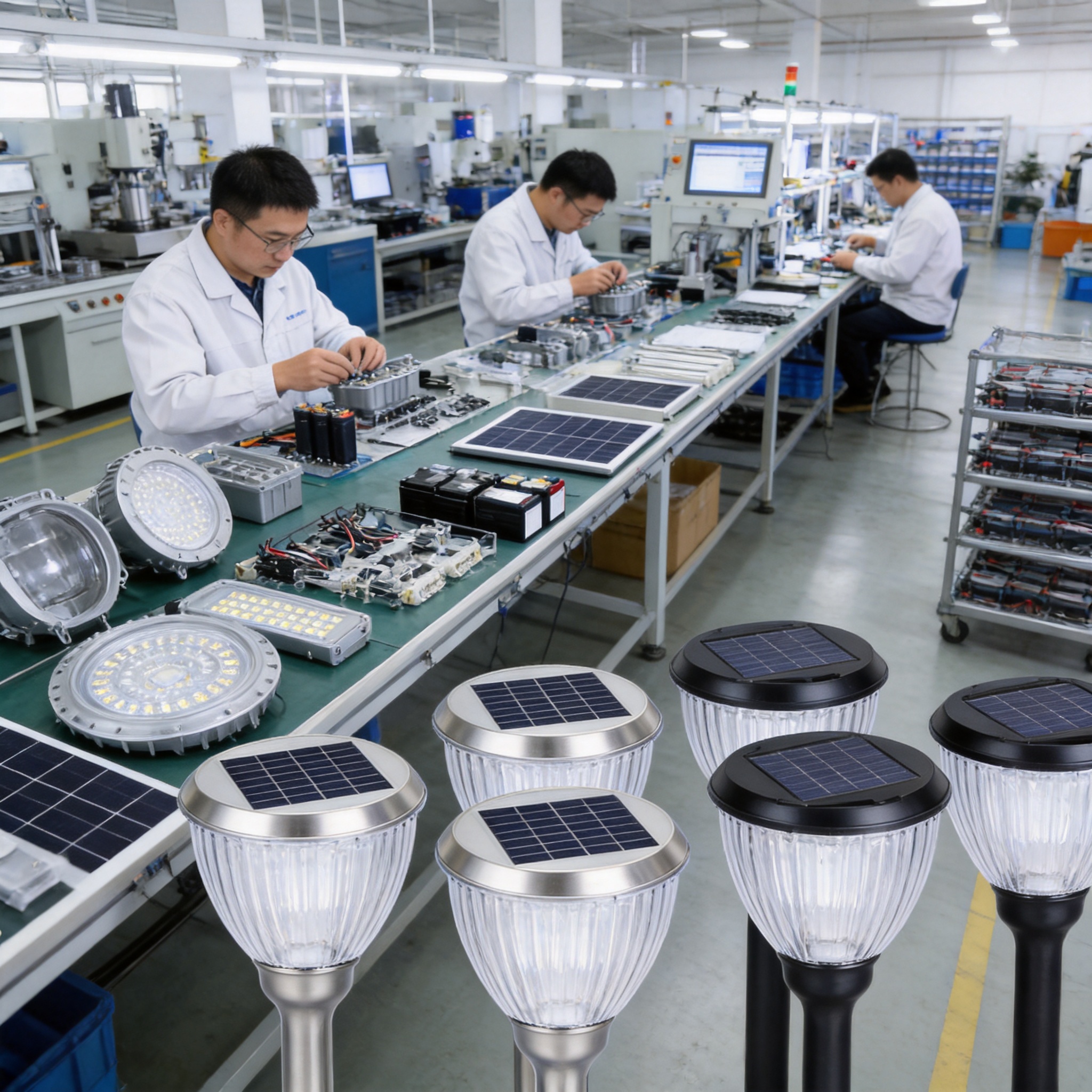
The manufacturer behind the ZC-TYD1105 provides more than a finished lighting fixture. Its capabilities include product design adjustment, LED selection, branding support, mold design, OEM/ODM services, and SKD/CKD customization. These services can help international customers develop products that better match their own markets, technical requirements, and brand identities.
Integrated development is valuable because solar lighting requires coordination between mechanical housing, photovoltaic components, battery storage, LED technology, optical design, and control systems. A supplier with experience across these areas can reduce communication gaps between separate vendors and improve the efficiency of product development.
Customers may request changes to the exterior appearance, material details, LED configuration, color temperature, packaging, labeling, or branding approach. The exact scope of customization depends on technical feasibility, tooling requirements, order quantity, and project objectives. Early communication can help establish realistic development schedules and production expectations.
Die-Casting and CNC Capabilities
Die-casting is an important manufacturing process for producing consistent aluminum lighting housings. It can support repeatable shapes, integrated structural features, and efficient production of components for medium- and large-volume orders. In outdoor lighting, a well-designed die-cast housing can contribute to mechanical durability, heat management, and a professional appearance.
CNC machining can be used for precision processing, finishing, and adjustment of metal parts. CNC equipment supports controlled dimensional accuracy and repeatability, which are important when different components must be assembled together. These capabilities can also assist in the production of customized parts and tooling for OEM or ODM projects.
Combining die-casting with CNC processing allows the manufacturer to control more of the production chain internally. This can improve coordination between design, tooling, machining, assembly, and quality inspection. It may also support faster adjustment when a customer needs a modified housing or a special mechanical detail.
Mold Design and Tooling Support
Lighting products with custom housings often require dedicated molds or tooling. The ability to support mold design can help customers move from a concept or reference design toward a manufacturable product. Tooling quality influences dimensional consistency, surface appearance, assembly accuracy, and production efficiency.
For customers developing a private-label solar garden light, tooling support can be particularly valuable. It enables the product to be differentiated through housing shape, decorative details, mounting structure, or brand-specific visual features. A coordinated process between design and manufacturing can also help identify potential production issues before mass manufacturing begins.
Aging Lines and Product Testing
Lighting products are expected to operate reliably over long periods, and aging processes can help identify certain early-stage performance issues before products are shipped. The manufacturer operates aging lines as part of its production capabilities. Aging and functional testing may be used to evaluate lighting operation, electrical stability, assembly quality, and other relevant characteristics.
Testing should be considered at different stages of the manufacturing process. Incoming material inspection helps verify the quality of key components. In-process inspection can identify assembly or dimensional problems. Final inspection can confirm product appearance, basic operation, labeling, and packaging condition. For solar products, testing may also involve the interaction between the panel, battery, LED system, and control components.
Goniophotometer and Lighting Evaluation
The use of goniophotometers supports professional evaluation of lighting distribution. Such equipment can help measure how light is emitted across different angles and can assist in the development or verification of optical performance. This is relevant when customers need a more controlled lighting pattern for pathways, landscape zones, or architectural applications.
Lighting distribution affects how many fixtures are needed, how far apart they should be installed, and how evenly an area is illuminated. A professional measurement approach can provide more reliable information than visual assessment alone. It can also assist with lighting design and project documentation for customers who require photometric support.
Quality, Certification, and Environmental Responsibility
Management System Certifications
The company reports certification to ISO 9001, ISO 14001, and ISO 45001. These standards relate respectively to quality management, environmental management, and occupational health and safety. Certification does not replace product-specific evaluation, but it indicates that the organization has established formal systems for managing important operational areas.
ISO 9001 can support consistent procedures for product development, purchasing, production, inspection, corrective action, and customer service. ISO 14001 focuses on environmental management and encourages organizations to identify and control environmental impacts. ISO 45001 addresses occupational health and safety practices within the workplace.
For international customers, these management systems may provide additional confidence when evaluating a supplier for long-term cooperation. Buyers should still confirm the specific scope and validity of certifications during the procurement process, especially when a project has special regulatory or documentation requirements.
Product Certifications
The company states that relevant products have CB and CE certifications. These certifications can be important for international sales and market access, although the applicable requirements depend on the destination market, product configuration, and intended use. Customers should verify that the exact ZC-TYD1105 configuration and any customized version are covered by the required technical documentation.
Certification planning should begin early in an OEM or ODM project. Changes to the LED system, battery, control electronics, housing, or power architecture may affect testing and documentation requirements. Coordinating product development with compliance planning can reduce the risk of delays before shipment.
Environmentally Conscious Lighting
Solar operation offers an environmental benefit by using renewable energy collected from sunlight. The product does not need to draw daily operating power from the grid, which may help reduce energy consumption depending on local conditions and system usage. The use of LED technology further supports efficient operation compared with many older light sources.
Environmental performance also depends on the durability and service life of the product. A robust fixture that remains functional for a long period can reduce the frequency of replacement and the material resources associated with repeated production and transport. Responsible manufacturing, proper maintenance, and appropriate end-of-life handling are all relevant to the overall environmental profile.
Advantages Compared with Conventional Garden Lights
Lower Civil Work Requirements
One of the main differences between the ZC-TYD1105 and conventional wired garden lights is the reduced need for electrical infrastructure. Grid-connected systems may require cable trenches, conduit, distribution equipment, and connection points. Solar fixtures integrate energy generation and storage into the lighting product, which can reduce the civil work needed for many installations.
This difference can be especially important in finished landscapes. Digging through paving, lawns, or planting beds may increase project costs and create restoration work. A solar product can help reduce these effects when the site receives sufficient sunlight and the lighting requirements are compatible with the product’s intended use.
Greater Placement Flexibility
A wired garden light is often constrained by the location of cables and electrical outlets. The ZC-TYD1105 can be positioned more independently, provided that the solar panel has adequate exposure. This allows lighting designers to respond more directly to the landscape layout.
Greater placement flexibility can improve the visual balance of a garden or park. Fixtures can be placed near key landscape features, route changes, entrances, and gathering areas without requiring the entire electrical layout to be redesigned. This can also make future expansion easier because additional solar fixtures may be added in suitable locations without extending a central power network.
More Practical for Remote Areas
Remote outdoor areas can be difficult and expensive to connect to the electrical grid. Solar lighting provides a practical alternative for locations such as rural gardens, scenic areas, temporary venues, and distant sections of large properties. The ZC-TYD1105 can be evaluated for these environments because it is designed to operate as an independent lighting unit.
Remote installations still require careful planning for maintenance access, security, sunlight exposure, and weather conditions. However, avoiding long power cables can simplify the overall project and make lighting possible in areas that might otherwise remain unlit.
Flexible Appearance and Customization
Some low-cost solar lights are designed only for basic retail use and provide limited options for customization. The ZC-TYD1105 is supported by OEM and ODM services, which can offer greater flexibility for distributors, contractors, developers, and brand owners.
Customization may include LED selection, color temperature, product styling, branding, packaging, and design adjustments. This allows customers to develop a product that aligns with a particular market segment or project identity. A customized product can also help distributors distinguish their offering from generic fixtures.
Design Considerations for Project Customers
Solar Exposure
The first design consideration is access to sunlight. The solar panel should be installed where it can receive strong direct sunlight for a suitable portion of the day. Trees, roof overhangs, adjacent buildings, walls, and temporary structures should be reviewed before installation.
Sunlight conditions can change as trees grow or as seasonal shadows move across a site. A location that appears suitable in summer may receive less sunlight in winter. A professional site survey can help project teams select positions that offer more consistent charging throughout the year.
Fixture Spacing
Fixture spacing should be determined by the purpose of the lighting, the physical layout of the site, the desired brightness, and the distribution characteristics of the product. Lights intended mainly for decorative effect may be installed differently from lights intended to support pathway visibility.
Spacing that is too wide can create dark areas, while excessive fixture density may increase project costs and produce unnecessary brightness. Photometric data, mock-up installations, and on-site evaluation can support more accurate planning.
Color Temperature
The 3000–6500K range gives project designers several visual options. Warm light is generally associated with comfort and hospitality, while cooler light can create a cleaner or more contemporary appearance. The best selection depends on the surrounding environment and the desired user experience.
Projects should also consider consistency. If solar garden lights are installed near other outdoor fixtures, differences in color temperature may be visually noticeable. Coordinating the solar lights with existing façade, pathway, street, or landscape lighting can create a more unified result.
Maintenance Planning
Although solar lighting reduces wiring and electricity requirements, it is not maintenance-free. The solar panel should be checked periodically for dirt and physical damage. The housing, optical components, and mounting structure should also be inspected for signs of impact, corrosion, looseness, or unusual wear.
Battery performance may gradually change over time. Project owners should establish a maintenance schedule that includes functional checks and cleaning. Early identification of reduced nighttime operation can help prevent larger service issues and maintain consistent lighting quality.
Weather and Environmental Conditions
Outdoor lighting products must be selected according to the local environment. Customers should evaluate temperature ranges, rainfall, humidity, wind, dust, salt exposure, snow, and the risk of physical impact. Coastal locations may require particular attention to corrosion resistance, while industrial areas may present additional air-quality or contamination concerns.
The die-cast aluminum and PC construction provides a suitable material foundation for outdoor use, but product selection should always be matched with the actual conditions of the project. Proper installation, sealing, cleaning, and inspection are important for supporting long-term performance.
OEM and ODM Cooperation
Design Adjustment
Customers may need a garden light that differs from a standard catalog model. The manufacturer can support design adjustments based on project requirements, market preferences, and branding goals. Adjustments may relate to housing details, proportions, mounting arrangements, surface appearance, or decorative features.
A design adjustment project should begin with a clear technical brief. The brief may include target application, operating environment, preferred dimensions, required color temperature, battery expectations, solar conditions, installation method, and applicable certifications. Clear information helps the engineering team assess feasibility and propose suitable solutions.
LED Selection
LED selection can influence brightness, color temperature, efficiency, visual quality, and system power demand. Customers may request a specific light appearance or a particular LED specification for consistency with an existing product family.
When changing the LED configuration, the solar panel and battery should also be reviewed. Increasing the lighting output may increase energy consumption and could require changes to the charging or storage system. An integrated engineering evaluation helps ensure that the customized product remains balanced and reliable.
Branding and Packaging
Brand owners and distributors may benefit from customized logos, labels, product markings, user instructions, cartons, and packaging design. Professional branding can improve product recognition and make the fixture easier to position in a specific market.
Branding should be coordinated with technical labeling and compliance information. Model numbers, electrical specifications, warnings, installation guidance, and certification marks must be presented accurately. A well-organized packaging process can also reduce confusion during distribution and installation.
SKD and CKD Options
SKD and CKD customization can support customers with local assembly, regional distribution, or market-specific production strategies. The exact structure of these arrangements depends on the customer’s facilities, labor capabilities, logistics requirements, and regulatory environment.
Local assembly may provide benefits in selected markets, but it requires clear documentation, component identification, quality standards, and assembly procedures. The manufacturer’s experience with international cooperation can help customers establish a more organized supply chain approach.
Procurement Guidance for Buyers
When evaluating the ZC-TYD1105 for a project, buyers should begin by defining the intended use. Important questions include whether the product is primarily decorative or functional, how long it must operate each night, how much sunlight the site receives, and whether the project requires specific compliance documents.
Buyers should request technical documentation covering the solar panel, battery, LED configuration, dimensions, material construction, charging behavior, operating controls, and installation recommendations. For customized products, the approved specification should be recorded clearly so that samples and mass-production units can be compared against the same requirements.
It is also advisable to confirm packaging, delivery schedule, minimum order requirements, spare-part support, warranty terms, inspection procedures, and after-sales communication. These commercial details can influence the total value of the lighting system just as much as the initial unit price.
For larger projects, a sample or pilot installation can provide useful information. The sample can be reviewed for appearance, brightness, color temperature, charging performance, installation convenience, and compatibility with the landscape. Feedback from the pilot stage can then be used before full-scale deployment.
Installation and Use Recommendations
Before installation, inspect the product and confirm that the components are complete and undamaged. Select a location with good sunlight exposure and avoid areas that remain heavily shaded. Make sure the fixture is positioned securely and that surrounding vegetation will not block the solar panel as it grows.
The product should be installed according to the supplier’s technical instructions and the requirements of the site. Fasteners, foundations, mounting surfaces, and alignment should be checked carefully. Where several units are installed, consistent orientation and spacing can improve the visual quality of the finished project.
After installation, allow the solar system to charge under suitable daylight conditions before assessing nighttime performance. Initial evaluation should consider both the lighting appearance and the charging environment. If performance varies, inspect the panel for shading, dirt, incorrect orientation, or nearby obstructions.
Routine maintenance should include cleaning the solar panel, checking the housing, inspecting mounting points, and observing nighttime operation. Any damaged component should be handled by qualified personnel. Customers should avoid unauthorized modifications that could affect safety, charging behavior, or certification status.
Why This Product Is a Strong Choice for Outdoor Projects
The ZC-TYD1105 offers a practical combination of solar independence, integrated energy storage, durable material selection, broad color temperature flexibility, and a substantial LED chip configuration. Its design is suited to customers who want dependable basic outdoor lighting without the cost and disruption associated with extensive grid-connected infrastructure.
Its value is further strengthened by the manufacturing capabilities available behind the product. Die-casting, CNC machining, mold design, aging lines, goniophotometric evaluation, quality management systems, and OEM/ODM support provide a foundation for both standard supply and customized development.
Compared with generic solar garden lights that may offer limited engineering support, the ZC-TYD1105 can be considered as part of a broader professional lighting solution. Customers can obtain a product for immediate use, request adjustments for a specific market, or collaborate on a customized lighting program for a larger landscape project.
The product is not intended to replace every type of outdoor lighting. Site conditions, lighting goals, sunlight availability, and local regulations must always be considered. However, for gardens, parks, courtyards, communities, hospitality landscapes, and similar environments, it provides a balanced solution that combines practical installation with renewable energy operation.
Questions and Answers
What is the main purpose of the ZC-TYD1105?
The ZC-TYD1105 is an outdoor solar garden light designed to provide basic nighttime illumination for gardens, parks, courtyards, landscape areas, residential communities, and similar outdoor environments.
Does the product require a grid connection?
No. The fixture is designed as a standalone solar lighting product. Its solar panel collects energy during the day, and the integrated battery stores energy for nighttime operation.
What materials are used in the product?
The product uses die-cast aluminum and PC. These materials support structural strength, outdoor suitability, design flexibility, and potential heat-management requirements for the lighting system.
What is the solar panel specification?
The solar panel specification is 5V/28W. Actual charging performance depends on sunlight exposure, weather, panel orientation, shading, and other environmental conditions.
What is the battery capacity?
The product uses a 3.2V/36000mAh battery. The battery stores energy collected from the solar panel for use by the LED system after dark.
How many LED chips does the product include?
The ZC-TYD1105 includes 160 LED chips. The final lighting distribution depends on the LED configuration, optical design, control system, and installation arrangement.
What color temperatures are available?
The stated color temperature range is 3000–6500K. This allows customers to select warmer or cooler light characteristics according to the intended application and design preference.
How long does charging take?
The stated charging time is approximately 3–5 hours under suitable conditions. Actual charging time can vary depending on sunlight intensity, weather, season, shading, and installation orientation.
Where can this solar garden light be installed?
It can be considered for residential gardens, parks, courtyards, pathways, landscape zones, hospitality areas, commercial properties, residential communities, and other outdoor locations with adequate solar exposure.
Can the product be customized?
Yes. OEM and ODM support includes design adjustment, LED selection, and branding support. Customers can discuss additional requirements such as appearance, packaging, labeling, and project-specific configurations.
Does the manufacturer support large projects?
The manufacturer provides lighting products and related engineering services for industrial, residential, municipal, and commercial projects. Customers can discuss product quantities, technical requirements, photometric needs, customization, and delivery planning.
What manufacturing capabilities support this product?
Relevant capabilities include die-casting, CNC machining, mold design, aging lines, goniophotometers, product assembly, inspection, OEM/ODM development, and SKD/CKD customization.
What should customers check before installation?
Customers should check solar exposure, shading, installation position, fixture spacing, mounting stability, environmental conditions, and compatibility with the intended lighting purpose. The solar panel should have access to sufficient daylight.
How should the product be maintained?
Maintenance should include periodic cleaning of the solar panel, inspection of the housing and mounting structure, checking for damage or looseness, and observing nighttime operation. Maintenance procedures should follow the supplier’s instructions.
Is the product suitable for every climate?
The product is designed for general outdoor use, but project teams should evaluate local temperature, rain, humidity, wind, dust, salt exposure, snow, and other environmental factors. The installation should be matched to the actual site conditions.
Conclusion
The Outdoor Solar Garden Light ZC-TYD1105 is a versatile solution for customers seeking independent, energy-conscious, and easy-to-install lighting for outdoor landscapes. Its 5V/28W solar panel, 3.2V/36000mAh battery, 160 LED chips, die-cast aluminum and PC construction, and 3000–6500K color temperature range provide a practical specification for a wide variety of garden and landscape applications.
Its advantages extend beyond the product specifications. The fixture can reduce cabling and civil work, provide greater placement flexibility, and support lighting projects in locations where grid access is difficult. The manufacturer’s die-casting, CNC, mold design, testing, certification, and customization capabilities further support reliable supply and professional project cooperation.
For distributors, contractors, developers, landscape designers, and brand owners, the ZC-TYD1105 can serve as both a standard solar garden-lighting product and a starting point for customized development. With appropriate site planning, installation, and maintenance, it can contribute to safer, more attractive, and more energy-conscious outdoor environments.
References
1. International Organization for Standardization. ISO 9001 Quality Management Systems: Requirements.
2. International Organization for Standardization. ISO 14001 Environmental Management Systems: Requirements with Guidance for Use.
3. International Organization for Standardization. ISO 45001 Occupational Health and Safety Management Systems: Requirements with Guidance for Use.
4. International Electrotechnical Commission. General guidance for photovoltaic energy conversion and solar power system design.
5. International Electrotechnical Commission. LED lighting performance, safety, and electromagnetic compatibility principles.
6. Illuminating Engineering Society. Recommended practices for outdoor and landscape lighting design.
7. Cixi HuaSheng Lighting Co., Ltd. Product specifications and manufacturing capability information for the ZC-TYD1105 Outdoor Solar Garden Light.
Product: Outdoor Solar Garden Light ZC-TYD1105

YQF Group - World Leading One-Stop Lighting & Solar For the Global Partners
Custom & OEM Solutions for Global Lighting Brands
Copyright © Cixi HuaSheng Lighting Co., Ltd. All Rights Reserved.
Die-Casting Mould Supplier
