 English
 中文简体
 русский
 Français
 Español
 عربى
 Indonesia

Triple-Dimming-Mode LED Driver for Advanced Outdoor and Industrial Lighting
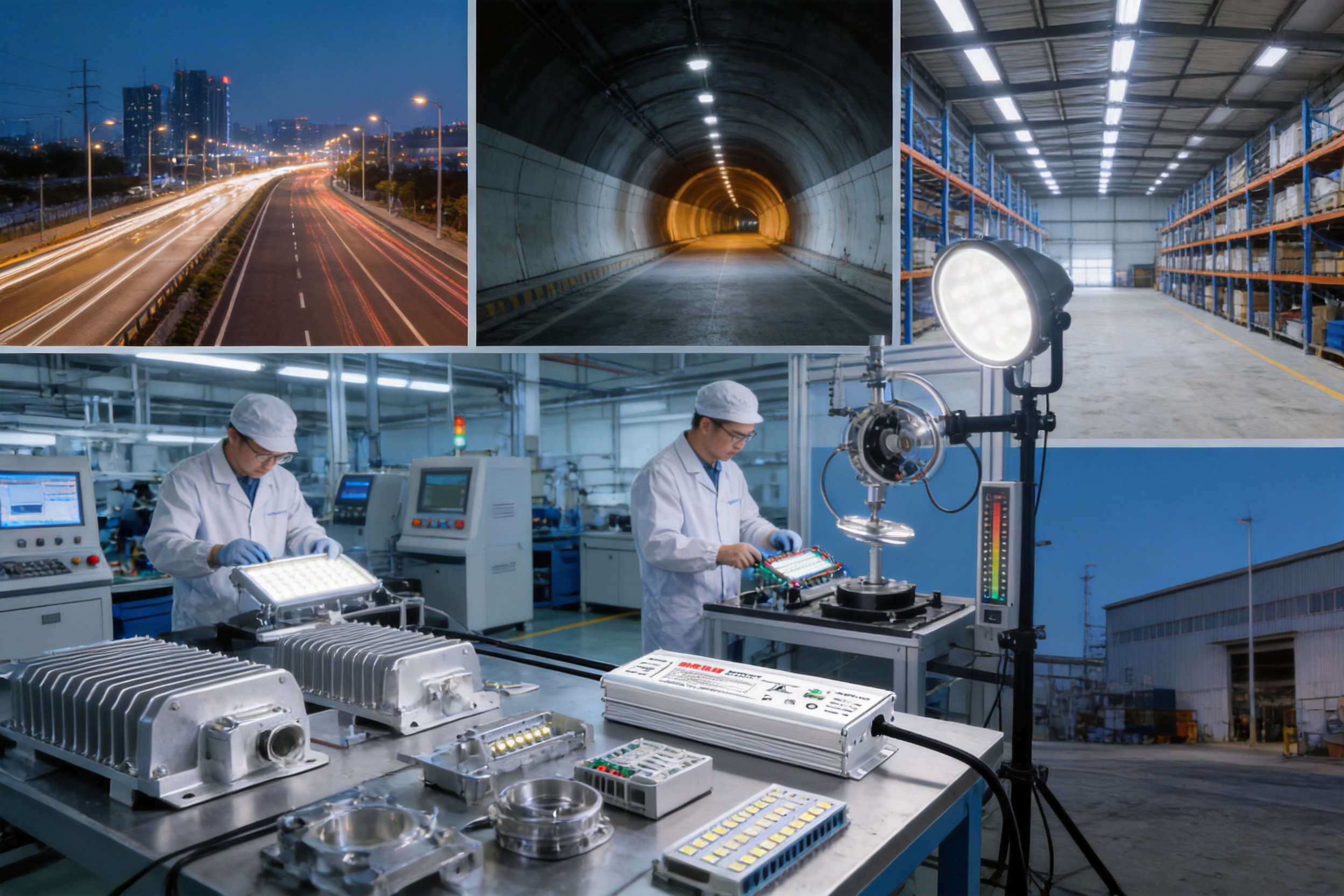
Modern outdoor and industrial lighting systems require more than a basic power conversion device. They need stable current regulation, broad electrical compatibility, reliable thermal performance, flexible dimming, long service life, and practical tools for commissioning and maintenance. The Triple Dimming Modes LED Driver X6I is designed to address these requirements in one programmable platform. It combines isolated constant-power output, offline current programming, three-in-one dimming, light-decay compensation, and work-log recording for demanding road lighting, industrial illumination, and other high-performance LED applications.
Available in power ratings from 75 W to 320 W, the X6I platform supports a wide selection of LED modules and system architectures. Its model range includes low-voltage, high-current versions as well as high-voltage, low-current versions. This flexibility allows lighting manufacturers, project engineers, and OEM/ODM customers to select a driver that closely matches the electrical characteristics of the luminaire rather than forcing every application into a single output configuration.
The driver is intended for projects where dependable performance matters over long operating periods. Outdoor luminaires can experience voltage variation, temperature changes, extended operating hours, and changing illumination requirements. Industrial installations may also demand precise control, robust construction, and straightforward field configuration. By combining a wide 110–305 Vac input range with programmable output current and multiple dimming methods, the X6I provides a practical foundation for intelligent LED lighting systems.
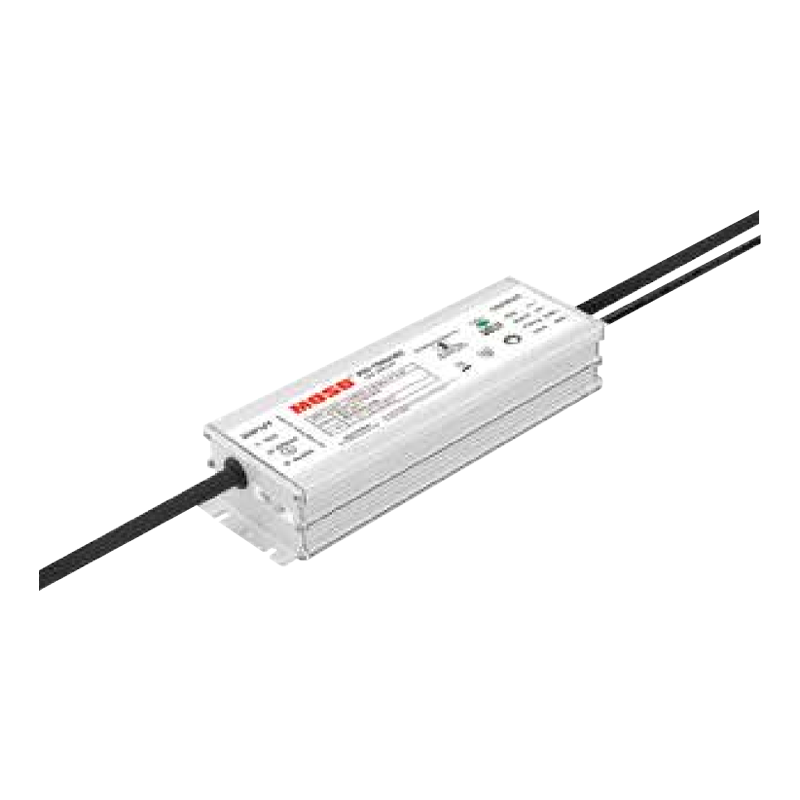
Triple Dimming Modes LED Driver (BIS) X6I
Why the LED Driver Is Central to Lighting Performance
An LED luminaire is only as reliable as the relationship between its light source, thermal design, optics, and driver. The driver determines how efficiently electrical energy is converted into regulated LED power. It also influences light stability, system lifetime, dimming quality, protection against electrical disturbances, and the ability to adapt a product to different projects.
In a conventional fixed-output arrangement, the driver may be selected for one current and one operating condition. That approach can work for standardized products, but it may limit flexibility when LED modules change, when a project requires different lumen levels, or when lighting authorities request a revised operating schedule. Replacing the driver or redesigning the luminaire can increase cost and extend the project timeline.
A programmable driver offers a more adaptable alternative. Current can be configured to suit the selected LED module, while dimming functions can be matched to the control system used by a road, industrial, municipal, or commercial project. This reduces the need to maintain many separate driver designs and helps lighting manufacturers develop multiple luminaire outputs from a common platform.
The X6I addresses these requirements through offline programmability. Current settings can be configured before installation, allowing manufacturers and project integrators to prepare the driver according to the target luminaire and operating plan. Offline adjustment is particularly valuable when a lighting system does not have a permanent digital network or when installers need to configure equipment efficiently before deployment.
The result is a driver platform that supports both product standardization and application customization. A manufacturer can design several luminaires around the same family while selecting different power and output-current combinations. A project engineer can also choose a suitable model based on LED voltage, current, wattage, dimming method, and physical space.
Core Advantages of the X6I Platform
Wide Input Voltage Compatibility
The X6I is designed for an input range of 110–305 Vac. This broad operating range helps the driver accommodate electrical systems with different nominal voltages and variations in supply conditions. It is suitable for many international project environments where grid characteristics are not identical.
Wide input capability is important in outdoor lighting because luminaires may be installed across large areas, along roads, in industrial parks, or in infrastructure projects where feeder conditions vary. A driver with a narrow input range may be more vulnerable to abnormal operating conditions or may require additional system planning. The X6I provides greater tolerance at the driver level, helping simplify product selection for regional applications.
Voltage stability also supports consistent luminaire behavior. When the input voltage changes within the specified range, the driver is designed to maintain regulated LED operation rather than allowing the light output to fluctuate significantly. This contributes to visual comfort, predictable energy consumption, and more dependable system operation.
Isolated Constant-Power Output
Isolation separates the input side from the output side of the power supply, supporting safer and more controlled system architecture. The X6I uses isolated constant-power output to regulate energy delivered to the LED load. This design is especially useful for outdoor and industrial luminaires, where long service life, electrical robustness, and system safety are major considerations.
Constant-power operation allows the driver to work across a defined output voltage range while maintaining the intended power level. This is valuable when LED modules have different forward-voltage characteristics or when a product family includes multiple module arrangements. Instead of restricting the luminaire to a single narrow electrical point, the driver can accommodate a broader operating window within the selected model’s limits.
The combination of isolation and constant-power regulation gives designers greater freedom when developing luminaires. It can help simplify the interface between the driver and LED board, support more consistent performance, and provide a stronger foundation for product customization.
Offline Current Programming
LED current directly affects light output, power consumption, thermal load, and long-term component stress. The X6I provides an adjustable full-power current range for every model family, allowing current to be configured according to the selected LED module and target application.
Offline programming is useful during production, quality control, and installation preparation. A luminaire manufacturer can set a current value before the fixture leaves the factory. This supports repeatable production and enables different lumen packages to be created using related hardware. It can also help installers prepare equipment without requiring a complex online communication network.
For OEM and ODM projects, current programmability provides an additional level of design freedom. Customers may require a specific output current for regional standards, a particular LED package, a target lumen level, or a defined thermal operating point. The X6I platform can be adapted to these requirements within the available model ranges.
Three-in-One Dimming
The driver supports three principal dimming methods: 0/1–10 V control, PWM control, and time-based control. These methods address different project requirements and allow the same driver family to serve a wide range of control architectures.
0/1–10 V dimming is widely used in lighting control systems because it provides an intuitive analog signal for adjusting output. It can be integrated with control panels, sensors, building management systems, or lighting management equipment that supports analog dimming.
PWM dimming provides another method of controlling perceived LED output. It can be useful where a control system already uses pulse-width modulation or where a project requires compatibility with a particular dimming interface. The exact system design should consider the controller, wiring arrangement, LED load, and project requirements.
Time control supports scheduled dimming without requiring continuous manual adjustment. Road lighting systems can reduce output during periods of lower traffic, while industrial or commercial installations can align lighting levels with operating hours. Time-based control helps reduce unnecessary energy use while retaining the required level of illumination when activity is highest.
Offering these three modes in one driver provides an advantage over single-method products. Lighting manufacturers do not need to create entirely different driver platforms for every control requirement. Project planners can also select the most appropriate dimming strategy without changing the basic driver architecture.
Light-Decay Compensation
LED light output gradually changes over the service life of the light source. Although LED technology provides a long operating life, lumen depreciation remains an important consideration in roadway, industrial, and infrastructure lighting. A luminaire that operates at its maximum initial output may deliver more light than necessary at the beginning of its life, while a fixed-output system may provide less illumination after years of operation.
Light-decay compensation helps address this difference by supporting a more controlled relationship between operating current and expected light output over time. By managing the light level according to the intended maintenance strategy, a project can work toward more consistent illumination throughout the service period.
This function may assist designers in balancing initial energy consumption, required illumination, and long-term performance. It is particularly relevant to projects with defined maintenance intervals, lighting-level requirements, or energy-saving targets.
Work-Log Recording
Work-log recording adds a service and management dimension to the driver. Operational information can assist with maintenance planning, troubleshooting, commissioning records, and product traceability. In large lighting projects, knowing how equipment has operated can help maintenance teams evaluate performance and identify unusual conditions.
Recording operational information is especially valuable when luminaires are installed across extensive roads, industrial sites, campuses, or municipal areas. Service personnel can use available records as part of a broader maintenance process rather than relying only on visual inspection or installation documents.
The work-log function also supports more disciplined project management. Manufacturers and integrators can document commissioning activities, while operators can use driver information when reviewing the condition of a luminaire or planning replacement work.
Model Range and Electrical Selection
The X6I family covers several power levels and output configurations. The product range extends from 75 W to 320 W, enabling use in compact outdoor luminaires, medium-power road lights, industrial fixtures, and higher-output lighting equipment.
| Model | Power | Output Voltage Range | Adjustable Full-Power Current | Typical Efficiency | Typical Power Factor | Dimensions |
| X6I-075Y062 | 75 W | 38–62 Vdc | 1.21–1.88 A | 89.00% | 0.96 | 129 × 68 × 37 mm |
| X6I-075Y108 | 75 W | 54–108 Vdc | 0.70–1.05 A | 90.00% | 0.96 | 129 × 68 × 37 mm |
| X6I-105Y062 | 105 W | 38–62 Vdc | 1.69–2.50 A | 91.00% | 0.97 | 154 × 68 × 37 mm |
| X6I-105Y150 | 105 W | 75–150 Vdc | 0.70–1.05 A | 92.00% | 0.97 | 154 × 68 × 37 mm |
| X6I-150Y062 | 150 W | 38–62 Vdc | 2.42–3.60 A | 91.00% | 0.96 | 174 × 68 × 37 mm |
| X6I-150Y214 | 150 W | 107–214 Vdc | 0.70–1.05 A | 92.00% | 0.97 | 174 × 68 × 37 mm |
| X6I-200Y062 | 200 W | 38–62 Vdc | 3.23–5.00 A | 92.00% | 0.97 | 194 × 68 × 39 mm |
| X6I-200Y286 | 200 W | 143–286 Vdc | 0.70–1.05 A | 92.00% | 0.97 | 194 × 68 × 39 mm |
| X6I-240Y062 | 240 W | 38–62 Vdc | 3.88–5.71 A | 92.00% | 0.97 | 209 × 68 × 39 mm |
| X6I-240Y343 | 240 W | 171–343 Vdc | 0.70–1.05 A | 93.50% | 0.97 | 209 × 68 × 39 mm |
| X6I-320Y457 | 320 W | 228–457 Vdc | 0.70–1.10 A | 94.00% | 0.97 | 231 × 98 × 42 mm |
The model naming structure reflects different power and output-voltage arrangements. The Y062 versions are designed for relatively low output-voltage and higher-current applications. These models are suitable where the LED assembly requires a voltage within approximately 38–62 Vdc. Other versions provide higher output-voltage ranges with lower operating current, which can be useful for LED arrays arranged in longer series strings.
Selection should begin with the LED module’s required voltage and current, followed by the target power, luminaire enclosure, thermal environment, and control method. The selected operating point should remain within the stated output range and should be evaluated together with the LED board’s forward-voltage tolerance and temperature characteristics.
Detailed Performance by Power Class
75 W Models
The 75 W models provide a compact solution for lower-power outdoor and industrial luminaires. The X6I-075Y062 operates from 38–62 Vdc with an adjustable full-power current range of 1.21–1.88 A. Its default output is specified as 38–53 V at 1.40 A. The X6I-075Y108 supports 54–108 Vdc and provides a 0.70–1.05 A adjustment range, with a default output of 54–108 V at 0.70 A.
Both 75 W models use a 129 × 68 × 37 mm housing. Their compact dimensions can help designers allocate space for the driver inside relatively small luminaires. Typical efficiency is 89.00% for the low-voltage model and 90.00% for the higher-voltage model, while typical power factor is 0.96 for both versions.
105 W Models
The 105 W range includes a low-voltage, higher-current version and a higher-voltage, lower-current version. The X6I-105Y062 provides 38–62 Vdc output with adjustable current from 1.69–2.50 A. Its default output is 38–50 V at 2.10 A. The X6I-105Y150 supports 75–150 Vdc and offers 0.70–1.05 A adjustment, with a default output of 75–100 V at 1.05 A.
Both versions measure 154 × 68 × 37 mm. Typical efficiency reaches 91.00% for the Y062 version and 92.00% for the Y150 version. Both models have a typical power factor of 0.97, supporting efficient use of input power in appropriately designed systems.
150 W Models
The 150 W models are suitable for medium-output street lights, industrial fixtures, and other luminaires requiring increased LED power. The X6I-150Y062 operates between 38 and 62 Vdc and provides an adjustable current range of 2.42–3.60 A. Its default output is 38–47 V at 3.15 A.
The X6I-150Y214 is intended for a higher-voltage LED arrangement, with an output range of 107–214 Vdc and a current adjustment range of 0.70–1.05 A. Its default output is 107–214 V at 0.70 A. Both models use a 174 × 68 × 37 mm housing. Typical efficiency is 91.00% for the Y062 version and 92.00% for the Y214 version.
200 W Models
The 200 W models extend the platform for higher-output luminaires. The X6I-200Y062 supports 38–62 Vdc and provides a current adjustment range of 3.23–5.00 A. The default output is 38–41 V at 4.90 A, making this version suitable for low-voltage LED assemblies requiring substantial current.
The X6I-200Y286 supports a 143–286 Vdc output range with an adjustable current of 0.70–1.05 A. Its default output is 143–286 V at 0.70 A. Both models measure 194 × 68 × 39 mm and have a typical efficiency of 92.00% and a typical power factor of 0.97.
240 W and 320 W Models
The 240 W class includes the X6I-240Y062, which operates at 38–62 Vdc with a 3.88–5.71 A adjustable current range. Its default output is 38–48 V at 5.00 A. The X6I-240Y343 provides a much higher output-voltage range of 171–343 Vdc, with a current adjustment range of 0.70–1.05 A and a default output of 171–343 V at 0.70 A.
Both 240 W models measure 209 × 68 × 39 mm. Typical efficiency is 92.00% for the Y062 model and 93.50% for the Y343 model. Both have a typical power factor of 0.97.
The highest-rated model is the X6I-320Y457. It delivers 320 W, supports 228–457 Vdc output, and provides an adjustable current range of 0.70–1.10 A. Its default output is 228–304 V at 1.05 A. Typical efficiency is 94.00%, and typical power factor is 0.97. Measuring 231 × 98 × 42 mm, this model is intended for luminaires with sufficient internal volume and thermal capacity.
Efficiency and Energy Management
Energy efficiency is a major consideration in outdoor and industrial lighting because luminaires may operate for many hours each day. Even small efficiency differences can influence annual energy consumption, thermal load, and system operating cost when multiplied across hundreds or thousands of fixtures.
The X6I models provide typical efficiency values from 89.00% to 94.00%, depending on the power class and output configuration. Higher-voltage models generally show strong efficiency figures within the listed range, with the 320 W model reaching a typical 94.00%. Efficient conversion reduces the amount of input energy lost as heat and can support more manageable thermal design.
Lower driver losses may also benefit the complete luminaire. When less heat is generated inside the enclosure, the LED board and other components may operate under more favorable thermal conditions. However, driver efficiency should always be evaluated together with luminaire ventilation, housing material, ambient temperature, LED efficiency, and installation conditions.
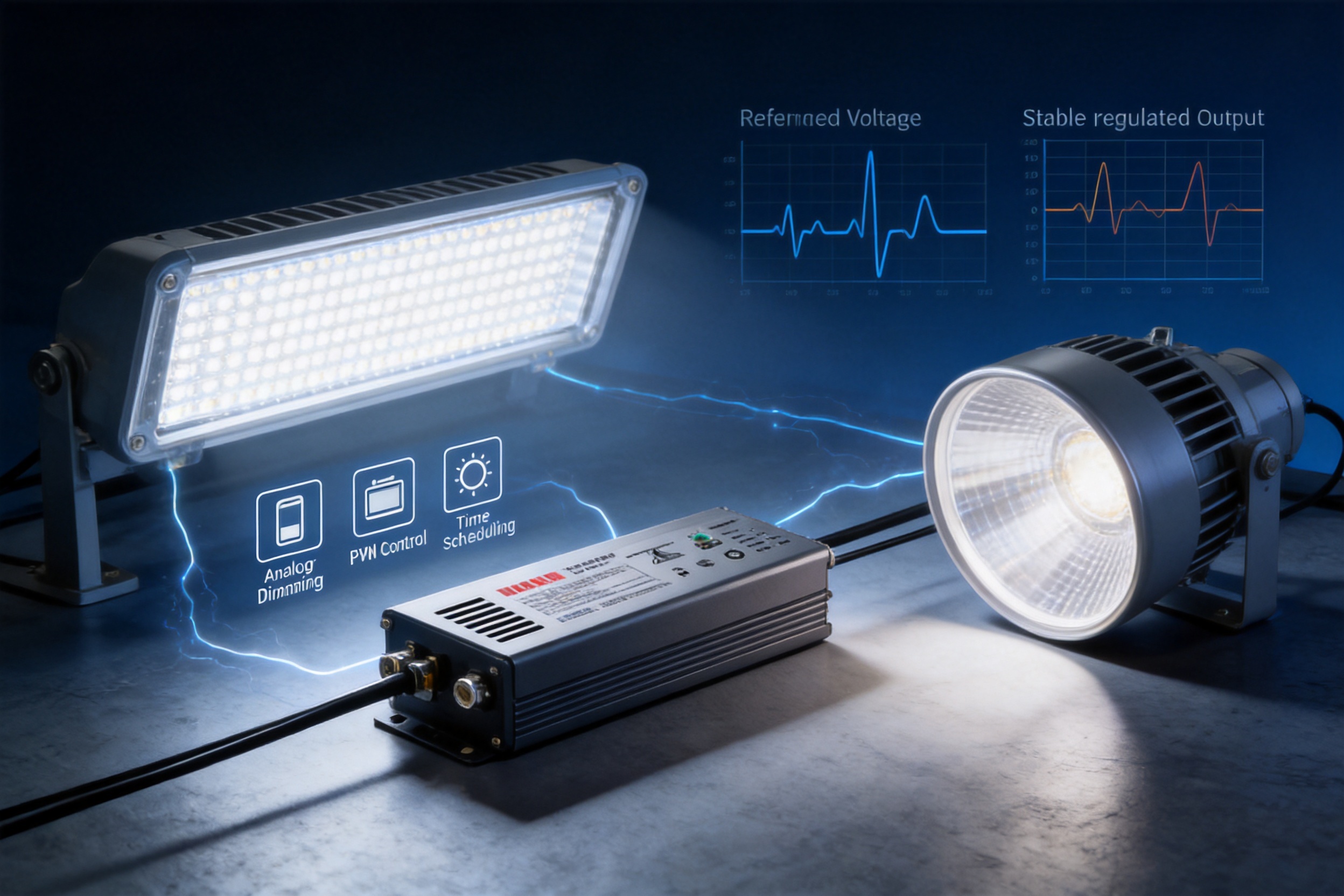
Dimming further supports energy management. A luminaire does not always need to operate at full output. Time-based control can reduce the operating level during lower-demand periods, while 0/1–10 V or PWM control can respond to a central lighting system or local control strategy. Combining efficient conversion with controlled output can reduce energy use without requiring a complete replacement of the luminaire.
Power Factor and System Compatibility
The X6I range provides typical power-factor values from 0.96 to 0.97. A high power factor indicates that the driver makes effective use of the incoming electrical supply under the stated test conditions. This can be important in installations with many luminaires operating simultaneously.
Power factor is relevant to project planning because it can influence current demand, distribution equipment, and the overall electrical behavior of a lighting installation. A driver with a strong typical power factor can help designers develop more efficient power-distribution arrangements, although the complete installation should still be evaluated according to local electrical standards and actual operating conditions.
For industrial facilities, roadway projects, and municipal installations, the driver’s input characteristics should be considered together with circuit protection, cable length, feeder capacity, control equipment, and surge-protection design. The X6I provides a strong platform, but correct system engineering remains essential for achieving dependable field performance.
Advantages Over Conventional Single-Function Drivers
Broader Application Coverage
A fixed-current driver may be suitable for one LED module, but it can become restrictive when a product line includes several wattages or LED configurations. The X6I range covers multiple power classes and voltage arrangements, allowing manufacturers to select a suitable model without changing the overall design concept.
This broad coverage can simplify product development and procurement. Instead of maintaining separate platforms with unrelated control interfaces, a manufacturer can build a family of luminaires around a driver series with common functional principles.
More Flexible Dimming Integration
Single-mode drivers can create compatibility problems when a project changes its control strategy. A luminaire designed for one dimming input may require a new driver if the customer later requests scheduled control or a different analog interface. The X6I reduces this limitation by integrating 0/1–10 V, PWM, and time-control functions into one platform.
This flexibility is valuable for export products because regional markets may favor different control methods. It is also valuable for project tenders, where the final control architecture may not be fully defined at the beginning of product development.
Greater Production and Commissioning Flexibility
Offline programming allows current configuration before the driver is installed. This is more practical than relying on a permanent online connection for every adjustment. It can help production teams create repeatable settings, support quality checks, and prepare different output versions without redesigning the entire luminaire.
For installers, preconfigured drivers can reduce commissioning time. For OEM/ODM customers, programmable current and configurable dimming logic can support customized product specifications while retaining a common hardware platform.
Improved Long-Term Lighting Strategy
Light-decay compensation and work-log recording distinguish the X6I from basic drivers that only provide power conversion. These functions address the operational life of the lighting system rather than only its initial installation.
A modern lighting project should be evaluated over its entire service period. The initial lumen level, scheduled dimming, maintenance approach, energy consumption, and expected aging of the LED source all influence the real value of the installation. The X6I supports a more complete approach by combining power delivery, control, compensation, and operational information.
Applications in Outdoor Lighting
Road and Street Lighting
Road lighting is one of the most suitable applications for a driver with flexible output control. Streets may require full illumination during evening traffic peaks and reduced output during late-night periods. Time control and programmable current can support these schedules while helping maintain an appropriate balance between visibility and energy consumption.
The wide input range is also useful for roadway networks with varying electrical conditions. Different pole circuits and distribution sections may have different nominal voltages or voltage behavior. Selecting a suitable X6I model can simplify deployment across a broader project area.
Light-decay compensation can support long-term maintenance planning. Instead of treating the initial light level as the only performance target, project managers can consider how the luminaire will operate as the LED source ages. Work-log recording can also assist in organizing maintenance across large numbers of fixtures.
Tunnel and Underpass Lighting
Tunnels and underpasses often require controlled transitions between different lighting levels. External daylight, traffic conditions, and operating schedules can affect the required output. A driver supporting analog, PWM, and time-based control gives system designers more choices when developing tunnel-lighting control strategies.
The appropriate model depends on the LED module voltage, fixture power, enclosure size, and thermal environment. Because the X6I range includes both low-voltage high-current and high-voltage low-current configurations, designers can match the driver to different LED array architectures.
Industrial Area Lighting
Industrial sites may include warehouses, loading areas, factories, logistics yards, and process facilities. These environments often require long operating hours, predictable illumination, and the ability to adjust light output according to work shifts or occupancy patterns.
The X6I can support high-bay and area-lighting designs within its power range. Time control can align lighting output with production schedules, while 0/1–10 V or PWM control can integrate with sensors and facility management systems when required. The driver’s programmable current range also helps manufacturers create different lumen packages for various mounting heights and beam distributions.
Architectural and Facade Lighting
Facade and architectural lighting may require different output levels for normal operation, special events, or late-night energy reduction. The three-in-one dimming capability can provide a practical control foundation for these changing requirements.
For facade fixtures, mechanical dimensions are often important because the driver must fit into a narrow housing or remote enclosure. The various X6I dimensions allow designers to compare available internal space with the required power and output configuration before finalizing the luminaire architecture.
Manufacturing Strengths and Engineering Capabilities
The manufacturer behind the X6I is an outdoor lighting specialist based in Ningbo, China. Its business covers LED street lights, tunnel lights, high-bay lights, linear lights, garden lights, solar lights, grow lights, explosion-proof lights, and related lighting products. This product breadth gives the company practical experience in the electrical, mechanical, optical, and environmental demands of professional lighting equipment.
The company operates with die-casting and CNC machining equipment, aging lines, and goniophotometers. These capabilities support a more complete manufacturing process, from mechanical components and tooling to electrical aging and photometric verification.
Die-Casting and CNC Manufacturing
Die-casting is widely used for producing strong, repeatable aluminum lighting housings and heat-dissipation components. A well-designed die-cast structure can support mechanical strength, consistent dimensions, and efficient thermal transfer. For outdoor luminaires, the housing also contributes to protection against environmental exposure and helps maintain the intended relationship between the LED board, optics, and driver.
CNC machining provides controlled processing for components that require precise dimensions, mounting interfaces, threaded features, or finishing operations. The combination of die-casting and CNC capability helps the manufacturer manage both high-volume production and application-specific mechanical requirements.
These processes are particularly valuable for OEM and ODM customers. A customer may require a customized housing, a modified mounting arrangement, or a specific interface for an installation project. In-house or closely managed tooling and machining capability can improve communication between design and production teams.
Tooling and Die-Casting Mould Development
Lighting products frequently require custom molds for housings, brackets, covers, and heat sinks. Mold design influences product appearance, structural integrity, manufacturing consistency, and thermal performance. The company provides die-casting mould design and manufacturing as part of its broader service offering.
For a customer developing a new luminaire around the X6I platform, coordinated mechanical and electrical development can reduce integration risks. The driver dimensions, mounting positions, ventilation strategy, and LED heat path can be considered together rather than being treated as separate tasks.
Aging and Reliability-Oriented Production
Aging lines are used to operate products or components under controlled conditions before shipment. This process can help identify early failures and verify that equipment performs consistently after a defined operating period. For LED luminaires and drivers, aging is an important part of production quality management because the products may operate for extended periods in the field.
Aging should be combined with incoming-material inspection, process control, electrical testing, visual inspection, and final functional verification. The manufacturer’s production resources provide a foundation for applying these controls across different lighting categories.
Photometric Testing
Goniophotometers are used to measure the distribution of light from a luminaire. Photometric data supports beam-angle evaluation, luminous intensity measurements, efficiency analysis, and lighting design calculations. This is important when a luminaire is intended for road lighting, industrial spaces, facades, or municipal projects.
Photometric capability also supports DIALux design services. By using measured luminaire data, engineers can develop lighting layouts that consider mounting height, spacing, road width, target illuminance, uniformity, and energy consumption. This allows the lighting product and the project design to be evaluated as a complete system.
Quality Systems and Project Support
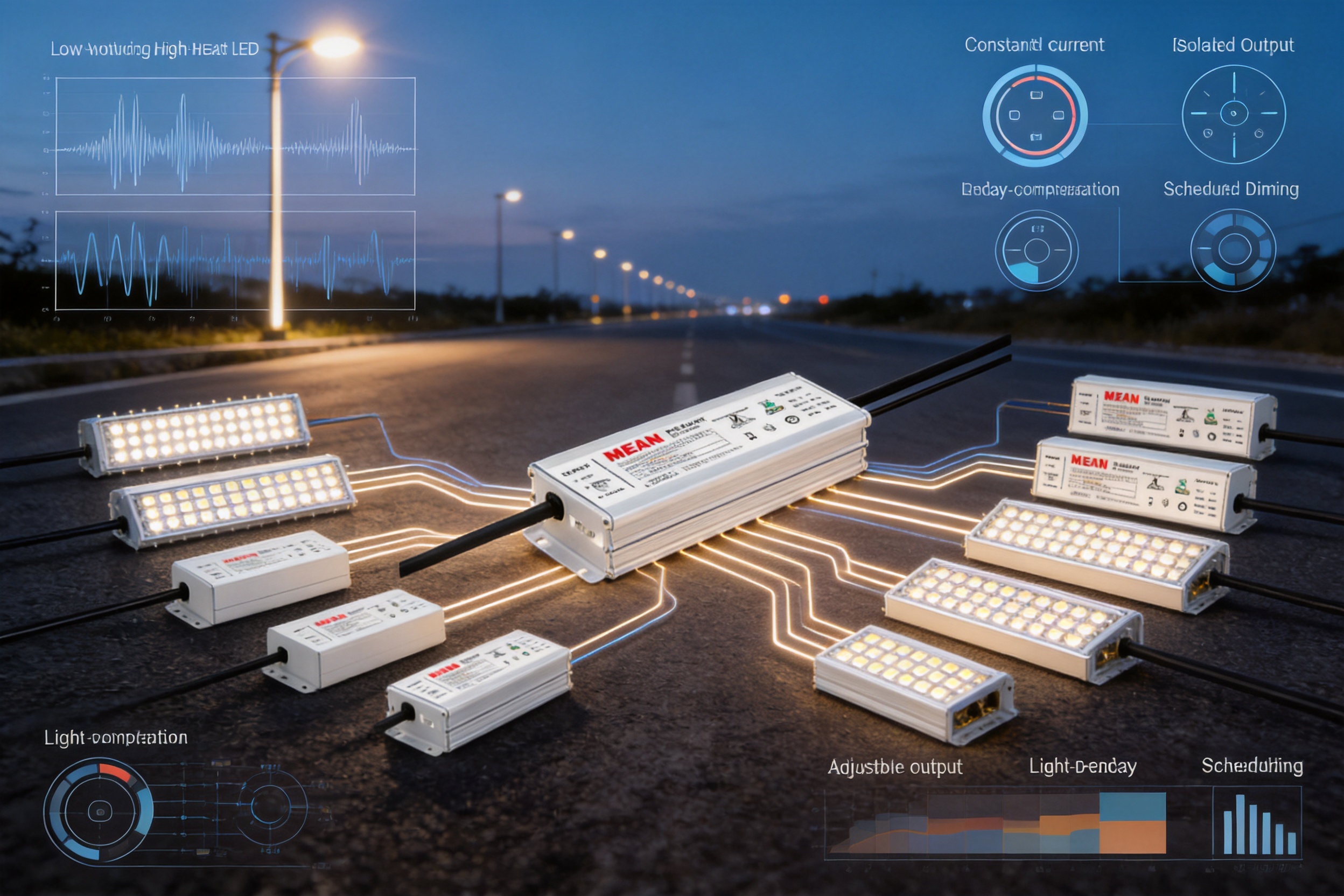
The company states that it is certified to ISO 9001, ISO 14001, and ISO 45001. These standards relate respectively to quality management, environmental management, and occupational health and safety. A structured management system can support more consistent processes, clearer responsibilities, traceability, and continual improvement.
The company also states that relevant products are certified by CB and CE. Certification requirements vary by product, market, and model, so customers should confirm the exact certification documentation for the selected driver or luminaire before placing an order.
In addition to manufacturing, the company provides one-stop services that include efficient lighting solutions, DIALux designs, mold design, OEM/ODM development, SKD/CKD customization, and delivery support. This range of services is valuable for customers that need more than a standard catalog product.
OEM and ODM customers may require changes to output current, dimming logic, mechanical structure, packaging, labeling, or production configuration. A supplier capable of coordinating design, tooling, testing, and delivery can help reduce the number of separate technical interfaces during a project.
OEM and ODM Customization Opportunities
The X6I is well suited to customized lighting programs because its key functions can support different luminaire specifications. Current ranges can be selected according to the LED module and target lumen output. Dimming logic can be adapted to the control requirements of a regional market or project owner. Mechanical integration can be coordinated with the housing and thermal design.
Customization should begin with a clear technical specification. Important information includes input voltage, LED forward-voltage range, target current, rated power, operating temperature, dimming method, control schedule, enclosure dimensions, mounting orientation, protection requirements, and expected service life.
For a new luminaire, the driver should be assessed during the optical and thermal design stages rather than added after the housing is complete. The selected driver generates some heat and must have sufficient clearance and thermal connection according to the final fixture design. The LED board, heat sink, driver, lens, and housing should be evaluated as an integrated assembly.
SKD and CKD customization can also be useful for international manufacturing or assembly strategies. Depending on project requirements, components may be supplied for local assembly, regional production, or final integration by a partner. Such arrangements require careful documentation, quality control, packaging planning, and responsibility assignment.
Design and Installation Considerations
The data provided for the X6I models should be used as the starting point for product selection, but engineers should verify complete technical documentation before production or installation. The LED module’s voltage must remain within the selected driver’s output range, and the current must be configured appropriately for the LED board.
The driver should be installed in a position that supports heat dissipation and protects it from unnecessary exposure to water, condensation, excessive dust, mechanical impact, and incompatible chemicals. The luminaire enclosure must be designed according to the environmental conditions of the application.
Input and output wiring should be arranged according to the relevant electrical requirements. Cable size, insulation, connectors, grounding, circuit protection, surge protection, and wiring distance can influence system performance. Installers should also verify polarity, control-interface compatibility, and the correct configuration of the dimming method.
For time-control applications, the schedule should be checked during commissioning. For analog or PWM control, the controller output and signal behavior should be verified across the complete dimming range. Any control system should be tested under actual installation conditions to confirm that the expected light levels are achieved.
Thermal validation is particularly important for high-power models. The 200 W, 240 W, and 320 W drivers may require a luminaire housing with suitable heat-dissipation capacity. Testing should consider maximum ambient temperature, full-power operation, dimming behavior, LED module temperature, driver temperature, and enclosure orientation.
How to Choose the Correct Model
Step One: Confirm LED Voltage
Determine the LED module’s forward-voltage range under realistic operating temperatures. Choose a driver whose output voltage range fully covers the intended LED operating point. Do not select a model based only on nominal voltage printed on an LED board.
Step Two: Confirm Required Current
Identify the target LED current and compare it with the driver’s adjustable full-power current range. The current should be selected according to the LED manufacturer’s recommendations, thermal design, required lumen output, and desired service-life strategy.
Step Three: Confirm Power
Check the relationship between LED voltage, LED current, and total output power. Select a model with adequate capacity while avoiding an unsuitable operating point. The luminaire’s optical and thermal performance should be validated at the selected power level.
Step Four: Select the Dimming Method
Determine whether the project will use 0/1–10 V, PWM, time control, or a combination of control strategies. The control system, wiring, commissioning process, and maintenance plan should all be considered before final selection.
Step Five: Check Mechanical Space
Compare the driver dimensions with the available space inside the luminaire. Verify mounting points, clearance, cable routing, heat dissipation, and access for production or service work.
Step Six: Review Project Documentation
For commercial or infrastructure projects, review the required certifications, test reports, control specifications, environmental conditions, warranty terms, and delivery requirements. The manufacturer can support OEM/ODM discussions when a standard model needs to be adapted.
Maintenance and Lifecycle Value
The value of an LED driver is determined not only by its purchase price but also by its effect on installation, energy consumption, maintenance, and product longevity. A flexible driver can reduce the need for multiple product versions, while dimming can lower operating energy during periods of reduced demand.
Light-decay compensation supports a lifecycle-oriented approach to illumination. Work-log recording can provide useful information for service teams, especially in large installations where maintenance history is difficult to manage manually. Offline programming can also simplify replacement preparation by allowing a new driver to be configured before it reaches the installation site.
A five-year warranty is stated for the product, providing additional confidence for customers planning long-term outdoor and industrial applications. Warranty conditions, operating limits, installation requirements, and documentation should be reviewed with the supplier for each project.
Routine maintenance should include visual inspection, checking for water ingress or corrosion, reviewing wiring and connectors, confirming dimming behavior, and examining the luminaire’s thermal condition. The driver should not be operated outside its stated electrical and environmental limits.
Q&A
What is the main purpose of the X6I LED driver?
The X6I is designed to provide regulated power and flexible control for LED lighting systems. It combines isolated constant-power output, offline current programming, three dimming methods, light-decay compensation, and work-log recording.
Which dimming methods are supported?
The platform supports 0/1–10 V dimming, PWM dimming, and time-based control. The appropriate method depends on the project controller, wiring arrangement, operating schedule, and required control behavior.
What input voltage range does the driver support?
The stated input range is 110–305 Vac. Project engineers should still verify the complete electrical specification and confirm compatibility with the local power system before installation.
What power ratings are available?
The listed range includes 75 W, 105 W, 150 W, 200 W, 240 W, and 320 W models.
Do all models have the same output voltage?
No. The range includes low-voltage, higher-current models and high-voltage, lower-current models. Output ranges extend from 38–62 Vdc on several Y062 versions to 228–457 Vdc on the X6I-320Y457.
How should the current be selected?
Current should be selected according to the LED module’s recommended operating point, forward voltage, thermal design, target lumen output, and project service-life requirements. It must remain within the adjustable range of the selected model.
Is the driver suitable for road lighting?
Yes. Its programmable current, time-control capability, wide input range, light-decay compensation, and work-log recording are relevant to road-lighting applications. The complete luminaire must still be engineered and tested for the intended environmental and photometric requirements.
Can it be used for industrial lighting?
Yes. The power range and output configurations support various industrial lighting designs, including suitable high-bay, area-lighting, warehouse, and facility applications. Model selection should be based on the LED assembly, fixture dimensions, control system, and thermal conditions.
What is the efficiency range?
The listed typical efficiency values range from 89.00% to 94.00%, depending on the model and output configuration.
What is the typical power factor?
The listed typical power-factor values are between 0.96 and 0.97.
Does the driver support customization?
The product information indicates that OEM/ODM partners can customize current ranges and dimming logic to match regional standards and project schedules. Specific customization scope should be confirmed during technical discussions.
What manufacturing capabilities support the product program?
The manufacturer operates die-casting and CNC machinery, aging lines, and goniophotometers. It also provides mold design, DIALux lighting design, OEM/ODM, SKD/CKD customization, and delivery services.
What certifications are associated with the manufacturer?
The company states that it is certified to ISO 9001, ISO 14001, and ISO 45001, and that relevant products are certified by CB and CE. Customers should request and verify documentation for the exact model and market.
What warranty is stated for the product?
A five-year warranty is stated for the X6I product. The applicable conditions should be confirmed in the formal quotation, technical agreement, and warranty documentation.
What should be checked before installation?
Engineers should verify input voltage, LED output voltage, operating current, power rating, dimming method, wiring, environmental conditions, thermal performance, mounting space, protection requirements, and commissioning procedures.
Conclusion
The Triple Dimming Modes LED Driver X6I is designed as a flexible power and control platform for modern outdoor and industrial lighting. Its main advantages include a 110–305 Vac input range, isolated constant-power output, offline current programming, 0/1–10 V, PWM and time-control dimming, light-decay compensation, work-log recording, and a broad selection of power and voltage configurations.
Compared with conventional fixed-function drivers, the X6I offers greater adaptability during product development, production, commissioning, and long-term operation. Its model range allows lighting manufacturers to match driver output to different LED architectures, while its programmable functions support multiple lumen packages and project control strategies.
The manufacturer’s die-casting, CNC machining, mold-development, aging, and photometric capabilities strengthen the product program by connecting driver integration with complete luminaire engineering. ISO management systems, stated CB and CE certification coverage for relevant products, DIALux design services, and OEM/ODM support further contribute to its suitability for international lighting projects.
For road lighting, industrial facilities, tunnels, facades, warehouses, and other demanding applications, the X6I provides a practical way to combine stable LED power with flexible control. Correct model selection, thermal design, installation, testing, and maintenance remain essential, but the platform gives manufacturers and project owners a strong foundation for efficient, configurable, and service-oriented LED lighting systems.
References
1. Product technical information for the Triple Dimming Modes LED Driver X6I, including model output ranges, power ratings, dimensions, typical efficiency, and typical power factor.
2. Manufacturer information concerning outdoor lighting production, OEM/ODM services, die-casting, CNC machining, aging lines, goniophotometers, and lighting design support.
3. General principles of LED driver selection, constant-current and constant-power operation, dimming control, thermal management, and luminaire system integration.
4. ISO 9001 quality management principles, ISO 14001 environmental management principles, and ISO 45001 occupational health and safety management principles.
5. General roadway, industrial, architectural, and outdoor lighting design practices concerning energy management, scheduled dimming, lumen maintenance, and photometric evaluation.
Product: Triple Dimming Modes LED Driver (BIS) X6I

YQF Group - World Leading One-Stop Lighting & Solar For the Global Partners
Custom & OEM Solutions for Global Lighting Brands
Copyright © Cixi HuaSheng Lighting Co., Ltd. All Rights Reserved.
Die-Casting Mould Supplier
