 English
 中文简体
 русский
 Français
 Español
 عربى
 Indonesia

Versatile Output Industrial Power Supply T30-150W: Flexible, Protected, and Production-Ready Power for Industrial Applications
Reliable power conversion is one of the most important foundations of modern industrial equipment. Automation controllers, factory sensors, communication devices, control cabinets, LED systems, and other electronic loads all depend on a stable power source that can match their voltage requirements and operate consistently under changing environmental and electrical conditions. When a power supply is poorly matched to an application, the result may include excessive ripple, nuisance shutdowns, overheating, shortened component life, difficult installation, or costly system maintenance.
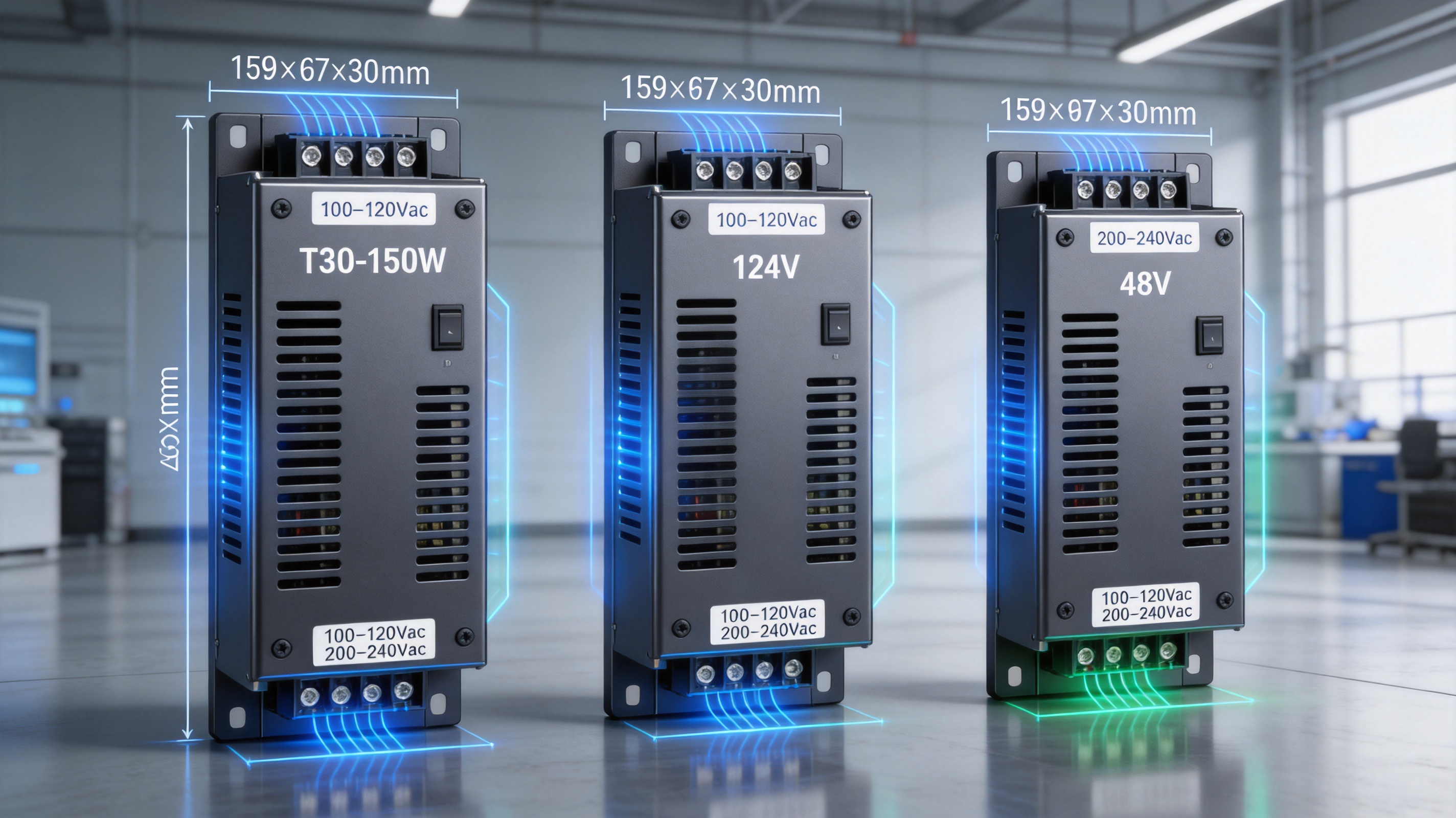
The Versatile Output Industrial Power Supply T30-150W is designed to address these challenges with a compact structure, selectable input voltage, multiple output configurations, and integrated surge protection. The product is available in 12V/12.5A, 24V/6.5A, and 48V/3.13A versions, allowing users to select the output that best fits their equipment. Its input range can be selected between 100–120Vac and 200–240Vac through a DIP switch, supporting deployment across different electrical systems without requiring a completely different power supply platform.
With a rated power class of 150W, a 159 × 97 × 30mm form factor, 300mV peak-to-peak ripple specification, and common-mode and differential-mode surge protection, the T30-150W is positioned as a practical solution for industrial equipment, control systems, automation devices, and LED-related applications. It combines configuration flexibility with a compact installation footprint, helping equipment designers solve both electrical matching and space limitations.
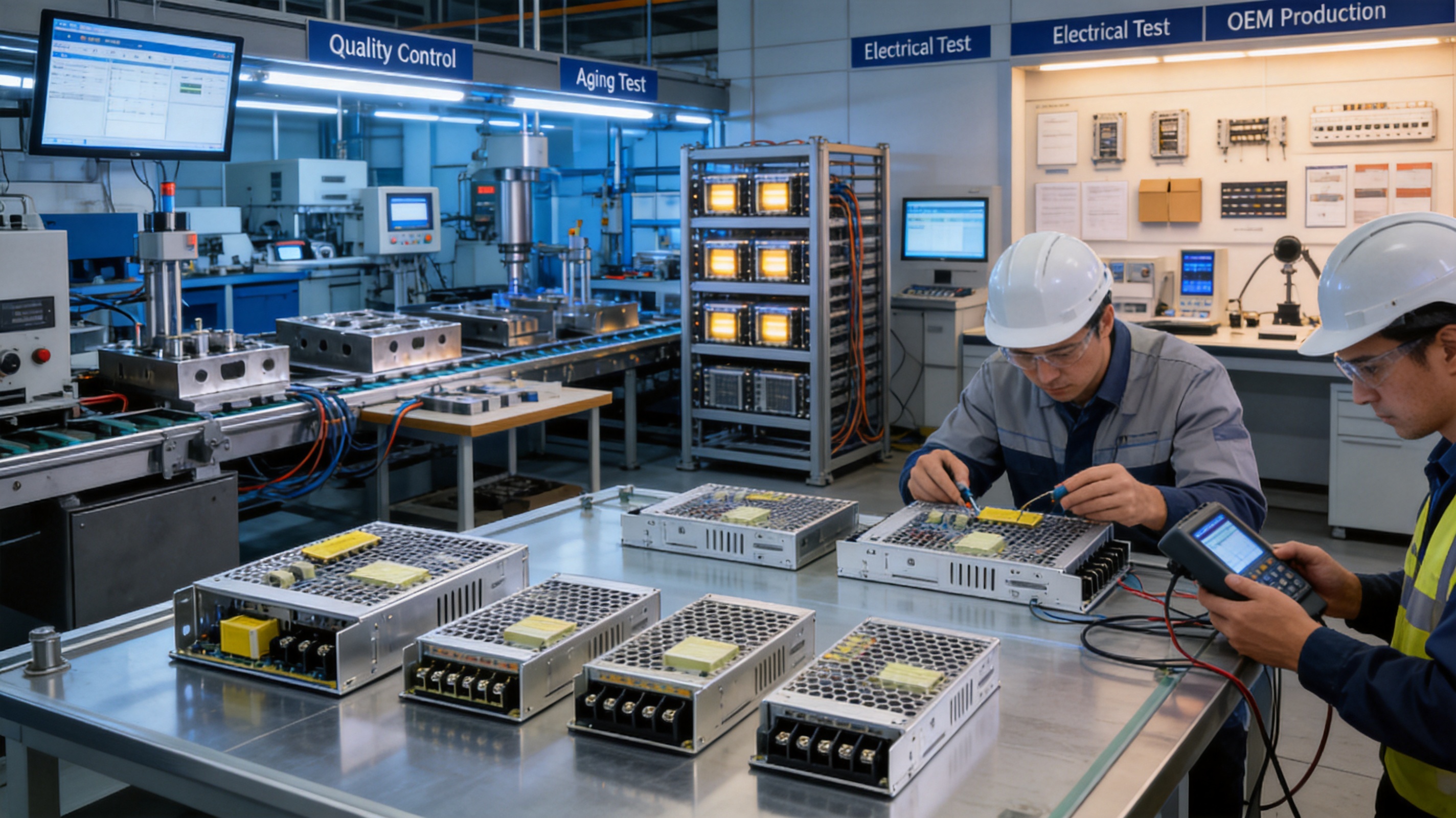
The product is manufactured by Cixi HuaSheng Lighting Co., Ltd., a Ningbo-based manufacturer with experience in LED lighting, industrial power products, die-casting, CNC processing, mold development, and customized OEM and ODM services. Its manufacturing resources allow the company to support not only standard products but also application-specific configurations involving outputs, connections, enclosures, and system integration requirements.
Versatile Output Industrial Power Supply T30-150W
Understanding the T30-150W Industrial Power Supply
The T30-150W is an industrial power supply platform designed for applications that require dependable AC-to-DC power conversion in a relatively compact enclosure. Rather than offering only one fixed output, the platform includes three practical output options. Users can select a 12V version rated at 12.5A, a 24V version rated at 6.5A, or a 48V version rated at 3.13A.
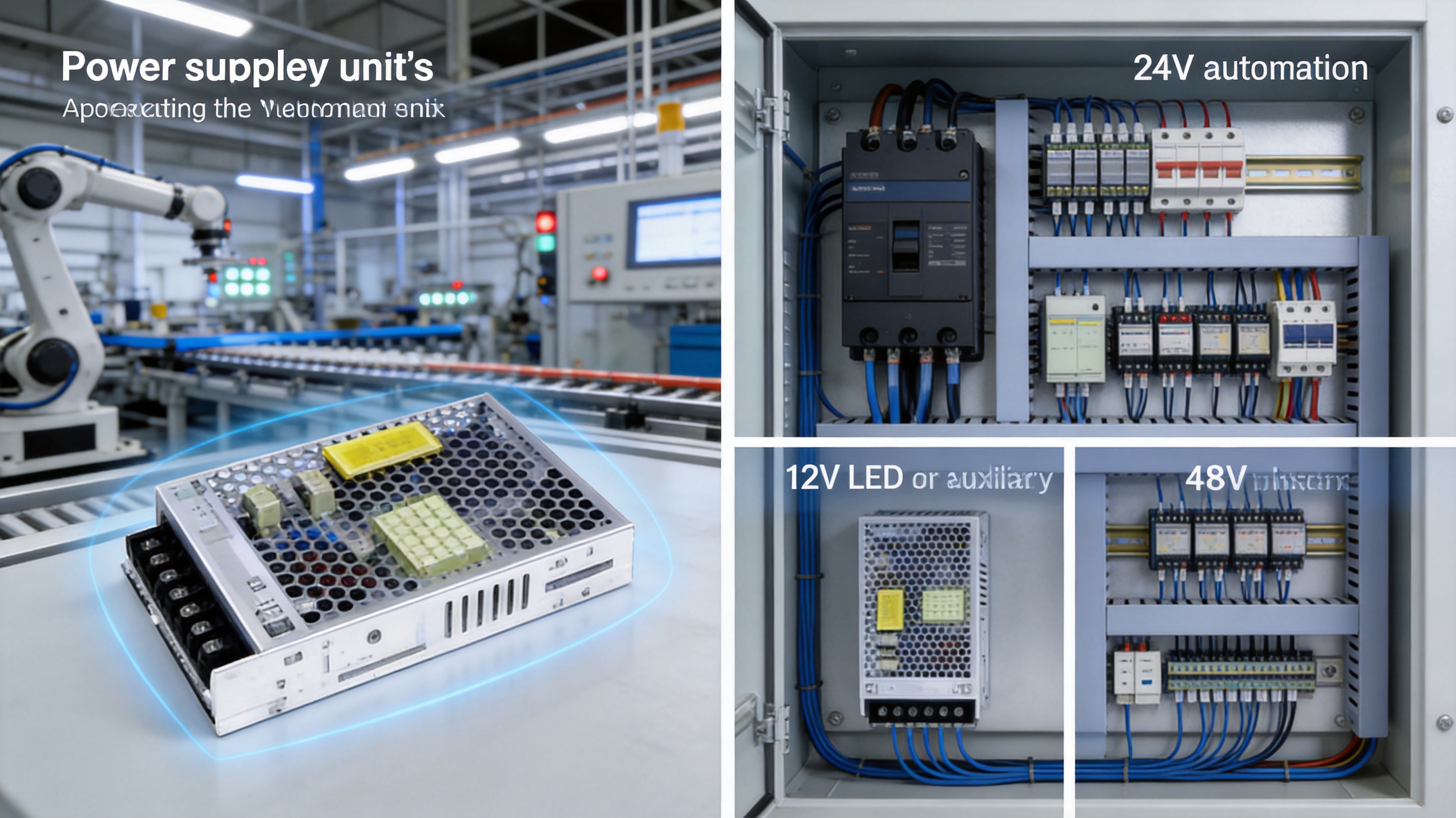
These three voltage levels cover many common requirements in industrial electronics. Twelve-volt systems are widely used for control accessories, compact devices, sensors, relays, LED modules, and low-voltage equipment. Twenty-four volts is a common standard in automation and control panels, where it can power programmable controllers, actuators, sensors, interface equipment, and industrial communication devices. Forty-eight volts is useful for equipment that benefits from higher distribution voltage, including selected communication systems, LED applications, and devices designed to reduce current over longer cable runs.
By providing multiple product variants within one product family, the T30-150W simplifies product selection and procurement. A machine builder can use a familiar platform while selecting the output version required by a particular control system. A distributor can maintain a focused product range rather than carrying a large number of unrelated models. An OEM can also discuss customized configurations with the manufacturer when a standard output, connector arrangement, or enclosure does not fully satisfy the application.
The supply accepts either 100–120Vac or 200–240Vac input, with the required range selected through a DIP switch. This feature provides an important advantage for equipment intended for different regions. Instead of redesigning the power section for every market, an integrator can configure the input setting during installation or production. Proper input selection remains essential, but the adjustable design can reduce model complexity and improve deployment flexibility.
Core Product Specifications
| Item | Specification |
|---|---|
| Product | Versatile Output Industrial Power Supply T30-150W |
| Output options | 12V/12.5A, 24V/6.5A, or 48V/3.13A |
| Input voltage | 100–120Vac or 200–240Vac, selected by DIP switch |
| Input frequency | 47–63Hz |
| Surge protection | 4kV common-mode and 2kV differential-mode |
| Ripple | 300mV peak-to-peak |
| Dimensions | 159 × 97 × 30mm |
| Certification | CE |
| Application direction | Industrial equipment, automation, control systems, LED-related applications, and customized equipment |
The specifications demonstrate that the T30-150W is intended to balance power capability, installation convenience, and electrical protection. Although the supply is compact, the available current ratings make it suitable for many medium-power industrial loads. The choice between 12V, 24V, and 48V also allows designers to consider cable length, current demand, voltage drop, device compatibility, and overall system architecture.
Flexible Output Selection for Different Industrial Systems
One of the strongest advantages of the T30-150W platform is the availability of three output configurations. Industrial systems are rarely identical. A compact controller cabinet may require 24V, while an LED module or auxiliary device may use 12V. Another installation may benefit from 48V distribution to reduce current in the wiring. A single fixed-output supply cannot address all of these conditions, but a product family with multiple output versions provides a more organized approach.
12V/12.5A Version
The 12V/12.5A version can deliver up to 150W at its nominal output rating. It is suitable for low-voltage equipment, LED-related systems, control accessories, small automation devices, and other applications designed around a 12V DC bus. At 12V, a 150W supply provides a relatively high current capability, making it important for installers to select suitable wire sizes, terminals, fusing, and ventilation arrangements.
Many lighting assemblies and electronic control devices use 12V because it is widely available and compatible with a broad range of components. The T30-150W 12V version can therefore support equipment where a stable DC source is required without using a bulky transformer and separate conversion stage. The compact 30mm height may also help when the supply must fit into a slim enclosure or equipment compartment.
24V/6.5A Version
The 24V/6.5A version is aligned with a widely used industrial control voltage. Twenty-four-volt systems are common in programmable control cabinets, sensors, relays, valves, actuators, industrial interfaces, and automation equipment. The voltage is high enough to reduce current compared with a 12V system while remaining compatible with many standard control components.
For machine builders, 24V is often a practical compromise between safety, distribution efficiency, and component availability. A 150W supply at 24V can support multiple devices when the total load is correctly calculated. Designers should account for startup currents, inductive loads, simultaneous operation, and future expansion rather than sizing the supply only from the nominal steady-state consumption of connected devices.
48V/3.13A Version
The 48V/3.13A version provides the same approximate 150W power class at a higher DC voltage. Higher-voltage distribution can help reduce current for a given power level, which may reduce resistive losses and voltage drop over suitable cable runs. This can be useful in selected communication, industrial, and LED-related applications where the connected equipment is designed for 48V operation.
The 48V version should be applied only with equipment and wiring systems rated for the voltage. Designers must also consider insulation, creepage, clearance, connector ratings, grounding, and protection requirements. When properly integrated, the higher-voltage variant can provide a useful option for installations where current reduction and distribution efficiency are priorities.
Selectable AC Input for International and Multi-Platform Use
The T30-150W supports a 100–120Vac or 200–240Vac input range selected through a DIP switch. This adjustable input design is particularly useful for manufacturers serving more than one geographic market. Electrical systems vary by country and facility, and a power supply configured for one nominal range may not be suitable for another. The selectable input feature allows the same basic product platform to be prepared for different supply environments.
For OEM production, a selectable input can simplify purchasing and assembly. Instead of maintaining separate power supply designs for each region, a manufacturer can use one platform and establish clear configuration procedures. The DIP switch setting should be checked during incoming inspection, assembly, and final testing. A visible label or documented production checklist can help prevent incorrect input selection.
The 47–63Hz frequency range is compatible with common commercial and industrial AC systems. Even so, system engineers should verify the actual site conditions, including input fluctuations, transient events, generator operation, and the presence of harmonics or other power-quality issues. The supply should be installed according to its technical documentation, with appropriate upstream protection and adequate airflow.
Compared with a supply designed for only one input range, the T30-150W offers greater configuration flexibility. Compared with a universal-input product, its DIP-switch arrangement also makes the intended input setting explicit, which can be useful in controlled equipment designs where a defined input configuration is preferred. The setting should never be changed while the unit is energized, and qualified personnel should perform installation and commissioning.
Surge Protection for Demanding Electrical Environments
Industrial electrical networks can expose power supplies to disturbances caused by motors, contactors, relays, variable-speed drives, switching equipment, long cable runs, and external electrical events. These disturbances may appear as common-mode or differential-mode surges. If not adequately controlled, they can stress input components and reduce system reliability.
The T30-150W specifies 4kV common-mode surge protection and 2kV differential-mode surge protection. Common-mode protection addresses disturbances occurring between the input conductors and earth or chassis reference. Differential-mode protection addresses disturbances between the input conductors themselves. The two ratings describe different electrical conditions and are both relevant when evaluating industrial power supply resilience.
Surge protection does not mean that a power supply can be installed without considering the rest of the electrical system. Proper grounding, upstream circuit protection, cabinet design, cable routing, shielding, and site-level surge protection remain important. However, integrated protection at the power supply helps strengthen the equipment against common transient conditions and can reduce the risk of immediate damage or unstable operation.
This feature is especially valuable in automation cabinets and industrial equipment that contain switching loads. When a motor, solenoid, or relay changes state, the associated transient energy can affect nearby circuits. Separating power and signal wiring, using suitable suppression devices, and following good cabinet layout practices will complement the power supply’s internal protection.
Ripple Performance and Stable DC Power
Ripple is the residual periodic variation present on a DC output after AC-to-DC conversion and filtering. Excessive ripple can affect sensitive control electronics, communication devices, sensors, LED systems, and other loads. It may contribute to visible flicker in lighting applications, inaccurate measurements, noise in signal circuits, or reduced operating margins in electronic equipment.
The T30-150W specifies 300mV peak-to-peak ripple. This specification gives system designers a reference point when evaluating compatibility with the intended load. The actual performance in a complete system may depend on input conditions, output loading, cable length, grounding, measurement method, and the characteristics of connected equipment. Engineers should evaluate the supply under realistic conditions rather than relying only on an unloaded measurement.
A controlled ripple level is one of the product’s practical strengths. Industrial control systems often combine power electronics and low-level signals in a confined cabinet. A suitable power supply can help reduce the possibility that output fluctuations interfere with sensors, controllers, interfaces, or communication equipment. In LED applications, stable DC power can also support more consistent light output and reduce unwanted visual effects when the connected LED system is correctly matched.
Installers can further improve system performance by keeping DC output wiring appropriately sized and reasonably short, separating high-current paths from sensitive signal wiring, and ensuring that connectors are secure. The power supply should not be operated beyond its intended current or environmental limits, and additional filtering should be considered when the load has unusually strict noise requirements.
Compact Mechanical Design for Space-Constrained Installation
The T30-150W measures 159 × 97 × 30mm. Its 30mm height is particularly relevant for applications where vertical clearance is restricted. Industrial control cabinets, machine housings, LED equipment compartments, and retrofit enclosures frequently have limited installation depth or height. A compact power supply can make it easier to arrange wiring, terminal blocks, controllers, protection devices, and ventilation paths within the available space.
Compact dimensions can also reduce the size of the overall equipment enclosure. A smaller enclosure may lower material use, simplify transportation, and improve the visual integration of the finished machine. However, compactness should always be considered together with heat dissipation. Designers should provide the clearances and airflow recommended for the operating conditions, especially when the unit is installed near other heat-generating components.
The relatively narrow profile can support organized cabinet layouts. For example, the supply may be positioned near the input protection and distribution section, while the DC output is routed toward controllers or load groups. Careful wiring can reduce unnecessary conductor length and make maintenance easier. The final arrangement should allow access for inspection, testing, replacement, and safe isolation.
Compared with larger conventional supplies, the T30-150W can offer an installation-efficiency advantage. It may help equipment manufacturers preserve cabinet space for functional modules rather than allocating excessive volume to the power conversion section. This is an important consideration in modern machines, which are becoming more compact while incorporating more sensors, communication interfaces, and automation functions.
Application Areas
Industrial Control Cabinets
Industrial control cabinets commonly include programmable controllers, relays, sensors, interface modules, communication devices, actuators, and indicator systems. The 24V version of the T30-150W is a natural option for many such arrangements. The power rating can support a group of devices when the load calculation includes startup behavior and appropriate operating margins.
The selectable input feature can simplify cabinet deployment in facilities with different AC standards. Surge protection can add resilience in environments where switching equipment is present. The compact form factor can also help maintain a clean cabinet layout, provided that thermal and wiring requirements are respected.
Automation Equipment
Automation equipment often requires stable auxiliary power for sensors, control interfaces, motor-control accessories, valves, safety components, and communication devices. The T30-150W can serve as a dedicated DC source within a machine, separating control power from other equipment where appropriate.
Machine builders can choose the output voltage according to the architecture of the system. The 12V version may suit auxiliary electronics, the 24V version may support standard control components, and the 48V version may serve selected higher-voltage distribution designs. Using a consistent product family can simplify documentation, service training, and spare-parts planning.
LED-Related Applications
LED systems require a power source that is correctly matched to the input voltage, current, control method, and environmental conditions of the lighting assembly. The T30-150W can support selected LED-related applications requiring 12V, 24V, or 48V DC. It may be used in industrial lighting equipment, architectural installations, signage, cabinet lighting, display systems, and other projects when the electrical specifications are compatible.
For LED applications, engineers should verify whether the connected modules require constant voltage or constant current operation. The T30-150W output options are described by voltage and current ratings, so the connected LED system must be designed for the selected constant-voltage arrangement where applicable. Additional dimming, control, or protection components may be needed depending on the project.
Industrial Equipment and Auxiliary Systems
Many industrial machines use separate power supplies for auxiliary functions such as displays, control panels, monitoring instruments, communication gateways, and low-voltage accessories. The T30-150W can provide a dedicated source for these subsystems, helping isolate them from larger power circuits and simplifying service diagnostics.
Because the product is available in three output variants, equipment designers can retain a familiar mounting concept while selecting the voltage appropriate for each machine platform. This may be useful in OEM production, where several machines share similar mechanical structures but use different electronic architectures.
Advantages Compared with Less Flexible Alternatives
The T30-150W offers several advantages when compared with basic fixed-output or minimally protected power supplies. The first is output choice. A single-output product forces the designer to adapt the system to the supply or add additional conversion stages. The T30-150W platform instead provides 12V, 24V, and 48V options within one product family.
The second advantage is selectable input voltage. Equipment intended for different regions can use the same basic supply platform, with the input range configured through the DIP switch. This can reduce product variation and make international deployment more straightforward.
The third advantage is integrated surge protection. Industrial locations can expose electronics to disturbances that are less common in simple residential environments. The specified common-mode and differential-mode ratings provide a clearer protection profile than an unprotected supply.
The fourth advantage is the compact form factor. A 159 × 97 × 30mm structure can be easier to integrate into cabinets and enclosures than a larger power unit with similar power capability. Compactness may improve equipment design efficiency and support more flexible placement.
The fifth advantage is customization potential. Through OEM and ODM cooperation, customers may discuss customized outputs, connections, enclosures, and application configurations. This is important when an off-the-shelf product is close to the required design but needs a modified interface or mechanical arrangement.
These advantages do not eliminate the need for engineering verification. Product selection should always consider load type, operating temperature, installation method, required approvals, protection coordination, grounding, and expected service life. The strength of the T30-150W lies in giving designers a practical and adaptable starting point rather than requiring every application to use an identical configuration.
Manufacturing Strengths of Cixi HuaSheng Lighting Co., Ltd.
Cixi HuaSheng Lighting Co., Ltd. is located in Cixi City, Ningbo, Zhejiang Province, China. The company specializes in outdoor lighting and related industrial products, while also supporting LED indoor and outdoor solutions, power products, die-casting, CNC machining, mold development, and customized manufacturing services.
The company’s production capabilities are relevant to the T30-150W because a power supply is often installed as part of a larger lighting or industrial assembly. Customers may require more than an electrical module. They may need an enclosure, mounting structure, cable connection, control interface, or integration arrangement that matches a complete luminaire, machine, or project. Experience across lighting and mechanical production can help coordinate these requirements.
Die-Casting and Mechanical Manufacturing
Die-casting capability supports the production of metal housings, heat-dissipation structures, brackets, and other components requiring repeatable geometry. In industrial and lighting applications, mechanical parts must often balance strength, weight, thermal performance, corrosion resistance, and appearance. Controlled die-casting can provide consistent dimensions for repeated production runs.
The company also operates CNC machines for precision processing. CNC machining can be used to refine mounting surfaces, drill accurate holes, produce threads, improve fit between components, and achieve dimensional consistency. These capabilities are valuable when a customized power supply enclosure or mounting assembly must align with a customer’s equipment.
For OEM and ODM projects, mechanical repeatability is as important as electrical performance. A power supply may function correctly on a workbench but become difficult to install if mounting holes, cable outlets, or enclosure interfaces vary between production batches. Die-casting, machining, inspection, and controlled assembly processes can help reduce these risks.
Mold Design and Development
Mold design is another important manufacturing strength. A mold determines the repeatability, surface quality, and dimensional stability of many mass-produced components. When customers request a customized housing, bracket, cover, or lighting structure, mold development can support a solution tailored to the application rather than forcing the project to use a generic shape.
The company’s mold-related capabilities are also relevant to lighting products that may be used alongside the power supply. A complete project may include a luminaire body, optical component, mounting arm, junction cover, or protective enclosure. Coordinating mold design with power supply integration can reduce interface problems during assembly.
Aging Lines and Product Reliability
Aging lines are used to operate products for a controlled period before shipment, helping manufacturers identify certain early-life defects and verify performance under sustained operation. For lighting products and power-related assemblies, aging can be an important part of production quality management.
Although an aging process does not replace design validation or field testing, it can provide an additional production screening step. It may help reveal problems associated with assembly, soldering, wiring, thermal behavior, or component instability before products are packaged. Consistent aging procedures contribute to a more controlled manufacturing process.
Photometric and Testing Resources
The company operates goniophotometers and other production resources associated with lighting evaluation. These instruments are primarily relevant to photometric performance, beam distribution, and lighting product verification. Their presence reflects a broader engineering environment in which electrical, mechanical, optical, and thermal elements can be considered together.
For customers purchasing power supplies for LED applications, this broader lighting expertise can be helpful. The supplier understands that the power source is part of a complete system involving LEDs, drivers, thermal structures, optics, housings, control devices, and installation conditions. Such system awareness can support more practical project discussions.
Quality, Certification, and Management Systems
The T30-150W is identified with CE certification. CE marking indicates that the product is intended to meet applicable European Union requirements within the scope relevant to the product and its declaration. Customers should review the applicable documentation and confirm that the exact configuration is suitable for the intended market and installation.
Cixi HuaSheng Lighting Co., Ltd. is described as holding ISO 9001, ISO 14001, and ISO 45001 certifications. ISO 9001 relates to quality management, ISO 14001 relates to environmental management, and ISO 45001 relates to occupational health and safety management. These management systems provide structured frameworks for process control, environmental responsibility, and workplace safety.
Management-system certification does not by itself guarantee that every individual product will perform correctly in every application. However, it indicates that the company has established formal processes in important operational areas. For industrial customers, this can support supplier evaluation, documentation review, corrective-action procedures, and long-term cooperation.
The company also reports products certified by CB and CE and maintains strategic partnerships with international companies. These resources may support customers seeking a supplier capable of serving export projects and managing documentation for global markets. Product-specific certification and market requirements should always be confirmed before purchase.
OEM and ODM Customization Possibilities
The T30-150W is suitable for standard procurement, but its value can increase when used as the foundation for a customized project. OEM and ODM collaboration may support modifications to output configuration, connectors, wiring, enclosure dimensions, mounting arrangements, and application-specific integration.
Customized output requirements may include a particular voltage, current limit, terminal arrangement, or connection method. A customer may need the supply to interface with a proprietary control board, an LED module, a machine harness, or a field-replaceable wiring assembly. Early discussion with the manufacturer can determine whether the standard platform is suitable or whether additional development is required.
Mechanical customization can involve mounting holes, brackets, cable glands, protective covers, ventilation openings, labels, and enclosure dimensions. These details may appear minor, but they strongly affect installation efficiency. A correctly positioned cable outlet can prevent sharp bends, reduce strain on conductors, and simplify assembly.
Application configuration may also include packaging, labeling, documentation, inspection procedures, and production testing. For a customer building equipment under its own brand, a coordinated OEM program can improve consistency between the power supply and the finished product. ODM cooperation may go further by supporting a product concept designed around the customer’s technical and commercial requirements.
Customization should be managed through a structured engineering process. The customer should provide load details, input conditions, operating temperature, installation orientation, environmental exposure, required connectors, target certifications, and expected production quantity. The manufacturer can then evaluate feasibility, prepare drawings or samples, define validation steps, and establish production specifications.
Installation and System Design Considerations
Correct installation is essential for reliable operation. Before connecting the T30-150W, the installer should confirm the selected input voltage setting, verify the AC wiring, inspect the protective earth arrangement where applicable, and ensure that the DC output matches the connected load. The DIP switch should be set only when the equipment is safely de-energized.
The power supply should be mounted in a clean and adequately ventilated location. Heat-generating equipment should not be placed directly against the unit unless the system has been designed and tested for that arrangement. The enclosure should protect the supply from water, conductive dust, corrosive chemicals, excessive vibration, and other environmental conditions beyond its specified range.
Output wiring should be selected according to current, length, temperature, insulation rating, and installation method. This is particularly important for the 12V/12.5A version, where current can be relatively high. Undersized wires can cause voltage drop and heat generation. Terminal screws or connectors should be tightened according to appropriate procedures, and cable strain should be controlled.
Load calculations should include inrush current and transient demand. Some devices draw significantly more current during startup than during normal operation. Motors, capacitive loads, LED assemblies, and electronic control equipment may all have startup characteristics that must be considered. A suitable safety margin can help prevent nuisance shutdowns and excessive thermal stress.
Grounding and electromagnetic compatibility should be addressed at the system level. Power wiring should be routed separately from sensitive signal wiring where practical. If the application includes relays, motors, solenoids, or variable-speed drives, appropriate suppression and filtering should be evaluated. The internal surge protection of the supply works best when combined with sound installation practice.
Selection Guide for Buyers and Engineers
When selecting a T30-150W variant, the first question is the required DC voltage. If the equipment is built around a 12V bus, the 12V/12.5A version should be evaluated. If the system uses standard industrial control voltage, the 24V/6.5A version may be more suitable. If the architecture is designed for 48V distribution, the 48V/3.13A version may offer the best match.
The second question is the total power demand. The connected load should not exceed the power supply’s intended rating. Continuous consumption, startup demand, future expansion, and ambient temperature should all be considered. A supply operating permanently at its maximum rating may have less thermal margin than one selected with appropriate capacity.
The third question is the available AC input. Determine whether the installation provides 100–120Vac or 200–240Vac and set the DIP switch accordingly. For equipment shipped internationally, include input configuration in the production and commissioning documentation.
The fourth question is the mechanical environment. Compare the 159 × 97 × 30mm dimensions with the available mounting area, cable routing, ventilation clearance, and service access. A supply that fits the enclosure but blocks airflow or prevents safe wiring is not a successful design.
The fifth question is compliance and documentation. Confirm the required certification, test reports, labels, user instructions, and production records. If the supply is part of a larger product, the final equipment may require additional evaluation beyond the power supply’s individual certification.
Technical Value for Distributors and System Integrators
Distributors can benefit from carrying a product family that covers several common output voltages while sharing a similar power class and mechanical concept. This simplifies product training and allows sales teams to address different applications without introducing an entirely unrelated supply for every requirement.
System integrators can use the T30-150W as a repeatable building block. The same input selection procedure, similar installation approach, and familiar product dimensions can reduce engineering effort across multiple projects. Integrators should still maintain separate documentation for each output version and confirm the correct model before assembly.
For project-based businesses, the company’s broader manufacturing capabilities may provide an additional advantage. A customer may source the power supply, LED fixture, housing, bracket, or customized assembly through coordinated discussions. This can reduce the number of interfaces between separate suppliers and make responsibility for mechanical and electrical integration clearer.
Q&A
What output voltages are available?
The T30-150W is available in 12V/12.5A, 24V/6.5A, and 48V/3.13A versions. Each version is intended for a different DC system architecture, so the correct choice depends on the connected equipment and total load.
Can the input voltage be used in different countries?
Yes. The input can be configured for 100–120Vac or 200–240Vac using a DIP switch. The selected setting must match the actual AC supply, and the switch should only be changed when the unit is safely disconnected from power.
What is the power rating of the product?
The product belongs to the 150W power class. The current rating changes with the output voltage: 12.5A at 12V, 6.5A at 24V, and 3.13A at 48V.
What protection features are specified?
The product specifies 4kV common-mode surge protection and 2kV differential-mode surge protection. These features help address certain electrical transients, but correct grounding, upstream protection, cabinet design, and wiring remain necessary.
What is the specified ripple level?
The ripple specification is 300mV peak-to-peak. Actual system performance may vary with load, input conditions, measurement method, cable arrangement, and connected equipment.
Is the product suitable for LED applications?
It can be suitable for selected LED-related applications that require compatible 12V, 24V, or 48V constant-voltage power. The customer must confirm whether the LED system requires constant voltage or constant current and verify all electrical and thermal requirements.
Can the product be customized?
OEM and ODM cooperation can support customized outputs, connections, enclosures, and application configurations. Feasibility depends on technical requirements, certification needs, development scope, and expected order volume.
What are the product dimensions?
The stated dimensions are 159 × 97 × 30mm. Installation clearance, cable access, ventilation, and service space should be included in the final equipment design.
What certifications and management systems are associated with the supplier?
The product is identified with CE certification. The company is described as holding ISO 9001, ISO 14001, and ISO 45001 certifications, with relevant products also certified by CB and CE. Product-specific documentation should be reviewed for each project.
How should the supply be selected for an automation cabinet?
Start by identifying the cabinet’s DC voltage, total continuous load, startup demand, ambient temperature, input voltage, and available mounting area. The 24V version is often relevant to industrial controls, but the final selection must be based on the actual equipment requirements.
Does surge protection eliminate the need for external protection?
No. Integrated surge protection is one part of a complete protection strategy. Upstream fusing or circuit protection, grounding, suppression for inductive loads, correct cable routing, and facility-level surge protection may still be required.
Conclusion
The Versatile Output Industrial Power Supply T30-150W is a practical platform for industrial and LED-related power applications that require flexible voltage selection, compact installation, and protection against common electrical disturbances. Its three output options—12V/12.5A, 24V/6.5A, and 48V/3.13A—allow designers to select a configuration suited to the architecture of their equipment. The 100–120Vac or 200–240Vac DIP-switch input selection further supports regional and project flexibility.
The specified 4kV common-mode and 2kV differential-mode surge protection, 300mV peak-to-peak ripple, and 159 × 97 × 30mm dimensions provide a useful combination for control cabinets, automation systems, industrial equipment, auxiliary devices, and compatible LED applications. Compared with less flexible fixed-output products, the T30-150W can reduce product variation, simplify equipment integration, and support a wider range of system designs.
Its value is strengthened by the manufacturing resources of Cixi HuaSheng Lighting Co., Ltd. The company combines lighting production with die-casting, CNC machining, mold design, aging lines, photometric equipment, OEM, ODM, SKD, and CKD capabilities. This combination allows customers to discuss not only the power supply itself but also the mechanical, lighting, and application requirements of a complete product.
For successful deployment, engineers should verify output compatibility, load capacity, input configuration, thermal conditions, wiring, grounding, environmental exposure, and certification requirements. When these factors are properly addressed, the T30-150W can serve as a compact and adaptable power foundation for demanding industrial and lighting equipment.
References
1. Cixi HuaSheng Lighting Co., Ltd. Product information for the Versatile Output Industrial Power Supply T30-150W.
2. Cixi HuaSheng Lighting Co., Ltd. Industrial lighting, power supply, OEM, ODM, die-casting, CNC machining, and manufacturing capability information.
3. International Electrotechnical Commission. General principles for electrical equipment safety, protection, insulation, and installation design.
4. International Organization for Standardization. ISO 9001 Quality Management Systems—Requirements.
5. International Organization for Standardization. ISO 14001 Environmental Management Systems—Requirements with Guidance for Use.
6. International Organization for Standardization. ISO 45001 Occupational Health and Safety Management Systems—Requirements with Guidance for Use.
7. European Commission. General principles associated with CE conformity assessment and applicable product safety requirements.
8. Industrial power supply engineering practices covering surge protection, ripple evaluation, grounding, thermal management, wiring, and control cabinet integration.
Product: Versatile Output Industrial Power Supply T30-150W

YQF Group - World Leading One-Stop Lighting & Solar For the Global Partners
Custom & OEM Solutions for Global Lighting Brands
Copyright © Cixi HuaSheng Lighting Co., Ltd. All Rights Reserved.
Die-Casting Mould Supplier
