 English
 中文
中文 Pусский
 French
 Español
 عربى
عربى
Waterproof Solar LED Street Light for Reliable Outdoor Illumination
Modern outdoor lighting must do more than produce bright light. It must remain dependable through rain, humidity, dust, temperature changes, mechanical impact, and long periods without direct maintenance. In locations such as coastal roads, industrial compounds, highways, residential streets, parking areas, and municipal projects, lighting failure can reduce visibility, create safety risks, and increase operating costs. The Waterproof Solar LED Street Light HS-TYX is designed to address these challenges with a weather-resistant structure, efficient LED performance, solar power compatibility, and a practical range of wattages.
The HS-TYX series is a solar street lighting solution developed for demanding outdoor conditions. Its available input wattage range is 40W to 80W, while its stated light effect is 190–200 lm/W ±5%. The fixture provides IP65 protection against dust and water ingress and IK08 impact resistance. Three product models are available: HS-TYX-40W, HS-TYX-60W, and HS-TYX-80W. Their dimensions are designed to accommodate different illumination requirements while preserving a streamlined streetlight profile.
What distinguishes this product is not one isolated feature, but the relationship between its protection structure, optical performance, solar system adaptability, manufacturing capabilities, and customization support. A solar street light must function as a complete outdoor system rather than as an ordinary lamp fitted with a panel. The lamp body, LED module, driver or control electronics, battery arrangement, solar panel, mounting structure, and installation environment all influence final performance. The HS-TYX platform is intended to support this complete-system approach.
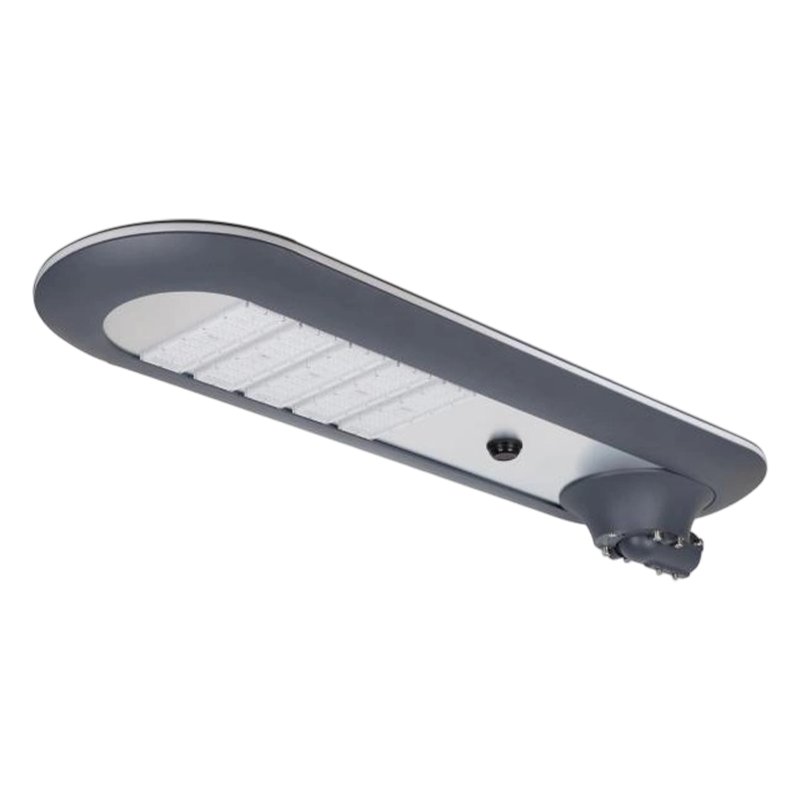
Waterproof Solar LED Street Light HS-TYX
Designed for Difficult Outdoor Environments
Outdoor lighting fixtures are exposed to conditions that are rarely present in indoor applications. Rainwater can enter through joints if sealing is weak. Humidity can accelerate corrosion or damage electrical components. Dust may collect around ventilation points, optical surfaces, and connection areas. In coastal environments, salt-laden air can make corrosion more severe. Industrial areas may add chemical vapors, airborne particles, vibration, and accidental impact.
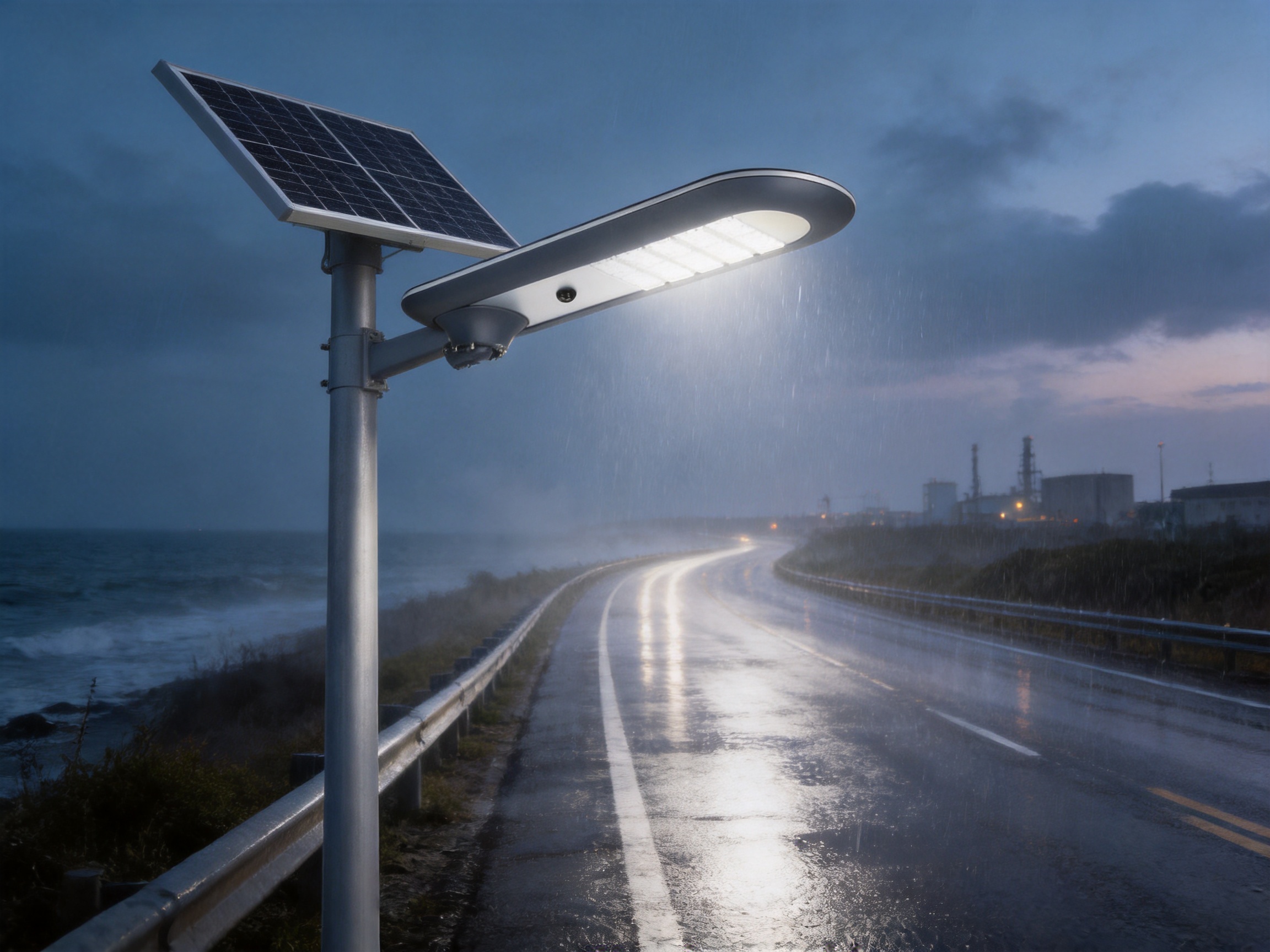
The HS-TYX is designed as a weather-resistant lighting system for harsh outdoor environments. Its stated IP65 protection grade indicates that the enclosure is designed to resist dust ingress and water jets from multiple directions. This is important for public roads, factory entrances, logistics yards, and other areas where the fixture is regularly exposed to rain and airborne contamination.
The IK08 rating adds a mechanical protection advantage. Outdoor luminaires may be struck by stones, tools, branches, maintenance equipment, or other objects. IK08 protection is not a guarantee against every type of impact, but it represents a stronger level of impact resistance than an unprotected or lightly constructed housing. This makes the fixture more appropriate for locations where accidental physical contact is possible.
Protection performance depends on the complete luminaire, including housing joints, seals, cable entries, mounting points, covers, and installation quality. For this reason, a reliable product design must consider more than the rating printed on a specification sheet. The enclosure needs a consistent structure, suitable sealing interfaces, and corrosion-resistant material selection. The HS-TYX product description emphasizes reinforced sealing design and corrosion-resistant materials, supporting its intended use in rainy, humid, coastal, and industrial environments.
Applications in Rainy and Humid Regions
In regions with frequent rainfall, a street light may remain exposed to water for many hours each week. Repeated wetting and drying cycles can place stress on seals and connection points. High humidity can also contribute to condensation inside a poorly protected housing. A weather-resistant solar street light should therefore be designed to minimize entry paths and protect sensitive electronic components.
The HS-TYX is suitable for roads, pathways, parking areas, and public spaces where regular rain exposure is expected. Its protection grade helps reduce the risk associated with dust and water entering the fixture during normal outdoor operation. Project designers can also request customization of the waterproof level when a specific installation has more demanding requirements.
Suitability for Coastal Areas
Coastal applications require special attention because salt in the atmosphere can accelerate the corrosion of exposed metal surfaces. A lighting housing installed near the sea may be subjected to wind-driven moisture, salt deposits, and intense sunlight. The combination of humidity and salt can gradually weaken untreated materials and fasteners.
The HS-TYX is positioned for coastal use through its corrosion-resistant material approach and reinforced sealing design. For a coastal project, buyers should confirm the required material grade, coating method, fastener selection, sealing arrangement, and maintenance schedule before production. The available OEM/ODM service can support housing structure and waterproof-level customization when the project requires a more specific environmental configuration.
Use in Industrial Outdoor Zones
Industrial outdoor zones often include loading bays, storage yards, access roads, manufacturing campuses, and perimeter areas. These locations may require high illumination efficiency, robust housing, and stable operation under dust and vibration. A failure in a remote yard or vehicle route may be inconvenient to repair, especially when the fixture is mounted high above the ground.
The HS-TYX is designed to reduce exposure-related problems through IP65 protection and IK08 impact resistance. Its 40W to 80W range gives project planners several output options. The most suitable model depends on pole spacing, mounting height, roadway width, required illuminance, solar resource, and local lighting standards. A professional lighting calculation should be completed before final model selection.
High-Efficiency LED Performance
The HS-TYX series provides a stated light effect of 190–200 lm/W ±5%. This specification expresses the amount of light produced for each watt of electrical input under the stated product conditions. High efficacy is particularly valuable in solar lighting because available electrical energy is limited by the solar panel, battery capacity, weather, and operating schedule.
When a fixture produces more light from the same electrical input, a project may be able to achieve the required illumination with lower power consumption. In a solar system, this can support a more balanced configuration between the LED load, solar panel, battery, and controller. It may also help extend operating time during periods of reduced sunlight, although actual autonomy depends on the complete solar design and local climate.
High light effect should not be evaluated in isolation. A suitable street light must also provide appropriate optical distribution, thermal management, color consistency, glare control, mechanical reliability, and long-term lumen maintenance. A lamp that produces strong laboratory output but creates excessive glare or poor roadway uniformity may not deliver the best real-world result. The HS-TYX should therefore be assessed as part of a complete photometric design.
Efficiency and Solar System Balance
Solar street lights collect energy during daylight and use stored energy after dark. The available energy changes with season, latitude, weather, panel orientation, shading, battery condition, and operating hours. Reducing unnecessary electrical consumption is therefore one of the most direct ways to improve system resilience.
The 40W, 60W, and 80W options allow the system to be matched to different road and area requirements. A lower-wattage model may be suitable for pathways, residential streets, or areas with moderate lighting demand. A higher-wattage model may be considered for wider roads, industrial yards, intersections, or locations requiring a larger illuminated area. The final choice should be supported by a DIALux or equivalent lighting calculation and by a solar autonomy assessment.
High efficiency can also reduce the size pressure on other solar components. However, it does not automatically mean that every project can use a smaller panel or battery. The system must still account for the desired number of operating hours, dimming profile, consecutive cloudy days, seasonal solar radiation, battery chemistry, and local regulations. A manufacturer with solar configuration experience can help coordinate these variables.
Thermal Considerations
LED performance and service life are influenced by operating temperature. Excess heat can accelerate the aging of LED packages, drivers, seals, and other electronic parts. Outdoor fixtures installed under direct sunlight may experience high surface temperatures even before the lamp is switched on.
A durable luminaire should provide a housing structure that supports heat dissipation while maintaining protection against water and dust. The mechanical design must balance thermal management with sealing. Open ventilation may improve airflow but can create contamination paths, while a fully sealed structure requires careful attention to heat transfer through the housing.
For this reason, the housing structure is an important part of the HS-TYX platform. The product supports OEM/ODM customization of the housing structure, enabling project requirements to be considered during development. Buyers should request thermal test information, operating temperature ranges, driver details, and lumen-maintenance data when evaluating the product for large-scale deployment.
Three Wattage Options for Flexible Project Planning
The HS-TYX product family is available in three main configurations. The 40W model measures 966 × 410 × 180 mm. The 60W model measures 1,130 × 410 × 180 mm. The 80W model measures 1,380 × 410 × 180 mm. The dimensions increase with the rated wattage, providing a larger housing platform for the higher-output versions.
| Product Model | Input Wattage | Product Size | Typical Planning Consideration |
|---|---|---|---|
| HS-TYX-40W | 40W | 966 × 410 × 180 mm | Suitable for lower-power roadway, pathway, and area-lighting requirements |
| HS-TYX-60W | 60W | 1,130 × 410 × 180 mm | Balanced option for general streets, access roads, and medium-area applications |
| HS-TYX-80W | 80W | 1,380 × 410 × 180 mm | Suitable for higher-output applications and larger illuminated areas |
The table provides a starting point rather than a substitute for a lighting design. Road width, pole height, pole spacing, mounting angle, pavement reflectance, local lighting class, and required uniformity all affect the correct selection. Two roads with the same length may require different luminaires because their widths, traffic levels, and pole layouts differ.
The choice of wattage should also consider solar availability. An 80W lamp may deliver a larger illuminated area, but it generally requires a more substantial solar energy configuration than a 40W lamp. In regions with long rainy seasons, the solar panel and battery may need to be sized for reliable operation during consecutive days of low solar input. A project should evaluate both nighttime lighting demand and daytime energy recovery.
Compact Integration of Light and Solar Components
Solar street lights are often selected for locations where grid connection is difficult, expensive, or unavailable. The product must therefore support efficient integration with a solar panel, battery, controller, and mounting arrangement. A well-planned integrated system reduces the need for separate electrical infrastructure and may simplify installation along remote roads or newly developed sites.
The HS-TYX product description identifies solar system configuration as an area available for OEM/ODM support. This is useful for projects with different autonomy requirements, panel dimensions, battery locations, control strategies, or installation conditions. Instead of forcing every customer into a single standard configuration, customization can help align the luminaire with a regional solar design.
Project buyers should clarify whether the required solar panel, battery, controller, mounting accessories, and remote-management functions are included in the final quotation. They should also confirm battery placement, expected operating schedule, dimming options, charging behavior, and protection functions. These details influence system performance and should be defined before mass production.
Advantages Over Generic Outdoor Lighting Alternatives
Many basic outdoor lamps are designed primarily for connection to a stable grid supply. They may not provide the same level of attention to solar energy management, battery autonomy, or remote installation conditions. A solar street light must be evaluated on how effectively it converts limited daytime energy into dependable nighttime illumination.
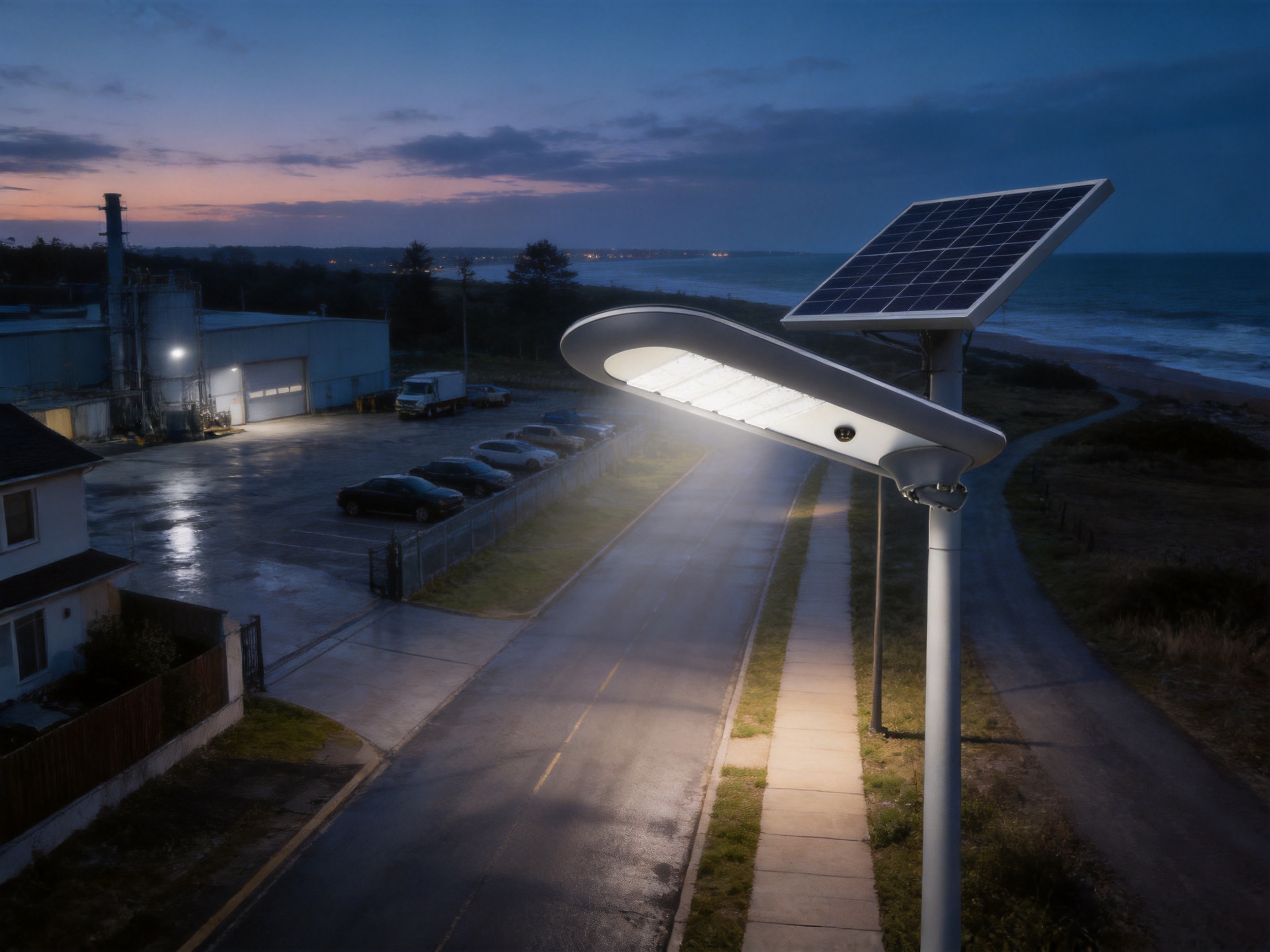
Compared with a conventional grid-powered street light, the HS-TYX can help reduce the need for underground cables, trenching, utility connection work, and ongoing electricity supply. This is especially valuable for rural roads, construction sites, remote campuses, parks, and areas where extending the grid is technically complicated or financially unattractive.
Compared with lower-cost generic solar lamps, the HS-TYX offers a more clearly defined protection level, impact-resistance rating, wattage range, and customization path. Generic products may use a fixed housing and a limited configuration that cannot be adapted to a specific climate or solar resource. The HS-TYX platform is intended to support reinforced sealing, housing customization, waterproof-level adjustments, and solar system configuration.
Compared with products designed only for mild climates, its stated application focus includes coastal, rainy, highway, and industrial environments. These applications require greater attention to sealing, corrosion resistance, mechanical strength, and maintenance accessibility. Product selection should still be based on verified test reports and project-specific conditions, but the design direction is aligned with challenging outdoor use.
Lower Dependence on Grid Infrastructure
Grid-connected lighting can be highly effective where reliable electrical infrastructure already exists. However, it may be expensive to install along undeveloped roads or large industrial sites. Cable theft, trench damage, power interruptions, and utility expansion can also create long-term concerns.
A solar street light generates power locally. This can make it appropriate for locations where electrical connection is unavailable or where construction work must be minimized. The installation process may be faster because the system does not require the same level of cable routing and electrical trenching as a grid-powered project. The exact installation requirements depend on the selected solar architecture and local electrical standards.
Reduced Exposure to Weather-Related Failure
Weather resistance is a major differentiator in outdoor lighting. A fixture with weak sealing may suffer from water ingress, corrosion, or electrical faults. The HS-TYX focuses on IP65 protection, reinforced sealing, and corrosion-resistant materials to address these risks.
Its IK08 rating also provides an advantage in environments where mechanical impact is possible. A stronger enclosure can help protect the optical and electrical elements from accidental contact. This is important near industrial traffic routes, public pathways, maintenance areas, and roads where debris may be thrown by passing vehicles.
More Options for Custom Projects
Standardized products are efficient for simple applications, but large infrastructure projects often require adjustments. Pole dimensions, mounting arrangements, solar conditions, color temperatures, operating schedules, housing materials, and control systems may vary from one market to another. A product that supports OEM/ODM development can reduce the need to compromise between a standard catalog model and the actual project requirement.
The HS-TYX supports customization in waterproof level, housing structure, and solar system configuration. These options allow buyers to discuss environmental requirements at the design stage. Customization should be managed through technical drawings, prototypes, validation tests, and clearly approved production samples. This process helps ensure that modifications do not reduce optical performance, structural strength, or protection levels.
Manufacturing Capabilities Behind the Product
A reliable lighting product depends on manufacturing discipline as much as on its visible design. Cixi HuaSheng Lighting Co., Ltd. is located in Ningbo, China, and operates as an outdoor lighting manufacturer serving international customers. Its product scope includes LED street lights, tunnel lights, high-bay lights, linear lights, garden lights, solar lights, grow lights, explosion-proof lights, and other lighting products.
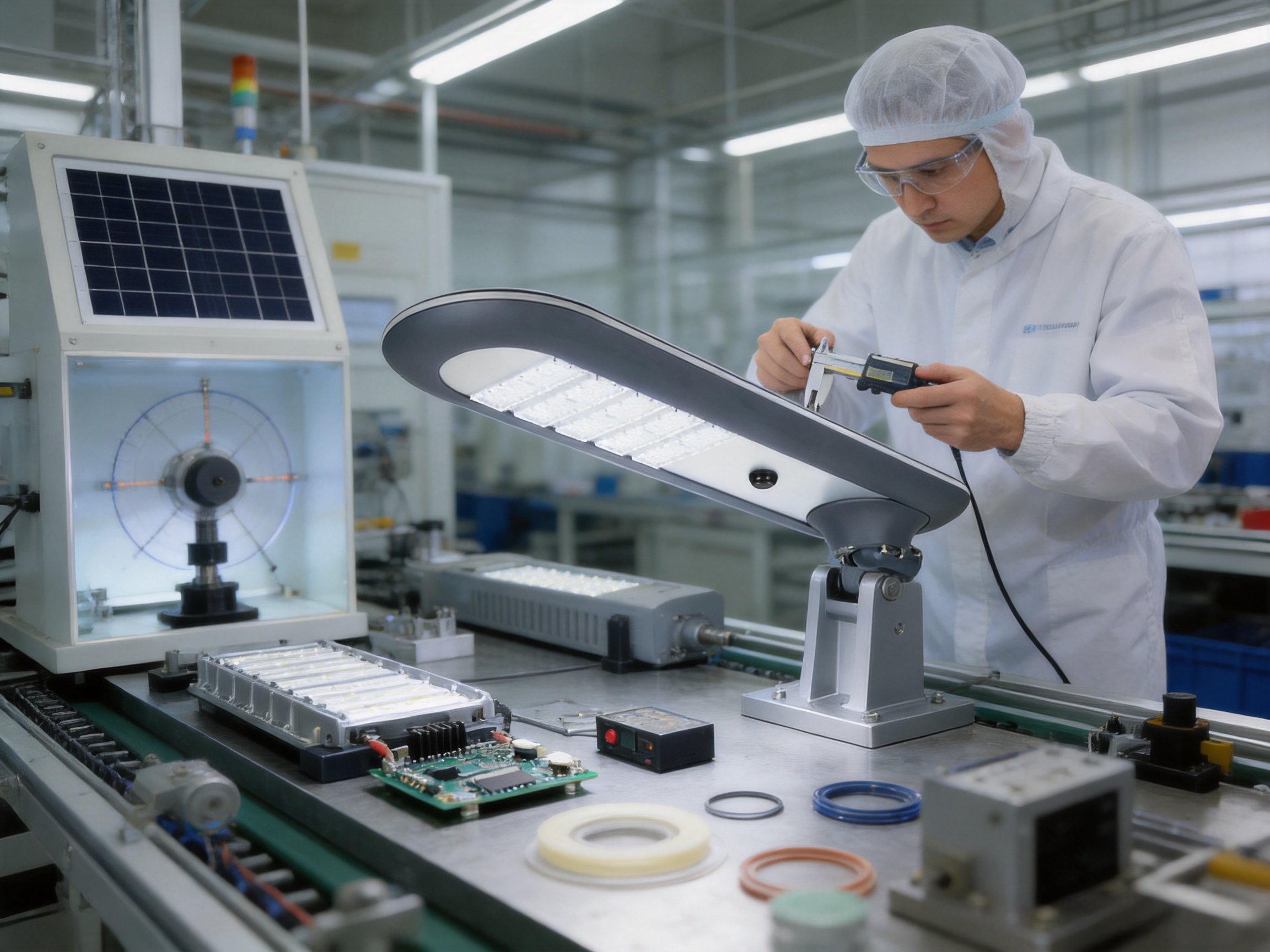
The company’s manufacturing resources include die-casting and CNC machines, aging lines, and goniophotometers. These capabilities support several important stages of luminaire production. Die-casting can be used to create strong and dimensionally consistent metal housings. CNC machining can refine mounting surfaces, connection interfaces, and other precision features. Aging lines can support product screening by operating fixtures for a defined period before shipment. Goniophotometers can measure photometric characteristics and help validate light distribution.
Die-Casting for Strong Housing Structures
Die-casting is widely used in LED lighting because it can produce complex metal housings with repeatable geometry and good structural rigidity. For outdoor street lights, the housing must accommodate LED modules, optical components, drivers, mounting interfaces, covers, seals, and heat-dissipation surfaces.
A stable die-cast structure can help maintain alignment between the optical and mechanical components. It can also provide a consistent base for sealing and surface treatment. The quality of the final housing depends on mold design, alloy selection, casting parameters, finishing, inspection, and subsequent machining.
For the HS-TYX, die-casting capability supports the development of a robust outdoor structure. When a customer requests housing customization, engineering teams can consider mounting angles, pole interfaces, panel integration, drainage paths, thermal surfaces, and service access. These decisions are important because a housing designed only for appearance may be difficult to assemble, maintain, or protect against weather.
CNC Machining for Precision Interfaces
CNC machining can improve the accuracy of critical surfaces after casting. Mounting holes, connection areas, sealing grooves, cable openings, and assembly interfaces may require tighter dimensional control than a raw cast surface can provide. Proper machining supports repeatable assembly and can reduce variation between production batches.
Precision is especially important for outdoor products because small deviations can affect gasket compression, pole mounting stability, optical alignment, and water-resistance performance. CNC processing also allows a manufacturer to refine prototypes and customized structures without relying only on manual modification.
Aging Lines for Production Screening
LED luminaires contain electronic components that may reveal early defects during operation. Aging or burn-in processes operate products for a controlled period under defined conditions. This process can help identify certain early failures before products leave the factory.
Aging is not a substitute for component qualification, environmental testing, or long-term field validation. Nevertheless, it is a useful part of a broader quality system. For a solar street light, the aging process should ideally consider the LED module, driver, controller, charging functions, switching behavior, and relevant protection circuits. Customers should request information about the aging procedure, duration, operating conditions, and inspection records when purchasing for large projects.
Photometric Measurement with Goniophotometers
A goniophotometer measures the distribution of light emitted by a luminaire as it is rotated through different angles. The resulting data can be used to generate photometric files and evaluate luminous intensity, beam distribution, uniformity, and other characteristics.
This equipment is valuable for street lighting because the objective is not simply to produce high lumen output. The light must be directed toward the roadway or target area while controlling spill light and glare. Photometric testing can support DIALux calculations, project design, compliance documentation, and comparison between product versions.
For the HS-TYX series, professional photometric measurement helps connect the stated 190–200 lm/W ±5% light effect with practical optical performance. Buyers should request the appropriate test data, including measurement conditions and photometric files, when preparing a tender or installation plan.
Quality and Certification Strengths
The manufacturer states that it is certified to ISO 9001, ISO 14001, and ISO 45001. These standards address quality management, environmental management, and occupational health and safety management respectively. Certification does not eliminate the need for product-specific inspection, but it indicates that the company has established formal management systems in these areas.
The company also states that relevant products are certified by CB and CE. These certifications can support international market access, although the exact applicability depends on the product model, target country, electrical configuration, and current regulatory requirements. Buyers should verify the certificate scope and confirm that the delivered HS-TYX configuration matches the tested version.
Quality Management
ISO 9001-oriented processes can help organize document control, supplier evaluation, production procedures, corrective actions, inspection records, and customer feedback. For a customized solar street light, document control is particularly important. Housing changes, component substitutions, solar configuration revisions, and firmware or controller updates should be recorded and approved.
A structured quality system also helps create consistency between prototypes and mass-production units. This is important because a sample that performs well cannot guarantee that every later unit will have the same sealing, optical output, wiring, or mechanical quality unless production controls are maintained.
Environmental Responsibility
Outdoor lighting projects are increasingly evaluated according to energy efficiency, product life, recyclability, and manufacturing impact. ISO 14001 certification indicates a formal approach to environmental management. High-efficiency LED technology can reduce operating energy consumption, while solar operation can reduce reliance on grid electricity in suitable locations.
Environmental performance should be considered across the product life cycle. Buyers should examine material selection, packaging, battery replacement, end-of-life handling, repairability, and the expected service period. Solar street lighting can provide strong environmental benefits, but responsible battery management is essential because batteries are central to system operation and require appropriate recycling or disposal.
Occupational Health and Safety
Lighting manufacturing involves casting, machining, surface treatment, electrical assembly, testing, and warehouse operations. ISO 45001 certification reflects attention to workplace risk management. A safer manufacturing environment can support more stable production and reduce interruptions caused by preventable incidents.
Installation and Project Planning
Correct installation is essential for achieving the intended performance of the HS-TYX. Before installation, project teams should review the roadway layout, pole height, pole spacing, mounting direction, solar panel orientation, shading conditions, soil stability, wind exposure, and access for future maintenance.
The solar panel needs adequate access to sunlight during the charging period. Nearby buildings, trees, walls, utility structures, and other poles can create shade. Seasonal changes should also be considered because a location that receives good sunlight in summer may experience significant shading in winter. The battery and controller configuration must be selected based on local solar radiation and the required lighting schedule.
The fixture should be mounted securely using compatible hardware and a suitable pole interface. The mounting structure must withstand the local wind load and the weight of the complete assembly. In coastal or high-wind locations, engineering review may be required for pole foundation, fasteners, surface treatment, and installation angle.
Lighting Calculation Before Purchase
A lighting calculation helps determine whether the 40W, 60W, or 80W model is appropriate. The calculation should include road width, pole arrangement, installation height, overhang, tilt angle, pavement characteristics, target illuminance, uniformity, glare limits, and applicable standards.
Photometric files from the selected fixture can be imported into lighting design software. The results can then show whether the proposed arrangement provides sufficient illumination across the roadway and surrounding areas. This approach is more reliable than selecting a wattage based only on the total road length or the nominal lumen figure.
Solar Autonomy Assessment
Solar autonomy refers to how long the system can continue operating when solar charging is insufficient. The required autonomy may vary according to climate, road importance, maintenance access, and project budget. A remote highway may require a different reserve strategy than a small garden path.
The assessment should consider average and worst-case solar radiation, panel output, battery usable capacity, charging efficiency, controller performance, lamp wattage, nighttime operating hours, dimming schedules, and consecutive cloudy days. The HS-TYX platform can be configured for project-specific solar requirements, but the final design must be based on local environmental data.
Maintenance Access
Even a durable solar street light requires periodic inspection. Maintenance teams may need to clean the solar panel, inspect seals and fasteners, check battery condition, verify charging performance, and examine the pole and foundation. Dust, bird activity, leaves, and industrial deposits can reduce panel output if they accumulate on the surface.
The luminaire should be installed in a way that allows technicians to access the relevant components safely. Maintenance procedures should identify which parts are replaceable, how the housing is opened, how cable connections are protected, and how the system is isolated before service. Clear maintenance documentation can reduce downtime and support consistent field performance.
OEM and ODM Customization Opportunities
OEM and ODM services allow customers to develop lighting products that match specific market or project requirements. The HS-TYX series supports customization of waterproof level, housing structure, and solar system configuration. These options may be relevant to municipal tenders, infrastructure programs, regional distributors, engineering contractors, and lighting brands.
Waterproof-Level Customization
Different environments may require different protection strategies. A standard IP65 configuration may be suitable for many outdoor applications, while a project with severe water exposure or specialized washing procedures may require additional design review. Buyers should define the expected water conditions, cleaning methods, installation angle, cable-entry requirements, and inspection standard.
Any change to the sealing structure should be validated through appropriate testing. A larger gasket, a revised joint, or a different cable gland can affect assembly time, compression, serviceability, and long-term performance. Customization should therefore be developed as an engineered solution rather than as a cosmetic modification.
Housing-Structure Customization
Housing customization may involve dimensions, pole interfaces, mounting brackets, optical compartments, panel integration, heat-dissipation features, access covers, or surface treatment. The manufacturer’s die-casting and CNC machining resources can support the development of revised structures and precision interfaces.
Customers should provide installation drawings, target dimensions, environmental requirements, preferred materials, and expected annual volume. The development process may include design review, mold development, prototype production, photometric testing, mechanical testing, thermal evaluation, and pilot production.
Solar-System Configuration
Solar customization can include panel capacity, battery configuration, controller settings, dimming schedules, operating profiles, and system architecture. In some projects, the battery is integrated into the lamp body; in others, it may be installed in a separate housing or below the panel. The preferred arrangement depends on temperature, security, accessibility, and service requirements.
Customers should specify the desired daily operating hours, expected autonomy, local climate, minimum battery reserve, charging strategy, and any remote monitoring requirements. The more accurately these conditions are described, the more appropriately the solar system can be configured.
Applications Across Multiple Outdoor Sectors
The HS-TYX is suitable for a broad range of outdoor lighting projects where solar operation and weather resistance are important.
Municipal Streets and Residential Roads
Municipal and residential roads often require consistent lighting with manageable installation and operating costs. Solar street lights can be considered for new developments, low-density communities, rural roads, and areas where grid expansion is delayed. The 40W and 60W versions may be appropriate for many moderate-width streets, subject to lighting calculations.
Highways and Access Roads
Highways, service roads, and access routes require careful attention to uniformity, glare, pole spacing, and safety. The HS-TYX’s weather-resistant design is relevant to roads exposed to rain, dust, wind, and vehicle-related impact. The 80W version may be considered where the required illumination area is larger, but the final selection must follow the road classification and engineering design.
Industrial Parks and Logistics Areas
Industrial parks and logistics areas may operate throughout the night. Truck routes, loading zones, storage yards, and security perimeters require dependable illumination. The IP65 and IK08 ratings provide a useful protection foundation for these environments, while the solar configuration can help reduce the need for extensive cabling across large sites.
Coastal Walkways and Public Spaces
Coastal walkways, promenades, parking areas, and recreational spaces are visually sensitive but also exposed to salt and moisture. Corrosion-resistant materials and reinforced sealing are important considerations. Buyers should also confirm the preferred housing finish, fastener materials, and maintenance plan for the local marine environment.
Remote and Off-Grid Locations
Remote locations may include agricultural roads, mining access routes, emergency access paths, rural communities, and construction sites. In these areas, the cost of installing grid infrastructure can be high. A solar street light can operate independently when the solar panel, battery, controller, and LED load are correctly matched.
How to Compare the Product with Competing Solutions
Comparing outdoor lighting products only by wattage or initial price can lead to an incomplete decision. A professional comparison should include protection, efficiency, optical data, materials, solar autonomy, maintenance, certification, customization, and total cost of ownership.
First, compare the actual protection level and test conditions. An IP rating should be supported by appropriate documentation, and the product configuration tested should match the delivered model. Also examine impact resistance, corrosion protection, operating temperature, and resistance to vibration.
Second, compare useful optical performance rather than only nominal lumens. Review the light distribution, beam angle, color temperature, color rendering, uniformity, glare, and available photometric files. A high lm/W value is valuable, but the light must be directed effectively onto the target surface.
Third, compare the solar system rather than the lamp alone. Examine panel capacity, battery technology, usable battery energy, charge-controller functions, autonomy, dimming schedule, and protection against overcharging or deep discharge. A low-cost lamp with an undersized battery may appear attractive initially but deliver poor reliability during cloudy periods.
Fourth, compare manufacturing and support capabilities. Die-casting, CNC machining, aging lines, and photometric equipment can support more consistent production and better engineering control. ISO management certifications and CB or CE documentation may also help buyers evaluate supplier readiness.
Finally, compare customization and after-sales support. A supplier that can adapt the housing, waterproof structure, and solar configuration may provide better project fit than a supplier offering only fixed catalog products. Spare parts, technical drawings, installation instructions, test reports, and warranty procedures should be included in the purchasing discussion.
Total Cost of Ownership
The initial purchase price is only one part of the cost of an outdoor lighting project. Total cost of ownership includes transportation, installation, foundations, poles, solar components, grid connection or cable work, electricity consumption, maintenance, component replacement, and end-of-life handling.
Solar street lights can reduce electricity expenses and avoid some grid construction costs. Their value is particularly clear where trenching or utility connection is expensive. However, batteries and other electronic components have finite service lives and must be included in the lifecycle budget.
A high-efficiency luminaire may reduce the energy required for the same target illumination. Better protection can reduce the frequency of weather-related repairs. Stronger mechanical construction may reduce replacement caused by accidental impact. These benefits should be considered alongside the initial price when comparing the HS-TYX with less expensive alternatives.
Maintenance planning also affects total cost. Fixtures that are difficult to open, inspect, or replace can increase labor expenses. A project should identify whether the LED module, driver, controller, battery, panel, and sealing components can be serviced independently. Documentation and spare-parts availability can improve long-term project economics.
Recommended Procurement Process
A structured procurement process helps reduce technical and commercial risk. The first step is to define the application: road type, location, climate, pole height, spacing, operating hours, illumination target, and required autonomy.
The second step is to request the complete product specification. This should include the exact HS-TYX model, wattage, dimensions, LED information, light effect, IP and IK ratings, materials, driver or controller details, solar panel data, battery data, operating temperature, and warranty terms.
The third step is to review photometric and solar calculations. The supplier should provide appropriate files and explain the assumptions used in the design. The customer can then verify whether the proposed fixture meets the project’s lighting and autonomy objectives.
The fourth step is sample evaluation. A sample should be inspected for housing finish, fastener quality, sealing, mounting fit, cable entry, label information, optical appearance, charging behavior, and nighttime performance. For customized products, the approved sample should become the reference for mass production.
The fifth step is production quality control. Inspection plans should cover incoming components, die-cast housings, CNC features, electrical assembly, sealing, aging, photometric performance, packaging, and final appearance. Critical changes should require customer approval.
The final step is installation and post-installation verification. Teams should confirm pole stability, panel orientation, lighting direction, charging performance, operating schedule, and system response. A commissioning record can provide a useful baseline for future maintenance.
Frequently Asked Questions
What is the main purpose of the HS-TYX solar street light?
The HS-TYX is designed to provide reliable outdoor illumination in locations that may experience rain, humidity, dust, corrosion, and mechanical impact. It combines LED lighting with a solar-compatible system configuration for streets, highways, industrial zones, coastal areas, and other outdoor applications.
What wattages are available?
The series includes 40W, 60W, and 80W models. The listed models are HS-TYX-40W, HS-TYX-60W, and HS-TYX-80W. The correct model should be selected according to the lighting calculation, mounting arrangement, road dimensions, and solar resource.
What are the product dimensions?
The HS-TYX-40W measures 966 × 410 × 180 mm. The HS-TYX-60W measures 1,130 × 410 × 180 mm. The HS-TYX-80W measures 1,380 × 410 × 180 mm.
What is the stated light effect?
The stated light effect is 190–200 lm/W ±5%. This figure should be considered together with optical distribution, thermal conditions, operating current, and the complete photometric test report.
What protection ratings does the product have?
The listed protection grade is IP65/IK08. IP65 indicates protection against dust ingress and water jets under the applicable test conditions, while IK08 indicates a specified level of impact resistance. Actual performance depends on the complete product configuration and correct installation.
Is the product suitable for coastal areas?
The product is intended for coastal use and emphasizes corrosion-resistant materials and reinforced sealing. Coastal projects should still confirm the required coating, metal materials, fasteners, sealing design, and maintenance schedule according to local salt exposure.
Can the waterproof level be customized?
Yes. OEM/ODM support includes waterproof-level customization. Any change should be defined through technical documentation and validated with appropriate testing before mass production.
Can the housing structure be customized?
Yes. Housing structure customization is available. This may support changes related to mounting, dimensions, sealing, thermal management, component integration, or project-specific installation conditions.
Can the solar system be customized?
Yes. Solar system configuration is included in the stated OEM/ODM service. Customers should provide information about operating hours, autonomy, local sunlight conditions, battery preferences, dimming requirements, and installation constraints.
Does the product require a lighting calculation?
Yes. A lighting calculation is recommended before purchase. Road width, pole height, pole spacing, mounting angle, target illuminance, uniformity, and local standards should be considered when selecting the model and layout.
What manufacturing equipment supports the product?
The manufacturer has die-casting and CNC machines, aging lines, and goniophotometers. These resources support housing production, precision machining, production screening, and photometric evaluation.
What certifications and management systems are stated?
The manufacturer states that it is certified to ISO 9001, ISO 14001, and ISO 45001. It also states that relevant products have CB and CE certifications. Buyers should verify the scope and validity of documentation for the exact product configuration and destination market.
What should buyers confirm before ordering?
Buyers should confirm the exact model, wattage, dimensions, optical data, IP and IK ratings, solar panel, battery, controller, autonomy, operating schedule, mounting arrangement, materials, certifications, warranty, spare parts, packaging, and inspection requirements.
Conclusion
The Waterproof Solar LED Street Light HS-TYX is developed for outdoor projects where efficiency, weather resistance, solar adaptability, and manufacturing support are important. Its 40W to 80W range provides flexibility for different roads and areas, while its stated 190–200 lm/W ±5% light effect supports energy-conscious solar system design. IP65 and IK08 protection provide a defined foundation for use in rainy, dusty, coastal, highway, and industrial environments.
The product’s competitive value is strengthened by more than its basic specifications. Reinforced sealing, corrosion-resistant materials, housing customization, waterproof-level customization, and solar system configuration support allow it to be adapted to project conditions. The manufacturer’s die-casting, CNC machining, aging, and photometric capabilities provide an engineering and production foundation for consistent outdoor lighting products.
For the best result, the HS-TYX should be specified as part of a complete lighting and solar plan. Buyers should evaluate photometric performance, solar autonomy, installation conditions, maintenance access, certification documentation, and lifecycle cost. When these factors are properly coordinated, the product can provide a practical and durable solution for streets, highways, industrial areas, coastal spaces, and remote outdoor locations.
References
1. International Electrotechnical Commission. Degrees of Protection Provided by Enclosures for Electrical Equipment.
2. International Electrotechnical Commission. Degrees of Protection Provided by Enclosures Against External Mechanical Impacts.
3. International Organization for Standardization. Quality Management Systems: Requirements.
4. International Organization for Standardization. Environmental Management Systems: Requirements with Guidance for Use.
5. International Organization for Standardization. Occupational Health and Safety Management Systems: Requirements with Guidance for Use.
6. International Commission on Illumination. Recommendations for the Lighting of Roads for Motor and Pedestrian Traffic.
7. International Electrotechnical Commission. Photobiological Safety of Lamps and Lamp Systems.
8. Illuminating Engineering Society. Lighting Handbook and Outdoor Lighting Design Practices.
9. Manufacturer-provided product specifications for the HS-TYX waterproof solar LED street light.
10. Manufacturer-provided information concerning outdoor lighting production, quality systems, customization, and testing capabilities.
Product: Waterproof Solar LED Street Light HS-TYX
Custom & OEM Solutions for Global Lighting Brands
Copyright © Cixi HuaSheng Lighting Co., Ltd. All Rights Reserved.
Die-Casting Mould Supplier
