 English
 中文简体
 русский
 Français
 Español
 عربى
 Indonesia

Outdoor Solar Path Light ZC-TYD2705 and ZC-TYD2403: Efficient, Durable Illumination for Modern Pathways
Outdoor pathways require lighting that is reliable, practical, and visually compatible with the surrounding environment. Whether the setting is a public park, residential community, hotel garden, scenic walkway, campus, or industrial landscape, pathway lighting must provide more than basic brightness. It must support pedestrian safety, organize movement, withstand outdoor exposure, operate efficiently, and remain simple to manage over time.
The Outdoor Solar Path Light ZC-TYD2705 and ZC-TYD2403 are designed to meet these requirements through an integrated solar-powered lighting structure. Both models combine a die-cast aluminum body, a solar panel, a rechargeable battery, 80 LED chips, adjustable color temperature, and intelligent operating functions. Together, these features create a practical lighting solution for locations where grid connection may be inconvenient, expensive, or undesirable.
These solar path lights are intended for customers seeking a dependable outdoor lighting product with a clean installation concept and flexible customization options. Instead of requiring underground power cables throughout a site, the fixtures collect energy during daylight and use stored power for illumination after sunset. This approach can simplify project planning, reduce dependence on conventional electrical infrastructure, and provide greater freedom when arranging outdoor lighting layouts.
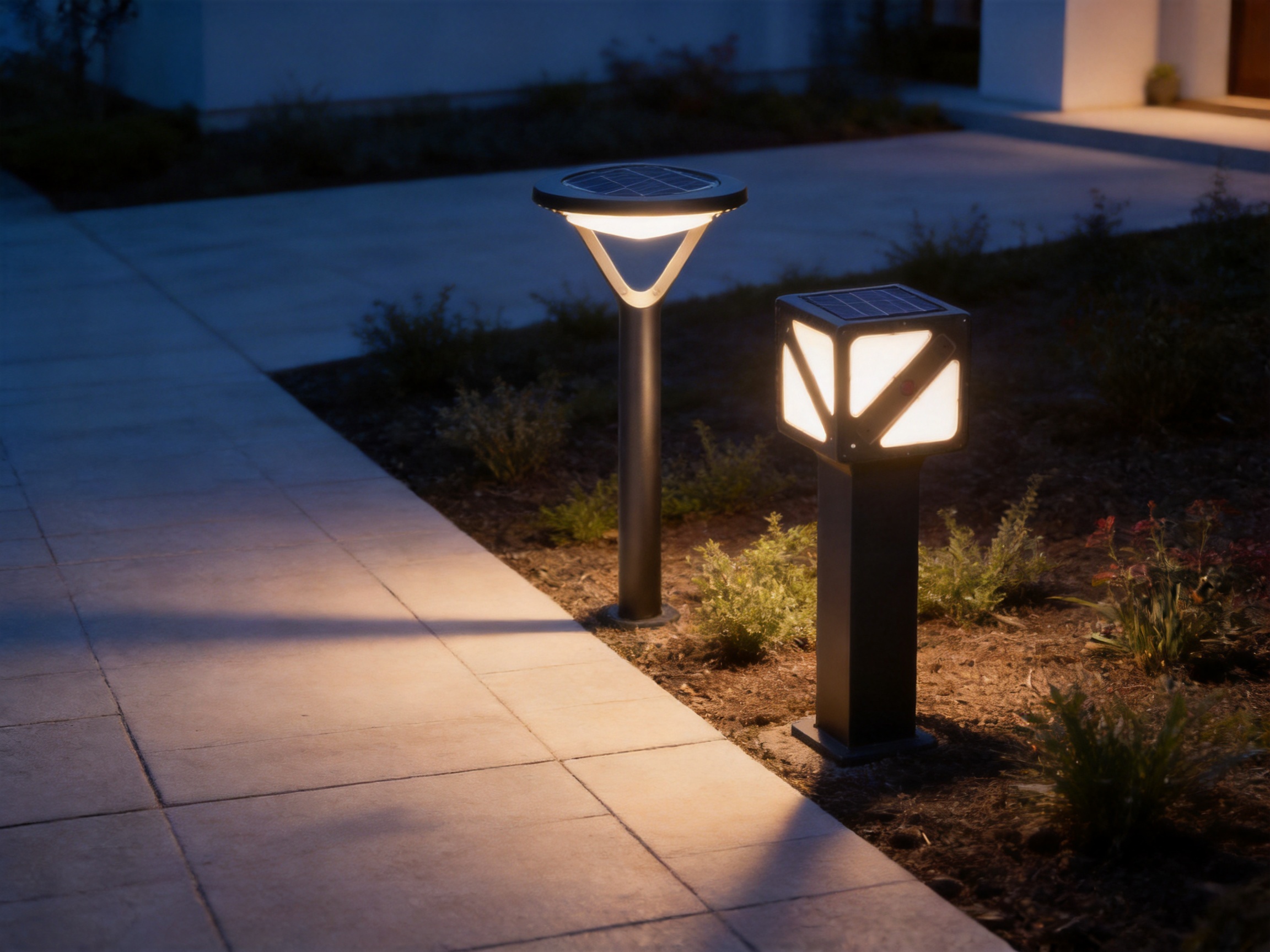
The two models share the same main electrical and material configuration while offering different housing shapes and dimensions. The ZC-TYD2705 uses a round form with a diameter of 480 mm and a height of 410 mm. The ZC-TYD2403 uses a square form measuring 400 mm by 400 mm with a height of 420 mm. This choice allows project designers to select a visual style that best suits the landscape architecture and overall site character.

Outdoor Solar Path Light ZC-TYD2705/ZC-TYD2403
Product Overview
The ZC-TYD2705 and ZC-TYD2403 belong to the category of solar garden and pathway lighting. Their primary purpose is to illuminate pedestrian routes in outdoor areas. They can be used along walkways, garden paths, park routes, entrance roads, courtyards, residential passages, resort landscapes, and scenic areas.
The lighting arrangement is intended to guide pedestrians safely at night. A well-planned path light installation can help identify changes in direction, steps, junctions, edges, entrances, and activity areas. It can also contribute to the visual organization of a landscape by creating a consistent lighting rhythm along a route.
Unlike large-area floodlights or high-mounted street lights, pathway lights are generally installed closer to pedestrian level. This makes them suitable for creating localized illumination without unnecessarily lighting the entire surrounding area. The result can be a more comfortable nighttime environment, particularly in gardens, residential spaces, and recreational areas where excessive brightness may reduce visual comfort.
Both models are designed as self-contained solar fixtures. The solar panel, battery, LED light source, and control functions are integrated into the product system. This integrated approach reduces the number of external components required during installation and can help simplify project coordination.
Shared Configuration
The two models use die-cast aluminum as the primary material. This material is commonly selected for outdoor lighting housings because it provides a strong structural base and supports the manufacture of clean, consistent shapes. A properly finished aluminum housing can also contribute to long-term resistance against normal outdoor exposure.
Each model is equipped with a 5V/20W solar panel and a 3.2V/20000mAh battery. The solar panel collects energy during daylight, while the battery stores energy for nighttime operation. Both products use 80 LED chips, providing a distributed light source across the fixture rather than relying on a single light-emitting element.
The color temperature range is listed as 3000-6500K. This range allows the lighting appearance to move from a warmer tone suitable for gardens and residential landscapes to a cooler white tone that may be preferred for clearer route definition and more functional outdoor environments.
The ZC-TYD2705 is listed with time control, microwave sensor, and optical sensor functions. These functions can help the lighting system respond to operating schedules, surrounding movement, and available ambient light. The supplied specification table does not list the same working-mode details separately for the ZC-TYD2403, so project buyers should confirm the final control configuration when requesting a quotation or customized production.
Technical Specification Table
| Specification | ZC-TYD2705 | ZC-TYD2403 |
|---|---|---|
| Product category | Solar garden light | Solar garden light |
| Primary application | Outdoor pathway illumination | Outdoor pathway illumination |
| Material | Die-casting aluminum | Die-casting aluminum |
| Solar panel | 5V/20W | 5V/20W |
| Battery | 3.2V/20000mAh | 3.2V/20000mAh |
| Quantity of LED chips | 80 pieces | 80 pieces |
| Listed working modes | Time control, microwave sensor, optical sensor | To be confirmed according to project configuration |
| Color temperature | 3000-6500K | 3000-6500K |
| Dimensions | Diameter 480 mm × height 410 mm | 400 mm × 400 mm × height 420 mm |
Why Solar Path Lighting Is Valuable for Outdoor Projects
Conventional pathway lighting often requires a complete electrical infrastructure. This may include trenching, conduit, underground cables, junction boxes, transformers, and connection work. In a new construction project, these requirements can be included in the original site plan. In an existing garden or park, however, excavation may disturb paving, vegetation, drainage systems, and established landscaping.
Solar pathway lighting offers an alternative installation concept. Because the fixture generates and stores its own energy, it may reduce the need for long cable runs between the lighting points and a central power source. This can be particularly useful in locations where trenching is difficult or where the route changes frequently during landscape development.
Solar fixtures can also support more flexible placement. A project team can position lights according to the actual pedestrian route, landscape composition, planting arrangement, or architectural feature instead of being restricted by the location of an existing power supply. This flexibility is valuable for parks, scenic areas, resort gardens, and temporary or phased developments.
Another advantage is the potential reduction in operating electricity consumption from the public grid. During normal operation, the fixture relies on solar energy collected during the day. The actual performance depends on solar exposure, weather conditions, battery condition, control settings, installation angle, and local climate, but the basic operating principle is designed to reduce dependence on conventional grid electricity.
Solar path lights may also be suitable for projects that emphasize environmental responsibility. The company manufactures a broad range of energy-efficient lighting products and identifies environmental management as part of its operational system. When solar fixtures are combined with efficient LED technology and suitable control functions, they can contribute to a more resource-conscious outdoor lighting plan.
Advantages of the ZC-TYD2705 and ZC-TYD2403
Integrated Solar Operation
The most important advantage of these models is their integrated solar lighting structure. The fixture combines a solar panel, rechargeable battery, LED source, housing, and control system within one outdoor product. This reduces the number of separate items that installers and project managers need to coordinate.
An integrated structure can also make the product easier to specify. Instead of selecting a light source, battery system, solar module, and control device from different suppliers, the buyer can evaluate one coordinated product configuration. This can help reduce compatibility concerns during project planning.
Large Battery Capacity for Nighttime Use
Both models are specified with a 3.2V/20000mAh battery. Battery capacity is an important factor in solar lighting because it determines how much energy can be stored for nighttime use and for periods when solar charging conditions are less favorable.
The battery works together with the control system and LED output. A project should not assess battery capacity in isolation; actual runtime also depends on LED power, operating mode, sensor settings, weather, temperature, battery chemistry, and charging conditions. Nevertheless, the listed 20000mAh configuration provides a substantial storage specification for a compact pathway lighting product.
For professional projects, buyers should confirm the battery type, expected cycle life, operating temperature range, charging protection, discharge protection, and replacement procedure before final approval. These details help ensure that the product is correctly matched to the intended environment.
Distributed LED Light Source
Each model uses 80 LED chips. A multi-chip arrangement can support a broad and more uniform light-emitting area compared with a single concentrated source. This is useful for path lighting because pedestrians need visual guidance across a route rather than an isolated point of intense brightness.
The LED source is also compatible with the energy-saving design of a solar fixture. LED technology generally provides efficient conversion of electrical energy into light, long service potential, compact size, and design flexibility. These characteristics make LED chips suitable for fixtures that must operate from stored solar energy.
Optical performance still depends on the LED package, lens design, diffuser, fixture geometry, installation height, spacing, and surface reflectance. Therefore, a professional project should evaluate the complete photometric design rather than using LED quantity as the only measure of lighting quality.
Flexible Color Temperature Range
The 3000-6500K color temperature range provides flexibility for different landscape requirements. Warmer light around the lower end of the range can create a welcoming and comfortable atmosphere in gardens, courtyards, hotels, and residential areas. Neutral or cooler light may be appropriate where route visibility, functional clarity, or a more contemporary appearance is desired.
Color temperature should be selected according to the surrounding architecture, vegetation, pavement material, neighboring luminaires, and local lighting policy. Consistency is especially important in projects using multiple fixture types. The available range allows buyers to coordinate the path light with other outdoor lighting products in the same development.
Intelligent Control Options
The ZC-TYD2705 is listed with time control, microwave sensor, and optical sensor functions. Time control can be used to establish a planned operating schedule. An optical sensor can respond to ambient brightness, helping the light switch on after dusk and switch off when sufficient daylight returns. A microwave sensor can detect movement and support demand-based lighting behavior.
These functions can be used separately or in a project-specific control strategy, subject to the final product configuration. For example, a path light may operate at a lower level during quiet periods and increase its output when movement is detected. Such a strategy may help balance visibility, energy use, and nighttime environmental comfort.
Sensor performance is affected by installation location, detection range, mounting orientation, obstructions, surrounding surfaces, and local conditions. The control logic should therefore be reviewed during the design stage. Buyers should also verify whether the requested sensor and dimming functions are included as standard or supplied as an OEM/ODM option.
Two Housing Designs for Different Landscapes
The ZC-TYD2705 has a round housing with a diameter of 480 mm and a height of 410 mm. Its circular geometry may work well with curved paths, organic landscape layouts, circular plazas, and garden designs that use rounded forms.
The ZC-TYD2403 has a square housing measuring 400 mm by 400 mm and a height of 420 mm. Its linear geometry may be suitable for modern architecture, rectilinear paving patterns, formal gardens, commercial courtyards, and developments that use strong horizontal and vertical lines.
Although the two products share the same primary electrical configuration, their different forms can influence the visual identity of a project. This is an important advantage for landscape designers, distributors, and contractors who need product variety without managing entirely different technical platforms.
Die-Cast Aluminum Housing and Outdoor Durability
The use of die-cast aluminum is a significant structural feature of these solar path lights. Outdoor fixtures are exposed to rain, sunlight, temperature changes, dust, accidental contact, and mechanical stress during installation and maintenance. The housing must protect internal components while also maintaining a stable appearance in the landscape.
Die casting allows molten aluminum alloy to be formed under controlled pressure into a detailed mold. This manufacturing method can produce repeatable shapes, integrated ribs, mounting areas, curved surfaces, and component interfaces. It is well suited to lighting products that require both structural strength and a refined exterior form.
A die-cast body can also help support heat management. LED components and electronic control systems produce heat during operation. The housing can be designed to transfer heat away from internal components and release it into the surrounding environment. Effective thermal design can support more stable operation and help protect the service life of electronic parts.
Outdoor durability depends on more than the base material. Surface treatment, sealing, fastener selection, gasket quality, lens protection, assembly accuracy, and quality inspection all play an important role. The supplier should confirm the specific ingress protection rating, corrosion resistance treatment, coating system, and environmental test results for the final production version.
Protection Against Outdoor Conditions
The product description identifies durable waterproof construction as one of the product objectives. Waterproof performance is particularly important for solar path lights because the fixtures remain outdoors throughout the year and may be exposed to rain, irrigation, humidity, condensation, and seasonal weather changes.
In a professional purchase process, customers should request the applicable ingress protection rating and relevant test documentation. They should also consider the local climate. Coastal areas may require enhanced corrosion protection because salt-containing air can accelerate surface degradation. Locations with freezing temperatures may require attention to material expansion, battery performance, drainage, and seal durability.
Installation quality is equally important. Cable entries, fasteners, covers, seals, and mounting interfaces must be correctly assembled. The product should be installed on a stable foundation and positioned so that water does not remain around critical openings. A durable fixture can only deliver its intended performance when installation and maintenance procedures are properly followed.
Manufacturing Capabilities Behind the Product
Cixi HuaSheng Lighting Co., Ltd. is located in Cixi, Ningbo, Zhejiang Province, China, and specializes in outdoor lighting products for global customers. Its manufacturing scope includes LED street lights, tunnel lights, high-bay lights, linear lights, garden lights, solar lights, grow lights, explosion-proof lights, and other lighting products.
The company's production capabilities include die-casting equipment, CNC machines, aging lines, and goniophotometers. These resources are relevant to the manufacture of solar pathway lights because they support several stages of product development and quality control.
Die-Casting Production
Die-casting equipment supports the formation of aluminum lighting housings. A controlled die-casting process can help maintain consistent dimensions across production batches. This consistency is important when the housing must accommodate a solar panel, battery, LED board, control components, seals, and mounting parts.
Accurate casting can also reduce unnecessary variation in wall thickness, cooling structures, and assembly interfaces. Once a mold has been properly developed and validated, repeatable production can help improve assembly efficiency and reduce the risk of component mismatch.
CNC Machining
CNC machines can be used for secondary machining operations such as drilling, tapping, surface finishing, and the preparation of precise interfaces. These operations are useful when a cast component requires accurate mounting holes, threaded areas, heat-transfer surfaces, or connections for other parts.
The combination of die casting and CNC machining can provide a balance between production efficiency and dimensional accuracy. Die casting creates the main structure, while CNC processing refines areas that require closer tolerances or clean assembly results.
Mold Design and Development
Mold design is especially important for products such as the ZC-TYD2705 and ZC-TYD2403 because their external appearance and internal component arrangement depend on the quality of the tooling. The mold influences the housing shape, component placement, draft angles, wall structure, cooling features, and assembly interfaces.
The company provides mold design services and die-casting mould manufacturing support. This capability can be valuable for customers who require a customized housing, a private design, a modified mounting structure, or a new product platform derived from an existing concept.
Good mold development should consider manufacturability from the beginning. Designers need to evaluate material flow, shrinkage, ejection, parting lines, dimensional stability, post-machining requirements, and surface appearance. Early coordination between product design and manufacturing engineering can reduce later tooling changes and help control development costs.
Aging and Reliability Processes
Aging lines are used in manufacturing to operate products or components under controlled conditions before shipment. This process can help identify early failures, unstable electrical behavior, poor connections, or defects that may not be visible during a simple visual inspection.
For solar path lights, aging and functional testing may include verification of LED operation, charging behavior, control response, sensor activation, switching performance, and general electrical stability. The exact process depends on the final product specification and the manufacturer's internal quality plan.
Photometric Testing
Goniophotometers are used to measure the distribution of light emitted by a luminaire. This equipment can help evaluate luminous intensity, beam distribution, total luminous flux, and related photometric characteristics.
Photometric testing is valuable because a pathway light should be evaluated according to how it illuminates the route, not simply according to its LED count or nominal electrical specification. Test data can support lighting calculations, spacing decisions, glare evaluation, and DIALux or other lighting design workflows.
For project customers, access to photometric measurement capability can make it easier to review whether a selected fixture is appropriate for the pathway width, mounting height, spacing, surface reflectance, and required illumination level.
Quality and Management Strengths
The company identifies ISO 9001, ISO 14001, and ISO 45001 certifications as part of its management framework. These standards relate respectively to quality management, environmental management, and occupational health and safety management.
ISO 9001 can support a structured approach to process control, documentation, corrective action, customer requirements, and continuous improvement. For an international lighting buyer, a systematic quality framework can provide greater confidence that production activities are managed through defined procedures rather than relying only on individual inspection.
ISO 14001 reflects attention to environmental management. This is relevant to a solar lighting manufacturer because environmental performance includes more than the energy source of the final product. It can also involve material selection, production waste, chemical handling, resource use, packaging, and operational controls.
ISO 45001 focuses on occupational health and safety. Manufacturing processes such as die casting, machining, assembly, aging, and testing require appropriate procedures and workplace controls. A structured safety management system can support a more responsible and stable production environment.
The company also states that relevant products have CB and CE certifications. Certification requirements vary by product, market, model, and configuration. Buyers should request the applicable certificates and test reports for the exact product version being purchased rather than assuming that documentation for one model automatically applies to another.
OEM and ODM Customization Options
Different outdoor projects often require different visual and technical details. A municipal park may seek a discreet fixture with warm light, while a hotel landscape may require a decorative form that matches the architectural style. A residential development may need a standardized appearance across many pathways, while a distributor may want a private-label product with specific packaging.
The product description identifies OEM/ODM support for pole design, lighting angle, and structural customization. These options allow buyers to discuss adaptations that go beyond selecting a standard catalog item.
Pole and Mounting Design
Pole design influences the installation height, visual proportion, stability, and light distribution of a path light. Custom pole options may include variations in height, base structure, mounting interface, decorative profile, or connection method. Any change should be evaluated for wind loading, foundation requirements, maintenance access, and compatibility with the fixture housing.
Lighting Angle
Lighting angle affects where the light is directed and how evenly the pathway is illuminated. A project may require broader lateral coverage, more forward-directed light, or a carefully controlled distribution to reduce spill into adjacent properties or planted areas.
Lighting angle customization should be verified through photometric testing. A change in lens, reflector, LED board, diffuser, or housing geometry may affect luminous intensity, glare, uniformity, and total output.
Structural Customization
Structural customization may include housing dimensions, decorative details, component arrangement, mounting features, access covers, or internal supports. Customers should provide drawings, target quantities, market requirements, environmental conditions, and expected installation methods at the beginning of the development process.
Customization normally involves design review, prototype development, tooling evaluation, sample approval, testing, and mass-production validation. Early agreement on these stages can help prevent misunderstandings about development costs, minimum order quantities, lead times, certification, and ownership of tooling.
Applications in Different Outdoor Environments
Parks and Public Gardens
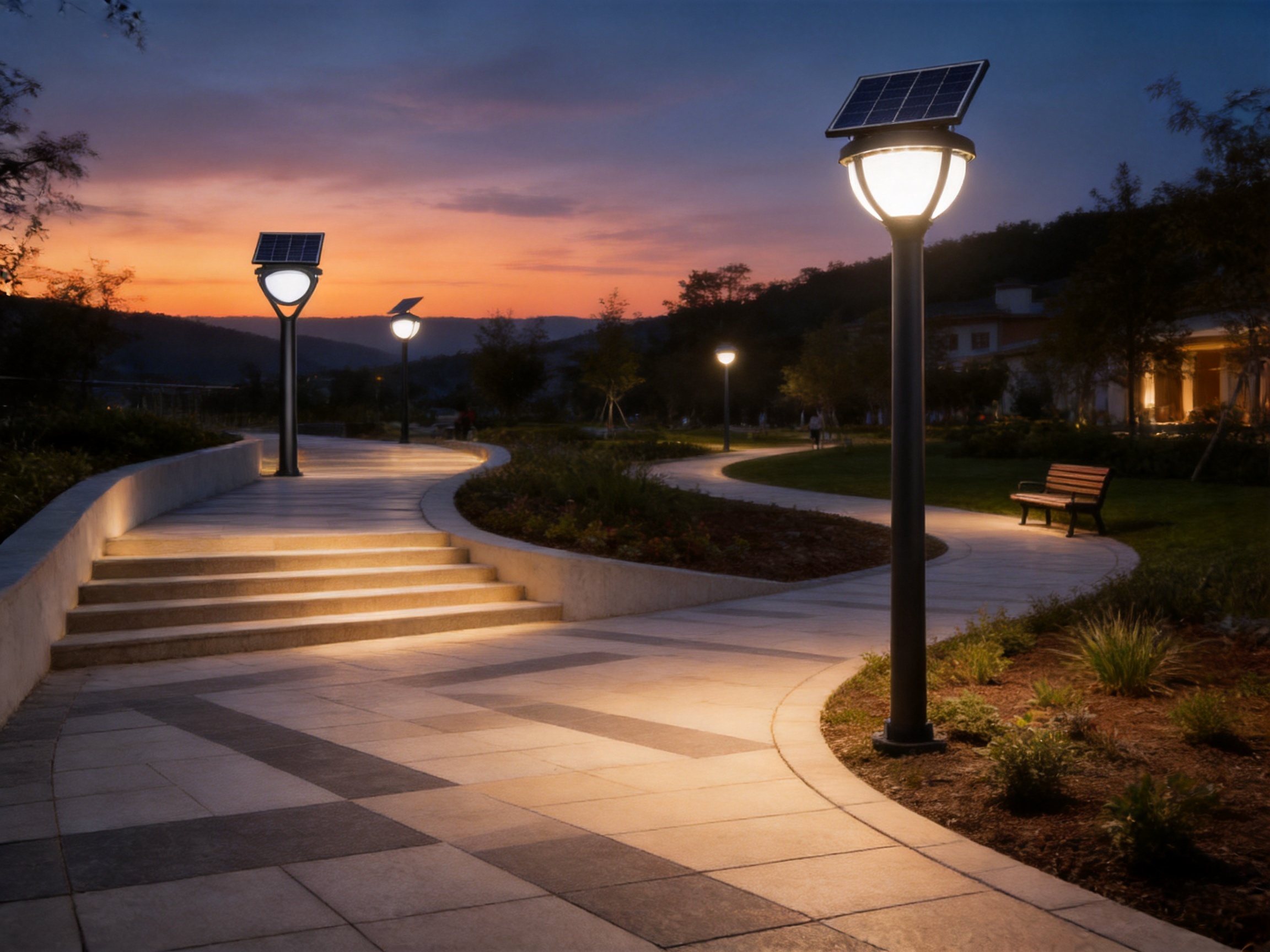
Parks often contain winding paths, planted areas, benches, recreational zones, and changes in elevation. Solar path lights can help define routes without requiring extensive trenching through landscaped areas. The round ZC-TYD2705 may complement organic garden layouts, while the square ZC-TYD2403 may suit formal or contemporary park sections.
For public parks, designers should consider vandal resistance, maintenance access, battery replacement, nighttime operating schedules, and the relationship between path lighting and nearby trees. Fixtures should be placed so that growing vegetation does not shade the solar panel or obstruct the light output.
Residential Communities
Residential pathways require a balance between visibility, comfort, appearance, and control of light spill. The adjustable color temperature range allows the product to be coordinated with building façades, entrance lighting, landscape fixtures, and community signage.
Sensor functions may be useful in residential areas where pedestrian activity varies significantly during the night. A planned control strategy can help keep routes visible while avoiding unnecessary full-output operation during periods of low activity.
Hotels and Resorts
Hotels, resorts, and leisure facilities often use lighting as part of the guest experience. A warm color temperature can create a calm and welcoming atmosphere around gardens, walkways, pool approaches, and outdoor seating areas. A consistent fixture design can also contribute to the visual identity of the property.
Because hospitality projects place high value on appearance, buyers may benefit from OEM/ODM options for housing form, pole design, coating, and lighting distribution. The final product should be evaluated not only for nighttime illumination but also for its daytime appearance.
Scenic Areas and Tourist Walkways
Scenic areas may include long paths, uneven terrain, limited access to grid electricity, and sensitive natural surroundings. Solar path lights can provide a practical option where cable installation would disturb the environment or require extensive civil work.
In these locations, designers should assess seasonal sunlight, tree coverage, weather patterns, battery performance, route length, emergency access, and maintenance logistics. Solar lighting should be positioned to support safe movement while respecting ecological and visual considerations.
Campuses and Institutional Sites
Schools, university campuses, healthcare grounds, and institutional properties may contain multiple pedestrian routes that connect buildings, parking areas, gardens, and service zones. Solar path lights can be used as supplementary lighting for low-speed pedestrian areas and landscaped connections.
For institutional projects, the lighting plan should be coordinated with accessibility requirements, emergency routes, security lighting, and local regulations. Path lights are not a substitute for higher-output safety lighting where vehicle traffic or complex hazards are present.
Installation Planning
Correct installation is essential to the performance of any solar lighting product. The solar panel needs adequate exposure to daylight, ideally without prolonged shading from buildings, trees, signs, walls, or other fixtures. The installation angle and orientation should be considered according to the geographic location and seasonal sun position.
Spacing should be determined from the photometric distribution, mounting height, pathway width, required illuminance, desired uniformity, and visual appearance. Fixtures placed too far apart may create dark gaps, while fixtures placed too close together may produce unnecessary cost and excessive brightness.
The foundation or mounting surface must be stable and appropriate for the local soil and weather conditions. The installer should confirm that the pole or fixture is vertical, firmly secured, and protected from impact by maintenance equipment or vehicles.
Solar panels should be kept clean enough to receive daylight effectively. Dust, leaves, bird deposits, snow, and other obstructions can reduce charging performance. The maintenance schedule should be matched to the local environment and site accessibility.
Recommended Project Review Items
Before placing a large order, buyers should review the planned installation area, average sunlight availability, seasonal weather, expected operating hours, pathway dimensions, mounting arrangement, battery requirements, color temperature, control logic, and applicable electrical standards.
A sample installation or pilot area can be useful for evaluating nighttime appearance, sensor behavior, light distribution, glare, visual comfort, and daytime aesthetics. Pilot testing is especially valuable when the project uses customized housing, modified optics, or nonstandard control settings.
Maintenance and Lifecycle Considerations
Solar path lights are designed to reduce wiring requirements, but they still require routine inspection. Maintenance personnel should check the housing, solar panel, mounting structure, lens, seals, fasteners, and visible signs of impact or corrosion.
The solar panel should be inspected for dirt and shading. The light output should be observed over time to identify changes in brightness, operating duration, or switching behavior. If a fixture begins to operate for a shorter period than expected, possible causes may include reduced solar exposure, battery aging, charging problems, sensor settings, or electronic faults.
Batteries are consumable components. Their service life depends on chemistry, charge and discharge cycles, temperature, depth of discharge, and operating conditions. Buyers should confirm whether replacement batteries are available, how they are accessed, and whether replacement can be completed without replacing the entire fixture.
Maintenance records can help operators identify recurring issues and plan preventive replacement. For large projects, it may be useful to keep spare batteries, control components, seals, or complete fixtures according to the expected maintenance strategy.
At the end of the product lifecycle, responsible disposal should be considered. Aluminum, electronic components, batteries, and packaging materials may require different handling. Environmental management practices in manufacturing can be complemented by responsible maintenance and recycling procedures at the project site.
Comparison with Conventional Grid-Connected Path Lights
Grid-connected path lights may provide stable access to electrical power and can be integrated into centralized control systems. They may be preferred in dense urban areas, locations with limited sunlight, or projects that require continuous high-output operation throughout the night.
Solar path lights offer different benefits. They can reduce the need for trenching and cabling, support independent operation, and provide greater flexibility in areas where grid access is difficult. They may also be advantageous for phased developments, remote landscapes, and sites where civil construction needs to be minimized.
The better solution depends on project conditions. Solar lighting should not be selected solely because it avoids cabling, and grid lighting should not be selected solely because it is familiar. A proper comparison should consider installation cost, energy consumption, maintenance access, environmental conditions, operating schedule, lighting performance, lifecycle cost, and future site changes.
Comparison with Basic Low-Cost Solar Lights
Basic solar garden lights may be suitable for decorative applications or small private areas, but they may not provide the structural quality, battery capacity, control options, optical planning, or customization potential required for professional projects.
The ZC-TYD2705 and ZC-TYD2403 are positioned as more structured outdoor lighting products. Their die-cast aluminum housings, 20W solar panels, 20000mAh batteries, 80 LED chips, configurable color temperature, and available control functions provide a broader platform for commercial and municipal applications.
The manufacturing capabilities behind the products also distinguish them from purely decorative consumer items. Die-casting, CNC machining, aging lines, photometric equipment, mold development, and management certifications can support a more controlled product development and production process.
However, professional buyers should still compare verified specifications. Important points include actual luminous flux, operating duration, battery chemistry, ingress protection, corrosion testing, wind resistance, sensor range, warranty terms, spare parts, and certification scope. A reliable purchasing decision should be based on documented performance rather than general product category claims.

How to Select Between the Two Models
The ZC-TYD2705 and ZC-TYD2403 share the same listed solar panel, battery, LED quantity, and color temperature range. The main visible difference is the housing shape and size. Selection can therefore be based on landscape style, available installation space, desired visual language, and project standardization requirements.
The round ZC-TYD2705 may be preferred when the project uses curved pathways, circular planting beds, flowing landscape forms, or softer decorative elements. Its 480 mm diameter creates a broad visual presence that may suit larger garden areas or prominent pedestrian routes.
The square ZC-TYD2403 may be selected for projects with rectilinear paving, modern architecture, geometric planting arrangements, or a compact square visual profile. Its 400 mm by 400 mm footprint may help designers coordinate the fixture with rectangular paving modules or structured landscape layouts.
Because product specifications can be adapted through OEM/ODM development, the final choice may also depend on the customer's target market, branding requirements, installation method, and quantity. Buyers should request drawings and samples when the appearance or mounting structure is critical to the project.
Procurement Guidance for International Buyers
International buyers should begin by providing a clear project brief. The brief should include application, quantity, destination market, required certifications, expected operating hours, local climate, mounting method, preferred color temperature, control requirements, packaging needs, and target delivery schedule.
The supplier should then confirm the standard configuration and identify which functions are optional. This is especially important for the ZC-TYD2403 because the supplied information does not specify its working modes in the same detail as the ZC-TYD2705. Buyers should obtain written confirmation of the selected control system before approving production.
Samples should be inspected for housing finish, dimensions, panel integration, battery access, light distribution, sensor response, operating duration, and charging performance. Where possible, the sample should be tested outdoors under conditions that represent the actual project.
Documentation should include product drawings, electrical specifications, installation instructions, testing information, certificates applicable to the exact model, packaging details, warranty conditions, and recommended maintenance procedures.
For customized products, the commercial agreement should define tooling ownership, sample approval, acceptable tolerances, change-control procedures, minimum order quantity, lead time, replacement parts, and responsibilities for certification or regulatory review.
Company Strengths and One-Stop Service
Cixi HuaSheng Lighting Co., Ltd. provides more than standard fixture manufacturing. Its stated capabilities include efficient lighting solutions, DIALux designs, mold design, OEM/ODM development, SKD/CKD customization, and delivery support.
DIALux design support can help customers assess fixture spacing, illumination levels, uniformity, and overall lighting composition before installation. This is useful for pathway projects because the best spacing depends on the complete optical distribution and the surrounding site conditions.
Mold design and manufacturing support can reduce the need for a buyer to coordinate separately with a lighting designer, tooling supplier, and assembly factory. SKD and CKD options may also assist customers that operate local assembly or distribution programs and need a more flexible supply model.
The combination of manufacturing equipment, product categories, engineering support, certification experience, and international export activity creates a useful foundation for project-based lighting supply. Customers can discuss both standard solar path lights and broader lighting requirements through one manufacturing partner.
Conclusion
The Outdoor Solar Path Light ZC-TYD2705 and ZC-TYD2403 provide a practical solution for pathway illumination in gardens, parks, residential developments, scenic areas, resorts, campuses, and other outdoor environments. Their integrated solar structure supports independent operation, while the die-cast aluminum housing provides a strong platform for outdoor use.
The two models include a 5V/20W solar panel, 3.2V/20000mAh battery, 80 LED chips, and a 3000-6500K color temperature range. The ZC-TYD2705 offers listed time control, microwave sensor, and optical sensor functions. The ZC-TYD2403 shares the main hardware configuration while presenting a different square housing design, with final control functions to be confirmed for the selected configuration.
Compared with basic decorative solar lights, these products offer a more professional platform for project applications. Their value is supported not only by the product specifications but also by manufacturing capabilities such as die casting, CNC machining, mold development, aging processes, and photometric testing.
The company's ISO management systems, stated CB and CE product certification experience, OEM/ODM services, DIALux support, and broad outdoor lighting portfolio further strengthen its ability to serve international customers. For the best result, buyers should evaluate the final product configuration, photometric performance, environmental protection, battery details, control functions, and certification documents before mass production.
When correctly specified, installed, and maintained, the ZC-TYD2705 and ZC-TYD2403 can help improve nighttime route visibility, reduce dependence on grid infrastructure, organize outdoor spaces, and support a more efficient approach to landscape lighting.
Questions and Answers
What is the main purpose of the ZC-TYD2705 and ZC-TYD2403?
They are solar-powered outdoor pathway lights designed to illuminate pedestrian routes in parks, gardens, residential communities, scenic areas, resorts, campuses, and similar outdoor locations.
What are the main differences between the two models?
The primary listed difference is the housing shape and size. The ZC-TYD2705 is round, measuring 480 mm in diameter and 410 mm in height. The ZC-TYD2403 is square, measuring 400 mm by 400 mm and 420 mm in height. Both models share the same listed solar panel, battery, LED quantity, and color temperature range.
What material is used for the housing?
Both models use die-casting aluminum. This material supports structural strength, repeatable manufacturing, and the development of outdoor housing forms with suitable component interfaces and thermal characteristics.
What solar panel and battery are included?
Each model is listed with a 5V/20W solar panel and a 3.2V/20000mAh battery. Actual operating duration depends on sunlight, control settings, LED output, weather, temperature, and battery condition.
How many LED chips does each product use?
Both models use 80 LED chips. The final lighting distribution depends on the LED arrangement, optics, diffuser, housing design, installation height, and spacing.
What color temperature is available?
The listed color temperature range is 3000-6500K. Warmer settings may suit gardens, residential areas, and hospitality environments, while cooler settings may be selected for more functional or contemporary outdoor lighting designs.
Does the product include motion sensing?
The ZC-TYD2705 is listed with a microwave sensor, optical sensor, and time control. The working-mode information for the ZC-TYD2403 should be confirmed with the supplier for the exact order configuration.
Can the product be customized?
Yes. OEM/ODM customization is available for areas such as pole design, lighting angle, and structural design. Customers should confirm tooling, samples, testing, certification, minimum order quantity, and lead time before approving a customized version.
Is the product suitable for coastal locations?
It may be suitable when the final surface treatment and corrosion protection are matched to the coastal environment. Buyers should request information about coating, corrosion testing, fasteners, sealing, and maintenance requirements before selecting the product for a salt-air location.
Can the lights replace all other outdoor lighting?
They are designed for pathway illumination and should be applied according to the project's lighting requirements. They may not replace high-output street lights, security floodlights, emergency lighting, or vehicle-area lighting where higher illumination levels are required.
What should be checked before installation?
Important checks include solar exposure, shading, pathway width, fixture spacing, mounting stability, control settings, foundation conditions, local weather, expected operating hours, and compatibility with local regulations.
What manufacturing equipment supports production?
The company identifies die-casting machines, CNC equipment, aging lines, and goniophotometers as part of its manufacturing and testing capabilities. These resources support housing production, machining, reliability testing, and photometric evaluation.
What certifications and management systems are associated with the manufacturer?
The company identifies ISO 9001, ISO 14001, and ISO 45001 certifications. It also states that relevant products have CB and CE certifications. Buyers should request documents applicable to the exact model and configuration being purchased.
Can the supplier provide lighting design support?
The company states that it provides efficient lighting solutions and DIALux designs. This can help customers evaluate fixture placement, lighting distribution, and project performance during the planning stage.
References
1. Product specification information for Outdoor Solar Path Light ZC-TYD2705/ZC-TYD2403, including material, solar panel, battery, LED quantity, working modes, color temperature, and dimensions.
2. Manufacturer information for Cixi HuaSheng Lighting Co., Ltd., including production capabilities, product categories, certifications, and engineering services.
3. General principles of LED outdoor lighting design, including pathway illumination, color temperature selection, lighting distribution, glare control, and maintenance planning.
4. General principles of solar lighting system design, including solar charging, battery storage, energy management, installation orientation, shading evaluation, and seasonal performance.
5. General principles of aluminum die-casting and CNC machining for outdoor lighting housings.
6. General principles of photometric testing using goniophotometric equipment for luminaire evaluation.
7. General quality, environmental, and occupational health and safety management principles associated with ISO 9001, ISO 14001, and ISO 45001.
Product: Outdoor Solar Path Light ZC-TYD2705/ZC-TYD2403

YQF Group - World Leading One-Stop Lighting & Solar For the Global Partners
Custom & OEM Solutions for Global Lighting Brands
Copyright © Cixi HuaSheng Lighting Co., Ltd. All Rights Reserved.
Die-Casting Mould Supplier
